

Fear can feel automatic, but the response it triggers can be approached in a different way. Virtual hypnotherapy for phobias uses a therapist-guided video session to help you relax, use guided imagery and consider calmer responses to a feared situation. The aim isn’t to dismiss the fear, but to work with the patterns that keep it feeling overwhelming.
If reassurance alone hasn’t helped, it doesn’t mean you’re failing. A phobic response can arise before logical thoughts catch up. Therapy offers a structured way to explore it without requiring you to confront the trigger directly during a session.
This article explains what virtual hypnotherapy for phobias involves, how its techniques may help, and what to consider when thinking about treatment and progress. You’ll also learn what can shape the process and how professional support can be tailored to your needs.
Key Takeaways
- Understand what a guided online session may involve, from focused relaxation to imagery shaped around your fear.
- Learn why treatment pace can vary, and what to consider when weighing quick progress against a steadier approach.
- Explore how a therapist can work with difficult experiences without requiring dramatic reliving of them.
- See how suggestion, visualisation and calmer associations may help shift an automatic fear response over time.
What is hypnosis for phobias and fears?
More than 11% of the population is estimated to have some kind of irrational fear. A phobia is an intense, automatic reaction to something posing little or no real threat. Flying, heights, spiders, confined spaces and social situations are familiar examples. Ordinary fear responds to real danger; a phobic trigger can set off the body’s alarm even when danger is slight.
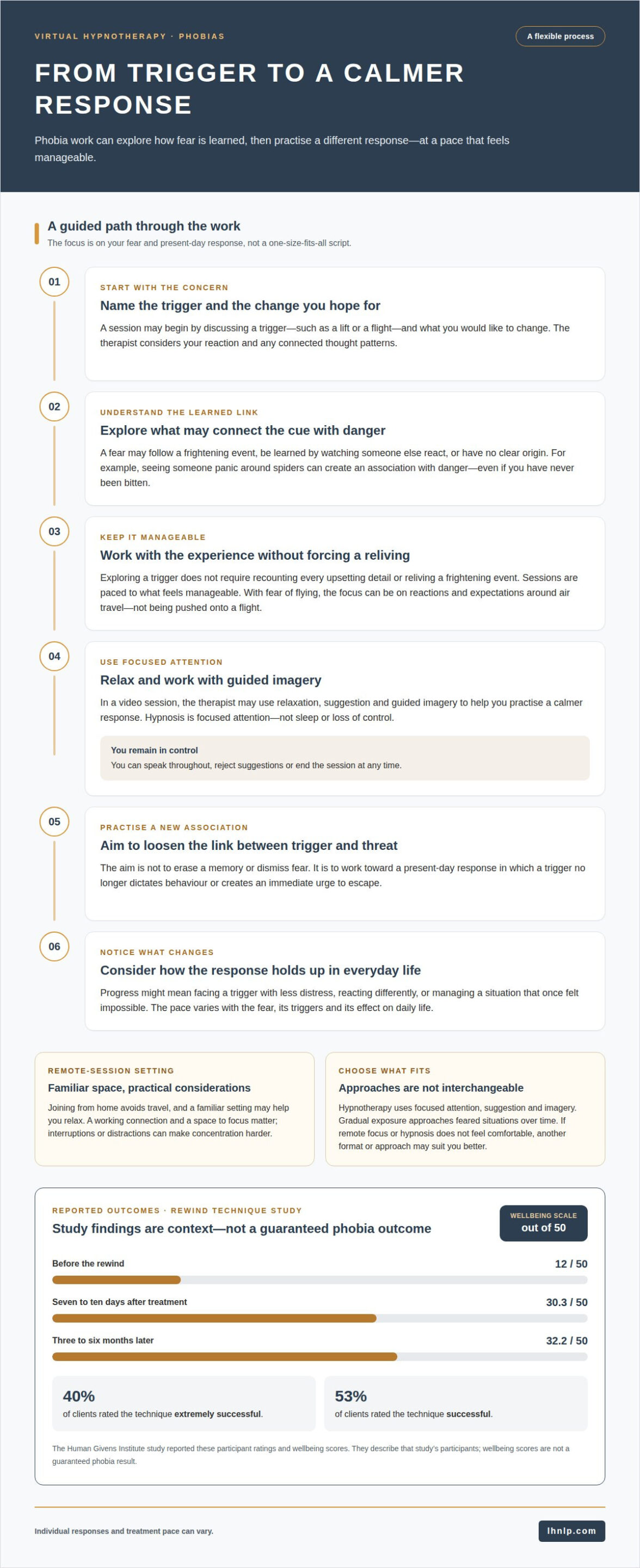
Hypnosis is a state of focused attention. In virtual hypnotherapy for phobias, a therapist guides the session online. It may begin with a discussion of the trigger, such as a lift or a flight, and the change you hope to make. The therapist may then use relaxation and guided imagery to help you practise a calmer response. You remain aware and in control, can speak throughout, reject suggestions or end the session at any time. Hypnosis isn’t sleep or a loss of control.
Online hypnotherapy lets a person join from home, without travelling along a busy street to a clinic. A familiar setting may help someone feel relaxed and engage with the guided exercises. Online sessions are described as effective as in-person treatment for most people, though each format has practical differences. A video appointment needs a working connection and a space where the person can focus. In-person sessions offer face-to-face contact in the room.
Hypnotherapy and approaches such as CBT or exposure therapy work differently. Hypnotherapy uses focused attention, suggestion and imagery. Gradual exposure involves approaching feared situations over time. These methods shouldn’t be treated as identical.
Online sessions can be interrupted by connection problems or distractions at home, which may make it harder to focus. The NHS notes that resistance to hypnosis may make entering a true hypnotic state unlikely. A therapist can explain the process and adapt the session to the person’s needs. Online hypnotherapy sessions offer a way to receive guided support remotely.
Claims about treatment speed and lasting results
Progress depends on the fear, its triggers and the effect it has on daily life. When considering claims about treatment, look at the approach being used and how outcomes are assessed.
Expected Pace and Lasting Results
Some practitioners report completing phobia work within 1-3 sessions, while some clients prefer a slower pace. Phobias can often be reduced or resolved in one or two hypnotherapy sessions, but these are reported outcomes, not a timetable for every person. Consider whether progress means facing a trigger with less distress, changing a reaction, or managing situations that once felt impossible. Lasting change also involves how the new response holds up in everyday life.
Treatment Outcomes and Wellbeing Scores
A Human Givens Institute study of the Rewind Technique found that 40% of clients rated it extremely successful and 53% rated it successful. Participants’ average wellbeing score was 12 points out of 50 prior to the rewind, 30.3 points out of 50 seven to ten days after treatment, and 32.2 points out of 50 three to six months later. These scores describe that study’s participants and measure wellbeing, not a guaranteed phobia outcome.
Hypnotherapy may be used for fears linked to animals, specific situations or social settings, including anxiety about speaking. A therapist considers the trigger, your reaction and any connected thought patterns. A fear tied to one situation may need a different focus from anxiety affecting several areas of daily life.
Who might prefer another approach to virtual hypnotherapy for a phobia? If you find it difficult to focus in a remote session or don’t feel comfortable engaging with hypnosis, another format or approach may suit you better. The right option depends on your needs and the support you’re looking for.
Package pricing should be considered in relation to what the plan includes, such as the number and length of sessions and any follow-up. The cost depends on the case and is given after a quote request. Reviewing the available treatment approaches can help clarify what the support involves.
Processing difficult experiences related to a phobia
A phobia can follow a frightening event, but it doesn’t always begin with a clear memory. Fear can also be learned by watching someone else react.
How Learned Experiences Can Shape Phobias
For example, seeing someone panic around spiders may lead you to associate them with danger, even if you’ve never been bitten. A frightening flight or feeling trapped in a lift can also link a situation with threat. Later, a similar cue may prompt alarm and avoidance. The mind can retain that learned association even when the original event is unclear or forgotten.
Processing Learned Fears and Traumatic Experiences
In hypnotherapy, a practitioner can help you explore triggers and the responses attached to them. This doesn’t require reliving a frightening experience or recounting every upsetting detail. Sessions are paced to what feels manageable. For example, if you fear flying, you can focus on your reactions and expectations around air travel without being pushed into a flight or direct confrontation.
A practitioner’s experience matters because fears can have different roots and expressions. It’s useful to understand whether a response centres on a remembered incident, behaviour observed in someone else, or a trigger with no obvious origin. This helps shape a session around your concern instead of treating every phobia as the same problem.
A practitioner’s registration is another aspect to consider. Their approach, relevant experience and registration can help you understand how sessions are conducted and what support involves. These details don’t determine your response, but they provide context about the method and its boundaries.
Progress can involve changing your present-day response, even if the past feels unclear. The aim isn’t to erase a memory, but to loosen its connection with danger so a trigger no longer dictates your behaviour or creates an immediate urge to escape.
How hypnotherapy aims to help with phobias
Hypnotherapy aims to change the learned response attached to a trigger, rather than simply arguing that danger is unlikely. If you fear flying, for example, a therapist can help you practise a calmer response to thoughts of boarding instead of letting anxiety and stress escalate.
Logical reassurance can fall short when a fear response happens automatically. Focused attention, suggestion and guided imagery offer another way to work with those reactions. If you’re afraid of needles, for example, you could picture a medical appointment while practising a steadier response, without facing needles during the session.
The work may follow a clear sequence: identify the trigger and your response to it, use relaxation to settle your attention, then rehearse a different way of encountering the feared situation. This imagined scenario gives your mind an alternative pattern to associate with the trigger.
- Relaxation: Progressive muscle relaxation can ease physical tension linked with stress.
- Guided imagery: The therapist leads a visualisation of a challenging situation with a calmer outcome.
- Suggestion: Positive affirmations can reinforce confidence and a sense of control.
These techniques focus on changing your reaction, not proving that your fear is unreasonable. Imagining a flight while feeling settled, for instance, can help separate the trigger from the alarm response. A therapist can shape imagery around your circumstances, whether your concern is flying, needles or another specific fear.
Sessions may also introduce self-hypnosis and self-regulation tools. You can use these to practise calm attention when anxiety arises in everyday situations. In short, hypnotherapy works with attention, imagery and suggestion to build a different response, rather than relying on reassurance alone.
To explore how online hypnotherapy sessions can support this process, learn about the approach and how sessions are structured.
London Hypnotherapy & NLP: Phobia Treatment
London Hypnotherapy & NLP offers personalised, solution-focused Phobia Treatment through hypnotherapy, including virtual sessions. It may be a next step if fear affects everyday choices, such as travelling, attending appointments or speaking in social situations, and you’d like professional support to work on your response.
Sessions are tailored to your concern and what you hope to change, rather than assuming every phobia has the same cause. You can discuss your trigger, its effect on daily life and whether an online appointment suits you. The focus is on finding a considered way forward, without promising a particular result or timetable.
For a conversation about phobia treatment, contact London Hypnotherapy & NLP.
Take the Next Step at Your Own Pace
When considering virtual hypnotherapy for phobias, start by asking yourself: what would you like to feel able to do differently? Perhaps you want to approach a situation you currently avoid or have more choice when fear appears. Naming a practical goal can help make an initial conversation focused and personal.
London Hypnotherapy & NLP offers Phobia Treatment and virtual sessions, as well as Hypnotherapy for Anxiety, Hypnotherapy for Weight Loss and Hypnotherapy for Smoking Cessation. The right focus starts with the concern that matters most to you. Results vary, so no particular outcome can be promised, but a thoughtful conversation can help you consider whether this approach feels right for you.
If you’re ready to discuss a possible next step, contact London Hypnotherapy & NLP. Change doesn’t need to begin with a leap; one considered step can open the way forward.
Frequently Asked Questions
How do I find a hypnotherapist?
For phobia support in London, you can contact London Hypnotherapy & NLP and discuss your concern with practitioner Dr MKA Bux, known as Kamal, a registered Clinical Hypnotherapist. Explain the situations you find difficult and what you’d like to change; this helps focus the conversation on your needs. To enquire, call 020 3393 1094 or 07711 285 414, or email info@lhnlp.com.
How do phobias start?
Phobias can develop after a frightening experience or by learning from someone else’s fearful response. For example, if you felt trapped during a journey, you may later feel anxious in similar travel situations. Sometimes the original event isn’t clearly remembered. A practitioner can explore the trigger and its effect on your choices, even if you can’t identify when the fear began.
How do you treat phobias?
Phobia treatment is tailored to your trigger, the response it brings and the change you want in daily life. Hypnotherapy may use relaxation, guided imagery and suggestion to help you rehearse a different response. The therapist discusses the approach and adapts it to you. During hypnosis, you remain aware and in control, and you can reject suggestions or end the session at any time.
Is online hypnotherapy as effective as seeing you in person?
Online hypnotherapy can be as beneficial as face-to-face sessions. London Hypnotherapy & NLP offers remote appointments through Zoom and Skype, so you can join without travelling to the Harley Street clinic in London. Sessions last one hour. You remain aware and in control throughout, whether online or in person, and can reject suggestions or end the session at any time.
What Is a Phobia, and How Is It Different from a Fear?
Fear is a natural response to real danger, while a phobia involves an intense reaction to a trigger that poses little or no real threat. Caution around a dangerous animal is ordinary fear; a severe response to a picture of an animal may point to a phobic reaction. The key difference is the intensity and impact on everyday choices.
How effective is virtual hypnotherapy for phobias?
Virtual hypnotherapy for phobias may help some people change their response to a specific trigger, but outcomes vary. Progress can depend on the nature of the fear, its effect on daily life and how well this approach suits you. To assess change, notice whether ordinary activities feel more manageable. No particular result can be promised.