

A setback doesn’t have to be the end of a quit attempt. In life after quitting smoking success stories, progress can mean moving through difficult moments and finding a way forward. Katherine had smoked for 25 years; after planning her quit in April 2019, she smoked her last cigarette at midnight on 16 May. Her first three days went quite well, but day four was particularly difficult.
It’s understandable to wonder whether quitting will make a difference you can feel, especially if previous attempts haven’t lasted. These life after quitting smoking success stories describe changes people noticed in their health, taste, smell and appearance, as well as what helped Katherine through the challenges of stopping. They also show why a lapse needn’t erase what you’ve learned or prevent another attempt. Progress is personal: it may take shape one decision at a time, rather than following an effortless path.
Key Takeaways
- Notice how people describe changes in health, taste, smell and appearance after quitting, while remembering that each person’s experience is different.
- Explore how support, nicotine replacement and planning for triggers can make a quit attempt more manageable.
- Consider the personal reasons behind a decision to stop, including how smoking habits can shape everyday life.
- Treat a setback as information about what was difficult, not proof that another attempt can’t succeed.
Health, taste, smell and appearance benefits after quitting
Life after quitting smoking can feel different from person to person, and these stories don’t establish a universal timetable or result. Notice your own changes without expecting them in a set order: consider how food tastes, whether familiar smells seem different, and how your skin or breathing feels during everyday activities. Jotting down these observations can make personal progress easier to recognise.
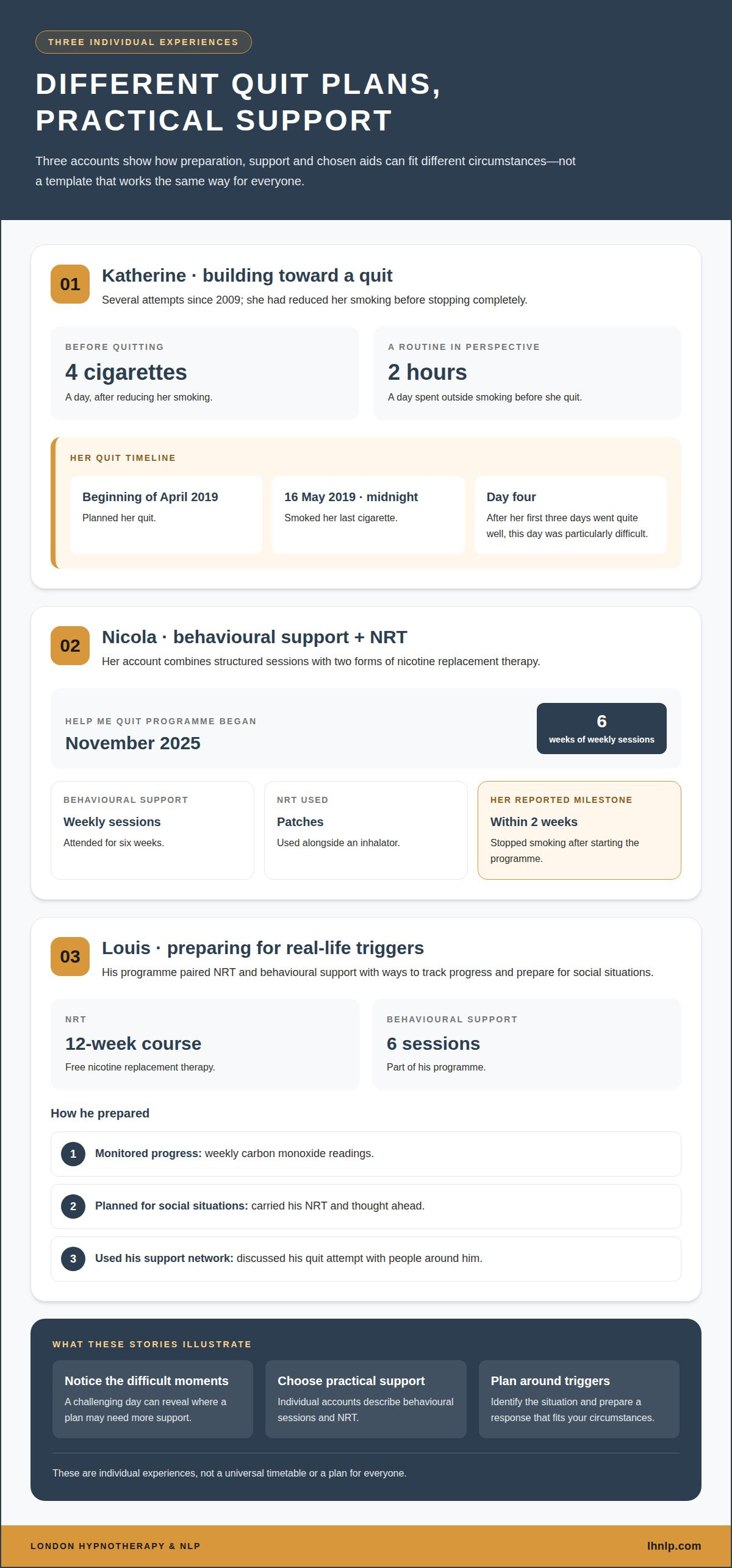
Katherine’s experience offers a specific account of stopping, rather than a catalogue of guaranteed benefits. She had smoked for 25 years, planned her quit at the beginning of April 2019, and smoked her last cigarette at midnight on 16 May 2019. She got through her first three days quite well, but found day four particularly difficult. Her result was a completed quit attempt, despite an early challenge.
How much money can UK smokers save by quitting? Savings depend on how much a person smokes and what they spend, so there is no single amount that applies to everyone.
Withdrawal can involve cravings, irritability, restlessness, low mood, or changes in concentration and sleep. Its intensity and duration vary. Katherine’s difficult fourth day shows one early challenge, not a timetable that applies to everyone.
Are there inspiring UK smoking cessation stories from people with different backgrounds or health conditions? Yes. John Morcom was 69 and had smoked since he was 14; Cathy Hunt began smoking at 11 and was diagnosed with lung cancer in May 2015. Their circumstances differ, showing that reasons and experiences around stopping are personal. To make your own progress visible, choose one daily marker, such as recording a smell, a meal or a short walk, and notice how it changes over time.
Previous quit attempts and cessation aids
A previous attempt can reveal where a plan needs more support. Katherine had made several attempts to stop smoking since 2009. Before her successful quit, she had reduced her smoking to four cigarettes a day. That detail shows the effort already underway, even before she stopped completely. A useful next step is to identify what helped during earlier attempts and what situations made smoking more likely.
Nicola’s experience combined behavioural support with nicotine replacement therapy (NRT). She began the Help Me Quit programme in November 2025 and attended weekly behavioural support sessions for six weeks. She used nicotine patches alongside an inhalator, and stopped smoking within two weeks of starting the programme. Her account shows how practical support and aids can be brought together in one quit plan.
Louis Vandarl’s programme included a twelve-week course of free NRT and six behavioural support sessions. He monitored his progress with weekly carbon monoxide readings. To prepare for social situations, Louis carried his NRT, planned ahead and discussed his quit attempt with his support network. These steps addressed specific triggers rather than relying on willpower alone.
Consider what each part of a quit plan is meant to support. Behavioural sessions can help people examine routines and prepare for difficult situations. Nicola and Louis both used NRT, while Louis also monitored his progress and drew on support from people around him. These are examples from individual programmes, not a template for everyone.
To prepare for another attempt, note the setting, feeling or routine linked to a previous lapse. Then choose a response for that moment, such as carrying a chosen aid or telling someone you trust about your plan. Katherine’s earlier attempts, Nicola’s combined support and Louis’s preparation show different ways to shape a quit attempt around real circumstances.
Reasons Katherine decided to quit
Before quitting, Katherine spent two hours a day outside smoking. Her routine shows how much time cigarettes occupied in her life, though her account doesn’t say that time was her only reason for stopping. If you’re considering a change, notice where smoking fits into an ordinary day. That can make the decision more concrete.
Map one typical day, from your first cigarette to your last. Record the time and place, along with what came just before each cigarette, such as a work break, a journey or a stressful conversation. Katherine’s two hours outside offer a striking example of time spent smoking. Tracking your own routine can reveal patterns to plan around.
Reasons to quit are personal. Some people focus on time; others consider health, money, family or the role stress plays in their smoking. These are possible motivations, not claims about Katherine. Name a reason that feels specific to your life. “I want more time for a walk after work” gives you a clearer prompt than a broad intention to change.
A simple reflection can turn that reason into a practical prompt:
- Name the moment: identify one routine linked with smoking, such as a break outside.
- Choose a replacement: decide what you’ll do during that break, such as taking a short walk.
- Keep the reason visible: write down why that change matters to you.
Katherine’s account makes the scale of her daily smoking routine visible, without suggesting that time was her only motivation. If stress or a familiar setting prompts an urge to smoke, noting the trigger can help you prepare another response. Start with one routine, one reason and one manageable change. Your reason can help you remember what you’re moving towards when an old pattern returns.
Advice to keep trying after setbacks
Katherine found an article saying that the first year of being smoke-free can be the hardest, and said this felt true for her. A difficult stretch may make quitting seem unsuccessful. Instead, treat it as information: notice what happened, how you felt and what might help next time.
Nicola identified stress, emotional changes and social situations involving alcohol as smoking triggers. Naming your own triggers can turn a vague fear of slipping into a plan for a specific situation. If a stressful evening tends to prompt a cigarette, decide in advance whom to talk to or what activity could help you pause.
These life after quitting smoking success stories show why personal plans matter: triggers and helpful responses differ. Practical steps include recognising your cues, preparing for challenging situations and involving supportive people. Treat these as useful approaches, not a ranking of the most common advice.
After a lapse, try this short reset:
- Describe the moment: write down the situation and feeling that came before smoking.
- Find the pressure point: note whether stress, an emotional change or alcohol played a part.
- Adjust the next plan: choose one response for that situation and tell someone supportive.
Trying again doesn’t require pretending a setback didn’t happen. It means using the experience to shape a more realistic next step. Katherine’s account of the first year offers perspective, while Nicola’s named triggers show how specific a plan can become. Reading life after quitting smoking success stories can help you consider what might work for you, but the next step is to identify your own pressure point and prepare for it. If smoking is closely tied to stress, support for managing stress can help you explore that pattern and plan for difficult moments. Explore support for a new quit attempt.
London Hypnotherapy & NLP: Hypnotherapy for Smoking Cessation
London Hypnotherapy & NLP offers Hypnotherapy for Smoking Cessation for people seeking individual support to change their smoking habits. In solution-focused sessions, practitioner Kamal helps clients explore smoking patterns and challenges, then work towards a quit attempt tailored to their needs. This may suit you if you’ve tried to quit before, find particular triggers difficult or want support alongside your decision to stop.
Sessions focus on your experience, rather than treating every quit attempt the same way. You can discuss situations that make smoking harder to resist and what you hope will change. The aim is to support your efforts, not promise a particular result.
If you’d like to discuss support for stopping smoking, contact London Hypnotherapy & NLP.
Choose one next step that feels possible
Meaningful change can begin with a small decision you can make today. Choose one routine to reconsider, write down what you want to reclaim, or decide who could support you when an urge feels strong. Keep the next step clear and personal. It doesn’t have to solve everything at once.
Reading life after quitting smoking success stories can offer perspective, but your own reasons and circumstances matter too. If you’re considering guided support, describe what you want help with and what made previous attempts difficult. A focused conversation can help you decide whether Hypnotherapy for Smoking Cessation fits the support you’re seeking.
London Hypnotherapy & NLP offers a space to discuss your next step without turning it into a promise or a test of willpower. You remain in control of your decision; support can help you approach it with greater intention.
Begin a conversation with London Hypnotherapy & NLP, and take the next step at your own pace.
Frequently Asked Questions
What do people say improved in their lives after quitting smoking?
People describe changes in their senses, daily routines and feelings about their choices. Food may seem more vivid, familiar scents may stand out, and time once organised around smoking can be spent differently. Experiences vary, so note what you notice, such as enjoying a meal or taking a walk. This can help you recognise personal changes without comparing them with someone else’s story.
How long after quitting smoking do people notice health benefits?
There’s no single timetable that applies to everyone. Some people notice changes in everyday sensations or activities before broader differences in how they feel. The pace depends on individual circumstances and what they observe. Rather than waiting for one milestone, track changes over time and discuss health concerns with a healthcare professional. A personal record can make gradual shifts easier to recognise.
How do people cope with cravings and prevent relapse after quitting?
When a craving comes, try a planned pause instead of responding automatically. Move away from a place associated with smoking, occupy your hands and give the urge time to pass before deciding what to do next. Keep cigarettes and lighters out of easy reach, and write a short reminder of why you chose to quit. If you lapse, treat it as a cue to adjust your plan, not abandon it.