

What if stopping your inner critic isn’t about silencing it, but understanding what it’s trying to protect? If you’re wondering how to stop my inner critic, begin by noticing its words without treating them as facts. Then answer with a voice that is compassionate, curious and focused on what you can learn. Change takes practice, rather than happening all at once.
It makes sense if self-criticism feels like a push to do better. Harshness can seem like the only way to stay motivated or avoid mistakes. Yet you can take your struggles seriously without speaking to yourself as though you deserve blame. A kinder response can recognise what hurts and still help you decide what to do next.
This article explores how self-compassion, social pressures and a growth-oriented inner voice can change your response to critical thoughts. You’ll also learn to distinguish the critic from an inner mentor: a steadier voice that encourages small, meaningful steps.
Key Takeaways
- Meet self-criticism with curiosity and reassurance, rather than adding another layer of blame.
- Notice how social expectations and fear of judgement may shape the standards you hold yourself to.
- Turn harsh verdicts into opportunities to learn, practise and recognise evidence of progress.
- Tell the difference between a critic that warns or judges and an inner mentor that helps you take a constructive next step.
1. Building a compassionate inner voice
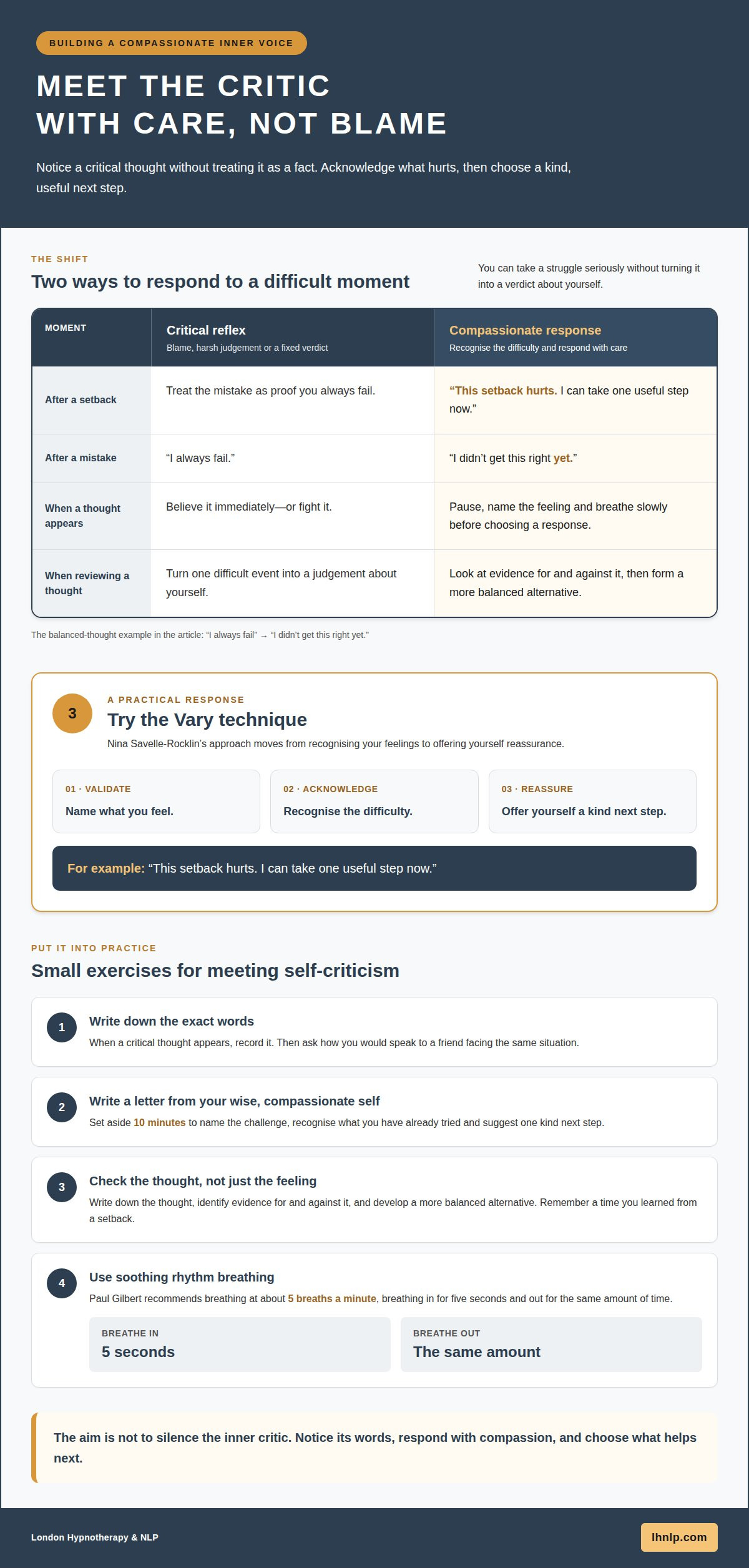
Self-compassion offers an alternative to self-criticism: acknowledge the hurt, then respond with care rather than blame. Compassion-focused therapist Paul Gilbert describes compassion as turning towards suffering and taking action to alleviate it. Try Nina Savelle-Rocklin’s Vary technique: validate what you feel, acknowledge the difficulty, then reassure yourself. For example, “This setback hurts. I can take one useful step now.”
Practical exercises can make negative self-talk easier to meet. When a critical thought appears, write down its exact words, then imagine how you would speak to a friend facing the same situation. You could also set aside 10 minutes for a letter from your wise, compassionate self. Name the challenge, recognise what you’ve already tried, and suggest one kind next step.
Cognitive behavioural therapy can help address self-criticism by examining the links between thoughts, feelings and actions. To challenge a thought, write it down, identify evidence for and against it, then develop a more balanced alternative. If “I always fail” follows a mistake, remember a time you learned from a setback and reframe it as “I didn’t get this right yet.”
Mindfulness and self-compassion can loosen the inner critic’s grip by helping you notice a thought without immediately believing or fighting it. Pause, name the feeling and breathe slowly. Paul Gilbert recommends soothing rhythm breathing at about five breaths a minute, breathing in for five seconds and out for the same amount of time. Then choose a response that recognises the difficulty without attacking you.
A virtual-reality study at University College London gave women with severe inner-critic issues the chance to practise consoling a crying child. They then experienced the scene as the hurt child, hearing their own recorded compassionate words and seeing their gestures. You can adapt the idea without VR: imagine comforting your five-year-old self, as Elena did, and speak with the warmth you’d offer a child who needed reassurance.
2. Recognising social pressures that fuel self-criticism
An inner critic is the internal voice that judges, warns or finds fault with you. It can develop from learned expectations, past criticism and pressure to avoid mistakes, turning outside standards into rules you apply against yourself. Notice when its negative tone appears, such as after feedback, comparison or a difficult conversation.
Social pressure can make those rules feel personal. A colleague’s promotion, a family comment about appearance or polished posts online may trigger shame or anxiety. Brené Brown describes shame as the belief that you’re flawed and unworthy of love or belonging; secrecy and fear of judgement can strengthen it. Naming the trigger helps separate an external expectation from your own values.
Self-criticism is associated with depression, social anxiety, perfectionism and body image concerns. It can also affect motivation: if every mistake becomes proof that you’re incapable, you may avoid trying again. Accepting that negative self-talk is a human response doesn’t mean agreeing with it. It means noticing the thought before deciding whether it deserves your trust.
Weight-related criticism shows how social standards can become an emotional burden. One account describes Paul, who was 60 pounds overweight and criticised his appearance daily, even looking at his reflection in an elevator door. Instead of treating that judgement as motivation, notice its cost: does it support a useful choice, or deepen shame and make change harder? For weight concerns tangled with harsh self-talk, Hypnotherapy for Weight Loss may offer relevant support.
Record a moment when your inner voice turns against you. Write down what happened, the feeling that followed and the exact judgement, then ask what you can learn from the mistake. “I handled that meeting badly” leaves room to prepare differently; “I’m hopeless” turns one event into a verdict. A specific, learning-focused response makes growth possible without denying disappointment.
3. Adopting a growth-oriented inner voice
A growth-oriented voice treats ability as something you can develop, not a fixed verdict. When a thought says, “I can’t speak up in meetings,” try, “I might share one idea.” That small change leaves room for practice without demanding instant confidence. If you’re asking how to stop my inner critic, start by letting a more balanced possibility sit alongside its prediction.
Give the critic a name, such as “The Alarm”, to recognise its thoughts without confusing them with facts. When it predicts, “You’ll embarrass yourself,” pause and ask, “Why not try one question?” Naming the pattern creates space between the warning and your response. You can choose a small action instead of letting fear decide for you.
Keep a record of evidence that challenges harsh conclusions. After a setback or rejection, write down a compliment, a skill you practised or a task you completed. For example, a declined proposal doesn’t erase positive feedback on your last project. This exercise helps your mind remember a fuller picture, rather than treating one difficult outcome as proof of failure.
Build competence through deliberate practice, useful research and reflection on mistakes. If a presentation went poorly, identify one specific point to improve, then rehearse it before the next meeting. A friend can offer perspective, but ask for concrete feedback rather than reassurance alone. Each practical adjustment gives your inner voice fresh evidence to draw on.
Notice when the critic’s demands keep you silent. If “I must get everything right” stops you submitting a draft, define a realistic next step: edit the introduction, then share it with a trusted colleague. Learning how to stop my inner critic means using errors as information, not pretending they don’t matter. One imperfect attempt doesn’t define what you can learn or do next.
4. Distinguish the inner mentor from the critic
Healthy self-reflection examines a choice and asks what you can learn. Harmful self-criticism turns one moment into a verdict about your worth. After a meeting, reflection might say, “I interrupted; next time I’ll pause.” The critic says, “I always ruin conversations.” The first supports change; the second can keep you stuck.
An inner mentor can still challenge you, but it speaks with respect and points towards action. Before a meeting, it might say, “You’re feeling nervous; prepare one question and try asking it.” A critic predicts threat and urges silence: “Don’t speak, or they’ll think you’re foolish.” Notice the difference in purpose: one helps you take a considered risk; the other tries to prevent discomfort through avoidance.
Test the voice in a specific moment. Ask whether it describes an action or attacks your identity, whether it offers a useful next step, and whether you’d speak that way to a friend. If the thought is “I’m hopeless at small talk”, a mentor might suggest greeting someone on public transport. If you’re wondering “how to stop my inner critic”, begin by noticing which voice is speaking.
Meditation and mindful walking can help you hear the mentor beneath habitual criticism. As you walk, notice each step and the thoughts that arise; you don’t need to force them away. When a judgement appears, label it “critic” and return your attention to the path. Paul Gilbert’s work connects self-criticism with activation of the brain’s threat system. Trying to silence the critic by force may keep your attention fixed on it; noticing its warning, then choosing a values-led response, offers another route.
Practise this distinction in everyday choices: speaking up in a question-and-answer session, joining a conversation at a party or sharing an idea at work. The mentor doesn’t promise every attempt will feel easy. It helps you act with care, learn from the result and try again. If you’re looking for support with anxiety as you explore how to stop my inner critic, that could be a useful next step.
London Hypnotherapy & NLP
London Hypnotherapy & NLP offers NLP Coaching and Clinical Hypnotherapy to help you explore thought patterns linked to anxiety or self-doubt. If self-criticism repeatedly shapes your choices or makes it difficult to act, tailored sessions can help you work towards a more constructive response. The focus is on understanding what you want to change and developing practical ways forward, rather than demanding that your inner critic disappear overnight.
You might consider support when self-guided exercises feel difficult to maintain or critical thoughts are affecting everyday life. The right approach depends on what you’re experiencing and what you want to work on. For a straightforward next step, contact London Hypnotherapy & NLP to discuss your needs.
Take your next step with kindness
Changing your relationship with self-criticism doesn’t mean waiting until every doubt disappears. It begins with choosing a response that respects what you’re feeling while leaving room for a different action. If you’re still asking how to stop your inner critic, consider what support could help you practise that shift and sustain it.
London Hypnotherapy & NLP offers NLP Coaching, alongside Hypnotherapy for Anxiety, Hypnotherapy for Weight Loss and Hypnotherapy for Smoking Cessation. These services address different concerns, so the most relevant starting point depends on what you want to work on.
If you’d like to explore whether support feels right for you, contact London Hypnotherapy & NLP. You can begin with one honest conversation, and take the next step at a pace that feels manageable.
Frequently Asked Questions
How long before I see changes in how I’m feeling?
There’s no fixed timetable, because progress depends on the thought patterns involved, the situations that trigger them and how consistently you practise a different response. Look for small signs, such as recovering sooner after a mistake or speaking up despite self-doubt. Brief notes about situations, feelings and actions can help you notice changes that are easy to overlook day to day.
What is the Should Monster?
The Should Monster is a metaphor for the inner voice that piles on demands, such as “I should always be productive”. It represents outdated survival instincts, described as trying to keep you safe using patterns shaped over 80,000 years. The image can help you recognise that rigid demands are protective responses, not instructions you must automatically obey.
Why doesn’t a great plan make the shoulds go away?
A plan can organise action, but it won’t automatically resolve the pressure behind each “should”. The Creative Engine has four phases: Collect, Decide, Act and Reflect, with the Should Monster appearing during reflection. Before adding a new habit, assess your capacity, criteria and other commitments. Then decide whether to act, turn a chosen “should” into a “will”, and begin with a manageable habit.
Your Own Worst Enemy?
Being hard on yourself can feel like being your own worst enemy, but a critical thought isn’t your whole identity. Treat it as one voice in an internal conversation. Imagine hearing the same judgement between two strangers: would it sound fair, useful or needlessly cruel? That perspective can help you understand the thought without letting it define you.
When does persistent self-criticism indicate depression, anxiety or another mental health condition?
Self-criticism alone doesn’t establish a diagnosis, but it’s associated with depression, social anxiety, perfectionism and body image concerns. Pay attention if it persists alongside changes in mood, avoidance or difficulty managing everyday responsibilities. If these experiences are affecting your life, discuss them with your GP or a qualified mental health professional, who can consider the wider pattern and appropriate support.
What treatments and support are available for self-criticism in the UK?
Support can include talking through the thoughts and circumstances that make self-criticism difficult to manage. London Hypnotherapy & NLP offers NLP Coaching and Hypnotherapy for Anxiety, options to explore if those approaches fit what you want help with. If you’re concerned about your mental health or need a diagnosis, speak with your GP or a qualified mental health professional.