

What if the deepest sense of control you’ve ever felt came not from straining your willpower, but from a quiet, focused partnership with your own subconscious mind? It’s common to feel a flicker of hesitation when considering this path, especially if your only exposure to hypnosis is through the dramatic exaggerations of cinema or stage performances. You might worry about losing your autonomy or feel anxious about what happens in a hypnotherapy session when you close your eyes. Those fears are a natural response to the unknown. In reality, this process is a collaborative journey where you remain the conscious architect of your own experience.
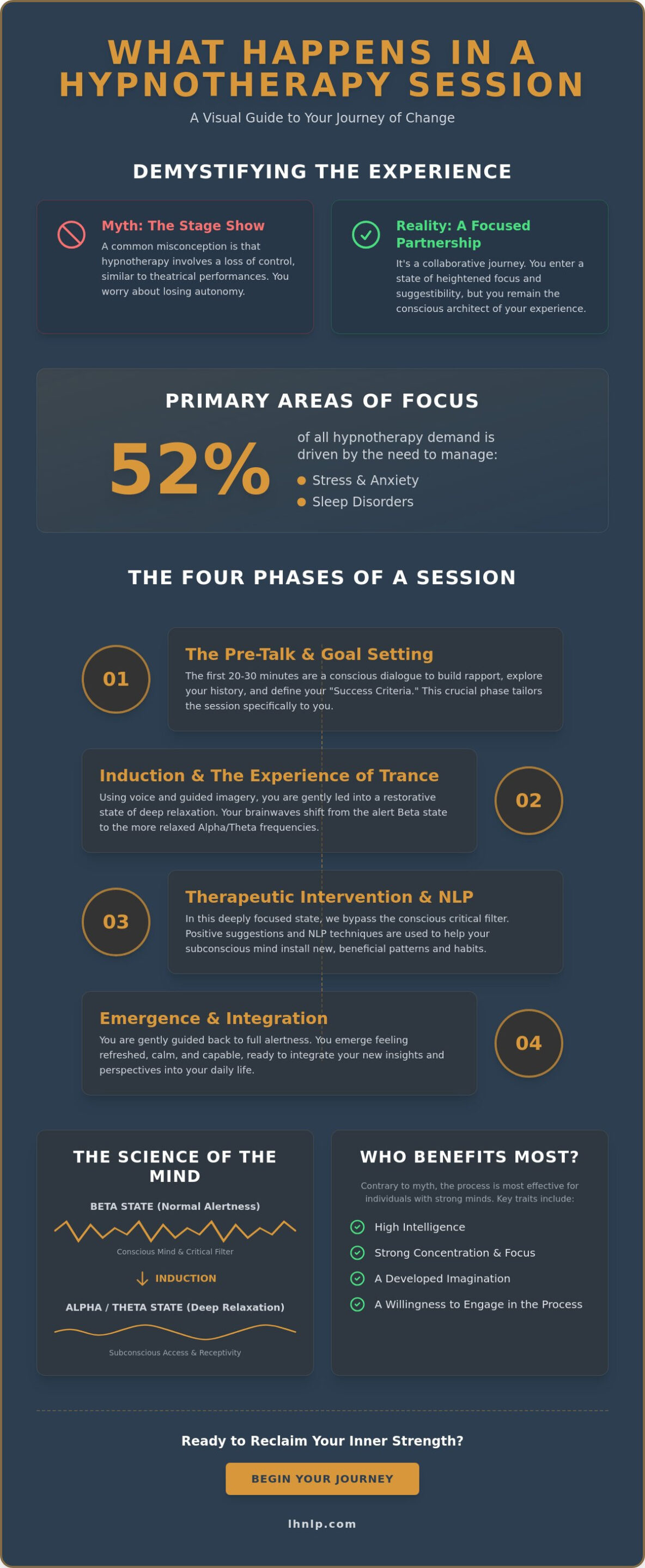
As public perception shifts toward evidence-based mental health solutions, more people are choosing this method to address their internal blocks. Verified data shows that stress, anxiety, and sleep disorder therapies now account for approximately 52% of all hypnotherapy demand. This guide promises to demystify the entire process, showing you exactly how a professional appointment unfolds, from the initial consultation to the physical sensation of deep relaxation. We’ll explore the methodical steps that turn a simple conversation into a powerful tool for positive change, ensuring you feel safe, informed, and ready to reclaim your inner strength.
Key Takeaways
- Understand that clinical hypnotherapy is a state of heightened focus and suggestibility, far removed from the loss of control often seen in stage entertainment.
- Discover why the initial “pre-talk” is essential for tailoring the session to your personal history and specific emotional triggers.
- Learn exactly what happens in a hypnotherapy session during the induction phase, where voice and imagery guide you into a restorative state of trance.
- Explore how therapeutic interventions and NLP techniques work directly with the subconscious to bypass old habits and install positive new patterns.
- Gain clarity on the emergence process, ensuring you return to full alertness feeling refreshed and capable of integrating your new insights.
Demystifying the Trance: What is Clinical Hypnotherapy?
Clinical hypnotherapy isn’t magic. When we explore Clinical Hypnotherapy, we find a therapeutic tool designed to facilitate a state of deep, focused attention and heightened suggestibility, allowing the mind to become more receptive to positive, lasting change. It’s a method that bridges the gap between your conscious intentions and your subconscious patterns. Unlike the theatrical performances seen on television where participants seem to lose their agency, a professional session is entirely collaborative. You remain the conscious architect of your journey. Many people ask what happens in a hypnotherapy session regarding their level of control; the answer is that you’re always in the driver’s seat, guided by a mentor who understands the delicate architecture of the human mind.
Your conscious mind acts as a critical filter, processing logic and daily tasks, while your subconscious stores the deep-seated habits and emotional responses that often feel beyond your reach. Therapy creates a bridge between these two realms. It allows us to bypass the critical filter temporarily so that positive suggestions can take root where they matter most. This partnership ensures that the changes you seek aren’t just temporary fixes, but fundamental shifts in how you perceive and respond to the world around you.
To better understand this concept, watch this helpful video:
The Science of the Alpha State
To truly understand what happens in a hypnotherapy session, we must look at the science of brainwaves. During a session, your brain activity shifts from the alert Beta state into the more relaxed Alpha or Theta frequencies. This isn’t an unusual or “alien” feeling. You’ve experienced this many times before. It’s the same sensation as “highway hypnosis” during a long drive or the moment you become so engrossed in a novel that the world around you fades away. It’s a natural, daily occurrence that we simply harness for intentional growth.
Who is Hypnotherapy For?
This method is effective for a wide range of challenges, from managing chronic stress to overcoming long-standing phobias. You can find a comprehensive list of applications on our treatments page, which covers everything from smoking cessation to public speaking coaching. A common misconception is that only “weak-minded” individuals are susceptible to hypnosis. In reality, the opposite is true. Because the process requires focus and imagination, people with high intelligence and strong concentration often experience the most profound results. It’s a skill that anyone can develop with the right guidance.
Phase One: The Pre-Talk and Goal Setting
The journey toward inner change begins long before you close your eyes. The first 20 to 30 minutes of a professional appointment are dedicated to what we call the “Discovery” phase. This is a vital period of conscious dialogue where the foundation for your success is laid. When people inquire about what happens in a hypnotherapy session, they often expect to dive straight into a trance, yet this initial conversation is where the real architecture of change is designed. By exploring your personal history and identifying the specific triggers that hold you back, the therapist can map out a route that is unique to your psyche.
During this time, you’ll work together to define your “Success Criteria.” This goes beyond a simple desire to “feel better.” We look for the tangible, visceral evidence of change. How will your body feel when you’ve overcome that phobia? What will your inner voice say when you’re standing on stage with confidence? This clarity acts as a beacon for your subconscious mind. It’s also the most important moment to ensure you feel a genuine sense of safety and comfort. A strong therapeutic alliance is the bedrock of any successful outcome. If you are curious about what to expect during hypnosis, this initial talk is precisely where those expectations are aligned and any hesitations are gently dissolved.
Building Rapport and Trust
Kamalyn Kaur uses this time to deeply understand your personality and communication style. This “Pre-induction Talk” serves as a safe space to address any lingering skepticism or fears you might have brought with you. Whether you’re worried about the depth of the trance or simply unsure of your own ability to relax, these concerns are met with professional empathy and logical explanation. This phase is often where NLP (Neuro-Linguistic Programming) naturally begins. By observing how you process information, the therapist starts the work of re-framing your challenges before the formal induction even starts.
Designing Your Personalised Suggestions
Every word used during the therapeutic phase is chosen with specific intention. The therapist listens for the metaphors and language patterns that already resonate with you, ensuring the suggestions feel like your own inner truth rather than external commands. We consciously shift the focus from the “problem” to the “solution,” moving away from the weight of past limitations toward the expansive possibility of your future. If you have logistical questions about how to prepare for your first visit, our FAQs page provides detailed answers to common concerns. This preparation ensures that when you are ready to begin, you can let go with complete confidence. To take the first step in this collaborative process, you might find it helpful to explore our range of specialised treatments to see which path best fits your current needs.
Phase Two: Induction and the Experience of Trance
Once the foundation of trust and goal setting is established, the session transitions into the induction. This is the bridge between your alert, analytical state and the expansive landscape of your subconscious mind. If you’ve wondered what happens in a hypnotherapy session at this pivotal moment, it’s a gentle, guided descent into a state of profound relaxation. The therapist utilizes a combination of rhythmic vocal patterns, focused breathing, and vivid mental imagery to help your nervous system settle. It’s not a sudden loss of consciousness, but rather a narrowing of focus that allows the outside world to fade into the background. You aren’t being “put under”; you are being invited into a deeper relationship with yourself.
Following the initial induction, we use “deepening” techniques to stabilize this relaxed state. This might involve a guided visualization, such as walking down a peaceful path or counting backward, which helps to further quiet the analytical mind. These methods ensure that the trance is steady enough for therapeutic work to begin. Throughout this entire phase, your autonomy remains absolute. You can speak, adjust your position, or even “wake up” and open your eyes at any point if you feel the need. Understanding how hypnosis works from a physiological perspective helps to clarify that this is a natural, safe, and highly governed state of being.
What Does Hypnosis Actually Feel Like?
The experience of trance is unique to every individual, yet most report a range of soothing physical sensations. You might feel a pleasant heaviness in your limbs, as if you’re sinking into a soft cloud, or perhaps a sense of lightness and tingling in your fingertips. Mentally, it feels like a state of “detached alertness.” Your inner critic, that constant commentator that often fuels anxiety or doubt, finally grows quiet. Time distortion is also common; a forty minute session might feel like only ten minutes have passed. It’s important to recognize that you aren’t asleep. You’re simply in a state of hyper-focus where your internal world becomes more vivid than your external surroundings.
The Role of the Hypnotherapist’s Voice
The practitioner’s voice becomes a steady anchor during this delicate phase. By carefully adjusting tone, rhythm, and pacing, the therapist speaks directly to the subconscious in a language it understands. While you are relaxing, the therapist is highly active, monitoring your physical responses such as changes in your breathing patterns or the subtle rapid eye movement (REM) that often signals a deep trance state. This level of observation requires significant expertise to ensure the session remains effective and supportive. You can learn more about the experience and philosophy behind this approach on our About Us page, which details the professional background necessary to guide someone through these profound internal shifts with care and precision.
Phase Three: Therapeutic Intervention and NLP Integration
This stage represents the heart of the journey, often referred to as the “Work” phase. While the previous steps focused on preparation and relaxation, this is where the actual transformation occurs. When exploring what happens in a hypnotherapy session, many people are fascinated by how the mind begins to accept new, healthier narratives. By speaking directly to the subconscious, we bypass the rigid habits and self-limiting beliefs that the conscious mind often struggles to release. This isn’t about imposing an external will. Instead, it’s about clearing the path so your own inner resources can flourish without the interference of old, outdated programming.
Suggestions are delivered during this time with surgical precision. They are designed to align perfectly with your personal goals, acting as catalysts for a new way of being. We often use metaphors and storytelling to facilitate this healing, as the subconscious mind thinks in symbols and images rather than abstract logic. Through these stories, we can gently re-frame past experiences, allowing you to view old obstacles as opportunities for growth. It’s a process of deep emotional recalibration that feels as natural as shifting your perspective after a long, insightful conversation with a trusted mentor.
The Power of NLP in Hypnosis
Neuro-Linguistic Programming (NLP) serves as the instruction manual for your mind. When integrated into a trance state, NLP techniques like “anchoring” or “reframing” become incredibly potent. Anchoring allows us to link a specific physical trigger to a state of calm or confidence, giving you a tool you can use in your daily life. Reframing helps you change the emotional charge of a memory, transforming a source of anxiety into a lesson of strength. To see how these methods are applied in a professional clinical setting, you can read our Hypnotherapy London: The Definitive Guide to Clinical Hypnosis & NLP in 2026.
Tailoring the Work to Your Issue
The beauty of this phase lies in its high degree of personalization. For instance, someone seeking freedom from a habit might visualize a vibrant, smoke-free future, while another person might work on “shrinking” the mental image of a fear until it loses its power. Our guide on Phobia Treatment in London offers specific examples of how these interventions dismantle irrational fears. Your subconscious is a protective mechanism. It will only accept suggestions that align with your core values. This ensures that the change is not only safe but deeply authentic to who you are. If you feel ready to begin this transformative work, you can book a session today to start your own process of positive change.
The Final Phase: Emergence and Integration
The final stage of our work together is the emergence. This is the moment where you are gently guided back to full, waking alertness. Unlike the abrupt end of a standard conversation, this transition is handled with deliberate care. The therapist typically counts from one to five, suggesting that with each number, you become more aware of your surroundings and the physical sensation of the chair beneath you. When people ask what happens in a hypnotherapy session at the very end, they are often surprised to find that the return feels as refreshing as waking from a deep, restorative sleep. You are never “jolted” back; instead, you arrive back in the present moment feeling integrated and calm.
Once you have fully returned to the room, we move into the “Post-Hypnotic Discussion.” This is a brief window of reflection where we discuss your experiences while they are still vivid. You might share a particular image that resonated or a shift in feeling that occurred during the trance. This conversation helps to anchor the work into your conscious awareness, bridging the gap between the subconscious shifts and your daily life. It is also the time when we discuss “Home Play.” These are practical exercises or self-hypnosis recordings designed to reinforce the suggestions we’ve planted, ensuring the internal change continues to grow long after you leave the clinic.
How You Will Feel Afterwards
You will likely leave the session with a profound sense of calmness and clarity. Many clients describe a feeling of “lightness,” as if a heavy weight has been lifted from their shoulders. It is possible to experience what some call a “hypno-hangover,” which is a mild sense of grogginess similar to waking from a nap, but this passes quickly with a glass of water and a few deep breaths. The change itself can manifest in different ways. For some, the shift is immediate and dramatic. For others, it is a “slow burn” that integrates over the following 24 to 48 hours. You might simply notice that you respond to an old trigger with a new, quiet indifference.
Next Steps and Continued Support
The number of sessions required depends entirely on your personal goals and the complexity of the issue. While smoking cessation might be addressed in a few intensive meetings, managing deep-seated anxiety often requires a longer period of collaborative work. For those with busy schedules or who live outside of London, our Online Hypnotherapy Services offer a flexible way to maintain momentum from the comfort of your own home. Whether we meet in person or virtually, the quality of the therapeutic alliance remains the priority. This ensures that what happens in a hypnotherapy session translates into real-world results.
If you are ready to explore the possibilities of your own mind, we invite you to take the next step. You can Contact London Hypnotherapy & NLP today to book your initial consultation at our clinics in Harley Street or Ealing. Your journey toward lasting change is ready to begin.
Your Journey Toward Lasting Change Begins Here
Understanding exactly what happens in a hypnotherapy session is the first step toward reclaiming your inner strength and breaking free from the patterns that no longer serve you. We’ve explored how this methodical process moves from a conscious discovery of your goals to a deep, restorative state of focused change. This isn’t about losing control. It’s about gaining it by aligning your subconscious habits with your highest intentions. The transition from where you are now to where you wish to be is not a leap into the dark, but a guided walk toward your own internal resources.
With over 20 years of clinical experience as an accredited NLP and hypnotherapy practitioner, I provide a safe and supportive space for this work at our Harley Street and Ealing locations. Whether you’re seeking freedom from anxiety, looking to overcome a phobia, or wanting to build unshakable confidence, the tools for your evolution are already within you. You don’t have to navigate these complexities alone. A professional partnership can help you unlock the doors that have felt closed for too long.
Book your personalized hypnotherapy session in London today and begin the process of intentional, mindful growth. Your potential for change is vast, and the right support can make all the difference in your life.
Frequently Asked Questions
How long does a typical hypnotherapy session last?
A standard session usually lasts between 60 and 90 minutes. This timeframe provides a balanced rhythm for both the conscious “Discovery” phase and the deeper subconscious work. Your very first appointment might be slightly longer, perhaps up to two hours, as we take the necessary time to explore your history and tailor the approach to your unique personality.
Will I remember everything that happened in the session?
You’ll likely remember the vast majority of the experience with clarity. While some moments might feel slightly hazy, much like a vivid dream or a deep meditation, you aren’t unconscious at any point. It’s a collaborative process where your conscious mind remains a quiet observer, allowing you to reflect on the insights you’ve gained once the trance has ended.
What if I can’t be hypnotised?
Hypnosis is a natural state of mind that almost everyone can access if they’re willing to engage with the process. If you’ve ever found yourself “lost” in a good book or a beautiful piece of music, you’ve already experienced a form of trance. It doesn’t require a special gift; it simply requires focus and a professional guide to help you narrow that focus intentionally.
Can I drive home after a hypnotherapy session?
You can absolutely drive home safely after your session concludes. We always include a dedicated emergence phase at the end of the appointment to ensure you’re fully alert, grounded, and present in the room. Most clients report feeling remarkably refreshed and clear-headed, often finding their drive home to be a peaceful time for further quiet reflection.
How many sessions will I need to see results?
The number of sessions depends entirely on the nature of the challenge and your personal pace of change. While some issues like smoking cessation can often be addressed in just one or two meetings, more complex goals like managing long-term anxiety or weight loss may require four to six sessions. We’ll outline a clear, methodical plan during your initial consultation.
Is hypnotherapy safe for children or teenagers?
Hypnotherapy is a very safe and gentle tool for younger clients. Children and teenagers often respond exceptionally well to this method because their imaginations are naturally active and less restricted by the analytical filters that adults develop. It’s a wonderful way to help them build confidence or overcome phobias in a supportive, empowering environment.
Can I do hypnotherapy sessions online via Zoom?
Virtual sessions are a highly effective and convenient option for many of our clients. We offer specialized virtual hypnotherapy sessions that provide the same professional results as our in-person appointments in London. As long as you have a quiet space where you won’t be disturbed and a stable internet connection, the therapeutic process remains deeply impactful.
Does the therapist have control over my secrets or bank details?
You maintain complete control over your thoughts, words, and actions throughout the entire process. A therapist cannot “force” you to reveal private information or do anything that goes against your core values. When you understand what happens in a hypnotherapy session, you’ll see it’s a professional partnership where your privacy and autonomy are always the highest priority.