

Positive affirmations cannot rewire an exhausted nervous system that has spent years running automated, subconscious survival loops. When searching for a qualified NLP practitioner London residents often encounter a noisy marketplace filled with unaccredited coaches, exaggerated claims, and temporary motivational highs. If you feel cautious about whether neuro-linguistic programming delivers lasting cognitive change or just another fleeting boost, your skepticism is entirely justified.
Because the practice remains self-regulated across the UK, separating clinical excellence from a weekend certificate requires clear criteria. In this decision guide, you’ll discover how to vet professional accreditations, distinguish generic talking therapies from subconscious reframing, and select an expert capable of facilitating sustainable transformation. We explore essential credential standards, compare established consulting rooms in Harley Street and the City with secure online sessions, and outline a grounded roadmap to help you choose the right therapeutic partnership.
Key Takeaways
- Learn how to evaluate independent UK registers, clinical training hours, and professional indemnity standards when vetting an accredited NLP practitioner London residents can rely on for authentic change.
- Discover why conscious willpower and surface-level motivation often fall short, and how subconscious reframing resolves the underlying neurological loops driving chronic stress, anxiety, and phobias.
- Clarify the structural differences between NLP coaching, clinical hypnotherapy, and traditional talking therapies like CBT to select the precise modality your situation requires.
- Weigh the focused therapeutic container of established consulting rooms in Harley Street or the City against the accessibility of secure virtual consultations.
- Gain a clear understanding of the clinical session framework, from linguistic pattern analysis to experiential techniques that anchor permanent behavioural shifts.
What to Look for in a London NLP Practitioner: Defining Clinical Standards
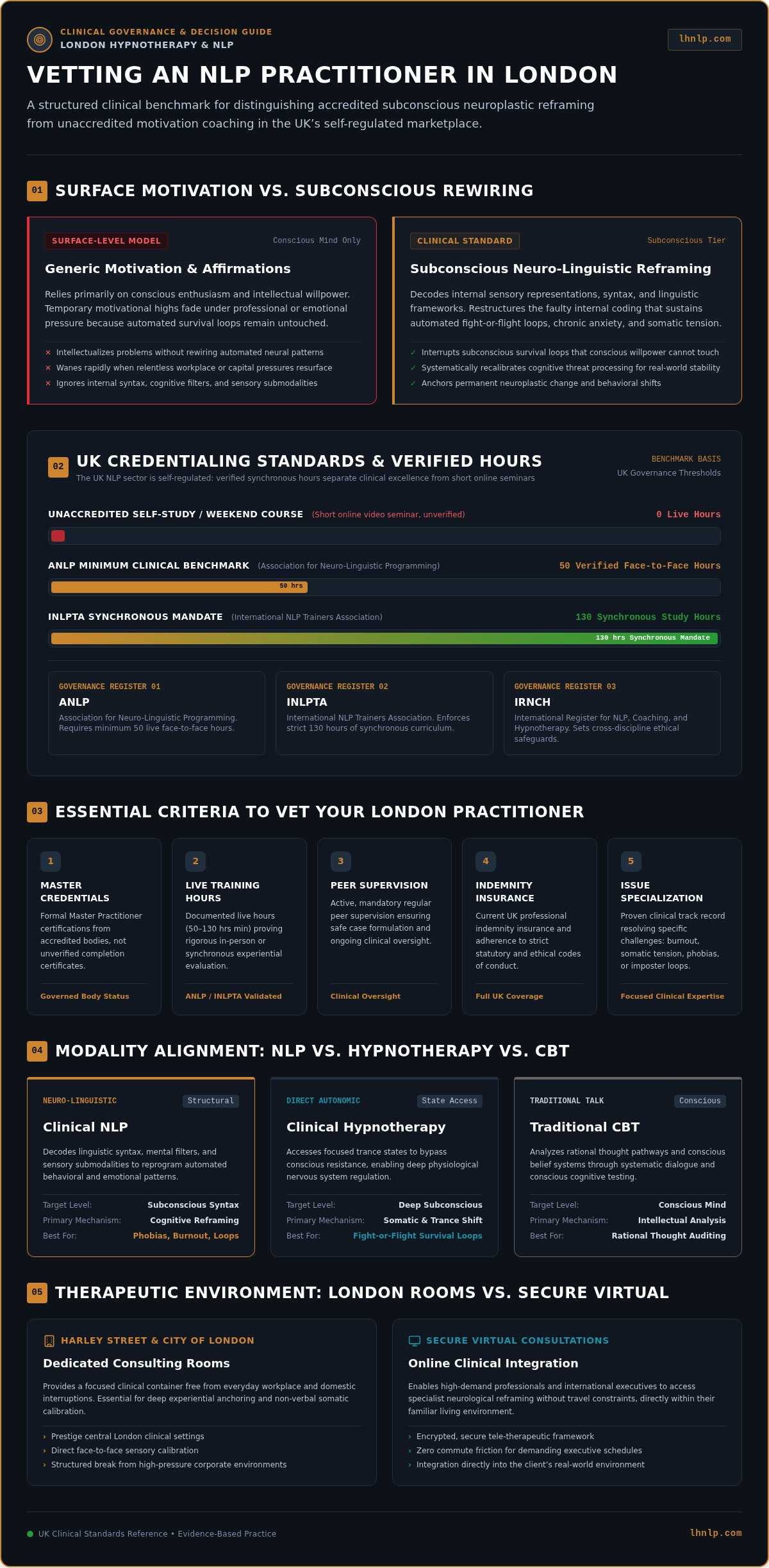
True cognitive transformation begins where conscious willpower ends. When evaluating an NLP practitioner London professionals often realize that intellectualizing a problem rarely resolves it. Clinical Neuro-Linguistic Programming explores how internal sensory representations, syntax, and subconscious linguistic frameworks dictate emotional states and behavioral loops. Rather than providing generic motivation, clinical practice systematically identifies the faulty internal coding that maintains chronic anxiety, imposter syndrome, and somatic tension.
The capital’s relentless pace creates distinct psychological pressures. City executives and creative leaders routinely hit performance plateaus or experience profound burnout because their neurology remains trapped in automated fight-or-flight responses. A certified clinical practitioner works at the subconscious tier to alter these automatic responses, enabling genuine neuroplastic restructuring instead of superficial mindset shifts.
To see how clinical neuro-linguistic techniques rapidly address deep-seated phobic responses, watch this demonstration:
Understanding Neuro-Linguistic Programming Beyond Motivation Coaching
Many individuals confuse neuro-linguistic methods with high-energy life coaching. Motivation coaching relies on conscious enthusiasm, which inevitably wanes when everyday pressures resurface. Clinical intervention decodes the precise cognitive filters, sensory submodalities, and linguistic patterns that trigger distress. By altering how your nervous system processes perceived threats, it creates sustainable neurological change that holds firm under real-world pressure.
Recognised Professional Bodies and Credentialing Standards in the UK
Because the discipline remains self-regulated across the UK, anyone can complete a short online video seminar and market themselves as an expert. Protecting your time and emotional health requires looking for practitioners affiliated with reputable governance bodies. When vetting an NLP practitioner London clients should verify clear clinical benchmarks:
- Independent Accreditation: Membership with established governing bodies such as the Association for Neuro-Linguistic Programming (ANLP), the International NLP Trainers Association (INLPTA), or the International Register for NLP, Coaching, and Hypnotherapy (IRNCH).
- Rigorous Training Hours: Verified live training rather than unaccredited self-study; the ANLP requires a minimum of 50 face-to-face hours, while INLPTA mandates 130 hours of synchronous study.
- Clinical Safeguards: Current professional indemnity insurance, regular peer supervision, and strict adherence to established ethical codes.
Selecting someone who combines these professional safeguards with specialized clinical expertise ensures you receive a methodical, solution-focused therapeutic intervention tailored to your individual neurology.
5 Essential Criteria to Vet Your NLP Practitioner in London
Therapist directories often reduce selection to postcodes and generic bios. When you need a skilled NLP practitioner London offers hundreds of options, but finding someone equipped for complex psychological patterns requires an objective rubric. Lasting transformation depends on competence, clinical integration, and methodological rigor.
Use these five concrete benchmarks during your vetting process:
- Verified Credentials: Formal Master Practitioner certifications through reputable bodies, backed by ongoing professional peer supervision and comprehensive indemnity insurance.
- Targeted Issue Specialization: Proven clinical expertise in your specific challenge, whether addressing acute anxiety, phobias, or public speaking blocks.
- Multi-Disciplinary Integration: The ability to weave neuro-linguistic repatterning with clinical hypnotherapy to access both conscious syntax and subconscious emotional memories.
- Transparent Case Evidence: Grounded case studies and authentic testimonials that reflect methodical progress rather than overnight miracles.
- Empathetic Calibration: Deep sensory acuity and conversational rapport established during an initial consultation, ensuring you feel heard rather than fitted into a script.
Verifying Accreditation, Clinical Training, and Supervision
Always ask a prospective practitioner where they trained, how many supervised hours they completed, and who oversees their ongoing practice. Legitimate practitioners welcome these questions. Confirm that their practice adheres to UK GDPR standards for data security. Clinical supervision is non-negotiable; it guarantees that your practitioner undergoes regular peer review to maintain therapeutic boundaries and professional efficacy.
Evaluating Specialisation for Anxiety, Phobias, and Career Performance
A generalist rarely possesses the nuance needed to unravel deeply rooted emotional triggers. As highlighted by Psychology Today’s clinical overview of Neuro-Linguistic Programming Therapy, practitioners apply these models to address specific emotional habits, behavioral loops, and psychological hurdles. London professionals facing intense boardroom pressures or debilitating social anxieties require customized interventions. Exploring specialized treatments designed for stress management and performance roadblocks helps align your goals with someone who understands your operating environment.
Assessing Rapport, Empathy, and Ethical Practice
Methodology matters, but the therapeutic relationship determines outcome. Does the practitioner listen to how you structure your experience, or do they push pre-packaged motivational scripts? Ethical practitioners outline realistic timelines and foster independence from the first conversation. If you want to explore how a bespoke plan fits your needs, review our approach at lhnlp.com to see what a grounded, client-centred partnership looks like.
NLP Coaching, Clinical Hypnotherapy, or CBT: Choosing the Right Pathway
Many people spend months in traditional talking therapy analyzing why they feel anxious, yet their physical symptoms remain stubbornly active. Cognitive Behavioural Therapy (CBT) excels at rational analysis, helping you identify cognitive distortions on paper. However, understanding a negative thought consciously doesn’t stop your chest from tightening during a high-stakes presentation. Somatic triggers operate far below conscious reasoning, rooted in primitive nervous system patterns that logic alone cannot soothe.
When working with a skilled NLP practitioner London clients gain practical tools to intercept these patterns in real time. Standalone neuro-linguistic coaching targets conscious linguistic habits, perceptual framing, and immediate state management. It provides powerful tactical relief for situational hurdles. Yet persistent visceral habits, deep-seated emotional associations, and automatic survival loops often demand deeper subconscious intervention to create lasting relief.
Comparing Modalities: Speed, Depth, and Core Objectives
Traditional talking therapies often require open-ended weekly commitments spanning six to twelve months. In contrast, solution-focused neuro-linguistic interventions operate as brief, focused engagements designed to build autonomy quickly. By altering internal sensory syntax, such as how loud an inner critic sounds or how close a distressing mental picture feels, linguistic repatterning accelerates emotional desensitization for trauma, phobias, and chronic self-doubt. Discover how clinical approaches differ in our definitive guide to clinical hypnosis & NLP.
The Clinical Synergy of NLP and Hypnotherapy
Authentic neurological change happens when conscious linguistic reframing integrates with subconscious induction. Standalone coaching shows you what needs re-wiring, while clinical hypnotherapy bypasses analytical resistance to embed those changes at a deeper tier. This powerful synergy resolves stubborn, conditioned coping patterns, including stress-related emotional eating, insomnia, and performance anxiety.
Instead of forcing yourself to white-knuckle through stressful situations, the integrated model updates the automatic nervous system response that generated the tension in the first place. Discover how integrative therapies unlock lasting results in anxiety therapy in London. Partnering with an experienced NLP practitioner London residents can resolve cognitive dissonance and cultivate genuine, lasting emotional resilience.
In-Person London Consultations vs. Online Sessions: Practical Considerations
Deciding between face-to-face appointments and digital consultations shapes your therapeutic experience. Both formats offer proven paths to cognitive change, but each serves different lifestyle demands and emotional needs. Finding the best NLP practitioner London has to offer involves assessing whether an in-person clinical setting or the comfort of your private space will best support your focus.
Consider how your environment affects your nervous system. For many, leaving home or the workplace creates a necessary physical boundary that signals the start of deep, reflective work. For others, eliminating cross-city transit reduces baseline stress, making subconscious reprogramming far easier to integrate.
The London Clinic Experience: Harley Street, the City, and Ealing
Stepping into a dedicated consulting space provides a structured, neutral container free from domestic distractions. Practice locations across London offer distinct advantages tailored to daily routines:
- Harley Street (Central London): Renowned for a long heritage of medical and clinical prestige, providing quiet consulting rooms easily accessible from Oxford Circus and Bond Street.
- Tokenhouse Yard (The City): Positioned moments from Bank and Liverpool Street, allowing corporate leaders and financial professionals to attend focused sessions without disrupting demanding schedules.
- Ealing (West London): Offers a calm suburban setting with direct links via the Elizabeth line, ideal for residents seeking clinical care away from central congestion.
Virtual Consultations: Clinical Efficacy from Home or Office
Modern tele-health studies confirm that digital neuro-linguistic work matches in-person interventions in both depth and permanence. Large-scale UK clinical studies show that remote psychological therapies achieve equivalent outcomes for anxiety and stress-related patterns, with research from Oxford University demonstrating symptom reductions comparable to face-to-face treatment.
Engaging in online hypnotherapy services allows you to process emotional shifts in the exact setting where real-world triggers occur. To ensure maximum clinical impact during virtual appointments, prepare your space mindfully:
- Secure a private room where you won’t be interrupted by family members, colleagues, or pets.
- Use quality noise-cancelling headphones to clearly hear language tone, pacing, and hypnotic cadence.
- Verify a stable, high-speed internet connection so your concentration remains unbroken throughout state shifts.
Whether you prefer an established consulting room or secure digital appointments, take the first step toward lasting calm by booking a consultation through lhnlp.com today.
Starting Your Journey: What to Expect During an NLP Program
Beginning therapeutic work should never feel like a leap into the unknown. A structured clinical program demystifies personal growth, turning internal cognitive shifts into a methodical, predictable process. When partnering with an experienced NLP practitioner London clients move through a phased framework designed to dismantle obsolete conditioning and establish lasting behavioural autonomy.
Transformation isn’t magic; it’s precision psychology applied to your unique mental architecture.
Phase 1: Precision Assessment and Neuro-Linguistic Mapping
Your journey opens with an in-depth clinical intake. Rather than merely cataloguing past events, your practitioner maps how you construct internal reality in the present moment. This stage identifies unconscious linguistic presuppositions, distorted perceptual filters, and somatic tension points. Crucially, your practitioner explores secondary gains, uncovering the hidden protective functions that maintain unwanted behaviours. Together, you define sensory-based outcome metrics, clarifying exactly how your physical body, posture, and internal voice will register relief once the work is complete.
Phase 2: Tailored Intervention and Subconscious Integration
With clear benchmarks established, sessions transition into experiential repatterning. Your practitioner uses targeted tools like sensory reframing, swish patterns, and somatic anchoring to disrupt automatic reactive loops. By weaving clinical hypnotherapy into neuro-linguistic processes, these resource states bypass conscious doubt and embed directly into the subconscious mind. Between appointments, you’ll complete simple cognitive exercises that reinforce neuroplastic development, grounding your shifts into daily habits.
Phase 3: Real-World Testing and Long-Term Empowerment
The true measure of cognitive change lies outside the consulting room. In this final phase, future-pacing techniques test your newly installed responses against challenging real-world triggers, whether addressing a hostile boardroom, navigating crowded transport lines, or setting relational boundaries. As automatic calm replaces historical panic, you achieve verified self-regulation milestones that confirm you no longer need therapeutic support. For practical details on session lengths and preparation, browse our detailed clinic FAQs.
Drawing on two decades of clinical experience across Harley Street, the City, and Ealing, London Hypnotherapy & NLP provides the structured expertise required for permanent cognitive alignment. Real change begins when your conscious goals and subconscious reflexes finally pull in the same direction.
Reclaiming Cognitive Freedom: Taking Your Next Step
Moving beyond chronic stress, phobias, or self-limiting beliefs doesn’t require endless talking therapy or fleeting motivational surges. Real transformation happens when you address the precise subconscious language maintaining those automatic survival loops. By insisting on verified clinical credentials, targeting specific issue specialisation, and choosing an approach that pairs conscious cognitive mapping with deep subconscious reframing, you set the foundation for permanent neuroplastic growth.
Selecting the right therapeutic partner brings clarity and safety to this transformative work. When searching for a dedicated NLP practitioner London offers many paths, but sustainable results require tested clinical rigor. Drawing on over two decades of clinical experience in London since 2005, our practice integrates neuro-linguistic repatterning with clinical hypnotherapy across discreet consulting rooms in Harley Street, Tokenhouse Yard, and Ealing, as well as worldwide online consultations. Schedule a confidential consultation with London Hypnotherapy & NLP to release outmoded patterns and cultivate lasting internal calm.
Frequently Asked Questions
What credentials should a reputable NLP practitioner in London hold?
A reputable NLP practitioner London clients can trust should hold verified Master Practitioner certification from recognized bodies like the ANLP, INLPTA, or IRNCH. They must maintain valid professional indemnity insurance, undergo regular clinical supervision, and adhere to strict codes of ethics. Look for complementary clinical accreditations in clinical hypnotherapy, which demonstrate a thorough grounding in subconscious behavioural modification rather than a quick, unaccredited online certificate.
How many sessions are typically required with an NLP practitioner to see results?
Because neuro-linguistic methods are solution-focused, tangible shifts often occur within three to six sessions. Acute challenges such as isolated phobias or public speaking anxieties frequently resolve even faster. In contrast, deep-rooted issues like complex relational patterns or long-standing burnout may benefit from a structured multi-session program. Progress is continually tracked through sensory-based metrics rather than open-ended, indefinite therapy schedules.
Can NLP and hypnotherapy help with severe work-related stress and burnout?
Yes, integrating neuro-linguistic programming with clinical hypnotherapy directly interrupts the chronic sympathetic nervous system arousal driving corporate burnout. While standard advice focuses on workload management, these clinical modalities systematically dismantle internal perfectionism, catastrophic mental framing, and somatic tension. By resetting subconscious threat perceptions, professionals rebuild nervous system resilience, improve sleep quality, and regain decisive cognitive clarity within high-pressure environments.
Is an online NLP session as effective as an in-person appointment in London?
Clinical research and modern tele-health outcomes confirm that virtual sessions match face-to-face appointments in effectiveness. Neuro-linguistic techniques rely on auditory cues, spoken syntax, and focused internal visualization rather than physical contact. When conducted via secure video links in a quiet, private environment with quality headphones, remote appointments deliver identical neuroplastic restructuring while removing the logistical friction and travel stress of central London commuting.
What is the difference between an NLP life coach and a clinical NLP practitioner?
An NLP life coach typically focuses on forward-looking conscious motivation, goal setting, and accountability. In contrast, a clinical NLP practitioner London residents consult handles deep subconscious conditioning, emotional trauma, and somatic resistance. Clinical practitioners possess rigorous supervised training, ethical governance, and dual-accreditation in modalities like hypnotherapy, allowing them to safely untangle chronic psychological patterns that conscious goal setting alone cannot shift.
What happens during a typical first appointment with an NLP practitioner?
Your initial consultation focuses on clinical mapping and rapport. Your practitioner explores the precise linguistic structures, internal imagery, and somatic cues you use to maintain unwanted states. You’ll discuss secondary gains, uncover situational triggers, and define clear, observable outcome benchmarks. Most opening sessions also include foundational reframing or gentle hypnotic integration so you leave with immediate experiential shifts and practical tools to apply between appointments.
Can NLP resolve long-standing specific phobias and social anxiety?
Yes, neuro-linguistic protocols are exceptionally effective for phobias and social fears because these conditions stem from rapid, subconscious associative conditioning. Techniques like the visual-kinesthetic dissociation protocol and timeline repatterning decouple traumatic memories from acute visceral reactions. By altering how your brain processes internal threat stimuli, the automated panic response dissolves, allowing calm, grounded confidence to replace habitual fight-or-flight reactivity.