

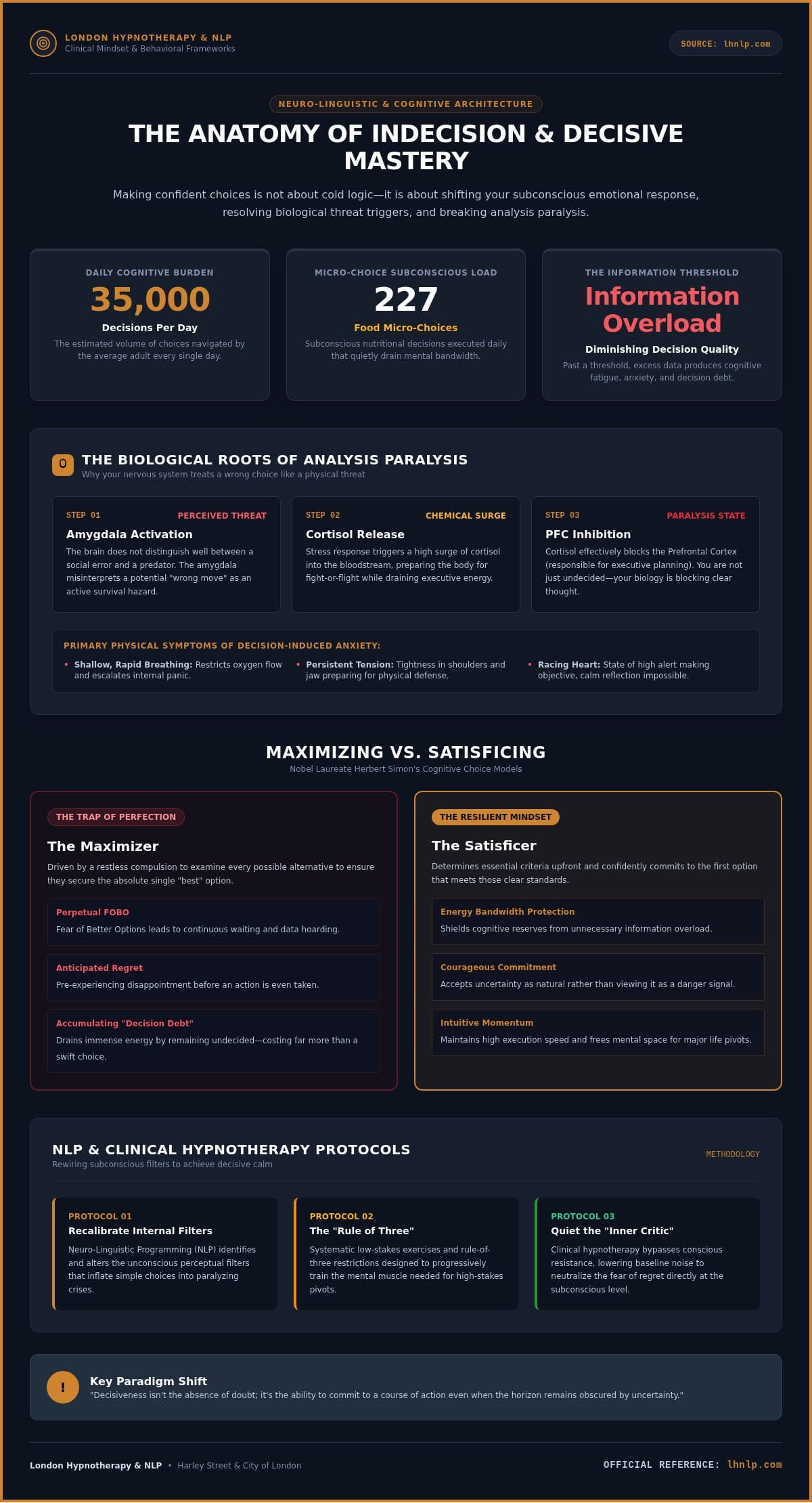
Did you know that the average adult navigates an estimated 35,000 decisions every single day? From the 227 micro-choices you make regarding food to the heavy, life-altering pivots that require you to learn how to be more decisive, your mind is in a constant state of evaluation. It’s understandable if you feel mentally exhausted, trapped in a cycle where every option feels like a potential doorway to regret. You might believe that gathering more data will finally provide clarity; yet, research suggests that an abundance of choice often only serves to deepen our paralysis.
If you’re ready to break free from the weight of overthinking, making confident choices is less about cold logic and more about shifting your subconscious emotional response. You deserve to move through your day with a sense of internal quiet rather than a chorus of “what ifs.” This guide will show you how to master the mental frameworks and NLP protocols required to trust your intuition and act with speed. We’ll explore the biological roots of indecision and provide practical tools to help you navigate both daily tasks and major transitions with newfound confidence and lasting peace of mind.
Key Takeaways
- Understand why the modern phenomenon of “Fear of Better Options” (FOBO) creates subconscious blocks and how to redefine decisiveness as an act of courageous commitment.
- Discover how to be more decisive by adopting the “Satisficing” framework, a method designed to protect your cognitive energy from the drain of unnecessary information overload.
- Explore how Neuro-Linguistic Programming (NLP) allows you to recalibrate the internal filters that often transform simple choices into sources of analysis paralysis.
- Learn practical, low-stakes exercises and the “Rule of Three” to systematically build the mental muscle required for making confident, high-stakes life pivots.
- Gain insight into how clinical hypnotherapy can quiet the “inner critic” and bypass the conscious mind to resolve the deep-seated fear of regret.
Why We Struggle to Decide: The Anatomy of Indecision
Decisiveness isn’t the absence of doubt; it’s the ability to commit to a course of action even when the horizon remains obscured by uncertainty. For many high-performing individuals, the quest for the “perfect” path leads to FOBO, or the Fear of Better Options. This modern phenomenon suggests that if we just wait a little longer or research a bit more, a superior choice will reveal itself. This state of perpetual waiting is actually your amygdala at work, treating the prospect of a “wrong” choice as a genuine threat to your safety. Indecision is a protective mechanism gone haywire.
To better understand the psychological mechanics of choice, watch this helpful video:
The Fear of the ‘Wrong’ Choice
Perfectionism often disguises itself as diligence, but in reality, it creates a mental stalemate that prevents growth. When you obsess over making the “right” move, you’re often grappling with anticipated regret, the painful feeling of disappointment you imagine experiencing before you’ve even acted. Your brain doesn’t distinguish well between a social faux pas and a physical predator; it treats a potential bad decision like a physical threat. This biological response triggers analysis paralysis, where the cognitive load of weighing every variable becomes so heavy that you remain frozen. Learning how to be more decisive requires acknowledging that “perfect” is an illusion that keeps you tethered to the spot.
How Anxiety Paralyses the Decision-Making Process
There’s a profound, often overlooked link between anxiety therapy London and discovering how to be more decisive. When anxiety takes hold, your body releases high levels of cortisol, which effectively inhibits the prefrontal cortex, the part of your brain responsible for complex planning and executive function. You aren’t just “undecided”; your biology is temporarily blocking your access to clear thought. You might notice physical symptoms during these moments:
- Shallow, rapid breathing that limits oxygen flow and heightens the sense of panic.
- Persistent tension in the shoulders and jaw as your body prepares for a “threat.”
- A racing heart that signals a state of high alert, making calm reflection impossible.
By addressing these underlying stress responses, you can restore the mental clarity needed to move forward with grace and trust in your own judgment.
Breaking the Cycle of Analysis Paralysis
To truly master how to be more decisive, we must first address the internal drive for optimization that often keeps us stuck. Nobel laureate Herbert Simon identified two distinct ways we approach choices: maximizing and satisficing. Maximizers feel a restless compulsion to examine every possible alternative to ensure they’ve found the absolute “best” option. While this might look like diligence, it usually results in exhaustion and a lingering sense of regret. Satisficers, conversely, determine their essential criteria first and choose the first option that meets those standards. This shift isn’t about lowering your standards; it’s about protecting your mental bandwidth from the weight of information overload.
Research suggests that once we pass a certain threshold of information, our ability to make a high-quality choice actually diminishes. We enter a state of cognitive fatigue where every new data point adds to our stress rather than our clarity. If you’re currently feeling the strain of these mental loops, incorporating structured stress management techniques can help lower the baseline of noise in your mind, allowing your natural intuition to surface.
The Myth of the Perfect Option
Perfection is a mirage that recedes the closer we get to it. When we hold out for the absolute best, we aren’t just being careful; we’re paying interest on a debt of inaction. This “decision debt” is the mental energy drained by staying undecided, which is often far more costly than making a slightly imperfect choice. Embracing a “good enough” standard for low-stakes tasks frees up your vitality for the decisions that actually shape your future. You might find that implementing specific strategies to stop overthinking helps you recognise when you’ve reached the point of diminishing returns.
Setting Time Constraints on Deliberation
Work expands to fill the time available for its completion, and the same is true for our worries. By applying Parkinson’s Law to your decision-making, you can force your brain to focus on the essentials. Give yourself a strict two-minute window for daily choices like what to eat or which email to answer first. For immediate actions, use the “5-Second Rule”: once you know what needs to be done, count down from five and move before your brain has the chance to intervene with a “what if.” A good decision made with conviction today is almost always more valuable than a perfect one that arrives a week too late. If you find that internal resistance still blocks your path, a session of NLP Coaching can be a powerful way to realign your subconscious drivers with your conscious goals.
NLP Techniques to Rewire Your Subconscious Decisiveness
Neuro-Linguistic Programming (NLP) acts as a user manual for your mind, offering a systematic way to understand how your internal architecture shapes your daily reality. Often, the struggle of how to be more decisive isn’t a lack of intelligence but rather a result of cluttered mental filters. These filters, composed of past experiences, beliefs, and values, act like a lens through which you view every choice. If your lens is smudged with fear or perfectionism, every path looks treacherous. By using NLP coaching, you can clean these filters and see possibilities with newfound clarity. It’s a shift from being lost in the fog to holding a reliable compass.
The language you use internally also dictates your capacity for action. When you tell yourself “I can’t decide,” you reinforce a state of helplessness. Instead, try reframing the moment: “I am choosing to wait for more data” or “I am currently prioritising other tasks.” This small linguistic shift moves you from a victim of circumstance to an active agent. For those seeking a deeper transformation, combining these techniques with hypnotherapy London allows you to address the subconscious roots of hesitation that logic alone cannot reach. According to research on decision fatigue, chronic stress significantly depletes our cognitive resources, making even minor choices feel monumental. NLP provides the tools to interrupt this depletion.
Future Pacing: Visualising Success
Future pacing is a cornerstone NLP technique that allows you to mentally “test drive” a decision before committing. Instead of looking at options from a distance, you step into the future as if the choice has already been made. What does your day feel like? How does your body react to this new reality? By assessing the emotional “vibe” and using visual submodalities, such as making the mental image brighter, closer, or more vivid, the “right” path often reveals itself. This visceral sense of alignment is far more powerful than a cold list of pros and cons.
Anchoring Confidence for Quick Choices
Anchoring allows you to “capture” a peak state of certainty and recall it at will. Think back to a time when you were undeniably decisive, a moment where you acted with total conviction. As you relive that memory, notice the physical sensations in your body. By pairing that intense feeling with a specific physical gesture, like pressing your thumb and forefinger together, you create a neurological link. Deploying this anchor when faced with a daunting menu or a complex email is a practical way to learn how to be more decisive in real-time. You aren’t searching for confidence; you’re simply triggering a resource you already possess.
5 Practical Steps to Becoming More Decisive
Decisiveness isn’t a fixed personality trait that you either possess or lack; it’s a muscle that requires consistent resistance to grow. If you want to master how to be more decisive in high-pressure professional settings, you must first practice in the low-stakes environments of your daily life. By systematically reducing the friction of choice, you preserve your mental energy for the moments that truly matter. Follow these five steps to begin your transition from hesitation to action:
- Start Small: Commit to minor choices, like your lunch order or a morning coffee, in under 30 seconds to build momentum.
- Limit Your Options: Use the “Rule of Three” by narrowing your choices to just three viable paths to prevent the paralysis of choice overload.
- Listen to Your Gut: Pay attention to somatic markers, which are the physical signals your body sends before your conscious mind catches up.
- Accept the Trade-off: Recognise that every “Yes” is naturally a “No” to something else, and that’s a necessary part of moving forward.
- Review and Pivot: Treat most decisions as reversible experiments rather than permanent, life-altering judgements.
Developing Your ‘Decisiveness Muscle’
It’s helpful to view each choice as a repetition in a mental gym. Sometimes, the most decisive action you can take is to consciously “decide not to decide” until a specific, self-imposed deadline. This isn’t procrastination; it’s a strategic choice that keeps you in the driver’s seat of your timeline. Accumulating these small wins is a vital part of building the internal confidence needed for larger, more complex life pivots. If you’re ready to move past the mental blocks holding you back, consider booking a Confidence Building Session to accelerate your progress.
Trusting Your Intuition (The ‘Gut’ Feeling)
Science suggests that intuition is actually a form of rapid pattern recognition where your subconscious processes data faster than your conscious mind can follow. To learn how to be more decisive, you must distinguish between genuine intuition and anxious fear. Fear is often loud, frantic, and felt as a tightening in the chest. Intuition is usually a quiet, steady pull toward a specific direction. If you’re stuck, try the coin-toss trick: assign an option to each side and flip it. Your gut reaction while the coin is in the air, whether you’re secretly hoping for heads or dreading tails, will reveal your true preference before the coin even lands.
Mastering Your Mindset with London Hypnotherapy
While practical frameworks and linguistic shifts provide essential tools for change, some professional blocks are rooted so deeply that logic alone cannot shift them. You might know all the strategies for how to be more decisive, yet still find yourself frozen when the stakes are high. This is often because your critical conscious mind acts as a gatekeeper, filtering out new possibilities based on old, protective scripts. London Hypnotherapy & NLP offers a gentle yet profound way to bypass this gatekeeper, allowing us to communicate directly with the subconscious parts of your mind that hold onto the fear of making a “wrong” choice.
At the heart of chronic indecision often lies an overactive inner critic, a voice that anticipates judgment or failure before you’ve even acted. In some cases, this hesitation is so intense that it functions similarly to a specific fear response. By incorporating phobia treatment protocols, we can desensitise the brain’s “threat” response to failure, transforming a daunting pivot into a manageable step. Kamalyn Kaur’s practice, based in the renowned medical enclave of Harley Street and in Ealing, serves as a premier destination for London professionals seeking to bridge the gap between their intellectual potential and their daily actions.
How Hypnosis Addresses Subconscious Blocks
Hypnosis isn’t about losing control; it’s about gaining it. It provides a state of focused relaxation where we can reprogram the “self-sabotage” scripts that tell you safety only exists in inaction. We work to build a core sense of internal safety, ensuring that your nervous system feels secure enough to choose a path and walk it. For those with demanding schedules, a virtual hypnotherapy session offers the same depth of transformation from the comfort of your own home or office, making mental optimization accessible regardless of your location.
Personalised NLP Coaching for High-Achievers
For high-performing individuals, indecision is rarely about a lack of options and almost always about the weight of expectation. Personalised NLP coaching allows us to tailor specific executive decision-making techniques to your unique professional landscape. We move beyond the “anxious high-achiever” archetype, helping you evolve into a confident leader who trusts their own internal compass. This process isn’t just about making faster choices; it’s about making them with a sense of quiet authority and total absence of post-decision anxiety. If you’re ready to reclaim your mental bandwidth, you can Book a consultation with Kamal to start your journey toward a more decisive, purposeful life.
Stepping Into Your Most Confident Self
True clarity isn’t found by waiting for more information; it’s forged by reclaiming your internal authority. You’ve explored how the biological “safety check” of the amygdala can accidentally stall your progress, and you’ve learned that mastering how to be more decisive is a skill that can be methodically refined. By moving from a maximizing mindset to one of purposeful satisficing, you free your mental energy for the pivots that truly define your life’s direction. Whether you’re refining your “decisiveness muscle” with small daily wins or using future pacing to test your path, the power to choose is already within you.
If you feel that deep-seated patterns of overthinking are still holding you back, professional support can accelerate your transformation. With over 20 years of clinical experience, Kamalyn Kaur provides solution-focused NLP and hypnotherapy tailored to the unique pressures of the London professional landscape. You can access these sessions at our Harley Street practice or through secure Zoom consultations. It’s time to quiet the inner critic and move forward with a sense of quiet, unwavering certainty. You are invited to Book Your Decisiveness Consultation in London and begin your journey toward lasting mental freedom. Your future is waiting for you to choose it.
Frequently Asked Questions
Is indecisiveness a sign of anxiety?
Indecisiveness is frequently a protective symptom of underlying anxiety rather than a character flaw. When you struggle with how to be more decisive, your nervous system is often stuck in a state of hyper-vigilance, treating a potential “wrong” choice as a genuine threat to your safety. In my London practice, I find that addressing the root cause of this anxiety allows the prefrontal cortex to regain its executive function, making decisions feel like a natural flow.
How can I stop overthinking every little thing?
To stop overthinking, you must shift from a “maximizing” mindset to a “satisficing” one. This means setting clear criteria for a “good enough” outcome and committing to the first option that meets them. You can also implement strict time limits for minor choices to preserve your mental energy. By lowering the stakes on trivial matters, you train your brain to trust its initial assessments, which is a vital step in learning to trust your own internal compass.
What is the 5-second rule for decision making?
The 5-second rule is a cognitive tool used to interrupt the cycle of hesitation and self-doubt. Once you have an instinct to act on a goal, you count backwards from five to one and physically move before your brain can manufacture reasons to stay still. This technique is particularly effective for London professionals who face decision fatigue, as it bypasses the analysis paralysis that often sets in when we give our minds too much time to over-deliberate.
Can hypnotherapy really help me be more confident?
Hypnotherapy is exceptionally effective for building confidence because it accesses the subconscious mind where your self-sabotage scripts are stored. While conscious effort is important, clinical hypnosis allows us to reprogram the deep-seated beliefs that fuel your hesitation. In our Harley Street or virtual sessions, we work to build a core sense of internal safety. This foundation makes it significantly easier to trust your judgment and take action without the weight of post-decision regret or social anxiety.
Why do I feel physically sick when I have to make a choice?
That physical sensation of nausea or tension is your body’s “fight or flight” response being triggered by a perceived threat. Your amygdala doesn’t distinguish between a physical predator and the social or financial risk of a “bad” decision. This physiological arousal can lead to shallow breathing and muscle tension, which further clouds your judgment. Recognising these somatic markers is the first step toward calming your nervous system, allowing you to regain the clarity needed for effective choices.
What is the difference between a ‘maximizer’ and a ‘satisficer’?
A maximizer is someone who feels compelled to examine every possible alternative to ensure they’ve found the absolute best option, often leading to exhaustion. A satisficer, however, determines their essential criteria first and chooses the first option that meets those standards. While maximizers might occasionally find a “better” objective result, they’re generally less happy and more prone to regret. Learning to satisfice is one of the most practical ways to understand how to be more decisive.
How do I know if I’m making a decision based on fear or intuition?
Fear usually feels loud, frantic, and is often accompanied by a tightening in the chest or a sense of urgency to avoid something. Intuition, conversely, is typically a quiet, steady, and neutral “pull” toward a specific direction. It lacks the emotional noise and panic associated with fear. By using NLP techniques like future pacing, you can mentally step into each potential outcome; if one feels expansive and calm while the other feels restrictive, you’ve found your answer.
How many hypnotherapy sessions do I need for confidence?
Every individual’s journey is unique, but our approach at London Hypnotherapy & NLP is strictly solution-focused. Many clients begin to experience a significant shift in their internal confidence after just three to six sessions. During our initial consultation, we’ll assess your specific behavioral blocks and design a personalized plan. Whether we meet in person at our Ealing or Harley Street locations or via virtual sessions, our goal is to provide you with lasting tools for self-reliance.