

What if the persistent exhaustion you feel isn’t a sign that you simply need more sleep, but a signal that your subconscious mind is running on an outdated, overtaxed operating system? You’ve likely tried the long weekends away and the early nights, yet that heavy weight of brain fog and the loss of passion for your career remain stubbornly in place. It’s a common struggle in our fast-paced capital, where the pressure to perform often leads to a hollowed-out version of yourself. You aren’t alone in feeling that your internal battery is no longer holding a charge, regardless of how much downtime you attempt to take.
By seeking professional therapy for burnout London, you can move beyond these surface-level fixes and begin to reprogram the subconscious drivers that keep you trapped in a cycle of depletion. This article will show you how the sophisticated tools of Hypnotherapy and NLP can rapidly restore your energy and provide the mental resilience required for a high-stakes life. We’ll explore a methodical path to reclaiming your vitality, helping you transition from a state of survival back into a position of absolute control and purpose.
Key Takeaways
- Recognise how London’s unique high-pressure culture contributes to the three pillars of burnout, helping you distinguish between simple fatigue and a deeper state of professional depletion.
- Understand why traditional talk therapy often falls short by reinforcing problems, whereas addressing the subconscious mind allows for a more profound and lasting shift in perspective.
- Discover how professional therapy for burnout London utilises the precision of Hypnotherapy and NLP to dissolve brain fog and rapidly restore your cognitive performance.
- Learn the essential steps for selecting a qualified practitioner in locations like Harley Street, ensuring your recovery is guided by accredited expertise and solution-focused methods.
- Gain the mental tools necessary to establish firm workplace boundaries, allowing you to reclaim your passion for your career while maintaining your internal sense of calm.
Understanding Burnout in the High-Pressure London Landscape
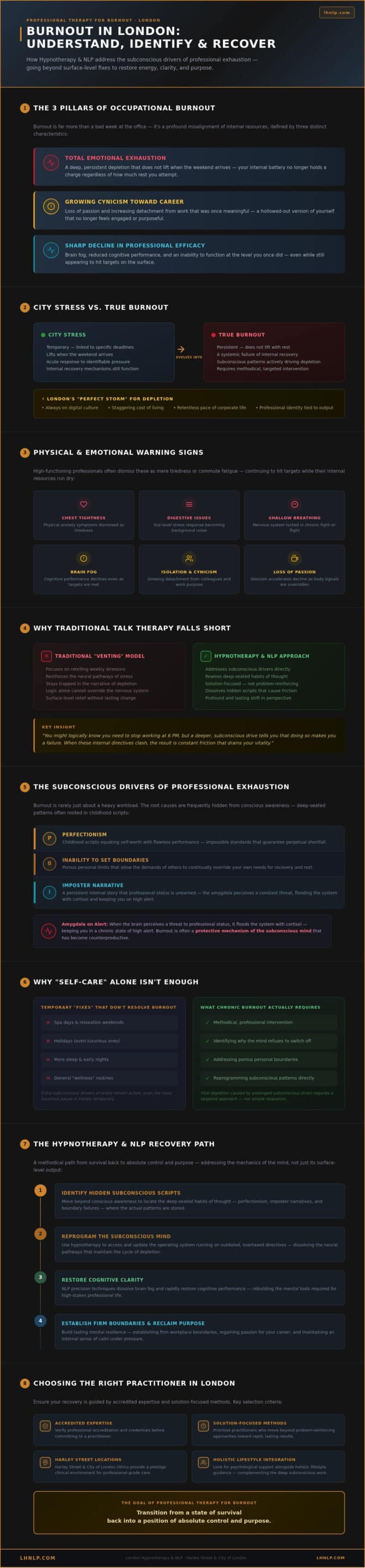
London exists in a state of perpetual motion. For many professionals, the boundary between “doing” and “being” has become dangerously blurred. While we often celebrate the ambition that drives the City, there is a threshold where healthy drive transforms into something more corrosive. This is occupational burnout, a condition characterised by three distinct pillars: a sense of total emotional exhaustion, a growing cynicism toward one’s career, and a sharp decline in professional efficacy. It’s far more than just a bad week at the office; it’s a profound misalignment of your internal resources.
Londoners face a unique set of pressures. The “always-on” digital culture, combined with the staggering cost of living and the relentless pace of corporate life, creates a perfect storm for depletion. While “City stress” is often temporary and linked to specific deadlines, true burnout is a persistent state that doesn’t lift when the weekend arrives. It represents a systemic failure of your internal recovery mechanisms. Seeking professional therapy for burnout London offers a way to address these deep-seated patterns before they become permanent fixtures of your identity.
The Physical and Emotional Toll of the London Grind
The burden isn’t just mental. Many clients arrive at my Harley Street or City clinics experiencing physical symptoms of anxiety that they’ve dismissed as mere tiredness or the result of a long commute. Tightness in the chest, digestive issues, and shallow breathing become the background noise of their lives. High-functioning professionals often fall into a trap, believing that because they are still hitting targets, they aren’t truly suffering. They wait until the point of total collapse before acknowledging that their internal resources are spent. This stoicism is often what accelerates the decline, as the mind tries to override the body’s desperate signals for rest.
When “Self-Care” Isn’t Enough
We are often told that a spa day or a week in the sun will fix our fatigue. However, if the subconscious drivers of your stress remain active, even the most luxurious holiday is merely a temporary pause. Chronic burnout syndrome is different from acute stress. It requires a more methodical approach than simple relaxation. Professional stress management helps you identify why your mind refuses to switch off and why your boundaries have become so porous. Burnout is a state of vital depletion caused by prolonged subconscious strain.
Why Traditional Talk Therapy May Fall Short for Burnout
Many people find that simply recounting their weekly stressors to a therapist provides a brief moment of relief, yet the underlying exhaustion remains stubbornly unchanged. This “venting” model can inadvertently reinforce the very neural pathways associated with stress. By repeatedly discussing the problem without addressing the mechanics of the mind, you risk staying trapped in the narrative of depletion. Logic alone is rarely enough to override a nervous system stuck in a chronic state of “fight or flight,” which is often why traditional NHS guidance on stress and mental health suggests looking at holistic lifestyle changes alongside psychological support.
The root causes of burnout are frequently hidden from our conscious awareness. You might logically know you need to stop working at 6 PM, but a deeper, subconscious drive tells you that doing so makes you a failure. When these internal directives clash, the result is a state of constant friction that drains your vitality. Effective therapy for burnout London must address these hidden scripts, moving beyond the surface level to where the actual habits of thought are stored.
The Subconscious Drivers of Professional Exhaustion
Burnout is rarely just about a heavy workload; it’s rooted in deep-seated habits like perfectionism, an inability to set boundaries, or a persistent “imposter” narrative. These patterns are often driven by childhood scripts that equate self-worth with productivity. When your amygdala perceives a threat to your professional status, it floods your system with cortisol, keeping you on high alert. Burnout is often a protective mechanism of the subconscious mind, effectively pulling the emergency brake when the conscious mind refuses to acknowledge its limits.
Moving Beyond the “Why” to the “How”
High-performing professionals in the City usually don’t have years to spend in open-ended counselling. They need outcome-oriented interventions that offer tangible shifts in how they experience their daily lives. While understanding the “why” behind your exhaustion is useful, it doesn’t automatically change the “how” of your daily reactions. This is where hypnotherapy London becomes invaluable, as it bypasses the analytical mind to install new, healthier responses directly into the subconscious.
Choosing a solution-focused therapy for burnout London allows you to move from passive observation to active reprogramming. It’s about shifting the internal gears so that resilience becomes your default state rather than a constant effort. If you’re ready to explore a more direct path to recovery, you can book a consultation to discuss a personalised approach tailored to your specific corporate or creative environment.
Hypnotherapy and NLP: A Solution-Focused Path to Recovery
London’s high-pressure environment demands more than just a sympathetic ear; it requires a precise, solution-focused therapy for burnout London that addresses the mechanics of the mind. Clinical Hypnotherapy acts as a gentle yet powerful bridge to the subconscious. It bypasses the critical conscious mind, which is often the source of the “I should be doing more” loop, to instil a deep sense of calm that logic alone cannot provide. This is essential when dealing with stress and burnout according to Mind UK, as the nervous system needs to feel safe before it can begin the process of genuine repair.
Neuro-Linguistic Programming (NLP) complements this by providing the “user manual” for your brain. While hypnosis works on the deeper layers of belief and identity, NLP offers immediate, practical tools for workplace resilience and boundary setting. The synergy of these two modalities provides a rapid route to recovery. It ensures that therapy for burnout London isn’t just about surviving the week, but about fundamentally changing how you interact with your professional world. A typical session is a space of intellectual elegance, where we dismantle the old architecture of stress and replace it with mental tools you can use in real-time.
Reprogramming the Perfectionist Mindset
Perfectionism is a primary driver of exhaustion, yet it’s often a habit we’ve carried since childhood. Using hypnosis, we can lower the “internal volume” of that inner critic that demands impossible standards. NLP techniques then help you reframe high-pressure situations as manageable challenges rather than existential threats. You’ll learn to create “mental anchors,” which are simple physical or cognitive cues that trigger a state of relaxation even in the middle of a frantic boardroom or a crowded commute.
Restoring Performance and Cognitive Clarity
Burnout often manifests as a thick “brain fog” that makes even simple decisions feel monumental. When the subconscious is no longer locked in a perpetual threat response, this mental clutter naturally begins to lift, restoring your decision-making capabilities. Professional efficacy is also inextricably linked to rest. Integrating insomnia treatment into your recovery ensures that your brain actually recovers during the night, allowing you to wake up with the clarity needed for executive leadership. This methodical approach also rebuilds the confidence required for public speaking and high-stakes presentations, which often suffers when your internal resources are spent.
Choosing the Right Therapy for Burnout in London
Finding the right support in a city as vast as London can feel overwhelming, especially when your energy reserves are already low. It’s not just about finding a practitioner; it’s about finding a guide who understands the specific pressures of your professional environment. When selecting therapy for burnout London, your first step is to define what success looks like for you. Are you seeking immediate relief from the physical symptoms of exhaustion, or are you ready for a comprehensive lifestyle overhaul that addresses the subconscious drivers we’ve discussed?
Rigour is essential. Always verify that your chosen therapist is registered with professional bodies such as the CNHC or the NCH. This ensures a standard of ethics and training that is non-negotiable in therapeutic work. Once credentials are confirmed, consider how the setting will influence your progress. Whether you choose the quiet prestige of Harley Street or the modern flexibility of online hypnotherapy services, the environment should feel like a sanctuary. Finally, never underestimate the “therapeutic fit.” A brief initial conversation allows you to sense whether the practitioner’s approach resonates with your own intellectual and emotional needs.
Harley Street vs. The City: Finding Your Ideal Setting
London offers several distinct atmospheres for healing. Harley Street remains the gold standard for those seeking a sense of prestige and clinical excellence. It provides a dedicated space for deep work, removed from the immediate triggers of the office. Conversely, Tokenhouse Yard offers discreet, high-quality support right in the heart of The City, perfect for professionals who need to integrate sessions into a busy working day. For those who find the central rush too stimulating, Ealing consultations provide a calmer, more suburban backdrop that can facilitate a quicker transition into a relaxed state.
Virtual vs. In-Person Burnout Therapy
Modern therapy has evolved beyond the traditional office setting. Virtual sessions via platforms like Zoom or Skype are remarkably effective for NLP and Hypnotherapy, often allowing clients to remain in the comfort of their own homes. This eliminates the stress of the commute, which is often a significant contributor to burnout in the first place. Digital sessions maintain the same levels of privacy and confidentiality as in-person meetings, provided you have a quiet, undisturbed space. This flexibility is often the deciding factor for busy executives who require therapy for burnout London but cannot spare the travel time.
If you’re ready to take the first step toward recovery, you can book a consultation to discover which location or format best supports your journey back to vitality.
Begin Your Recovery with London Hypnotherapy & NLP
Kamalyn Kaur isn’t just a practitioner; she’s an experienced mentor who understands the relentless pace of the capital’s professional circles. Her approach to therapy for burnout London is deeply rooted in empathy, professional credibility, and a solution-focused mindset. By blending Clinical Hypnotherapy with the precision of NLP, she offers a bespoke path for each individual. This isn’t a generic programme. It’s a methodically designed process that respects your intellectual boundaries while addressing the subconscious patterns that led to your depletion.
The structure of the sessions is designed for efficiency and depth. We begin with a comprehensive initial assessment to map out the architecture of your stress. From there, we transition into active reprogramming, moving from immediate symptom relief to long-term resilience. This outcome-oriented methodology is the preferred choice for London’s high-performing professionals because it delivers tangible results without the need for years of open-ended counselling. If you’re ready to start this process, you can contact the clinic to schedule your initial consultation.
Tailored Session Packages for Lasting Change
Deep-seated behavioural change requires consistency. While a single session can provide a powerful shift, multi-session packages ensure that your new habits are fully integrated into your daily life. These packages provide the ongoing support necessary to overwrite years of perfectionism and prevent future relapses into exhaustion. For London organisations looking to protect their most valuable assets, these methods can also be integrated into corporate wellness initiatives to foster a culture of sustainable high performance.
Your Journey to a Balanced Life
The ultimate goal of this work is to move you from a state of merely surviving the week to genuinely thriving in your career. You’ll finish the process with a suite of NLP tools that you can use for the rest of your professional life. These tools help you maintain cognitive clarity and emotional stability even in the most high-stakes environments. Reclaiming your vitality is possible. It starts with a single decision to prioritise your internal resources. Reclaim your edge, your passion, and your inner peace by choosing a therapy that works at the same level as your ambition.
Reclaim Your Edge and Inner Peace
Reclaiming your vitality is not a matter of sheer willpower; it’s a process of unlearning the subconscious patterns that led to your depletion. We’ve explored how the relentless pace of the capital requires more than just passive rest. It demands a methodical reprogramming of the mind’s threat response to ensure you can operate at your peak without sacrificing your well-being. By choosing a solution-focused therapy for burnout London, you move beyond the “why” and into the “how” of lasting, cognitive change.
Kamalyn Kaur brings over 20 years of experience to her Harley Street and City of London clinics, providing an intellectually elegant space for your recovery. Whether you seek to clear brain fog or restore your professional passion, her personalised approach offers a direct route to resilience. Don’t let another week pass in a state of hollowed-out exhaustion. You have the internal resources to thrive again; you simply need the right guide to help you access them once more.
Book Your Burnout Consultation with Kamalyn Kaur Today and take the first step toward a balanced, purposeful life. Your journey from survival to vitality begins with a single, decisive conversation.
Frequently Asked Questions
How many sessions of burnout therapy will I need?
Most clients find that three to six sessions are sufficient to achieve significant shifts in their mental state and behaviour. Because this is a solution-focused therapy for burnout London, we don’t engage in open-ended counselling that lasts for years. We focus on specific, tangible outcomes. Your progress depends on the complexity of your situation and your readiness to engage with the subconscious reprogramming techniques we use during our time together.
Is hypnotherapy for burnout safe and scientifically backed?
Clinical hypnotherapy is an entirely safe and evidence-based modality used to address the psychological drivers of exhaustion. It’s a natural state of focused attention that allows us to bypass the critical conscious mind. Research into neuroplasticity supports the efficacy of these methods in changing deep-seated habits. You remain in complete control throughout the process, working with an experienced practitioner who adheres to the strict ethical standards of the CNHC and NCH.
Can I still work while undergoing therapy for burnout?
You can certainly continue working while undergoing treatment. In fact, many professionals find that the tools they learn in therapy for burnout London allow them to handle their current workload with greater clarity and less emotional friction. The goal isn’t necessarily to leave your career, but to change your internal relationship with pressure. We provide practical techniques that you can apply in real-time during your working day to maintain your energy.
What is the difference between burnout and clinical depression?
Burnout is typically context-specific, rooted in professional exhaustion and a sense of reduced efficacy at work. While it shares symptoms with clinical depression, such as low mood or fatigue, it’s primarily a response to prolonged occupational stress. It’s important to understand that while we offer supportive therapy, we don’t provide a psychiatric diagnosis. If your symptoms feel global and unaffected by changes in your work environment, consulting a medical professional is a wise step.
Will my employer know if I seek therapy for burnout?
Your privacy is a cornerstone of the therapeutic relationship. We maintain absolute confidentiality, and your employer will have no knowledge of your sessions unless you choose to disclose that information yourself. This is particularly vital for those in high-stakes corporate or legal roles in The City or Harley Street. We provide a discreet sanctuary where you can explore your challenges without fear of professional repercussions or judgment from your organisation.
How quickly can I expect to see results with NLP?
NLP is known for its efficiency, often producing noticeable cognitive reframing within just one or two sessions. Unlike traditional talk therapy, which focuses on the history of the problem, NLP provides immediate tools for changing your current reality. You’ll likely notice a change in your internal dialogue and your reaction to stress quite quickly. These rapid results are why many busy London executives prefer this outcome-oriented approach over more time-consuming alternatives.
Do you offer evening or weekend appointments in London?
Appointment availability varies across our Harley Street, Ealing, and Tokenhouse Yard locations. To find a time that fits your specific schedule, it’s best to check our current calendar or contact the clinic directly. We understand the demands of a London work schedule and strive to offer flexibility where possible. Virtual sessions via Zoom or Skype also provide a convenient alternative if you find it difficult to visit our physical locations during standard business hours.
Can burnout therapy help with physical symptoms like heart palpitations?
While we don’t offer medical prescriptions, therapy can be highly effective in reducing the stress-induced physical symptoms of burnout. By calming the nervous system and reducing the “fight or flight” response, many clients find that heart palpitations, shallow breathing, and tension-related headaches begin to subside. We focus on the psychological root of these physical manifestations. If you have concerns about your heart health, you should always consult your GP to rule out underlying medical conditions.