

Have you ever wondered why a single unread message or a subtle shift in a colleague’s tone can feel like a devastating verdict on your entire character? This persistent need to scan our environment for approval acts like an invisible tether, pulling us away from our authentic selves and into a state of chronic emotional exhaustion. It’s a heavy burden to carry, yet for many, it’s the only way they know how to feel “enough.” If you’re tired of this cycle, learning how to stop seeking validation from others is the first step toward reclaiming your internal compass. We understand that this isn’t just about “caring less” about opinions. It’s about addressing the deep-seated subconscious patterns that once served as survival mechanisms but now limit your growth.
You deserve to make decisions without polling ten different people or fearing the sting of perceived criticism. This guide offers a bridge from external dependency to unshakeable self-confidence. We’ll examine the psychological roots of approval-seeking, from childhood influences to the digital dopamine loops of modern life. By using practical NLP and hypnotherapy-backed strategies, you’ll learn to rewire the internal dialogue that demands constant praise. We’re going to move beyond surface-level tips to provide a methodical process for building true emotional resilience and a sense of worth that no one else can take away.
Key Takeaways
- Recognise that seeking approval is a deeply ingrained survival mechanism, often shaped by early childhood experiences and evolutionary biology rather than a personal flaw.
- Master actionable strategies on how to stop seeking validation from others, such as the “Validation Pause,” to create essential space between your impulses and your actions.
- Identify the hidden costs of social monitoring, including decision paralysis and the subtle loss of your authentic voice in social settings.
- Understand why professional NLP and hypnotherapy are effective tools for bypassing conscious resistance to rewire long-standing patterns of people-pleasing at a subconscious level.
- Build unshakeable internal worth that allows you to navigate criticism and digital silence with a sense of calm, self-assured independence.
What Does It Mean to Seek Validation from Others?
At its core, seeking validation is the habit of using other people’s opinions as the primary measure of your own self-worth. It’s like trying to build a house on shifting sands; no matter how much praise you receive, the foundation never feels quite solid. Biologically, our ancestors relied on tribal approval for survival. In the prehistoric wild, being liked meant being protected, while rejection often meant death. This evolutionary “safety in numbers” root is why a June 2026 study found a significant positive correlation between social comparison and psychological distress. While we no longer face the same physical dangers, our nervous systems still react to social feedback with primitive intensity.
To gain a deeper understanding of these dynamics and how to stop seeking validation from others, watch this helpful video:
Understanding The Psychology of the Validation Loop helps us see that while healthy social feedback is a natural part of being human, it becomes toxic when it replaces our own judgement. We often find ourselves caught between two ways of navigating life: the “External Mirror” and the “Internal Compass.” One forces us to constantly adjust our reflection to please others, while the other allows us to move forward based on our own deeply held values and internal standards.
The Difference Between Internal and External Validation
Internal validation is the quiet, steady practice of honouring your own achievements and values without needing a witness. It’s the knowledge that you’ve done your best, regardless of the outcome. External validation, by contrast, provides a fleeting “high” that demands constant replenishment. Because you can’t control the thoughts or moods of those around you, relying on their approval is inherently unstable. It creates a state of perpetual alertness, where your peace of mind is always held hostage by someone else’s perspective.
When Validation Seeking Becomes a Problem
The line is crossed when “being nice” or “fitting in” begins to feel like self-betrayal. When you change your opinions to match the room or find yourself unable to make a simple choice without asking for ten opinions, you’re experiencing identity erosion. This constant social monitoring leads to chronic stress and a loss of authentic self. For many in the city, this cycle becomes so overwhelming that it requires professional support, such as anxiety therapy London, to break the subconscious need for external safety and begin the journey toward true autonomy.
The Psychology of the Validation Loop: Why We Do It
Why does a single lack of engagement on a social post or a neutral comment from a manager feel like a personal indictment? It isn’t a sign of weakness. It’s the result of a complex interplay between your neurochemistry and early psychological programming. Your brain treats social approval as a vital resource for survival. When you receive a “good job” or a digital like, your system is flooded with dopamine, the same chemical reward associated with physical safety and achievement. This creates a powerful addictive cycle. Understanding how to stop seeking validation from others begins with recognising that your mind is simply trying to keep you safe in the only way it knows how.
Childhood Blueprints and Attachment Styles
Our adult behaviours are often sophisticated echoes of childhood survival strategies. If you grew up in an environment where affection or safety felt conditional on your performance, you likely developed “Good Child” syndrome. You learned that being compliant or high-achieving was the primary way to secure love. This pattern often transitions seamlessly into the professional world, leading to an anxious attachment where you constantly scan for reassurance. Inconsistent parenting can create hyper-vigilance, making you overly sensitive to the subtle shifts in others’ moods as a way to predict and avoid rejection. These subconscious blueprints become the “operating system” for how you navigate adult relationships.
The Subconscious Mechanism of NLP
From the perspective of Neuro-Linguistic Programming (NLP), we don’t experience the world as it is; we experience our “map” of it. When someone offers a critique, the brain often uses a process called generalisation. Instead of seeing the feedback as a single data point about a specific task, the mind leaps to a global conclusion: “If they don’t like this, they don’t like me.” We begin to map external opinions as objective facts rather than subjective perspectives. NLP is a tool for linguistic and neurological reframing that allows us to update these internal maps and separate our identity from external feedback. By changing the internal language we use to describe our worth, we can dismantle the automatic search for safety in the eyes of others.
Your inner critic often acts as a protective, albeit misguided, mechanism. It believes that by criticising you first, it can shield you from the pain of being judged by someone else. However, this internal dialogue only serves to reinforce the validation loop. If you feel trapped by these automatic thoughts, exploring Confidence Building Sessions can provide the tools needed to rewire these outdated subconscious responses. Reclaiming your worth is a methodical process of moving from a state of hyper-vigilance to one of internal groundedness.
Signs You Are Trapped in an Approval-Seeking Cycle
Recognising the symptoms of this cycle is the first step in learning how to stop seeking validation from others. These signs are often subtle, woven into the fabric of your daily interactions so tightly that they feel like personality traits rather than survival mechanisms. One of the clearest indicators is decision paralysis. If you find yourself unable to choose a simple lunch spot or a weekend activity without polling three different friends, you’re outsourcing your internal authority. You’re seeking a safety net for your choices, fearing that a “wrong” decision might lead to social friction or disapproval. It’s a heavy way to live, always checking the wind before you take a step.
This pattern often manifests as the “Apology Reflex.” You might find yourself saying sorry for things that aren’t your fault, or even for simply expressing a preference. It’s a way of pre-emptively smoothing over any potential conflict. Similarly, you may experience hyper-sensitivity to digital tone. A short email or a text without an emoji can trigger hours of rumination, as your mind scans for hidden signs of rejection. When you pair this with an inability to set firm boundaries, you end up over-committing to tasks you don’t want to do. You’re driven by the fear that saying “no” will cost you your standing in the eyes of others, leaving you resentful and drained.
The Physical Toll of People-Pleasing
The constant state of social monitoring isn’t just mentally taxing; it’s physically exhausting. Many people don’t realise that their persistent shoulder tension or jaw clenching is actually the physical weight of others’ expectations. This chronic activation of the nervous system leads to profound fatigue, often referred to as “social burnout.” If you feel physically depleted by the end of a social day, you might benefit from stress management in London to help reset your body’s response to these perceived social threats. Your body is keeping score of the energy you spend trying to be “enough” for everyone else.
The ‘Chameleon’ Effect and Identity Loss
Social chameleoning occurs when you instinctively change your opinions or personality to match the room. While it might feel like a useful social skill, it leads to a fragmented sense of self. You start to wonder who you actually are when no one is watching. In high-pressure London careers, where “fitting in” can feel like a requirement for success, this identity erosion is a fast track to burnout. The fear that “the real me” isn’t enough to be loved or respected keeps the mask firmly in place, even as it becomes heavier to wear. True confidence comes from the ability to be consistent, regardless of who is in front of you.
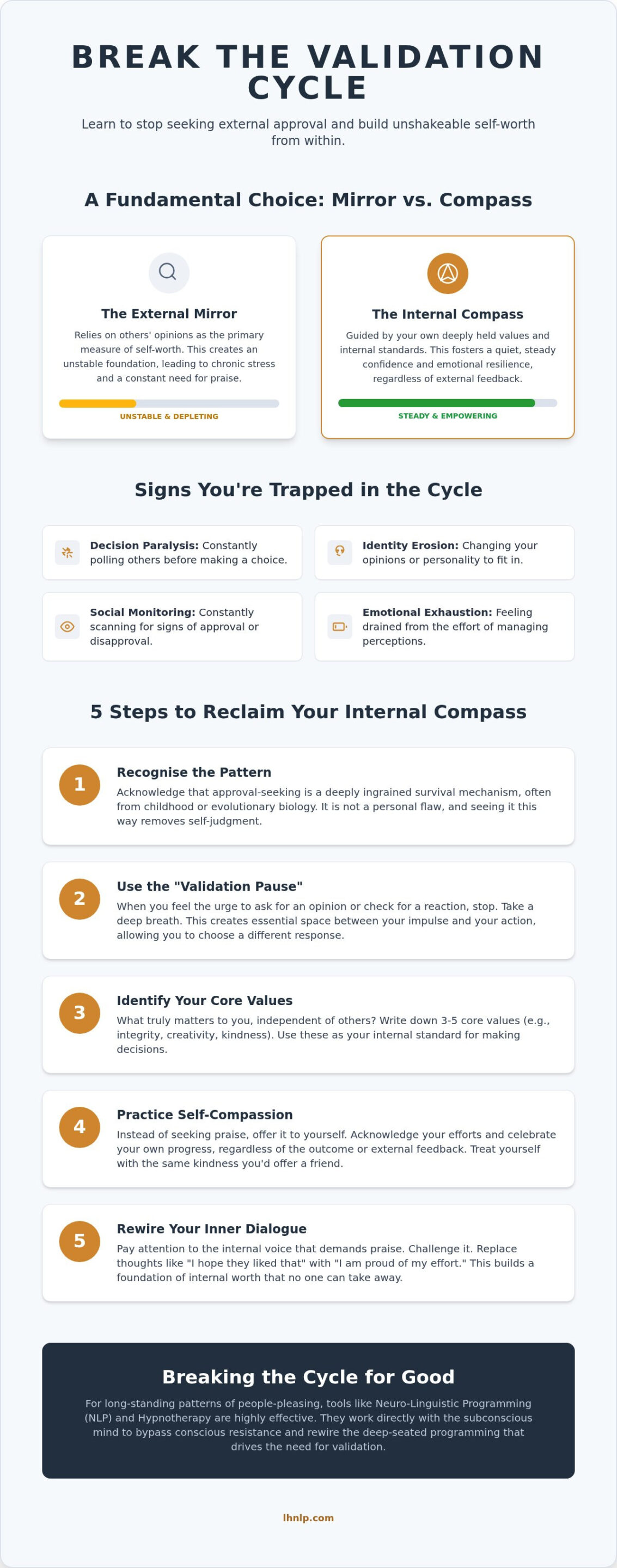
How to Stop Seeking Validation: 5 Steps to Internal Worth
Moving from a state of external dependency to internal groundedness requires more than just a change in perspective; it demands a structured reprogramming of your mental habits. This process isn’t about becoming indifferent to others, but about ensuring your self-worth is no longer up for public debate. When you understand how to stop seeking validation from others, you reclaim the energy you’ve been spending on social performance. This transformation is a methodical journey that begins with awareness and ends with a deep, unshakeable sense of self-approval.
- Step 1: Audit Your Triggers. Identify the specific people or platforms that prompt your deepest urges for approval. Is it a particular colleague, a family member, or the curated world of social media?
- Step 2: The ‘Validation Pause’. When you feel the impulse to ask for an opinion or share a win, wait five minutes. This creates a vital gap between the subconscious urge and the automatic action.
- Step 3: Rewire the Inner Dialogue. Instead of asking “Do they like me?”, start asking “Do I like them?”. This simple linguistic shift returns the power of evaluation to you.
- Step 4: Practice Radical Self-Acknowledge. Celebrate small, daily wins privately. Learn to feel the satisfaction of a job well done without needing to broadcast it for a digital “like.”
- Step 5: Set Internal Boundaries. Decide whose opinions actually deserve a seat at your table. Most people’s feedback is a reflection of their own maps of the world, not an objective truth about you.
The ‘Validation Fast’ Technique
To accelerate this shift, try a “Validation Fast” for 24 hours. During this period, commit to not sharing any personal achievements or seeking a second opinion on any non-essential choices. You might feel a sense of discomfort or anxiety as you sit with being “unwitnessed.” This is normal. By resisting the urge to outsource your worth, you’re building the psychological muscle of self-sufficiency. You’re proving to your subconscious that you can survive, and even thrive, without constant external reinforcement.
Reframing the Inner Critic with NLP
Neuro-Linguistic Programming offers powerful tools for changing how we process our internal world. You can begin by altering the “submodalities” of your inner critic. If that critical voice is loud and close, imagine making it smaller, quieter, or even giving it a ridiculous, squeaky tone. This reduces its emotional impact. You can also use “Perceptual Positions” to view your situation from the perspective of a neutral, compassionate observer. The Reframing technique involves consciously shifting the context or meaning of an event, such as viewing a lack of external praise as a moment to strengthen your own self-approval rather than a sign of personal inadequacy. If you’re ready to dismantle these old patterns, our Confidence Building Sessions can provide the professional guidance needed for lasting change.
Breaking the Cycle with Professional NLP and Hypnotherapy
Willpower often feels like trying to hold back a tide with a bucket. You may know intellectually that you should care less about what others think, yet the physical sensation of anxiety remains as sharp as ever. This is because validation seeking isn’t a logical choice; it’s an automated survival response stored deep within the subconscious mind. To truly master how to stop seeking validation from others, we must move beyond conscious effort and address the neurological “wiring” that keeps the cycle in place. Professional intervention provides the tools to rewrite these scripts, allowing for a shift that feels natural rather than forced.
Through tailored hypnotherapy London sessions, we can access the parts of the mind where these habits are rooted. While NLP offers rapid mindset shifts by reframing your internal narrative, hypnotherapy provides the deep relaxation necessary to plant new, empowering beliefs. This combination doesn’t just mask the symptoms of people-pleasing; it dissolves the underlying need for external safety, replacing it with a profound sense of internal groundedness.
Bypassing the Conscious Gatekeeper
The conscious mind acts as a gatekeeper, often rejecting new ideas that conflict with our established self-image. If you believe you’re “not enough,” your conscious mind will likely dismiss positive affirmations as false. Hypnosis allows us to gently bypass this filter, delivering direct suggestions to the subconscious that reinforce your inherent worth. In a typical confidence building session, we work to identify the specific root of your approval-seeking. Whether it stems from childhood blueprints or professional burnout, we address the cause directly, allowing you to respond to social feedback with calm indifference rather than reactive fear.
Creating a Future-Self Blueprint
One of the most effective NLP techniques for lasting change is “Future Pacing.” This involves creating a vivid mental blueprint of your life free from the weight of constant social monitoring. Imagine walking into a high-pressure meeting or a social event in the city and feeling entirely self-contained. You aren’t scanning the room for approval; you’re simply present. By integrating these new behaviours into your subconscious map, your brain begins to treat this confidence as your new “default” setting. This methodical approach ensures that the changes you experience in the chair translate seamlessly into your daily life. If you’re ready to reclaim your authentic identity, consider contacting Kamalyn Kaur at London Hypnotherapy & NLP for a bespoke plan tailored to your unique journey.
Reclaiming Your Internal Compass
True freedom isn’t found in the applause of others, but in the quiet, steady knowledge of your own value. We’ve explored how these patterns often begin as survival mechanisms; however, they don’t have to define your future. By auditing your triggers and mastering the “Validation Pause,” you’ve already begun the work of shifting your focus from the external mirror to your internal compass. Learning how to stop seeking validation from others is a process of unlearning the belief that you’re only as good as your latest achievement or the most recent praise you received.
Since 2005, London Hypnotherapy & NLP has helped individuals dismantle these deep-seated habits through bespoke treatments for anxiety and confidence. Whether you visit our Harley Street or Ealing locations or prefer global online sessions, our approach combines clinical hypnotherapy with NLP to reach the subconscious roots of your behaviour. Ready to reclaim your self-worth? Book a consultation with London Hypnotherapy & NLP today. You have the resources within you to stand tall, make decisions with clarity, and finally feel “enough” on your own terms. Your journey toward an unshakeable sense of self starts with a single, confident step forward.
Frequently Asked Questions
Is it normal to want validation from others?
Seeking approval is a natural human trait rooted in our evolutionary history. In the past, being part of a tribe was essential for survival, so our brains are wired to value social acceptance as a form of safety. While some external feedback is healthy for social cohesion, it becomes problematic when it’s your only source of self-worth. Understanding this biological root is the first step in learning how to stop seeking validation from others.
How do I know if I’m a people-pleaser or just being kind?
The distinction lies in your internal motivation and the emotional cost of the action. Kindness is an act of generosity that feels expansive and leaves you with your integrity intact. People-pleasing, however, is often driven by a fear of rejection or conflict. If you feel resentful, drained, or as though you’ve betrayed your own values to avoid a negative reaction, you’ve likely crossed the line into an unhealthy approval-seeking cycle.
Can hypnotherapy really stop me from caring what people think?
Hypnotherapy doesn’t make you indifferent to others, but it helps you build a solid internal foundation. By accessing the subconscious mind, we can dissolve the “automatic” need for external safety that drives hyper-vigilance. Our sessions in London help you move from a reactive state to one of grounded confidence. You’ll find that while you still value meaningful feedback, your self-worth is no longer dependent on every passing opinion or digital interaction.
Why do I feel guilty when I don’t get approval?
This guilt is often a lingering echo of childhood “blueprints” where safety was tied to compliance. If you learned that being “good” meant meeting every expectation, your nervous system interprets a lack of approval as a threat. Your brain uses guilt as a misguided tool to pull you back into “safe” people-pleasing behaviours. Recognising this as an outdated survival strategy allows you to begin the process of emotional reframing and internal self-validation.
How long does it take to build internal self-worth?
Building self-worth is a methodical process rather than an overnight event. While surface-level habits can shift quickly with NLP techniques, deep-seated subconscious patterns usually require a series of focused sessions. Most clients at our London practice begin to experience a significant shift in their internal dialogue within a few weeks. Consistency is key. You’re essentially training a new mental “muscle” that grows stronger every time you choose internal approval over external praise.
What is the first step I should take today to stop seeking validation?
The most effective first step is to practice the “Validation Pause.” Before you send a text to ask for an opinion or share a small win for praise, wait for five minutes. Observe the physical sensation of the urge without acting on it. This simple exercise helps you reclaim your autonomy and start the journey of learning how to stop seeking validation from others. It creates the space needed to choose your own response.
Does childhood trauma cause validation-seeking behaviour?
Experiences in early life significantly shape how we perceive our value. If you grew up in an environment where praise was conditional or your emotions were frequently invalidated, you may have learned that seeking external approval was the only way to feel secure. This isn’t a permanent medical condition, but rather a learned behaviour that can be updated. Our approach focuses on resolving these roots at a subconscious level to restore your natural sense of self-worth.
Can NLP help with social anxiety and approval-seeking?
Neuro-Linguistic Programming is exceptionally effective for social anxiety because it addresses how you “map” social interactions. Techniques like Reframing allow you to change the meaning of a neutral comment, while Perceptual Positions help you see yourself through a more objective lens. By updating your internal language and mental imagery, NLP helps you dismantle the fear of judgement. This creates a lasting shift in how you carry yourself in high-pressure social and professional environments.