

What if the very engine driving your professional success is actually a sophisticated survival mechanism designed to keep you from falling apart? You might be the individual everyone relies on, the one who never misses a deadline and always has the answer; yet, you’re haunted by a persistent fear of being unmasked as a fraud. While the world sees your achievements, you feel the internal cost of performing while panicking. Recognising the signs of high-functioning anxiety is the first step toward understanding that your drive doesn’t have to be fuelled by dread.
It’s exhausting to live in a state where you can’t truly relax, even when the weekend finally arrives and the notifications cease. You’ve likely mastered the art of the competence mask, but you deserve to experience success without the constant mental chatter and physical depletion. In this guide, we’ll peel back the layers of this high-performance facade to reveal the subtle markers that often go unnoticed by others. You’ll discover how to transition from a cycle of mere survival toward a state of genuine inner calm, using practical tools to reprogramme your subconscious responses and reclaim your mental equilibrium.
Key Takeaways
- Understand the fundamental difference between standard anxiety and high-functioning anxiety, where over-performance acts as a sophisticated mask for internal distress.
- Learn to identify the seven subtle signs of high-functioning anxiety that often hide behind professional success, people-pleasing, and meticulous perfectionism.
- Discover why the ‘always-on’ culture of London’s professional districts can dysregulate your nervous system and accelerate the journey toward the burnout horizon.
- Explore how solution-focused hypnotherapy and NLP can ‘reprogramme’ the subconscious drivers of your inner critic without sacrificing your professional ambition.
- Gain practical insights into moving beyond the exhausting cycle of ‘just coping’ toward a state of genuine inner calm and sustainable mental health.
What is High-Functioning Anxiety? The Art of Performing While Panicking
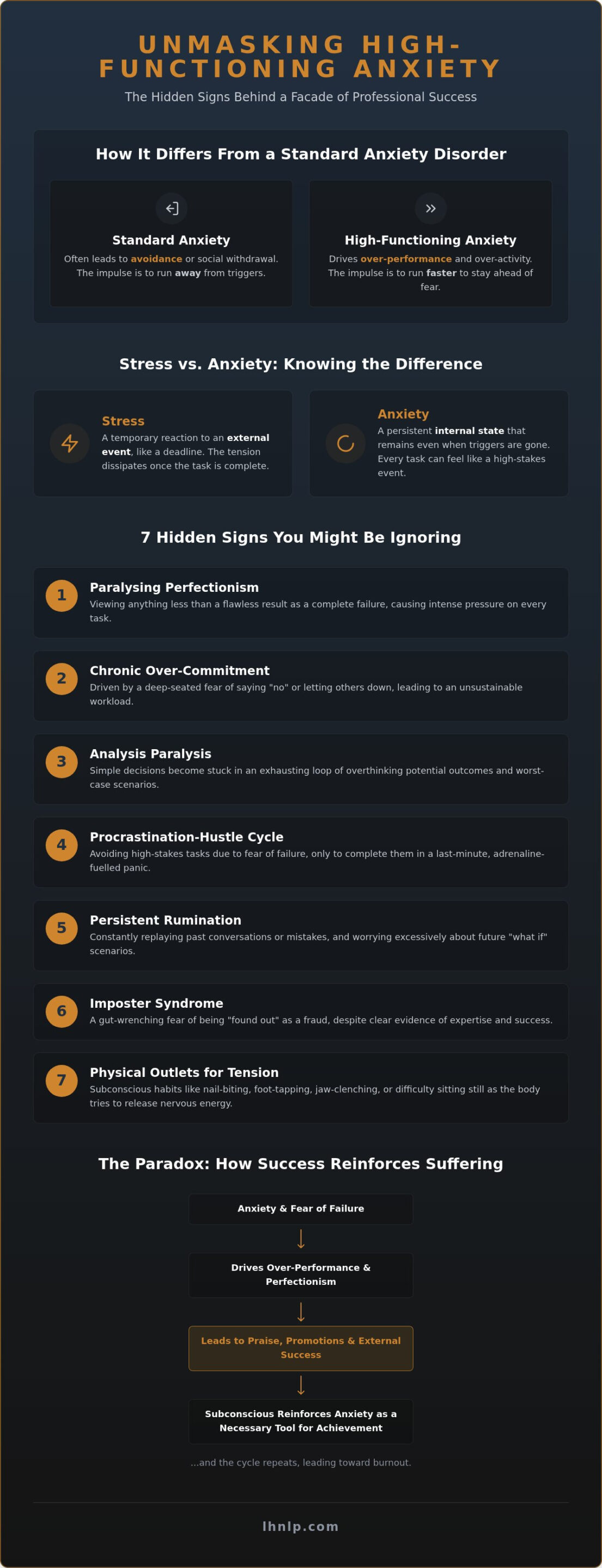
High-functioning anxiety isn’t a clinical diagnosis found in the DSM-5. It’s a descriptive term for a state where your external success masks a deep internal turmoil. While a standard anxiety disorder often leads to avoidance or social withdrawal, high-functioning anxiety pushes you toward over-activity. You aren’t running away; you’re running faster to stay ahead of the fear. This creates a ‘productive’ loop where the fight-or-flight response is constantly engaged, driving you to achieve more just to feel safe for a fleeting moment. It’s an exhausting way to live, yet it’s often invisible to those around you.
To better understand how this internal pressure operates and why it feels so relentless, watch this helpful video:
The Difference Between Stress and High-Functioning Anxiety
Stress is typically a reaction to an external event, like a heavy workload or a difficult client. Once the task is finished, the tension usually dissipates. Anxiety is different. It’s a persistent internal state that remains even when your to-do list is empty. For someone experiencing the signs of high-functioning anxiety, every email and every meeting feels like a high-stakes survival event. Your Inner Critic maintains the facade of success by convincing you that your worth is tied solely to your latest achievement. It’s a relentless voice that demands perfection, transforming the workplace into a psychological battlefield where you’re always on the defensive. You’re not just working; you’re surviving.
Why ‘Doing Fine’ Can Be a Danger Sign
The paradox of this condition is that your success often rewards your suffering. When your anxiety results in a promotion or praise, your subconscious mind begins to view the panic as a necessary ingredient for your performance. This positive reinforcement makes it hard to seek help; you might fear that losing the anxiety means losing your edge. Many professionals don’t realise they’re struggling until they hit a wall of total exhaustion. You’re ‘doing fine’ on paper, but your body is paying the price in cortisol and lost sleep. The high-functioning mask is a subconscious shield against perceived failure, hiding the frantic pedalling beneath the surface of a calm, successful exterior. Reaching out for professional treatments is often the only way to dismantle this shield without losing your identity as a high achiever. It’s about learning that you can be successful and calm at the same time.
7 Hidden Signs of High-Functioning Anxiety You Might Be Ignoring
Identifying the signs of high-functioning anxiety requires looking past the surface of a successful career. Often, what colleagues see as “attention to detail” or an “admirable work ethic” is actually a paralysing drive to avoid perceived failure. This state of being allows you to maintain a high level of performance while your internal world feels increasingly fragile. While your achievements may suggest you’re thriving, the following markers often tell a different story:
- Paralysing perfectionism that views anything less than a flawless result as an utter failure.
- Chronic over-commitment driven by a deep-seated fear of saying “no” or letting others down.
- Analysis paralysis where simple decisions become stuck in an exhausting loop of over-thinking.
- The procrastination-hustle cycle of avoiding high-stakes tasks only to finish them in a frantic, overnight panic.
- Persistent rumination and the constant replaying of past social interactions or future risks.
- Imposter syndrome and the gut-wrenching fear of being “found out” as a fraud despite your expertise.
- Physical outlets such as nail-biting, foot-tapping, or muscle tension that signal a nervous system in distress.
Mental and Emotional Indicators
Building on the concept of the productive loop mentioned earlier, the internal experience of these signs of high-functioning anxiety is one of constant rumination. You might find yourself replaying a conversation from three days ago, searching for a hidden slight or a mistake you might have made. This persistent need for reassurance persists even when you’ve received glowing feedback from your peers. At the core of this struggle is often Imposter Syndrome; you feel like a fraud who’s just one mistake away from being exposed. This fear drives you to work harder, not out of passion, but out of a desperate need to stay ahead of that perceived exposure. Understanding these patterns is essential for developing effective coping strategies for anxiety that address the root cause rather than just the symptoms.
Physical and Behavioral Red Flags
Your body often speaks the truths your mind tries to ignore through subtle physical habits. You might notice you’re picking at your cuticles during meetings or that your jaw is permanently clenched while you type. Sleep becomes a battleground where you feel “tired but wired”; your body is exhausted, but your mind is racing with tomorrow’s to-do list. Chronic muscle tension in your shoulders and frequent digestive issues are often dismissed as “just part of the job,” but they’re clear signals that your nervous system is overtaxed. It’s possible to maintain your high standards without sacrificing your physical well-being. If these markers feel all too familiar, exploring virtual hypnotherapy sessions can offer a gentle path to calming the physical storm while you address the mental drivers of your performance.
The London Professional: Why the City Breeds Over-Functioning
London isn’t just a city; it’s a high-velocity environment that demands constant adaptation and resilience. In the financial heart of the City or the legal corridors of Holborn, the ‘always-on’ culture isn’t merely encouraged; it’s often the baseline for professional survival. This relentless pace directly impacts nervous system regulation. When you spend your morning commute on a crowded Tube carriage mentally rehearsing a boardroom presentation, your body enters a state of high alert before you even reach your desk. The “Canary Wharf mindset” suggests that if you aren’t over-performing, you’re falling behind. This environment is a primary breeding ground for the signs of high-functioning anxiety, as the high cost of living in the capital creates a pervasive sense that failure is simply not an option. Even your leisure time can become a performance, where socialising in Mayfair or Shoreditch feels like an exhausting extension of your professional brand.
Hustle Culture vs. Mental Health
The glorification of ‘the grind’ in London’s tech and corporate sectors has turned chronic stress into a badge of honour. You’re expected to be the first in and the last out, while maintaining a perfectly curated social life that looks effortless on the surface. This pressure makes networking feel less like building genuine connections and more like a high-stakes audition, which significantly contributes to social anxiety. Many professionals find that a more tailored, Anxiety Therapy London approach is needed to navigate these unique urban pressures. It’s about finding a way to stay competitive without letting your internal peace be the price of your career progression.
The Isolation of the Urban High-Achiever
There is a specific, heavy loneliness that comes with being a high-achiever in a city of millions. You might be surrounded by people in a busy office or a packed gastropub, yet feel completely alone in your internal struggle. Because your external life looks so polished and successful, you might feel you have no right to complain or seek help. This leads many Londoners to wait far longer than necessary to seek support. They wait until the burnout horizon is unavoidable. Harley Street has long been a hub for those seeking discreet, professional mental health care, offering a space where the mask can finally be set aside. You don’t have to carry the weight of the city on your own shoulders. Recognising that your struggle is valid is the first step toward reclaiming your life from the grip of constant performance.
The True Cost of ‘Just Coping’: Why Success Isn’t a Cure
Many high achievers believe their anxiety is the secret ingredient to their professional success. They view it as a fuel that keeps them sharp, responsive, and ahead of the competition. However, this is a dangerous misconception that ignores the long-term erosion of your internal well-being. Success isn’t a cure for a dysregulated nervous system; it often just provides a larger, more high-stakes stage for the panic to play out. You might be hitting your KPIs and exceeding targets, but your quality of life is quietly diminishing behind the scenes. When success is built on a foundation of fear, you’re never truly able to enjoy the view from the top.
This internal friction inevitably spills into your personal life. You might be physically present at a weekend dinner in a quiet Richmond bistro, but mentally, you’re re-reading a passive-aggressive email from Friday afternoon. Your loved ones notice the distance, the lack of eye contact, and the way you can’t seem to “switch off” even in the safest environments. You aren’t just performing at work; you’re performing a version of yourself that is increasingly hollow. Challenging the “anxiety as a superpower” myth is essential because true power comes from clarity and composure, not from a frantic need to avoid failure.
The Subconscious Tax on Creativity and Joy
Constant vigilance kills the very thing most professionals need: strategic creativity. When your brain is stuck in survival mode, it prioritises immediate perceived threats over long-term vision and innovative thinking. You lose the ability to engage in “deep work” because your mind is constantly scanning for the next fire to extinguish. Hobbies you once loved start to feel like a waste of time because they don’t produce a measurable result or a professional gain. Professional success achieved through anxiety is a loan with a high interest rate. Eventually, the subconscious tax on your joy becomes too heavy to ignore.
From High-Functioning to Burnout
There is a specific point where the mask begins to crack and the weight becomes unbearable. You might notice that your usual signs of high-functioning anxiety are shifting from “doing too much” to a heavy, leaden feeling of dread. This is the transition toward the Burnout Horizon. Your coping mechanisms, which once felt like useful tools, now feel like lead weights. If you find yourself unable to focus or feeling an unusual sense of apathy despite your achievements, it’s a sign that your nervous system is finally demanding a debt repayment. Reclaiming your energy and your life requires a systematic approach to Stress Management in London that addresses the root causes of your drive.
Reclaiming Your Calm: How NLP and Hypnotherapy Break the Cycle
Breaking the cycle of over-performance requires more than just willpower; it demands a fundamental shift in the subconscious blueprints that equate safety with perfection. While you’ve spent years honing your professional skills, the internal mechanisms driving your anxiety have likely remained unexamined. Hypnotherapy offers a direct path to these deeper layers of the mind, allowing us to access and resolve the subconscious drivers of perfectionism. By working at this level, we can dismantle the ‘productive’ loop of panic without stripping away your ambition or your edge. It’s about evolving your drive so it’s powered by clarity rather than a fear of failure.
Neuro-Linguistic Programming (NLP) serves as a precise instrument for auditing and rewriting the internal dialogue of your Inner Critic. Instead of simply ‘managing’ your thoughts, NLP helps you understand the structure of your internal experience. We can identify the specific triggers that lead to the signs of high-functioning anxiety and install new, more adaptive responses. For the busy professional, this solution-focused approach is often more effective than traditional talk therapy. You don’t need years of analysis; you need practical, fast-acting tools that allow you to maintain your performance while reclaiming your internal peace.
Why High-Achievers Respond Well to Hypnosis
High-achievers often possess a natural capacity for deep focus and the ability to follow complex instructions, traits that make them exceptionally responsive to clinical hypnosis. In our sessions, we leverage these strengths to target the root cause of your distress rather than just treating the surface symptoms. We explore why your mind originally adopted the signs of high-functioning anxiety as a survival strategy and gently update that programming. You can find more detail on this process in our Hypnotherapy London Guide. This methodology ensures that the change is both profound and sustainable, allowing you to lead with authentic confidence.
Next Steps: Moving from Panic to Performance
Reclaiming your life is a methodical process that begins with a single, decisive step. Whether you choose to visit our clinics in Ealing or Harley Street, or prefer the convenience of Virtual Hypnotherapy Sessions, the focus remains on your individual journey toward balance. Each session is tailored to the unique pressures of your role, providing a discreet and professional environment for genuine change. You’ve already proven you can succeed under pressure; now it’s time to prove you can thrive in calm. Contact London Hypnotherapy & NLP today to begin your transition from the exhaustion of performing to the freedom of authentic success.
Embrace a Future Where Success Feels Like Peace
Living with the signs of high-functioning anxiety often feels like a relentless marathon with no finish line in sight. You’ve learned that your drive is a survival strategy; a sophisticated mask that keeps you performing while your internal world remains in turmoil. We’ve explored how the high-pressure culture of London deepens this struggle and why professional accolades are never a true substitute for a regulated nervous system. True achievement isn’t found in the exhaustion of ‘just coping’, but in the freedom of a calm, focused mind that no longer needs panic as its primary fuel.
As specialists in supporting high-achieving London professionals, we offer solution-focused clinical hypnotherapy and NLP designed to reach the subconscious drivers of your perfectionism. Whether you join us in our Harley Street or Ealing clinics, or prefer the flexibility of virtual sessions, our goal is to help you reprogramme the patterns that no longer serve you. It’s time to reclaim your energy and lead from a place of authentic composure. Book a consultation with London Hypnotherapy & NLP to start your journey toward a success that finally feels like peace. You’ve carried the weight of performance for long enough; let’s discover what’s possible when you finally feel safe to exhale.
Frequently Asked Questions
Is high-functioning anxiety a clinical diagnosis?
No, high-functioning anxiety isn’t a formal clinical diagnosis within the DSM-5. It’s a widely recognised psychological state often considered a subset of Generalised Anxiety Disorder. While you won’t receive a formal psychiatric diagnosis for it, the term accurately describes the experience of maintaining high performance while struggling internally. Our solution-focused approach addresses these feelings as real experiences that deserve professional attention regardless of how they are clinically classified.
Can high-functioning anxiety be cured, or just managed?
You don’t have to settle for just managing symptoms for the rest of your life. Through hypnotherapy and NLP, we work to reprogramme the subconscious drivers that make you feel unsafe without a mask of perfection. While we don’t provide a medical cure, many clients experience a profound shift where the need for anxious performance falls away. You can achieve a state of genuine inner calm that becomes your new, sustainable baseline.
How do I know if I have high-functioning anxiety or just a high-pressure job?
The key difference lies in whether your stress dissipates when the external pressure is removed. A high-pressure job creates tension during work hours, but high-functioning anxiety persists even on weekends or during holidays. If you find yourself ruminating on past mistakes or future risks when you should be resting, you’re likely seeing the signs of high-functioning anxiety. It’s an internal state of vigilance that doesn’t have a natural off switch.
Will therapy for anxiety make me less productive at work?
Addressing your anxiety typically increases your professional effectiveness rather than diminishing it. When you aren’t wasting mental energy on rumination or analysis paralysis, you gain significant cognitive space for strategic thinking and creativity. Our goal isn’t to remove your ambition but to change the fuel source. You’ll find that performing from a state of calm is far more sustainable and efficient than performing from a state of constant, exhausting panic.
How many hypnotherapy sessions are usually needed for anxiety relief?
Because our approach is solution-focused rather than open-ended, many clients begin to feel a shift within the first few appointments. While every individual’s journey is unique, a typical course of treatment involves between three and six sessions. This allows us to identify the root cause, apply NLP techniques to rewrite internal dialogues, and use hypnotherapy to solidify new, calmer patterns of behaviour without requiring years of traditional talk therapy.
What happens if I ignore the signs of high-functioning anxiety?
Ignoring the signs of high-functioning anxiety often leads directly to the burnout horizon. You can’t outrun your nervous system forever; eventually, the constant cortisol production takes a toll on your physical health and personal relationships. You might find your coping mechanisms suddenly failing, leading to a transition from over-functioning to being unable to function at all. Addressing these markers early prevents the heavy cost of a total mental and physical collapse.
Is hypnotherapy for anxiety effective via Zoom or Skype?
Yes, virtual hypnotherapy sessions are highly effective and offer a convenient solution for busy London professionals. Since hypnosis is a state of focused internal attention guided by vocal cues, the physical presence of the therapist isn’t required for success. Many clients find they can relax more deeply in the comfort of their own home or office. We’ve successfully supported clients globally using Zoom and Skype to achieve lasting relief from persistent anxiety.
How does NLP differ from traditional counseling for anxiety?
Traditional counselling often focuses on the why by exploring past trauma and history. In contrast, Neuro-Linguistic Programming (NLP) focuses on the how. We look at the specific structure of your internal thoughts and how they trigger your anxious responses. It’s a practical, forward-looking methodology that provides you with immediate tools to interrupt negative patterns. This makes it an ideal partner for clinical hypnotherapy when seeking rapid, sustainable change in your mental state.