

Confidence in public speaking grows through small steps, not by waiting for nerves to disappear. A four-week plan for overcoming public speaking nerves through practice can help you shape your talk, build a gradual practice hierarchy and mentally rehearse the experience. The aim isn’t to feel perfectly calm; it’s to feel prepared enough to speak while nerves are present.
If the thought of speaking turns your attention inward, it can be hard to shift your focus. You might worry about forgetting your words, being watched or showing your nerves. Preparation can help you focus instead on what you want to communicate and the people you’re speaking to.
In this guide, you’ll learn to shape a talk for its audience, progress from lower-pressure practice to more challenging situations, and use sensory visualisation to make the event feel familiar. You’ll also find a practical four-week confidence plan, with manageable exercises to build momentum at your own pace.
Key Takeaways
- Shape your speech around what the audience needs to hear, so your attention has a clear purpose beyond managing nerves.
- Build a step-by-step practice hierarchy, repeating each manageable challenge before moving on to a more demanding one.
- Use mental rehearsal to make the speaking situation feel more familiar and to practise how you want to respond.
- Follow a four-week plan that gradually moves from preparation to speaking practice and helps you keep building confidence.
1. Adapting a speech to the audience
Start with the people in the room, not a polished script. Write down who will attend, what they already know and what they need to understand or do afterwards. For a team update, colleagues may need a clear decision and its next step. For a community talk, listeners may need a plain-language explanation and a relatable example. This audience analysis gives each section a purpose and shifts your focus from how you appear to what you can offer.
Next, consider the venue and speaking conditions. A boardroom presentation, community hall talk and online meeting each call for different choices. Think about the room layout, microphone, slides and whether people can ask questions. If possible, visit beforehand and practise where you’ll speak. Choose an opening that suits the setting, such as a question that invites listeners to think or respond. A relevant question can help establish a connection before you move to your main points.
Think of eye contact as a way to connect with individuals, rather than addressing one large, indistinct crowd. Move your gaze between audience members, pausing naturally as you make a point. This can help build rapport and show whether listeners are following. If direct eye contact feels difficult, look briefly at one person, then move to another friendly face. Focus on sharing your message, not judging your performance.
Make the opening and closing especially familiar. Practise about 90 seconds of each, so you have a steady beginning and a clear final thought. For the middle, use brief bullet-point notes as memory prompts rather than reading full sentences aloud. A useful test is to explain each key point in one sentence, then add an example the audience will recognise. These choices make the speech feel tailored, while leaving room to respond naturally to the people listening.
2. Building a gradual public-speaking anxiety hierarchy
Fear of judgement, forgetting words or losing control in front of others can fuel public-speaking anxiety. Your body may respond with perspiration or facial blushing, even when you’re prepared. A practice hierarchy breaks one overwhelming event into smaller, manageable steps. Note which situations feel least and most demanding, then arrange them from lower to higher pressure.
For example, read your opening aloud alone, then practise it with a trusted friend. Next, share a short update in a small team meeting before working towards a longer presentation. Repeat a step until it feels more manageable before moving on. If it feels too difficult, make it smaller, such as practising with one colleague before addressing the whole group.
Pair each practice with a steady breathing routine. Sit comfortably, let your shoulders soften, breathe in gently and make the exhale longer than the inhale. According to the NHS, a breathing exercise for stress, anxiety and panic should be repeated for at least 5 minutes. Practise in a quiet moment first, then use a slower exhale before speaking or during a natural pause.
In the UK, you can look for informal local speaking clubs or structured courses for professional or adult learning. Costs vary according to the organiser, whether you choose ongoing membership or a taught course, and the course length and delivery format.
Discuss speaking anxiety with a GP or mental health professional if it persists, worsens or disrupts work, study or daily life. Explain which speaking situations trigger it, what you experience and whether you avoid them. If you want guided support alongside gradual practice, explore anxiety treatment options.
At each level, continue until anxiety significantly decreases; a 30-minute training session with co-workers can be one step. Take a deep inhale and long exhale, repeating the 4-7-8 sequence for 4-6 cycles.
3. Mental rehearsal and sensory visualisation
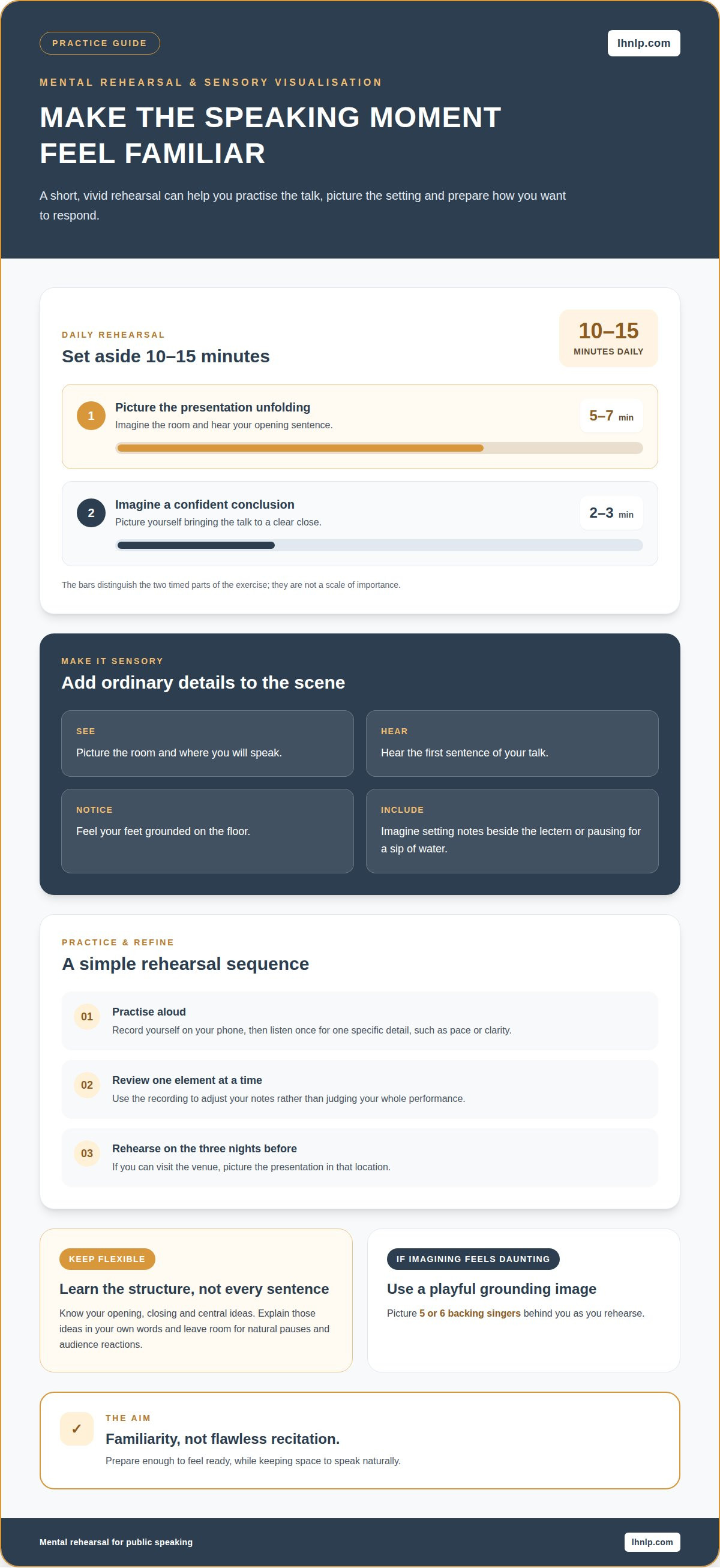
Set aside 10-15 minutes daily to rehearse your talk in your imagination. Spend 5-7 minutes picturing the presentation unfolding, then 2-3 minutes imagining a confident conclusion. See the room, hear your opening sentence and notice your feet grounded on the floor. A vivid rehearsal includes ordinary details, such as placing your notes beside the lectern or pausing for a sip of water.
Practise aloud and record yourself on your phone. Listen once for a specific detail, such as pace or clarity, and review one element at a time rather than judging your whole performance. Rehearse on each of the three nights before your speech, and picture the venue if you can visit it. If imagining an audience feels daunting, picture five or six backing singers behind you as a playful grounding image.
Keep notes brief, with one key idea or example for each point. For slides, use a clear heading and one supporting message instead of paragraphs you may be tempted to read aloud. Prepare for questions by writing down likely queries and practising concise responses. Also rehearse pausing, checking your notes and calmly restating a point if the technology fails.
Over-rehearsing can make a talk feel rigid if you memorise every sentence and try to reproduce it exactly. Learn your structure, opening and closing, then explain the central ideas in your own words. Leave room for natural pauses and audience reactions. The goal is familiarity, not flawless recitation, so adjust your notes after recording instead of polishing every phrase repeatedly.
Before the talk, check the venue in advance and picture the presentation in that location, so the imagined setting reflects where you will speak. A personal routine can be to go over the talk every night for three nights before the speech. If you need a grounding image before or during the speech, imagine 5 or 6 backing singers behind you.
4. A four-week speaking-confidence practice plan
Use a 30-day routine to make overcoming public speaking nerves practice part of everyday preparation. Identify 3-5 speaking opportunities for the coming month, from low to moderate challenge. A short update, a conversation with a friend and a work presentation can create a useful progression. Keep the steps realistic, so each one gives you a chance to practise without making the next feel unreachable.
- Week one: Choose a topic you know well. Practise your opening aloud, then deliver a brief version to a friend in a quiet setting. Ask what was clear and where they wanted more detail.
- Week two: Repeat the talk with your friend, using brief notes instead of a script. Practise pausing, restarting after losing your place and responding to a question.
- Week three: Speak to a small group unfamiliar with your topic. Ask what they understood, then adjust unclear explanations. If possible, rehearse in the room where you’ll speak.
- Week four: Complete a full rehearsal for a real speaking opportunity. Use your notes and visual aids, then reflect on one strength and one skill to develop.
Useful exercises include recording a short talk, practising its opening from memory and repeating a challenging step until it feels more manageable. After each attempt, note the situation, what you did and what you’d change. This helps you track progress through specific actions, rather than simply judging whether you felt confident.
In the UK, practise with a friend at home, invite colleagues to form a small audience or work with a speaking coach. Ask listeners for specific feedback on clarity, pace and connection. Treat overcoming public speaking nerves practice as a way to learn from each attempt, rather than expecting one rehearsal to resolve every concern.
For tailored guidance as you build confidence, explore support for confident speaking.
London Hypnotherapy & NLP: Hypnotherapy for Anxiety
London Hypnotherapy & NLP offers Hypnotherapy for Anxiety for people whose speaking nerves feel connected to wider anxiety, not only one presentation. Sessions are personalised and solution-focused, helping you explore the patterns behind your response and work towards a more settled way of approaching speaking situations.
If your goal is to prepare and speak with greater confidence, Public Speaking Coaching may help. London Hypnotherapy & NLP offers coaching that can complement the gradual practice in this guide, giving you a space to focus on specific challenges, such as starting a talk or speaking to a group.
Consider reaching out when anxiety keeps leading you to avoid speaking opportunities or makes preparation difficult. For support with your next step, contact London Hypnotherapy & NLP.
Let your next speaking opportunity become a step forward
Confidence doesn’t need to come before you speak. It can grow as you practise showing up, sharing an idea and learning from the experience. When an opportunity arises, choose one manageable action: volunteer for a brief update, ask a question in a meeting or share a prepared point with colleagues. Small acts of participation can make speaking feel less like a test and more like a skill you’re developing.
Keep your aim realistic. You don’t have to eliminate every flutter of nerves or deliver a perfect performance. Overcoming public speaking nerves through practice means building trust in your ability to continue, even when you feel unsettled. Notice what helps, keep what works and adjust your approach as your circumstances change.
If you’d value support in choosing a way forward, explore your next step with London Hypnotherapy & NLP. Each time you practise, you give your confidence another chance to take root.
Frequently Asked Questions
What causes nerves before public speaking and how can you manage them?
Nerves can arise when a talk feels high-stakes, the audience is unfamiliar or you’re unsure how to begin. Identify the specific concern, then choose a practical response. If you fear losing your place, mark key transitions in your notes and practise moving to the next point. Focused preparation gives you a clear step to take when uncertainty arises.
How often and for how long should you practise a speech?
Practise regularly in the days before your talk instead of cramming everything into one long rehearsal. The time you need depends on the speech’s complexity and how familiar you are with the subject. A focused run-through can help you check timing; another can help you practise transitions. Build one clear focus into each overcoming public speaking nerves practice session, such as speaking more slowly.
What breathing and relaxation techniques help before speaking?
Try the 4-7-8 breathing pattern: breathe in for a count of four, hold for seven, then breathe out for eight. Repeat the sequence for four to six cycles at a comfortable pace. You can also lower your shoulders and unclench your hands. Build your overcoming public speaking nerves practice around techniques you’ve tried beforehand, so you can use a familiar routine while waiting to speak.