

Replaying a past mistake can feel like problem-solving, but going over it repeatedly doesn’t necessarily bring clarity. Rumination is excessive, repetitive thinking that can crowd out other thoughts and activities. To learn how to stop ruminating on the past, notice whether your thoughts are leading to a realistic next step or simply circling the same regret. Focus on what you can change, take one small action and practise bringing your attention back to the present.
It’s understandable to hope that thinking the situation through one more time will finally help it feel settled. Yet when reflection turns into self-blame, it can affect your mood, sleep, focus and sense of possibility. This article will help you recognise rumination, understand how it may affect wellbeing and look at past mistakes with greater balance and self-compassion. You’ll also learn when professional support may help, especially if repetitive thoughts are interfering with everyday life. You don’t have to force the past out of your mind; a first step is finding a steadier way to relate to it.
Key Takeaways
- Ask whether revisiting the past is helping you identify a practical next step or keeping you caught in the same loop.
- Notice how repetitive thoughts affect your mood, sleep, concentration and ability to enjoy everyday life.
- Practise viewing past mistakes with self-compassion and consider a trusted person’s perspective.
- Seek professional support if rumination is affecting your wellbeing or making daily life harder to manage.
1. Distinguishing changeable problems from unchangeable events
The American Psychological Association defines rumination as excessive, repetitive thinking that interferes with other mental activity. Looking back isn’t automatically rumination: reviewing a conversation to understand it can help, while replaying it without gaining new insight can keep you stuck. Notice whether each review brings fresh information or simply repeats the same self-criticism.
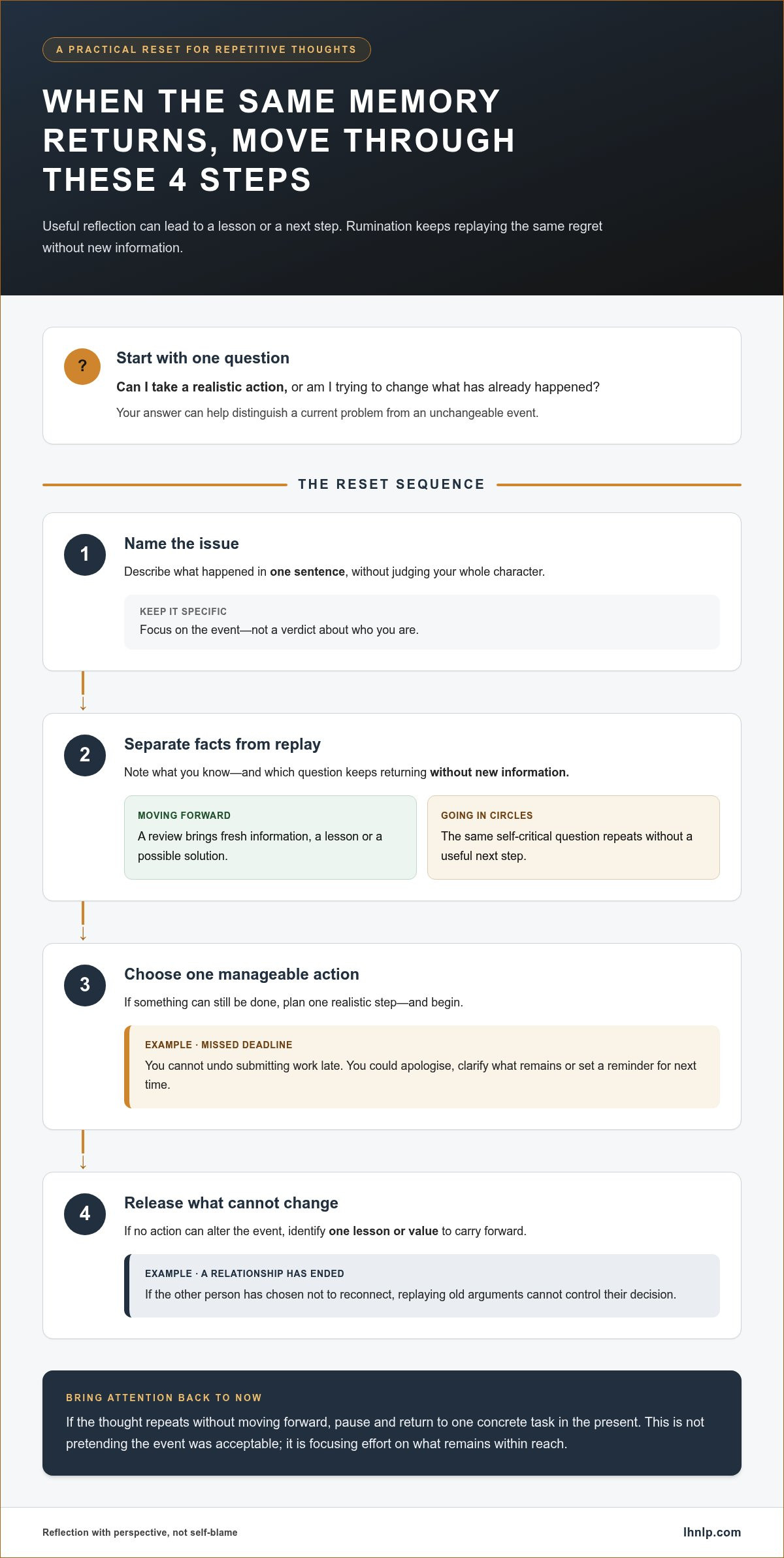
Useful reflection considers possible solutions or lessons. Unhelpful rumination circles questions such as “Why did I say that?” without identifying what you can do now. To begin working out how to stop ruminating on the past, ask: “Can I take a realistic action, or am I trying to change what’s already happened?” Your answer can help distinguish a current problem from an unchangeable event.
Consider a missed deadline. You can’t undo submitting work late, but you could apologise, clarify what remains or set a reminder for next time. If a relationship has ended and the other person has chosen not to reconnect, replaying old arguments can’t control their decision. Learning how to stop ruminating on the past means directing your effort towards what remains within your influence.
Try this sequence when the same memory returns:
- Name the issue. Describe what happened in one sentence, without judging your whole character.
- Separate facts from replay. Note what you know and which question keeps returning without new information.
- Choose one manageable action. If action is possible, plan a step, such as sending an apology, then begin.
- Release what cannot change. If no action can alter the event, identify one lesson or value to carry forward.
This doesn’t mean pretending a painful event was acceptable. It means focusing your effort on what remains within reach. If reflection produces a lesson or useful plan, it’s serving you. If the thought repeats without moving forward, pause and return to one concrete task in the present.
2. Effects of rumination on wellbeing
Replaying a painful conversation can affect more than your mood. Rumination can make depression more intense or longer-lasting, worsen anxiety and interfere with sleep. For example, repeatedly reviewing an argument at bedtime may leave your mind alert when you’re trying to rest. The next day, tiredness can make ordinary tasks feel harder.
In the moment, try changing what you do rather than debating every thought. Stand up, move to another room or focus on a simple task, such as washing a cup. If there’s a practical issue, write down one realistic action and begin it. These steps redirect your attention without requiring you to solve the entire past event.
A grounding exercise gives your attention an anchor in the present. Slowly name what you can see, hear and feel around you. For example, notice your feet against the floor and the sounds in the room. This sensory focus can interrupt a replay by bringing your attention back to your surroundings. Repeat the exercise when you notice the same memory taking over.
Daily routines can also provide structure when thoughts feel repetitive. Keep a regular bedtime routine, take a walk or do another form of movement, and use a journal to record what triggered the loop. Add a line about what you need now, such as rest, a conversation or a small task. A brief entry can help you notice patterns without turning journalling into another long review of the event.
Pay attention to changes in concentration, motivation and enjoyment. Rumination can make it harder to focus on a work task, start an activity or enjoy time with friends. If repetitive thoughts continue for a few weeks, they may disrupt sleep and bring signs of depression. Note what’s changing in your routine, such as avoiding plans or struggling to finish everyday tasks. These observations can help you recognise when the pattern is affecting your wellbeing and you may need more support.
3. Gaining perspective on past mistakes
A past mistake can start to feel like a verdict on your character. For example, forgetting a friend’s birthday may prompt the thought, “I’m selfish.” That conclusion overlooks other evidence, such as how you usually show care. Separate the action from your identity: “I forgot, and I can apologise.” This acknowledges the impact without turning one event into a definition of who you are.
In cognitive behavioural therapy (CBT), people work with a therapist to question unhelpful thoughts and consider other ways of looking at things, according to the NHS. To examine repetitive thoughts, write down the claim your mind is making, then ask what evidence supports it and what evidence complicates it. If you think, “Everyone at the meeting thought I was foolish,” consider what you actually observed. Did anyone say that, or are you interpreting a pause or expression?
Self-compassion isn’t the same as excusing harm. It means responding to your own mistake with the fairness you might offer someone else. If you spoke sharply to a colleague, acknowledge the effect, apologise where appropriate and decide how you’ll handle a similar moment. Forgiveness can involve releasing repeated self-punishment while still taking responsibility. Ask yourself: “What would repair look like, and what have I learned?”
A trusted friend can sometimes help you step back from an interpretation that feels absolute. Describe the event briefly, then ask what other explanation fits the facts. For instance, if a friend didn’t reply to your message, they may have been busy rather than rejecting you. Their view won’t erase your feelings, but it can widen your perspective. Choose someone who listens carefully and can be honest without shaming you.
Try a short written perspective check when a difficult memory returns: record what happened, what you’re telling yourself and one kinder, evidence-based interpretation. End with one lesson or repair action. This gives reflection a direction beyond blame. If the same thought remains painful, you can return to the exercise without expecting one entry to settle everything.
4. When to seek professional help
Consider professional support when repetitive thoughts interfere with work, relationships, sleep or daily responsibilities. For example, you might miss deadlines because you’re distracted, avoid friends after replaying an argument or lie awake reviewing an old decision. These effects matter more than whether you can explain exactly why the thoughts began.
Persistent rumination can occur alongside depression, postpartum depression, anxiety or post-traumatic stress disorder. A mental health professional can help assess how the pattern affects your life and identify suitable support. You don’t need to wait until every part of your routine feels unmanageable before raising the issue.
Cognitive behavioural therapy (CBT) can help people develop new ways to approach situations that trigger rumination. In sessions, you can practise noticing a recurring thought, examining its assumptions and trying a more balanced response. Medication may also help treat underlying conditions associated with rumination. Medication classes include SSRIs, SNRIs and tricyclic antidepressants. These medicines address underlying conditions rather than providing a universal treatment for repetitive thoughts.
If rumination affects your work, relationships or sleep, write down two examples before seeking help. Note what was happening, the thought that followed and what changed afterwards, such as losing focus during a meeting or withdrawing from a conversation. Share these details with a qualified mental health professional. They provide a clearer starting point than trying to describe every past event at once.
Choose support based on the difficulty affecting you most. If disrupted sleep has become a central concern, London Hypnotherapy & NLP offers Insomnia Treatment. If repeated conflict or relationship concerns are part of the picture, Relationship Coaching may be relevant. Neither offering should be treated as a psychiatric diagnosis or a substitute for mental health care when symptoms require it. For support focused on sleep, explore Insomnia Treatment options.
Seeking help isn’t an admission that you’ve failed to manage your thoughts. It’s a practical step when the same mental loop keeps narrowing your days, relationships or rest. Bring one recent example and explain what it is making harder. That gives the conversation a clear place to begin.
London Hypnotherapy & NLP: Hypnotherapy for Anxiety
London Hypnotherapy & NLP offers Hypnotherapy for Anxiety for people whose repetitive thoughts are connected with anxiety. If worry about past events is affecting your confidence or making everyday situations harder, this may be a relevant form of support. Sessions can focus on the anxiety you experience and the patterns you want to change, rather than treating every memory as something to erase.
It may also help to consider what you need most: support with anxiety or help with another concern, such as smoking cessation or weight management. If your difficulties feel severe or are disrupting daily life, seek appropriate mental health support as well. Hypnotherapy does not provide psychiatric diagnosis or medical prescriptions.
If you’d like to discuss whether Hypnotherapy for Anxiety suits your situation, contact London Hypnotherapy & NLP.
Choose the next step that feels manageable
Changing your relationship with the past rarely begins with a dramatic breakthrough. It can start with noticing one recurring thought, choosing not to treat it as the whole truth and turning your attention towards what matters today. That small shift gives the present more room.
If you’re working out how to stop ruminating on the past, let progress mean responding differently, not never remembering. A difficult memory may return; you can meet it with a steadier perspective and decide what deserves your energy now. If anxiety is part of what keeps the loop going, support can help you explore your experience and possible ways forward.
For a conversation about support, contact London Hypnotherapy & NLP. You can take this one step at a time, with patience and a clearer sense of what lies within your influence.
Frequently Asked Questions
What is rumination?
Rumination means getting caught in recurring thoughts that are difficult to set aside. It can focus on a past mistake, a current worry or something you fear may happen. For example, after a tense conversation, you might repeatedly reconsider what you said without reaching a fresh understanding. The key feature is the repetitive loop, not simply remembering an event.
Is rumination always linked to mental health conditions?
No. People can dwell on difficult events without having a mental health condition, and rumination isn’t a disorder on its own. For instance, thinking over an interview afterwards may help you prepare for another one. It becomes more concerning if the thinking feels hard to interrupt or starts interfering with daily activities, relationships or rest.
What is rumination and why do people dwell on the past?
Rumination is repetitive thinking that can leave someone revisiting the same memory or concern. A person may dwell on a past event in the hope that further thought will reveal an answer or prevent a similar experience. Ongoing stress, a history of trauma, perfectionism, anxiety and relationship worries can also be associated with this pattern.
When should I seek professional help for rumination?
Consider speaking with a mental health professional when repetitive thoughts are negatively affecting your life. For example, seek support if you’re regularly struggling to meet work responsibilities, avoiding people you care about or losing sleep because of persistent thoughts. You can describe what’s changed in your daily routine; cognitive behavioural therapy may help you develop new approaches.
Can rumination be linked to anxiety, depression, OCD or trauma?
Yes. Rumination may occur alongside anxiety, depression, obsessive-compulsive disorder (OCD) and post-traumatic stress disorder (PTSD), and it commonly occurs with generalised anxiety disorder. This overlap doesn’t mean repetitive thoughts alone establish a diagnosis. If you’re concerned about symptoms or their effect on daily life, discuss them with a mental health professional.