

What if the sudden procrastination stalling you inches from a career milestone isn’t a lack of discipline, but your mind’s instinctive attempt to keep you safe? When you stand on the verge of greater visibility, upper-limit anxiety often surfaces as quiet dread, acute imposter syndrome, or a lingering guilt about outgrowing your familiar circle. If you find yourself wondering whether fear of success hypnosis can genuinely dissolve this internal conflict, your intuition is pointing in the right direction. You already sense that sheer willpower cannot outwit a subconscious blueprint that equates profound achievement with emotional exposure.
In this guide, you will discover how clinical hypnotherapy and NLP dismantle the subconscious roots of upper-limit anxiety, self-sabotage, and imposter syndrome. We’ll examine why the mind actively protects familiar boundaries, how targeted subconscious realignment dissolves self-defeating habits permanently, and what it takes to cultivate an unshakeable sense of calm and deservingness as you step into lasting achievement.
Key Takeaways
- Uncover why sudden self-sabotage near milestones operates as a subconscious defence mechanism to protect you from vulnerability, rather than a failure of willpower.
- Learn how targeted fear of success hypnosis and NLP decouple professional visibility from your nervous system’s instinctual threat response.
- Understand why generic audio downloads fail to shift complex upper-limit blocks, and how bespoke clinical interventions address your specific subconscious triggers.
- Discover what truly happens during a clinical session, including how you maintain complete lucidity, active autonomy, and emotional safety throughout trance.
- Gain clarity on aligning inner emotional security with ambitious conscious goals so you can expand into leadership with enduring composure and self-trust.
Understanding Fear of Success: Why the Subconscious Resists Breakthroughs
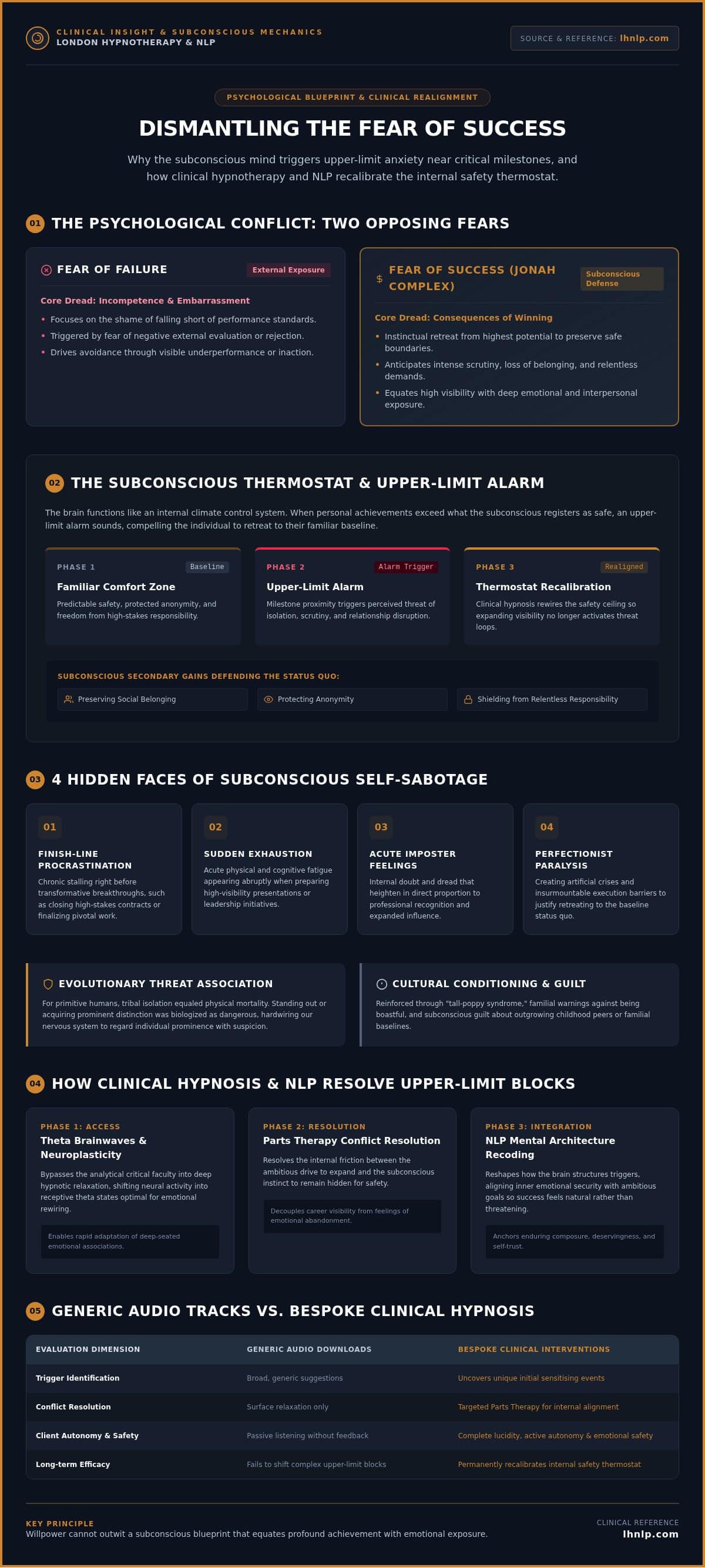
Most performance models treat achievement blocks as simple procrastination or a dread of failure. Fear of failure worries about incompetence and social embarrassment; fear of success dreads the consequences of winning. When you expand your influence, your nervous system anticipates intense scrutiny, disrupted relationships, and relentless demands. In psychology, this evasion of one’s highest potential is known as the Jonah complex, an instinctual retreat from personal greatness designed to keep you within familiar boundaries.
To explore how conflicting motivations trigger internal resistance, watch this breakdown of the psychological tension between these two fears:
Your mind functions like an internal thermostat. When your accomplishments surpass what your subconscious deems safe, an upper-limit alarm sounds. The brain values predictable safety over professional advancement. It relies on powerful secondary gains, including social belonging, protected anonymity, and freedom from high-stakes responsibility, to justify holding you back. Working with fear of success hypnosis allows you to recalibrate this internal setting, ensuring that rapid progress no longer triggers an automatic threat response.
The Hidden Symptoms of Subconscious Self-Sabotage
Subconscious resistance rarely announces itself openly; it masquerades as reasonable friction. You might experience chronic procrastination right at the finish line of signing a transformative contract, or sudden bouts of exhaustion when preparing keynote presentations. Imposter feelings intensify as visibility grows. Perfectionist paralysis takes hold, creating artificial crises that derail execution so you can retreat to the comfort of your current baseline.
The Psychological Roots: Outgrowing Social Groups and Vulnerability
From an evolutionary perspective, standing out carried genuine physical danger. For primitive humans, isolation from the tribe meant death, hardwiring our biology to view distinct prominence with suspicion. Cultural conditioning reinforces this instinct through tall-poppy syndrome, early familial cautions against being boastful, or subtle guilt about surpassing childhood peers. The mind anticipates that higher achievement brings isolating burdens, making targeted fear of success hypnosis a vital bridge to rewire those outdated safety associations.
How Clinical Hypnotherapy and NLP Dismantle the Fear of Success
Conscious intention rarely changes deep emotional conditioning on its own. While intellectual analysis clarifies why you stall, clinical hypnotherapy bypasses the analytical critical faculty, guiding the mind into a focused trance state. In this receptive space, practitioners uncover the initial sensitising events where personal competence was first misconstrued as a risk to belonging. Academic research on fear of success in the workplace demonstrates how unconscious expectations of interpersonal cost frequently stifle career progression. Applying fear of success hypnosis allows these early emotional associations to be updated safely, replacing outdated self-protection scripts with internal equilibrium.
Accessing the Subconscious Blueprint via Hypnotic Trance
During deep hypnotic relaxation, brainwave activity shifts into theta states that foster heightened neuroplasticity. This enables parts therapy, a method that resolves internal conflicts between the ambitious drive to expand and the protective impulse to stay hidden. When the subconscious recognises that visibility does not require emotional abandonment, tailored suggestions anchor feelings of self-worth. Success begins to feel natural rather than threatening.
Neuro-Linguistic Programming (NLP) Protocols for Rapid Change
Neuro-linguistic programming complements hypnotherapy by directly reshaping internal mental architecture. Rather than treating anxiety as an immovable fact, NLP alters how the brain codes memories and future possibilities through structured protocols:
- Timeline Therapy: Dissolves lingering guilt about surpassing peers, helping you honour your background while progressing freely.
- Resource Anchoring: Establishes reliable physiological states of grounded poise during high-stakes evaluations or negotiations.
- Cognitive Reframing: Recodes public visibility from an exhausting performance into an authentic vehicle for contribution.
- Future Pacing: Rehearses upcoming professional milestones under hypnotic trance, conditioning the nervous system to handle elevated recognition without stress.
When combined within bespoke NLP coaching, these approaches systematically rewire your baseline tolerance for achievement. You no longer have to fight internal resistance every time an opportunity appears. Instead, conscious ambition and subconscious emotional security work together, creating lasting confidence across every area of your professional life.
Comparing Solutions: Generic Audio Tracks vs. Bespoke Clinical Hypnosis
When high achievers decide to confront internal resistance, they often begin with self-guided digital resources. Generic audio tracks, guided meditation apps, and cognitive behavioural workbooks seem accessible, yet they routinely fall short when addressing entrenched upper-limit anxieties. A landmark meta-analysis on the efficacy of hypnosis confirmed that clinical hypnotic interventions produce substantial, lasting reductions in anxiety symptoms across diverse populations. Realising those clinical benefits, however, depends entirely on whether the therapeutic protocol matches the nuanced roots of the individual’s psychological block.
| Dimension | Generic Audio Downloads | Bespoke Clinical Hypnotherapy |
|---|---|---|
| Diagnostic Depth | Broad, generalised relaxation scripts | Pinpoints precise childhood loyalty binds and secondary gains |
| Subconscious Responsiveness | One-way audio; cannot adapt to resistance | Interactive calibration using real-time somatic feedback |
| Cognitive Reprogramming | Passive positive visualisations | Active parts therapy, timeline reframing, and future pacing |
| Outcome Sustainability | Temporary calm; root conflict remains intact | Permanent neural realignments of safety and achievement |
The Limitations of Self-Hypnosis MP3s and Mindset Audiobooks
Pre-recorded audio tracks treat all resistance identically. When an audio script suggests that you welcome public acclaim, an unaddressed protective belief may perceive that acclaim as an invitation to scrutiny. The conscious mind stays vigilant, actively analysing the suggestions instead of entering profound somatic trance. Without an experienced practitioner to navigate subconscious objections as they arise, standard recordings simply glance off your underlying psychological defence mechanisms.
The Advantage of Bespoke Clinical Hypnotherapy Sessions
Personalised fear of success hypnosis works differently because it is conversational, diagnostic, and tailored in real time. Rather than relying on generic assertions of confidence, an experienced practitioner listens for the specific linguistic patterns and metaphors that define your internal landscape. In clinical spaces like Harley Street, sessions isolate the exact secondary gains maintaining your plateau, whether that means sheltering relationships from envy or evading executive burnout. To understand how tailored protocols dismantle these intricate barriers, explore the clinical frameworks within our hypnotherapy treatments.
What to Expect in a Professional Hypnotherapy Session for Success Blocks
Entering a clinical setting to resolve achievement anxiety is a methodical, collaborative process. Many professionals arrive expecting a passive encounter, yet targeted clinical work requires active engagement between you and your practitioner. Through structured inquiry, your therapist maps the exact internal boundaries where progress starts feeling dangerous. Working with fear of success hypnosis provides a safe, structured space to dismantle those invisible boundaries so you can approach milestone moments with clarity and poise.
Step-by-Step Clinical Treatment Architecture
A bespoke fear of success hypnosis intervention follows a four-stage progression designed to transition you from internal friction to reliable action:
- Cognitive Consultation: Mapping the specific threshold parameters where self-sabotage occurs, identifying whether your resistance stems from visibility, guilt, or boundary loss.
- Somatic Induction: Guiding your physiology into a grounded state of physical calm and focused attention, slowing brainwave activity while keeping your mind alert.
- Therapeutic Reframing and Anchoring: Uncovering the root experiences connecting expansion with vulnerability, resolving internal conflict, and establishing physical anchors for executive composure.
- Progressive Future Pacing: Mentally rehearsing imminent professional milestones under trance, conditioning your nervous system to meet high-stakes demands without triggering alarm.
Progress isn’t abstract; it’s measured by real-world execution. You’ll notice the shift when you submit proposals without last-minute delays, negotiate contracts cleanly, and speak before audiences without sudden imposter panic.
Client Control, Ethics, and Common Misconceptions
Stage performance myths have created enduring misconceptions about hypnotherapy. You don’t surrender control, fall unconscious, or reveal private secrets during a session. Throughout therapeutic trance, you retain total executive awareness and agency. You can speak, reflect, and guide the focus of the session at every moment.
Ethical practitioners align with professional standards established by organisations like the British Society of Clinical Hypnosis and voluntary registers such as the CNHC. To learn more about how sessions unfold, explore the practical explanations on our hypnotherapy FAQ page.
If you’re ready to dissolve internal upper limits and expand your professional capacity, contact our London clinic to arrange an individual consultation.
Reclaiming Your Trajectory: Targeted Hypnotherapy in London and Globally
Breaking past an entrenched plateau rarely happens by simply applying more discipline. When conscious ambition repeatedly collides with subconscious resistance, forcing your way forward only increases physiological tension. Lasting achievement demands a different approach. By aligning your nervous system’s instinct for safety with your professional aspirations, you remove the internal brakes that stall momentum. Engaging with fear of success hypnosis transforms milestone execution from an exhausting personal battle into a natural, grounded progression.
At London Hypnotherapy & NLP, lead practitioner Kamalyn Kaur delivers tailored clinical solutions designed specifically for high-performing professionals facing upper-limit blocks. Rather than relying on generic mindset techniques, the practice integrates advanced clinical hypnotherapy with neuro-linguistic programming to dismantle complex achievement anxieties. Clients can access confidential, bespoke sessions in person across central London clinics, including Harley Street, Tokenhouse Yard in the City of London, and Ealing. For international executives or those requiring flexibility, seamless remote appointments are available through virtual hypnotherapy services.
Personalised Treatment Programs for High Performers
Every professional block carries a unique subconscious architecture. Programs are calibrated around the individual pressures facing founders, corporate executives, and creative directors:
- Harmonising Modalities: Pairing targeted hypnotherapy with practical NLP coaching to build lasting stress resilience and executive presence.
- Flexible Delivery: Offering clinical consultations at prestigious London locations or through secure online platforms worldwide.
- Outcome-Focused Pathways: Addressing the exact secondary gains and visibility fears that disrupt execution during pivotal career transitions.
This integrated framework ensures that stepping into higher tiers of leadership feels emotionally secure, sustainable, and entirely within your control.
Taking the Next Step Toward Unrestricted Growth
Recognising when willpower has reached its limit is a sign of self-awareness. When old patterns persist despite your expertise, subconscious alignment becomes the missing catalyst. Preparing for clinical intervention simply requires identifying where you encounter friction, whether in negotiations, public recognition, or final project delivery.
Realising your true capabilities begins with resolving the underlying conflict that keeps you playing small. To map your bespoke therapeutic pathway and eliminate chronic self-sabotage, book your one-to-one consultation with London Hypnotherapy & NLP today.
Align Your Ambition with Subconscious Certainty
Self-sabotage at pivotal career moments isn’t a character flaw; it’s an outdated protective mechanism. When you realign your subconscious need for safety with your conscious aspirations, chronic upper-limit anxiety naturally dissolves. Through targeted fear of success hypnosis, you release unconscious loyalty binds, neutralise imposter fears, and expand your capacity for professional visibility without burning out.
At London Hypnotherapy & NLP, lead practitioner Kamalyn Kaur draws upon extensive clinical expertise to dismantle deep-seated achievement blocks. By integrating advanced clinical hypnotherapy with neuro-linguistic programming across bespoke sessions in Harley Street, Ealing, Tokenhouse Yard, and secure virtual consultations, you receive individualised care tailored to your exact professional context.
Your next breakthrough doesn’t require more strain or self-criticism. When your mind feels fundamentally safe with expansion, sustained success becomes your natural baseline. Begin your transformation with a personalized hypnotherapy consultation and step into your full potential with quiet, unshakeable confidence.
Frequently Asked Questions
What is the difference between fear of failure and fear of success?
Fear of failure centres on the dread of inadequacy, mistake-making, or public embarrassment. Fear of success, by contrast, focuses on the unsettling consequences of winning, including heightened visibility, heavier expectations, and the threat of alienating your peer group. While failure keeps you immobilised in your existing routine, fear of success triggers self-sabotage just as major milestones come into clear view.
Can hypnosis permanently eliminate self-sabotaging professional habits?
Yes, hypnotherapy creates lasting change because it updates the subconscious beliefs driving those behaviours rather than relying on temporary willpower. By resolving the unconscious associations that link professional prominence to emotional vulnerability, fear of success hypnosis rewires your automatic reactions. Once your nervous system registers milestone execution as entirely safe, self-sabotaging impulses naturally dissolve without constant internal struggle.
How many hypnotherapy sessions are typically needed to resolve fear of success?
Most individuals experience profound, noticeable shifts within three to six bespoke clinical sessions. The exact duration depends on the depth of the initial sensitising events and how intensely the secondary gains protect the status quo. Straightforward performance blocks often clear rapidly, while complex, lifelong loyalty conflicts require structured time for subconscious reframing, emotional integration, and thorough future pacing.
Will I lose control or disclose private information during clinical hypnosis?
No, you maintain complete executive awareness, focused attention, and voluntary control throughout every stage of clinical hypnosis. The trance state is simply an experience of profound physical calm paired with heightened inner absorption. You cannot be coerced into revealing confidential thoughts or accepting suggestions that conflict with your personal ethics, values, or conscious intentions.
Are virtual online hypnotherapy sessions as effective as visiting a London clinic?
Online consultations deliver therapeutic outcomes identical to in-person sessions at central London clinics such as Harley Street or Tokenhouse Yard. Because hypnosis relies on auditory engagement and focused attention rather than physical touch, engaging from your own private, quiet environment often deepens relaxation. Video platforms provide seamless, direct access to experienced practitioners regardless of your geographical location.
Why do successful executives and entrepreneurs struggle with fear of success?
High performers frequently operate under relentless pressure where every upward step brings greater scrutiny and higher stakes. As professional status increases, subconscious alarms often interpret the expanded visibility as an existential threat to personal privacy or family connection. The unconscious mind then triggers procrastination or conflict to force an emotional retreat back to a safer, more familiar operational threshold.
How does neuro-linguistic programming (NLP) complement hypnotherapy for mindset blocks?
NLP provides precise cognitive tools to decode and reorganise how your brain structures internal experiences. While hypnosis facilitates access to subconscious memory stores in a calm trance state, NLP actively reframes negative thought patterns, neutralises past guilt through timeline protocols, and installs robust physiological anchors. Integrating both modalities creates a rapid, enduring mechanism for clearing executive and creative performance barriers.