

Yes, virtual hypnotherapy for confidence can help you explore thoughts and patterns that affect how you feel about yourself. At London Hypnotherapy & NLP, sessions take place online via Zoom or Skype, so you can work with a practitioner from your own space. Hypnotherapy won’t work for everyone, and results vary from person to person.
If speaking up, presenting or trusting your own decisions feels difficult, it’s natural to wonder what happens in a session and whether working online can feel comfortable. The format is straightforward, but the experience is personal: you’ll have space to discuss what you’d like to change and work at a pace that feels manageable.
This article explains how virtual hypnotherapy for confidence works, what to expect before and during an online session, and how to apply the work to situations such as public speaking. It also explains how hypnotherapy may fit alongside other mental health care, rather than replace it.
Key Takeaways
- Online sessions take place by video call, making it possible to work with a hypnotherapist without sharing a room.
- A quiet, undisturbed space and reliable audio and video can help you settle into a virtual session.
- Explore how confidence work may relate to public speaking, interviews and everyday social situations.
- Reflection between sessions can help you notice patterns and connect new insights with real-life experiences.
- Learn what client feedback can reveal about using hypnotherapy to approach confidence and speaking challenges.
Can Hypnosis help improve confidence?
Hypnosis may help you explore patterns in your thinking that affect confidence. Virtual hypnotherapy for confidence uses video calls, allowing you and the practitioner to work from separate locations while discussing your goals and possible responses.
To see an example of guided hypnosis, watch Instant Confidence Guided Hypnosis with Paul McKenna from Mindvalley Coach:
Online sessions can fit around work and home commitments, without a journey to the clinic. Before your appointment, choose a quiet, private space where you won’t be disturbed, and test your camera, microphone and internet connection. Headphones can make it easier to hear the practitioner and stay focused. London Hypnotherapy & NLP offers online sessions via Zoom or Skype, as well as in-person sessions at its Harley Street clinic in London.
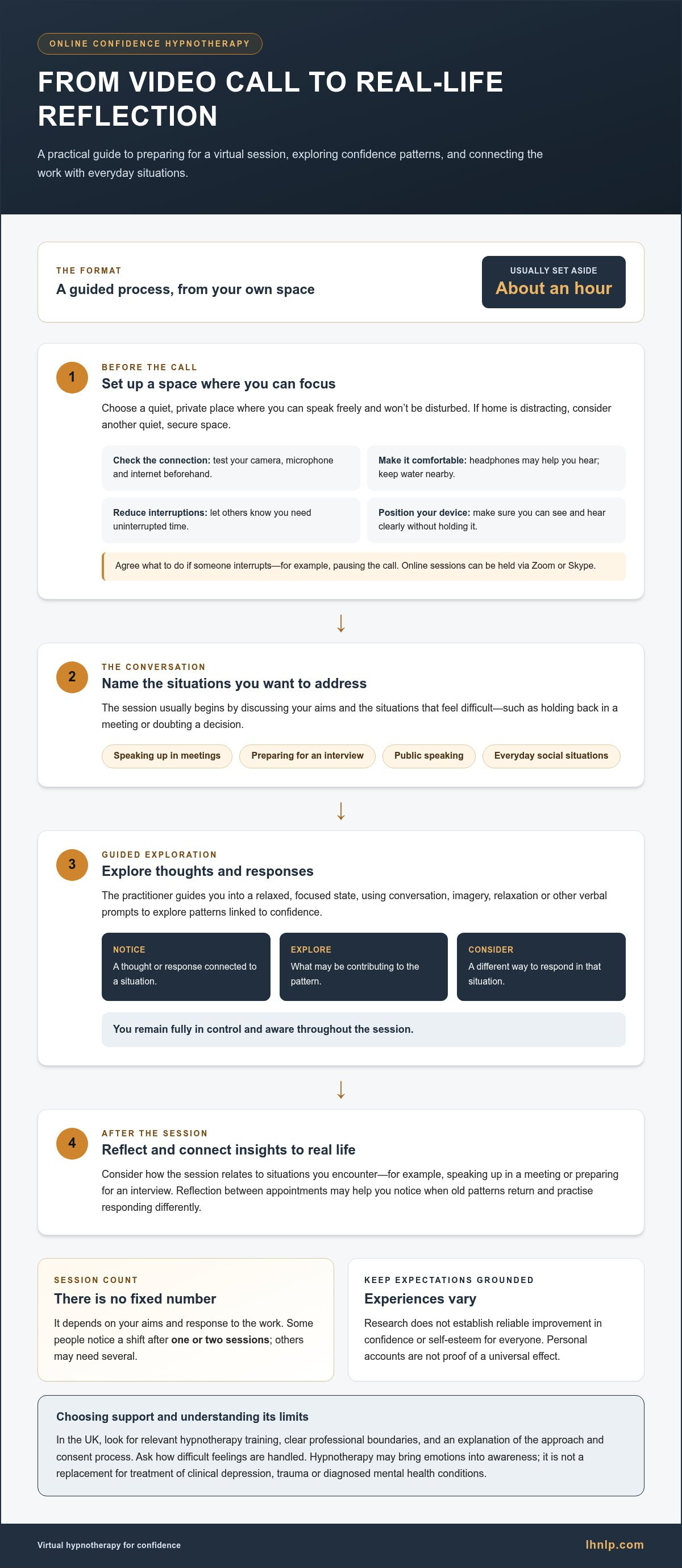
A session usually begins with a conversation about the situations you want to address, such as holding back in meetings or doubting a decision. The practitioner then guides you into a relaxed, focused state and may use conversation or imagery to explore relevant patterns. You remain fully in control and aware throughout. Afterwards, you can reflect on how the session relates to everyday situations, such as speaking up in a meeting or preparing for an interview.
For some people, familiar surroundings make it easier to settle into an online session. Others may find home distracting, particularly if household activity interrupts the call. Choosing a quiet space, letting others know you need privacy, and keeping water nearby can make the session more comfortable. These practical details don’t create confidence by themselves, but they can help you give the conversation your attention.
Session Numbers and Lasting Effects
The number of sessions varies from person to person, depending on your aims and response to the work. Some people notice a shift after one or two sessions, while others may need several. Reflection between appointments can help you recognise when old patterns return and practise responding differently. There is no fixed number of sessions for confidence work.
Evidence, Qualifications, and Risks
Evidence, qualifications and risks help you judge whether hypnotherapy is an appropriate form of support. Research doesn’t establish that hypnotherapy reliably improves confidence or self-esteem for everyone; personal accounts aren’t proof of a universal effect. In the UK, look for a practitioner with relevant hypnotherapy training, clear professional boundaries, and an explanation of the approach and consent process. Ask how they handle difficult feelings during a session. Hypnotherapy may bring emotions into awareness, and online sessions aren’t a replacement for treatment of clinical depression, trauma or diagnosed mental health conditions.
How online confidence hypnotherapy is described as working
Online hypnotherapy uses video calls to guide your attention towards a relaxed, focused state. A session combines discussion with guided techniques to explore thoughts and responses linked to confidence.
The online format lets you speak with the practitioner from a private space. A little preparation can help you stay focused and avoid interruptions.
How Online Hypnotherapy Works
Online hypnotherapy is a guided process that uses focused attention to explore thoughts and emotional responses. The practitioner first discusses your aims, then guides you through relaxation, imagery or other verbal prompts. For example, you might explore the thought that stops you contributing in a meeting. This can help you notice patterns and consider a different response.
Sessions are usually set aside for about an hour. Prepare by choosing a private room, telling others you need uninterrupted time, and testing your camera, microphone and internet connection beforehand. Headphones can make the therapist easier to hear. Keep a glass of water nearby, and position your device so you can see and hear clearly without holding it.
Comfort matters: familiar surroundings may make it easier to settle, while household noise can interrupt concentration. If privacy at home is difficult, choose another quiet, secure space where you can speak freely. Agreeing what to do if someone interrupts, such as pausing the call, can help you feel more at ease.
When choosing an online hypnotherapist in the UK, ask about relevant training, professional membership, their code of conduct, and how they handle consent and concerns. The practitioner should explain the approach clearly before beginning.
NHS access depends on local pathways and clinical need, while private insurance cover depends on your policy and whether the practitioner and treatment are eligible. Check the relevant funding or policy conditions before relying on either route.
Online and Face-to-Face Effectiveness
Online and face-to-face sessions differ in setting, not in the basic interaction between practitioner and client. Video calls allow discussion and guided exercises remotely, while in-person appointments take place in the same room. The format alone doesn’t establish which approach will be more effective for you.
Consider what helps you stay engaged. A familiar home setting may feel comfortable, while travelling to an appointment can create separation from daily distractions. Privacy, communication, connection quality and your ability to focus all shape the experience. If the screen freezes or the sound cuts out, pause and reconnect before continuing.
For a clearer picture of the format, explore these online hypnotherapy session details and consider which practical setting would support your attention and comfort.
Confidence in public speaking, interviews and social situations
A presentation, job interview or first conversation at an event can bring the same question: “What if I get it wrong?” Hypnotherapy can focus on the thoughts, beliefs and physical reactions connected with that moment, helping you explore how you want to respond.
For public speaking, the work can focus on a specific situation, such as introducing a project at a team meeting. You might describe what you fear will happen, notice how anxiety affects you physically, then use guided imagery to rehearse beginning your talk and returning to your key point after a pause. This doesn’t replace preparing the presentation itself. It can sit alongside practical preparation, such as practising aloud and organising clear notes.
Interview confidence may involve a different pattern. You might worry that a brief pause will make you seem unprepared, then rush through your answers. Exploring that belief can help you consider a more useful response: listen to the question, pause to think, and give one relevant example. The aim isn’t to promise a perfect interview, but to work with the thinking that makes answering feel harder.
Social situations can bring less visible challenges. At a gathering, for example, you may assume others are judging you and avoid starting a conversation. A session can use that scene to explore the expectation, picture a manageable first step, and consider a more balanced belief, such as “I can ask one question and see how the conversation develops.” Specific examples make the goal easier to apply outside the session.
Performance nerves can involve both thoughts and physical reactions. Before speaking, you might notice a tight chest, a dry mouth or racing thoughts. Recognising these reactions can help you identify when anxiety begins to shape your behaviour. A focused session can explore ways to meet that moment with greater steadiness, while practice in the real situation helps turn intention into action.
- For a presentation: picture entering the room, opening with your first sentence, and pausing to breathe.
- For an interview: rehearse listening fully before answering a question about a past achievement.
- For a social event: choose one simple opener, such as asking how someone knows the host.
These examples give the work a clear focus, rather than treating confidence as an abstract quality. Afterwards, reflect on what happened when you tried the chosen step: which belief appeared, how your body responded, and what helped you continue. Those details can guide the next conversation and make progress more tangible.
How hypnotherapy may address low confidence and self-esteem
Low confidence can develop through repeated thoughts, habits and responses to everyday situations. Hypnotherapy explores these patterns and helps you consider how you might respond differently.
Self-Esteem and Limiting Beliefs
Limiting beliefs are repeated assumptions about yourself, such as “I always get things wrong” or “My opinion doesn’t matter.” They can affect self-esteem by shaping how you interpret mistakes, praise and new challenges. For example, after receiving feedback at work, you might dismiss the positive points and focus only on one correction. Recognising that pattern gives it a name, rather than treating it as an unquestionable fact.
During a guided conversation, you can explore when a belief appears and what it leads you to do. If “I’m not capable” stops you applying for a role, consider the evidence for and against that thought. A more balanced alternative might be, “I’m still learning, and I can prepare for the interview.” The aim is to make room for another perspective, not to replace every difficult thought with forced positivity.
Confidence and self-esteem overlap, but they aren’t identical. You might feel capable of completing a familiar task while still doubting your broader worth. Naming a specific situation, such as avoiding a new responsibility, helps keep the discussion practical and relevant.
Addressing Low Confidence
Hypnotherapy uses relaxation and focused attention to explore responses linked with low confidence. Noticing a reaction can create a moment to choose what happens next. In a session, you might revisit the thought that appears before speaking up, then use guided imagery to picture sharing one idea calmly.
Relaxed attention is sometimes described as a way to work with the subconscious mind, where familiar associations and habits may influence reactions. This doesn’t mean losing control or being made to accept a suggestion. You remain fully in control and aware throughout, and can respond, ask questions and discuss what feels relevant. The session should connect its exercises to a real example, such as contributing at a team meeting.
Between sessions, reflection can help you notice whether the same belief arises in another setting. After a conversation, record the situation, the thought you noticed and the action you took. For instance, did you ask a question despite feeling unsure, or stay silent? This simple review makes changes easier to observe and gives the next session a concrete starting point.
Online appointments remove the journey to a session, and a familiar room may help you settle. Choose a private space and set aside uninterrupted time so you can focus on the guided work. Your surroundings can support attention, but the useful work comes from applying insights to everyday choices, such as accepting feedback or trying a new task.
Measure progress through specific actions, rather than a vague demand to “feel confident.” Notice whether you speak up, set a boundary or attempt something you previously avoided. These examples give you a grounded way to reflect on confidence and self-esteem over time.
Client feedback about confidence and public speaking
Client feedback can give a sense of what confidence work feels like in daily life, but one person’s account isn’t proof of a typical result. A useful account describes a clear situation, such as speaking at a team meeting, and what changed in the person’s response. Treat individual experiences as personal accounts, not a guarantee of what will happen for you.
Look for detail rather than a broad claim like “I feel more confident.” For example, feedback might explain that someone once avoided presenting, then practised opening with one prepared sentence. They might still have felt nervous, but stayed present long enough to share an idea. Confidence can mean acting in line with your intention, not eliminating every uncomfortable feeling.
For public speaking, meaningful feedback connects a session to a real moment. Someone might describe using a pause before answering a question, or remembering a guided image of speaking calmly. These examples illustrate the kind of specific change to look for, but they aren’t verified client reports or promised outcomes.
Feedback about self-esteem can be subtler. Someone may notice they no longer dismiss positive comments immediately, or that they can consider a mistake without treating it as proof of failure. Those shifts involve conscious reflection as well as emotional experience. A useful account explains what the person noticed, in which situation, and whether the change continued beyond the session.
When reading a testimonial, consider these points:
- Context: Does it name a challenge, such as an interview or presentation?
- Process: Does it explain what the person practised or explored?
- Outcome: Is the change described in observable terms, such as speaking once in a meeting?
- Limits: Does it avoid suggesting the same experience applies to everyone?
One account can help you imagine how confidence work might fit your aims, but it can’t establish what will happen for you. Notice whether the person describes active participation, reflection between sessions and a practical step taken afterwards. Those details offer a more grounded picture than sweeping claims about instant transformation.
If public speaking is the situation you want to work on, consider structured support that connects confidence-building with real speaking goals. Explore the next step towards speaking with greater confidence.
London Hypnotherapy & NLP: Hypnotherapy for Anxiety
London Hypnotherapy & NLP offers Hypnotherapy for Anxiety for people whose anxiety makes everyday confidence or speaking situations more difficult. Sessions are personalised and solution-focused, giving you space to discuss the situations you want to approach differently and explore practical ways forward.
This may be a relevant next step if anxious thoughts affect your participation at work, in social situations or elsewhere in daily life. Hypnotherapy can support work on anxiety-related challenges, but it isn’t a replacement for treatment of clinical depression, trauma or diagnosed mental health conditions.
If you’d like to discuss whether this approach fits your goals, contact London Hypnotherapy & NLP.
Take the next step towards speaking with greater confidence
Choose one situation you’d like to approach differently, then describe what happens before, during and after it. This reflection can help clarify whether support focused on confidence, public speaking or anxiety fits your needs. Virtual hypnotherapy for confidence may help you explore the thoughts behind a challenge and consider practical responses, with your goals at the centre.
London Hypnotherapy & NLP offers Hypnotherapy for Anxiety, Hypnotherapy for Weight Loss and Hypnotherapy for Smoking Cessation. If anxiety is affecting your confidence, take a considered next step by discussing the situation and what you hope to work towards.
Contact London Hypnotherapy & NLP to start that conversation. You don’t need to have every answer before reaching out; begin with the situation you’d like to change, and let that be the first step towards a more confident way forward.
Frequently Asked Questions
How Long Will the Effects of Hypnotherapy for Confidence Last?
There’s no single duration that applies to everyone. With virtual hypnotherapy for confidence, lasting change depends on your aims, daily experiences and how you use new responses. For example, after speaking up in a meeting, reflect on what helped. Track specific actions and thoughts over time, rather than judging progress by one difficult day.
Does It Work Just as Well Online?
Online sessions provide guided conversation and hypnosis by video call, while in-person sessions take place in the same room. The format alone doesn’t determine how useful the work feels. Privacy, clear sound, a stable connection and your ability to engage all matter. If a call keeps cutting out, pause rather than following an exercise while distracted. Choose the setting that helps you focus and speak openly.
How many sessions will I need?
The number of sessions varies with your aims, circumstances and response to the work. Some women notice a shift after one or two hypnotherapy sessions, but that doesn’t establish a standard course or predict anyone else’s experience. Identify a specific goal, such as contributing at a meeting, then reflect on what changes between appointments. That can help keep session planning connected to your real experiences.
What does it mean to be confident?
Confidence means trusting yourself enough to take part, decide or act, even when you feel uncertain. It doesn’t require feeling calm in every situation or succeeding every time. For example, you might ask a question in a group, acknowledge a mistake or apply for a role without knowing the outcome. These choices offer a more useful measure than comparing yourself with someone else.
What is Hypnotherapy?
Hypnotherapy is a guided approach that uses focused attention and relaxation to explore thoughts, feelings and responses. During hypnosis, you remain fully in control and aware, with no loss of awareness. A session may include discussing a concern, following spoken prompts and reflecting on what you noticed. For instance, you could explore thoughts that arise before giving a presentation and consider how you’d like to respond.
What makes a program stand out for lasting results?
A thoughtful programme connects each session to a clear, personally meaningful aim. It makes space to review real experiences, adjust the focus and consider how you’ll practise outside appointments. For example, after working on interview confidence, you could note which question felt difficult and what helped you answer. For virtual hypnotherapy for confidence, this reflection keeps the work grounded in everyday goals.
What is virtual hypnotherapy for confidence and how does it work?
It’s guided hypnotherapy delivered remotely through Zoom or Skype, focused on confidence-related aims. You and the practitioner can discuss a challenge, such as avoiding a work presentation, then use focused attention and verbal guidance to explore related thoughts and responses. You take part throughout and remain fully in control and aware. A private space and reliable audio can help you follow the session and speak comfortably.
What confidence issues can online hypnotherapy help with?
Online hypnotherapy can focus on challenges such as public speaking, interviews, contributing in meetings or starting conversations. It may also explore self-doubt that leads you to avoid a task. Identify the situation and the response you want to change, so the work has a practical focus. Hypnotherapy isn’t a replacement for treatment of clinical depression, trauma or diagnosed mental health conditions.