

What if a lasting exercise routine begins not with more willpower, but with understanding what gets in the way? If you’ve searched “hypnosis for motivation to exercise London,” you may be looking for support that feels more personal than another ambitious plan. Hypnotherapy may help you explore the thoughts, emotions and habits behind putting exercise off, then consider a realistic way forward.
It’s frustrating to keep intending to start, only to lose momentum and blame yourself when the routine doesn’t last. That pattern doesn’t mean you’re lazy or incapable. Motivation can be affected by practical barriers, expectations and past experiences. This article explains how to notice those influences, what hypnosis-based support may involve, and where its limits lie. The aim isn’t to promise a sudden transformation, but to help you find a manageable next step.
You’ll also learn what a session can involve and why hypnosis doesn’t mean losing control or awareness. In London, support can bring together Clinical Hypnotherapy, NLP, counselling and psychology, with sessions in person at Harley Street or online via Zoom or Skype. We’ll look at how this individualised approach may fit alongside a personally meaningful exercise routine, while recognising that results vary and hypnosis won’t work for everyone.
Key Takeaways
- Notice possible emotional and practical barriers to exercise without treating them as signs of laziness or diagnosing yourself.
- Explore how hypnosis for motivation to exercise London may help you understand unhelpful responses and consider change, without imposing motivation.
- Remember that you remain aware and in control during hypnosis, outcomes vary, and it may not work for everyone.
- Use a simple reflection to choose one manageable movement step linked to what matters to you, rather than pressure or punishment.
- Learn how Kamal’s personalised work with motivation, focus and sports performance may fit your needs, drawing on his experience as a registered Clinical Hypnotherapist and senior business psychologist.
Why can exercise motivation fade even when you want to be active?
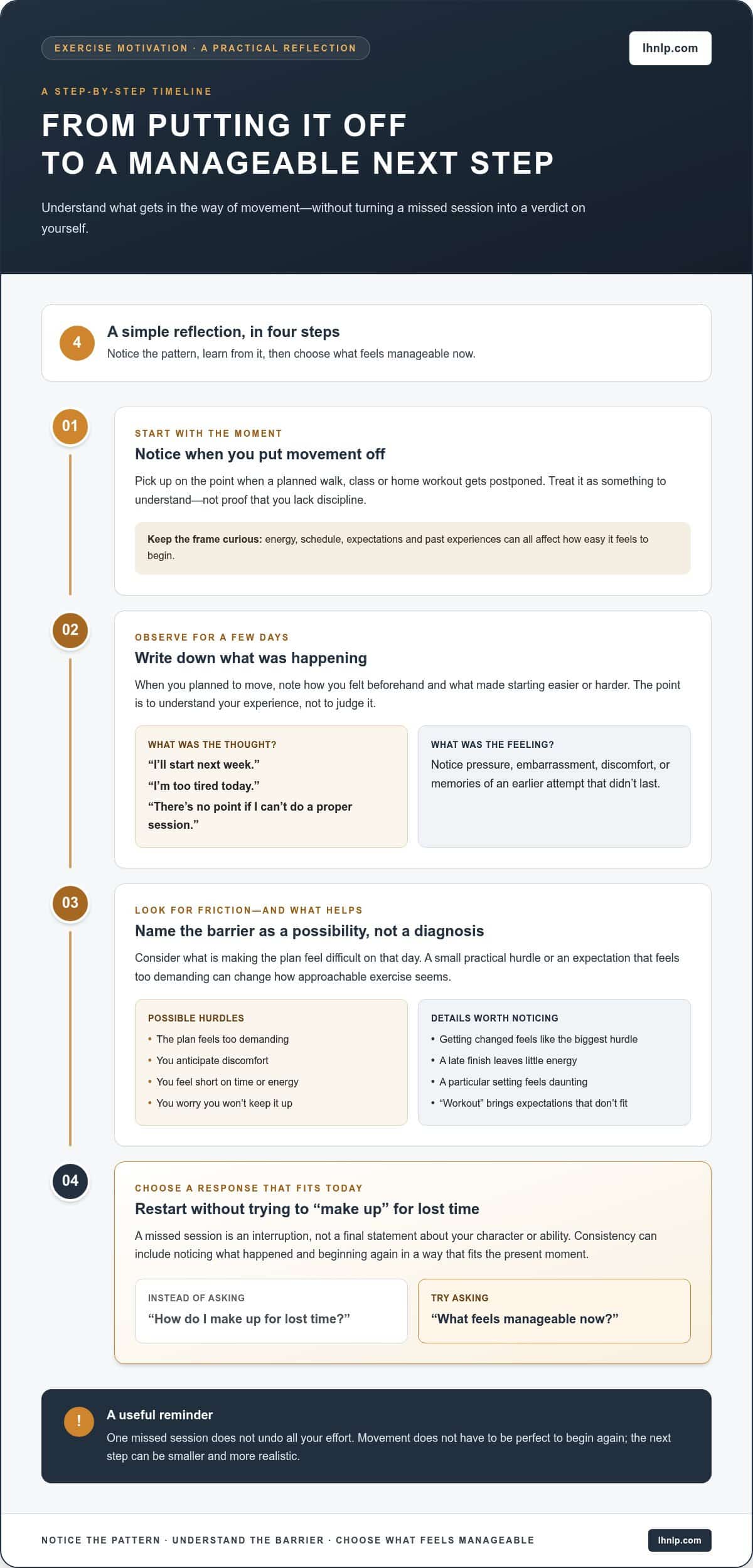
You can genuinely want to move more and still find yourself postponing the walk, class or home workout you planned. That gap can feel confusing, especially if you’ve made a fresh start before and hoped this time would be different. It doesn’t automatically mean you lack discipline. Your energy, schedule, expectations and past experiences can all affect how easy it feels to begin.
Motivation isn’t simply a fixed personal quality. It can be influenced by different needs and circumstances. This broader view of understanding motivation may help you approach the question with curiosity rather than blame. Notice what tends to happen just before you put exercise off. Is the plan too demanding for that day? Do you anticipate discomfort, feel short on time, or worry you won’t keep it up? These are possibilities to explore, not diagnoses.
What can sit behind putting exercise off?
Often, the barrier shows up as an inner conversation: “I’ll start next week,” “I’m too tired today,” or “There’s no point if I can’t do a proper session.” Exercise may also become linked with pressure, embarrassment, discomfort or memories of an earlier attempt that didn’t last. A well-intended plan can then feel less like an invitation and more like a test you might fail.
Try observing the pattern without labelling yourself. For a few days, note what you planned, how you felt beforehand and what made the activity easier or harder to start. Perhaps getting changed feels like the biggest hurdle, or a late finish leaves you with little energy. The purpose isn’t to judge or force an answer. It’s to understand your experience more clearly.
Why does a missed session sometimes become a longer pause?
When a routine depends on doing everything perfectly, one missed session can seem to undo all your effort. A thought such as “I’ve already failed this week” may turn a single interruption into a reason to stop altogether. Guilt can add another layer: returning to movement starts to feel like facing a verdict on your willpower, rather than simply choosing what to do today.
A pause is an event, not a final statement about your character or ability. Work, family demands, low energy or an unexpected change of plans can interrupt a routine. Consistency doesn’t have to mean never missing a session. It can include noticing what happened and beginning again in a way that fits the present moment. Ask, “What feels manageable now?” rather than, “How do I make up for lost time?”
If you’re considering hypnosis for motivation to exercise London, understanding these patterns can give a conversation about support a more personal starting point. The aim isn’t to manufacture enthusiasm or scold yourself into action. It’s to recognise what makes beginning difficult, so a next step can feel more approachable.
How might hypnosis support a more helpful response to exercise?
Hypnosis in a therapeutic setting is a focused process in which you work with a practitioner to explore thoughts, feelings and responses relevant to your goals. For exercise motivation, that might mean looking at what happens before you decide whether to move, and what could make that choice feel more achievable. The purpose isn’t to install motivation or make you follow instructions automatically. It’s to support reflection and useful change that remains yours to choose.
What does hypnosis mean in a therapy session?
A practitioner may guide you towards a focused, relaxed state and use conversation or therapeutic techniques to help you consider your experiences in a different way. You remain aware throughout, with no loss of awareness, and you stay fully in control. You can respond, ask questions or choose not to engage with a suggestion. Hypnosis isn’t sleep or surrendering your judgement.
The session can be shaped around your concerns and responses. For example, if the thought of a long workout feels overwhelming, you might explore what makes it feel demanding and what a more approachable form of movement means to you. This doesn’t promise that discomfort will disappear. It creates space to understand your reactions and consider another perspective at a pace that feels appropriate.
How could NLP and hypnotherapy relate to motivation?
Motivation can involve more than deciding to exercise. Thoughts, feelings and learned patterns may influence whether you begin, how you interpret effort and what you tell yourself after a difficult day. In an individual session, these responses can be explored rather than treated as fixed traits. You might notice that a particular setting feels daunting, or that the word “workout” brings expectations that don’t fit your needs.
At London Hypnotherapy & NLP, personalised support integrates Clinical Hypnotherapy, Neuro-Linguistic Programming (NLP), counselling and psychology. These approaches can help you examine the meaning you attach to exercise and consider responses that align more closely with your own reasons for moving. That could involve clarifying what matters to you or imagining how you’d like to respond when an old hesitation appears. Change is individual, may develop gradually, and hypnotherapy won’t work for everyone.
Hypnosis for motivation to exercise London is best understood as an opportunity to explore your relationship with activity, not a shortcut to automatic discipline. It can’t guarantee a routine or remove every practical barrier. You remain an active participant, deciding what feels useful and how to apply it outside the session. To learn more about the practice’s broader work, explore its hypnotherapy and coaching treatments.
Is exercise motivation hypnosis right for everyone? Benefits, limits, and alternatives
Hypnosis isn’t a way to hand over your choices. During a therapeutic session, you remain aware and in control, and you can decide how to respond to what’s discussed. It may offer space to explore your relationship with exercise, but it isn’t a switch that creates automatic discipline or guarantees a lasting routine.
What hypnosis can and cannot promise
A session may help you reflect on what makes starting difficult and consider a more useful response. What happens next depends on the individual, their circumstances and how they engage with the process. Some people may notice a shift sooner; others may need more time, and hypnotherapy won’t work for everyone. No single technique or fixed number of sessions suits every person.
Self-guided listening and personalised sessions are different formats, not a simple measure of which is best. A recording can be listened to independently and at a time that suits you. In a one-to-one session, you can discuss your concerns and responses with a practitioner, who can shape the work around what you bring to the conversation. Neither format can promise a particular outcome.
When considering hypnosis for motivation to exercise London, think about what kind of support feels appropriate. If you prefer to work privately at your own pace, self-guided listening may feel more comfortable. If you want to talk through your barriers and receive an individualised approach, a session with a practitioner may be a better fit. Neither option suits everyone.
When might another kind of support also matter?
Difficulty exercising can have many possible influences, and this article can’t identify the cause of fatigue, pain, anxiety or other concerns. If a health issue is affecting your wellbeing or what activity feels safe, seek advice from an appropriate healthcare professional. Hypnotherapy should not replace conventional medical treatment or advice.
Depending on your circumstances, hypnotherapy might sit alongside other forms of support, or you may decide a different approach is more relevant. There’s no need to treat that decision as a test of commitment. Your needs can change, and support should make room for that.
A useful way to assess fit is to ask yourself what you hope to explore, what you’d feel comfortable discussing and what next step seems realistic. Personalised work can be shaped around your experience rather than a promised result. The number of sessions is individualised: some clients improve after one, while others may need several. Keep expectations open and notice whether the approach feels helpful for you.
How can you make an exercise routine feel more achievable?
A routine is easier to approach when it fits the life you have now, rather than an ideal version of your week. Before setting a demanding schedule, identify what you want movement to bring into your life. It might be time outdoors, a clearer head, more energy for everyday tasks or simply a change of pace. A personally meaningful reason can be a steadier guide than pressure about appearance or a need to punish yourself.
How can you choose a first step that feels realistic?
Use this simple sequence as a starting point, not a test you have to pass:
- Name the friction. What makes starting difficult in your current circumstances? It could be uncertainty about what to do, a crowded diary, low confidence or not enjoying the activity you chose.
- Choose one specific action. Make it small enough to feel possible today. For example, you might take a short walk after lunch or look up a nearby activity you’re curious about. The right step is personal, not a prescribed level of effort.
- Notice your experience. Afterwards, consider what felt comfortable, awkward or enjoyable. Treat that information as useful feedback, not a score.
This approach turns a broad intention into something you can picture doing. If your first idea still feels too demanding, adjust it. Starting with a manageable action isn’t a lesser version of progress; it gives you a chance to learn what fits.
How can you respond when motivation dips again?
Plans meet real life. A missed session might reflect a change in work, family responsibilities, energy or circumstances. Rather than treating it as proof that you can’t be consistent, ask what it tells you about the plan. Was the timing difficult? Did the activity feel worthwhile? Would another option suit you better this week?
Build flexibility in from the start. Keep an alternative in mind for days when your original plan doesn’t work, or resume with a small action rather than trying to make up for missed time. There’s no need to set a rigid frequency or intensity here. The aim is to make returning feel possible while allowing your needs and preferences to change.
It can also help to replace “I’ve failed again” with “What would make the next attempt easier?” That shift keeps attention on a practical adjustment instead of a judgement about your character. London Hypnotherapy & NLP offers support with motivation, focus and sports performance. For some people considering hypnosis for motivation to exercise London, discussing personal barriers and aims can be a useful way to think through a realistic next step.
Exploring hypnosis for exercise motivation with a London practitioner
If you’ve reflected on what makes exercise difficult but would value a guided conversation, individual support can offer space to explore those patterns more closely. London Hypnotherapy & NLP’s personalised work includes motivation, focus and sports performance. The aim is to understand your experience and consider what may feel useful, not to promise a particular result or prescribe the same approach to everyone.
Kamal is a registered Clinical Hypnotherapist with over 25 years of experience and a senior business psychologist. In a session, you can discuss what you’d like to change, what tends to get in the way and what a personally meaningful next step might look like. You remain fully aware and in control throughout hypnosis. The process is collaborative, and your circumstances help shape the work.
What can you expect from a personalised session?
Sessions can integrate Clinical Hypnotherapy, NLP, Counselling & Coaching, and Psychotherapy as part of the treatment. These approaches offer different ways to explore your thoughts, feelings and responses around exercise, while keeping the focus on your individual aims. They don’t guarantee that motivation will change or that a routine will automatically follow.
Each session is one hour, and the fee is £190 per session. The number of sessions is individualised because people’s needs and responses differ. Some clients improve after one session, while others may need several; there’s no fixed course that applies to everyone. You can discuss what feels relevant and whether continuing support makes sense for you.
How can you take a next step in London or online?
In-person sessions take place at 96 Harley St, London W1G 7HY. The clinic is easily accessible via public transport and a short walk from the train station. If travelling to Harley Street doesn’t suit your circumstances, online sessions via Zoom or Skype offer another way to take part without coming to the clinic.
Searching for hypnosis for motivation to exercise London may be the beginning of a broader question: what kind of support would help you understand your barriers and choose a realistic way forward? You don’t need to have every answer prepared. It can be enough to describe what you’ve noticed and what you hope to explore, then decide whether individual support feels appropriate.
If a conversation about your aims feels like a useful next step, you can contact LHNLP to discuss a session. Take the time you need to decide. A more consistent routine is built through choices that fit your life, not pressure to get everything right at once.
Choose a next step that feels right for you
A more consistent relationship with exercise doesn’t have to begin with a sweeping promise. It can start with a small decision: noticing what you want movement to bring into your life, and choosing whether you’d like support to explore what has made that difficult. You don’t need a perfect plan before you begin.
If you’re considering hypnosis for motivation to exercise London, think about what you’d want to discuss in a personalised session. You might bring a recurring hesitation, a hope for a different relationship with activity, or a question about whether this approach feels suitable. The next step is yours to choose, and it can be taken at your own pace.
Contact LHNLP to discuss exercise motivation support and explore whether individual support could fit your needs. A fresh start doesn’t need to be dramatic. Let it be a considered step towards movement that feels more meaningful and achievable for you.
Frequently Asked Questions
Is hypnosis for exercise motivation safe if I am worried about losing control?
You remain fully aware and in control throughout hypnosis, with no loss of awareness. A session is a collaborative therapeutic process, not something imposed on you: you can respond, ask questions and decide what feels appropriate. If you have health concerns that affect your wellbeing or exercise, discuss them with an appropriate healthcare professional. You can also raise any worries about the process before deciding whether a session feels right for you.
Can hypnotherapy help me feel more motivated to exercise?
It may help you explore motivation, focus and personal patterns connected with starting or avoiding exercise. In a session, you could discuss a particular obstacle, such as repeatedly postponing a planned activity, and consider what might make beginning feel more manageable. Hypnosis for motivation to exercise London isn’t a guaranteed route to a routine: responses vary, and hypnotherapy won’t work for everyone. No particular fitness result or change in physical health can be promised.
How does hypnosis for exercise motivation work?
Hypnosis involves focused therapeutic work that can help you examine thoughts and responses linked with exercise. LHNLP integrates Clinical Hypnotherapy and NLP with counselling and psychology, tailoring the session to the person and their concerns. You stay aware and in control throughout. The process isn’t a formula that guarantees motivation; it offers a way to explore your experience and consider whether a different response might be useful in everyday situations.
How many hypnotherapy sessions will I need to improve exercise motivation?
There’s no fixed number of sessions for exercise motivation. The number is individualised because people’s circumstances and responses differ. Some clients may improve after one session, while others may need several. Rather than committing to a predetermined course, consider your aims and how you respond as the work progresses. A session can be a starting point for discussing what support may suit you, without assuming everyone needs the same amount.
How much does a hypnotherapy session for exercise motivation cost in London?
A one-hour session costs £190. The fee is per session, and the total commitment depends on the individualised number of sessions, which varies from person to person. There’s no fixed session count for exercise motivation, so one total wouldn’t apply to everyone. You can use this information to consider whether an individual appointment fits your circumstances before deciding on a next step.
Can I have hypnosis for exercise motivation online rather than in London?
Yes. LHNLP offers online sessions via Zoom or Skype, as well as in-person appointments at 96 Harley St, London W1G 7HY. The online option may suit you if travelling to Harley Street is inconvenient or you’d prefer to join from home. Both are ways to access a session; the format doesn’t guarantee a particular outcome. You can choose the setting that feels most practical for discussing your goals.
What happens if hypnosis does not help me exercise more?
Hypnotherapy won’t work for everyone, and a session can’t guarantee that your exercise habits will change. You remain in control of your decisions throughout, including whether to continue or consider another form of support. It may help to reflect on what you hoped to address and whether a different practical step is needed. Hypnotherapy isn’t a replacement for conventional medical care or other appropriate support for your wellbeing.