

What if feeling awkward around people isn’t proof that you’re bad at socialising, but a sign you’re putting too much pressure on each interaction? If you’re wondering how to overcome social awkwardness, you may know the familiar cycle: worrying about what to say, replaying the conversation afterwards, then avoiding the next chance to connect. That can feel isolating, especially when you want closer, easier relationships.
Social ease isn’t a fixed trait you either have or don’t. It can grow through low-pressure practice, small experiments and a kinder response to yourself when a conversation doesn’t go perfectly. You don’t need to become the most outgoing person in the room. Start with one manageable interaction at a time.
This article explores why social situations can feel uncomfortable and offers practical ways to begin and continue conversations, ease self-consciousness and spend less time overthinking afterwards. You’ll also find ways to build confidence gradually and recognise when personalised support may help, so you can move towards connection at a pace that feels realistic for you.
Key Takeaways
- Recognise social awkwardness as a feeling of unease or uncertainty, not proof that something is wrong with you.
- Understand how fear of judgement can turn your attention inward and fuel second-guessing during and after conversations.
- Learn how to overcome social awkwardness by listening, asking open questions and following up on what someone says.
- Build a gradual practice ladder, starting with familiar, brief exchanges and choosing steps that feel manageable.
- Consider personalised support if distress or avoidance repeatedly gets in the way of relationships, work or activities that matter to you.
What does social awkwardness feel like, and when does it matter?
Social awkwardness is a feeling of unease or uncertainty during an interaction, not a fixed personality type. You might be unsure how to join in, wonder whether a comment landed well or become very aware of a pause. One uncomfortable moment doesn’t define your social ability. It’s a moment, not an identity.
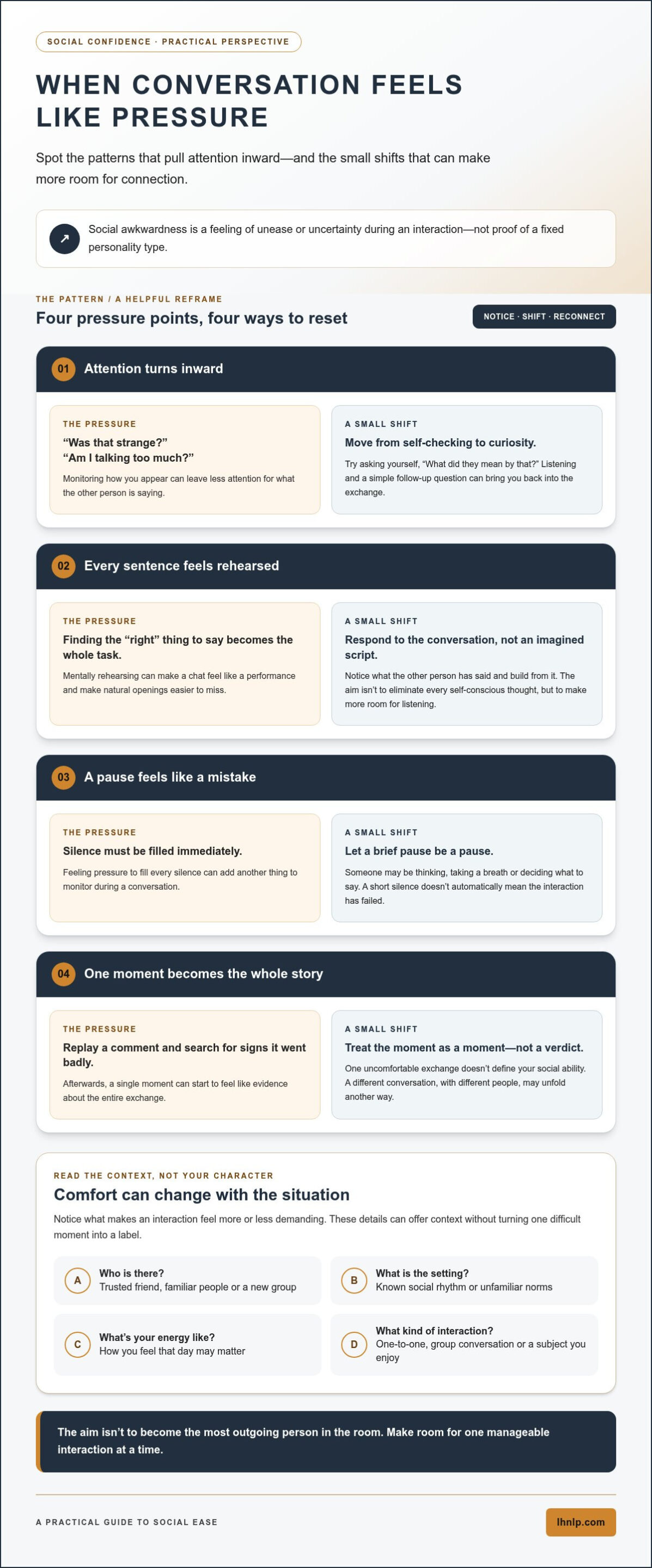
Imagine arriving at a gathering where several people are already talking. You may hover nearby, looking for a natural opening while worrying that interrupting would seem rude. With a trusted friend, you might chat freely. How comfortable you feel can depend on who’s there, how familiar the setting is, your energy that day and whether you enjoy that kind of socialising.
How can social awkwardness show up in everyday situations?
It can appear in small, ordinary exchanges: struggling to enter a group conversation, losing your words when someone asks a question or feeling pressure to fill every silence. You might later replay what you said and search for signs that you made a poor impression. These are possibilities, not a checklist or proof of a condition.
Notice the context rather than judging yourself as a whole. Do you feel more at ease one-to-one than in a group? Does conversation flow more readily when the subject interests you? These details can help you identify what makes an interaction harder, without turning one difficult moment into a verdict about who you are.
When is awkwardness more than an occasional uncomfortable moment?
Frequency, distress and impact matter more than one quiet or uneasy exchange. If fear of judgement regularly leads you to avoid people, or makes it difficult to take part in relationships, work or activities you value, it may be worth exploring the pattern. This still doesn’t mean you should diagnose yourself.
Ordinary uncertainty tends to come and go. Persistent fear or avoidance may deserve more attention, particularly if it narrows your life. Social anxiety disorder is a distinct clinical concept, and feeling awkward by itself doesn’t establish that someone has it. If ongoing anxiety is troubling you, the London anxiety therapy guide offers further context.
You don’t need to wait until a concern feels severe before reflecting on it. Ask yourself whether you’re avoiding situations you genuinely want to enjoy, and how much effort it takes to get through them. That honest observation is a useful first step in understanding how to overcome social awkwardness in a way that fits your circumstances.
Why can social situations feel difficult, even when you want to connect?
Wanting connection doesn’t always make conversation feel easy. If you’re anticipating judgement, some of your attention may turn towards monitoring yourself: Was that answer strange? Am I speaking too much? What should I say next? Instead of taking in the other person’s words, you’re also assessing how you appear. The more attention you spend evaluating yourself, the less space you may have to respond naturally.
This can create a loop. Worry before an interaction may lead you to plan or check every response. Close self-monitoring can then make it harder to follow the conversation, adding to your uncertainty. Afterwards, you might replay particular moments and treat them as evidence that the whole exchange went badly. This is one way to understand the experience, not a diagnosis or an explanation that applies to everyone. Social comfort can be shaped by different circumstances and personal histories.
How can fear of saying the wrong thing affect a conversation?
Mentally rehearsing each sentence can make a chat feel like a performance with no time to pause. You may miss a natural opening because you’re deciding whether your next words are clever, relevant or safe. Yet pauses are part of conversation. A brief silence can mean someone is thinking, taking a breath or deciding what to say. It doesn’t automatically mean the interaction has failed.
Notice where your attention goes. If you catch yourself thinking, “I sound boring,” gently shift towards curiosity: “What did they mean by that?” A simple follow-up question can bring you back into the exchange. The aim isn’t to eliminate every self-conscious thought, but to make more room for listening alongside it.
How do past experiences and unfamiliar settings shape social comfort?
A previous embarrassing moment may influence what you expect in a similar situation. If a joke once fell flat, for example, you might become cautious about speaking up in a new group. That memory can feel like a warning, even though a different conversation with different people may unfold another way.
Unfamiliar settings can also leave you unsure of the social rhythm. A new work event, a group with established friendships or a gathering where you don’t know the usual norms may take more effort to read. This doesn’t mean you lack social ability; you may simply have less context to draw on. Different people find different situations difficult, and there isn’t one cause that explains every experience.
As you consider how to overcome social awkwardness, look for patterns without turning them into labels. Notice what makes an interaction feel more or less demanding, and what helps you stay present. If self-guided reflection feels difficult, confidence-building support can give you a personalised space to explore these patterns and consider practical next steps.
What practical skills can help you feel less awkward in conversation?
Social confidence is easier to practise when you focus on one small skill instead of trying to manage every part of a conversation at once. Choose something specific, such as asking a follow-up question, and try it in a familiar, low-pressure setting. Afterwards, reflect on what you noticed without grading yourself on whether the exchange was perfect. The aim is to build familiarity, not perform.
Use this simple sequence to guide your practice:
- Choose one skill. Keep your focus narrow, such as listening for a detail you can ask about.
- Pick a manageable setting. Practise with someone familiar or during an everyday exchange.
- Stay curious. Respond to what the other person actually says, rather than trying to impress them.
- Reflect kindly. Notice what felt easier or harder, then decide whether to repeat the same skill.
How can you start and keep a conversation going?
Begin with something you genuinely share in the moment: the event, the queue, the room or an activity. You might say, “Have you been to this talk before?” If they mention enjoying a speaker, follow up with, “What did you find most interesting?” Let their answer guide your next question rather than firing off a list. You can also offer a small, related detail about yourself, so the exchange feels mutual rather than like an interview.
A pause doesn’t need rescuing. Give the conversation a moment to breathe. If a natural thought comes, share it, or return to something the other person mentioned. A useful opener is a bridge into the exchange, not a promise that you have to keep it going indefinitely.
How can active listening reduce pressure to perform?
While someone is speaking, try listening for their meaning instead of composing your next sentence in your head. Pick up one detail and respond to it: “You said you’ve just started a new role. How are you finding it?” If a follow-up doesn’t come to mind, a brief acknowledgement is enough. Listening can help you respond more naturally without needing to supply a constant stream of clever remarks.
Conversation also involves non-verbal cues, but there’s no single correct way to hold your body or make eye contact. Aim for a posture that feels comfortable and open. Let eye contact come and go naturally rather than forcing yourself to maintain it. The purpose is to communicate interest, not follow a rigid rulebook.
Afterwards, note one thing you tried and one thing you might adjust next time. Perhaps you asked a question but spoke very little about yourself, or noticed that looking away briefly helped you think. This gentle review gives you information without turning the interaction into a pass-or-fail test. If practising alone feels difficult, personalised confidence support can help you explore practical next steps at your own pace. This is one grounded way to learn how to overcome social awkwardness, one skill and interaction at a time.
How can you practise social confidence without overwhelming yourself?
Confidence can develop through small, chosen steps, rather than pushing yourself into the most demanding situation and hoping you’ll get used to it. Think of practice as a ladder: begin with an interaction that feels possible, then repeat it or make one small adjustment before moving up. You’re aiming to build experience at a pace you can sustain, not prove that you can tolerate anything.
How do you build a gradual practice plan?
Choose a behavioural goal you can control, such as greeting someone or asking one question. You can’t decide how another person responds, but you can choose whether to make the attempt. Your ladder might move from a familiar exchange towards a brief chat with someone new, then a longer conversation in a group. Adapt the steps to your circumstances, and stay at one level until it feels manageable enough to try a small variation.
- Start small. Greet someone you already recognise, or exchange a few words in a familiar setting.
- Repeat or vary the step. Try the same interaction again, or add one question if that feels within reach.
- Choose a next step. Consider a slightly less familiar person or a longer conversation, only if the step feels manageable.
- Review and adjust. Keep the next step similar, make it smaller or move forward based on what you learned.
This isn’t a test of willpower. If a step feels overwhelming, scaling it back is useful information, not failure. A brief hello may be more constructive practice than forcing yourself to stay at an event long after you feel able to engage.
What can you do after an interaction that felt awkward?
Afterwards, separate what you observed from what you inferred. “There was a pause after I asked a question” is observable. “They thought I was strange” is an interpretation, and you may not know whether it’s true. Give yourself a moment to settle before reviewing the exchange. Ask what you learned, what went adequately and what one small experiment might help next time.
Progress doesn’t have to mean feeling completely confident. It could mean showing up despite uncertainty, asking the question you intended to ask or recovering sooner after a moment that felt uncomfortable. Some attempts may still feel awkward. Treat that as part of practice, not a reason to judge yourself harshly.
A gradual practice plan is different from forcing yourself into distressing situations. If social fear or avoidance repeatedly interferes with relationships, work or activities you value, you may want to explore support. Ordinary discomfort alone doesn’t mean you have a disorder; the guide to therapy for anxiety in London offers context on persistent anxiety. For tailored help building confidence, explore confidence-building support and consider what next step may suit you.
When could personalised support help with social confidence?
Self-guided practice can be a useful starting point, but you don’t have to work everything out alone. Consider personalised support if distress or avoidance repeatedly gets in the way of relationships, work or activities that matter to you. Perhaps you turn down invitations you’d like to accept, or social worry makes it difficult to contribute at work. These patterns are worth taking seriously, even if you’re unsure what to call them.
Seeking help doesn’t mean ordinary awkwardness is a disorder. It can be a practical way to understand what makes certain interactions difficult and explore manageable ways forward. Support should begin with your concerns and goals, not an assumption that you need to become more outgoing or change who you are.
What might personalised confidence support involve?
At London Hypnotherapy & NLP, confidence-building support can draw on Clinical Hypnotherapy, Neuro-Linguistic Programming (NLP), counselling and coaching. The approach is collaborative and solution-focused, with sessions shaped around your concerns and how you respond. You might explore what happens before or during social situations, then consider practical steps that fit your circumstances. Kamal is a registered Clinical Hypnotherapist with over 25 years of experience and a senior business psychologist. You can read more about Kamal’s background and approach.
During hypnosis, you remain fully in control, with no loss of awareness. Hypnotherapy isn’t a guaranteed solution, and it won’t work for everyone; outcomes vary from person to person. It should not replace conventional medical care. If you’re already receiving support, your care needs remain important as you consider what may be helpful alongside it.
How can you take a first step with London Hypnotherapy & NLP?
A first conversation can be a chance to describe what you’re finding difficult and what feeling more at ease might look like for you. There’s no need to arrive with a perfect explanation. You could mention a particular situation you avoid, a pattern you’ve noticed or a social goal you’d like to approach gradually. From there, support can be considered in relation to your individual needs, rather than following a fixed script or assumed number of sessions.
Sessions are available in person at the Harley Street clinic, 96 Harley St, London W1G 7HY, and online via Zoom or Skype. The right next step may be a small practice you choose for yourself, or a personal conversation about what’s been holding you back. Learning how to overcome social awkwardness doesn’t require you to do it all at once. If tailored confidence support feels like a helpful next step, explore personalised support.
Let your next interaction be a small beginning
You don’t have to wait until you feel completely confident to take part in a conversation. A more useful aim may be to act in line with what matters to you, even while some uncertainty is present. Choose one interaction you’d like to approach differently, and let your next step be small enough to feel possible. Then give yourself room to learn from it instead of demanding a perfect performance.
Learning how to overcome social awkwardness isn’t about becoming someone else or making every exchange effortless. It’s about building more freedom to connect, one choice at a time. Some days will feel easier than others, and that’s part of being human. If you’d value a thoughtful space to explore confidence at your own pace, take a considered next step with personalised support.
Small acts of connection count. Keep going gently, and let confidence grow through experience.
Frequently Asked Questions
How do I overcome social awkwardness quickly?
There’s no dependable overnight fix, but you can make one interaction feel more manageable by choosing a small, clear aim. Before a meeting, decide to greet one person or contribute one relevant comment, rather than expecting yourself to feel completely relaxed. Afterwards, note what you actually did. If you’re learning how to overcome social awkwardness, reducing the pressure you put on a single conversation can be a useful first step.
Can social awkwardness be overcome?
Social discomfort can become easier to manage, although the pace and experience differ from person to person. Treat a difficult interaction as information rather than a verdict: perhaps a large group is tiring, while a one-to-one chat suits you better. Build on situations where connection feels more natural, and gradually try other settings. The aim doesn’t have to be changing your personality; it can be having more choice about how you participate.
What should I say when a conversation goes quiet?
You can let the pause sit for a moment, then make a simple comment or ask about something relevant to the setting. At a work lunch, for example, you might ask, “How did you get into this kind of work?” If you’ve run out of things to say, it’s also fine to say, “I’m going to grab a drink,” and return later. A quiet moment doesn’t require a clever line or an apology.
Is social awkwardness the same as social anxiety?
No. Social awkwardness describes a feeling or experience, while social anxiety refers to a more persistent pattern of fear around social situations. Feeling unsure at a new event doesn’t, by itself, mean you have an anxiety disorder. Consider how often the fear arises and whether it leads you to avoid important parts of life. If it’s causing ongoing difficulty, personalised support can help you explore your concerns without relying on self-diagnosis.
Why do I keep replaying conversations after they happen?
Replaying a conversation can be an attempt to work out how it went or prevent a similar uncomfortable moment next time. But repeated review can make guesses about other people’s thoughts feel like facts. Try writing down one thing you know happened and one thing you’re uncertain about, then shift to a grounding activity such as making tea or taking a short walk. Return to the interaction later only if there’s something useful to learn.
How can I be less awkward at work or social events?
Give yourself a simple structure for arriving: identify the host or a familiar colleague, say hello and choose a natural moment to join a conversation. At work, asking someone about a shared project can be easier than searching for an impressive topic. At a social event, you might offer to help with a small task or speak with one person at a time. Set a realistic aim for the occasion, and allow yourself a break if you need one.