

What if coping with a stressful job in London isn’t only about getting through the workload, but changing the cycle of pressure, response and recovery? When deadlines, messages or workplace expectations follow you home, it can feel as though there’s no clear point at which work ends. You’re not alone: the Health and Safety Executive estimates that 964,000 workers in Great Britain experienced work-related stress, depression or anxiety in 2024/25.
Managing that pressure starts with understanding what’s driving it, whether it’s workload, limited control, difficult relationships or the strain of staying switched on. This guide will help you identify the parts of work contributing most to your stress, try practical ways to steady yourself during the working day and create a more restorative transition after it. It also covers how to raise concerns or seek support when that feels difficult, and when personalised professional help may be useful. Small, considered changes can help you feel more in control, even when you can’t change everything about your job.
Key Takeaways
- Spot which demands, workplace dynamics or routines keep work on your mind after hours, so you can identify where pressure is building.
- Understand how demands, your response and recovery opportunities interact, and notice when tension or disrupted sleep may be affecting your ability to reset.
- Try a simple approach to coping with a stressful job in London: notice the trigger, pause, choose one controllable next step, then review what helped.
- Distinguish a demanding spell from a recurring pattern by considering how long it lasts, how it affects daily life and whether you can recover.
- If work stress feels persistent or difficult to manage alone, learn how personalised professional support may help you explore possible next steps.
Why a stressful job in London can feel hard to switch off from
When demands keep arriving, work can remain mentally present long after you’ve closed your laptop or left the workplace. You might replay a tense conversation on the journey home, check messages over dinner, or try to solve tomorrow’s problem when you’re meant to be resting. If this feels familiar, it doesn’t mean you’re failing to cope. Sustained pressure can make it harder to create a clear boundary between work and the rest of life.
London routines may add their own pressures. A crowded commute, a long journey, a quick change between meetings, or the pace and noise of a busy area can leave less room to pause, if those are part of your experience. They aren’t universal, and they may not be the main source of strain. Workload, tight deadlines, uncertainty about your role, team relationships or limited recovery time can each contribute in different ways.
For a wider overview of stress management techniques and models, it can help to explore how people respond to pressure and make room for recovery. The ideas here are practical coping guidance, not a diagnosis, and they don’t mean every demanding job is harmful.
To hear more about mental health in the workplace, watch this TEDx talk:
Which parts of a London workday may be adding pressure?
Separate the sources rather than treating the whole job as one problem. Is it the amount of work, deadlines that regularly clash, expectations from colleagues, or uncertainty about what your role requires? If commuting or a packed urban routine also drains you, include that in your picture. An intense day may ease after rest; pressure that repeatedly leaves you unable to recover deserves closer attention.
How can work stress follow you home?
After work, your mind may keep rehearsing what you said, anticipating a deadline or scanning for the next demand. You might notice tension or find it difficult to settle into an evening routine. These experiences can happen during stressful periods; on their own, they don’t prove that you have a mental-health condition. For more practical approaches, see this guide to stress management in London.
Try identifying what keeps the mental loop active: an unfinished task, unclear expectations, a difficult interaction or concern about what’s coming next. Naming the pressure won’t make it disappear, but it can turn a vague sense of being overwhelmed into something specific to understand. You may have influence over one part, need support with another, or simply need time away from the demands.
Coping with a stressful job in London doesn’t have to mean enduring every pressure without question. The next sections look at how ongoing stress can affect focus and recovery, how to recognise a recurring pattern, and what realistic steps may help during the working day and afterwards.
How the work-stress cycle affects focus, tension, and recovery
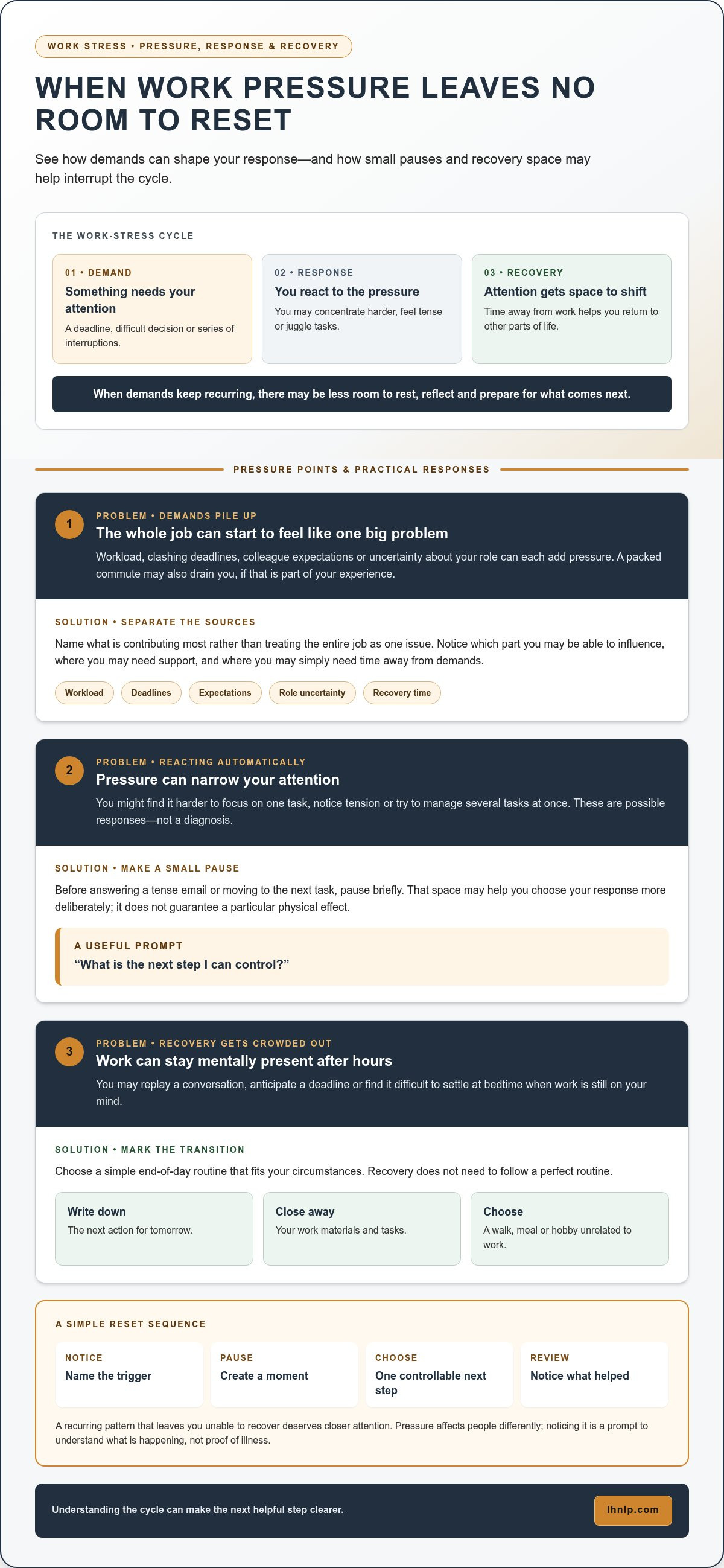
Work stress can be understood as a cycle: demands arise, you respond to them, and then you need opportunities to recover. A demand might be a deadline, a difficult decision or a series of interruptions. Your response could involve concentrating harder, feeling tense or trying to manage several tasks at once. Recovery is the space to let your attention move away from work and return to other parts of life.
That response differs from person to person. During a pressured day, you might find it harder to focus on one task, notice your shoulders tightening or struggle to settle at bedtime because work is still on your mind. These are possible experiences, not a diagnosis, and they don’t affect everyone in the same way.
A stress response describes how you may react to pressure; it isn’t, by itself, a clinical diagnosis. This distinction lets you notice what’s happening without labelling yourself. A short pause before answering a tense email or moving to the next task may create space to choose your response more deliberately. It doesn’t guarantee a particular physical effect, but it can interrupt the rush to react automatically.
What happens when pressure keeps recurring?
When demands arrive repeatedly, there may be less time to rest, reflect and prepare for what comes next. Imagine a workday where an urgent request interrupts planned tasks, a meeting creates new actions, and the final hour is spent catching up. This example isn’t a prediction or a typical outcome. It shows how one demand can crowd out recovery when there’s no pause between tasks. The NIOSH guide to preventing job stress also discusses workplace causes and prevention, highlighting the value of considering both individual responses and working conditions.
If attention feels scattered or tension lingers, treat those changes as prompts to notice the pattern, not proof that stress will inevitably cause illness. Ask whether the pressure is occasional or recurring, and whether you have enough opportunity to reset between demands.
Why recovery matters as much as managing demands
Recovery means deliberately stepping away from work tasks and work-related attention where you can. It might be a clear end-of-day routine: write down the next action for tomorrow and close your work materials, or choose an evening activity unrelated to your role. A short walk, preparing a meal or giving your attention to a hobby may help mark the transition. Choose what fits your circumstances; recovery doesn’t need to follow a perfect routine.
These practices can support coping with a stressful job in London, but they can’t remove an unreasonable workload or unclear expectations on their own. Personal strategies and attention to workplace causes belong together. If you’d like to explore individual support for stress, stress management sessions offer another possible step.
Is pushing through work stress the only option? How to notice a persistent pattern
Coping doesn’t have to mean absorbing every demand in silence. A pressure point may sometimes be eased by clarifying priorities, asking for practical support or changing how a task is approached. You may not be able to alter every workplace condition, but noticing what is happening can help you decide what to raise and what support might be useful.
A short-lived busy spell may feel intense, yet ease when a deadline passes or you have time to rest. A persistent pattern is more likely to recur, affect everyday life or leave you feeling unable to recover between working days. How long the strain lasts and how it affects day-to-day life matter more than one difficult day. This reflection isn’t a diagnostic checklist or a substitute for professional assessment; it’s a way to notice whether the pattern deserves attention.
When might work stress deserve closer attention?
Notice whether sleep, concentration, mood or relationships are repeatedly affected, and whether these changes appear alongside particular demands or interactions. You could make brief notes about what happened, how it affected you and whether you recovered afterwards. Keep the record factual and compassionate. Its purpose is to identify patterns, not to label yourself or reach a diagnosis.
For example, you might notice that concentration becomes harder after frequent last-minute changes, or that work thoughts regularly interrupt your evening. A few observations can help you describe what is difficult and consider what might change. If anxiety is a prominent part of your experience, professional support for anxiety may be one avenue to explore.
How can you raise pressure without blaming yourself?
Prepare a specific, work-focused example rather than feeling you must explain everything at once. Describe the demand, its effect on your work or wellbeing, and the practical support that could help. For instance: “The overlapping deadlines mean I can’t complete both tasks to the expected standard. Could we agree which one takes priority?”
Choose a suitable time and conversation partner for the issue, and make your request as clear as you can. Depending on your workplace, that could mean speaking with your manager or another appropriate person. You might ask for priorities to be clarified, a workload check-in or a discussion about how tasks are allocated. Preparing a concise example can make it easier to stay focused, though you can’t know in advance how someone will respond.
If raising the issue feels difficult, start by writing down what you want the other person to understand. You don’t need to prove that you’re struggling; a concrete description of the work situation is a useful place to begin. Coping with a stressful job in London can involve personal strategies, workplace conversations and, when pressure continues, professional support. The next section turns to practical steps you can try during and after work.
Practical ways to cope with a stressful job during and after work
When pressure rises, a small, repeatable sequence can make the next moment easier to navigate, even if you can’t change the workload straight away. The aim isn’t to make every demand disappear. It’s to notice what’s happening, create space before reacting and choose a useful next step that fits your role and circumstances.
Notice the trigger, pause, choose one controllable action, then review what helped. Try the steps in order, adapting them to your working day:
- Notice the trigger. Name the immediate pressure, such as an unexpected request, a difficult interaction or several tasks competing for attention. Keep it specific rather than judging yourself for feeling stressed.
- Pause briefly. If the moment allows, stop typing or step away from the screen. Let your breathing remain comfortable and unforced, and give yourself a moment to consider what needs attention first.
- Choose a next action. Separate what is genuinely urgent from what matters but can wait. Pick one manageable task, ask for a priority to be clarified, or identify who could help if the demand exceeds your capacity.
- Review afterwards. Notice whether the step was useful and what you might try next time. The point is learning, not expecting every technique to work in every situation.
What can you try when pressure rises at work?
Make the pause practical for your setting: take a moment before replying, stand and stretch if appropriate, or write down competing tasks so you can see them clearly. If you don’t control your workload, focus on what you can communicate. A specific request, such as asking which deadline takes priority, can give a work-focused conversation a clear starting point. If demands remain beyond your available capacity, consider raising this with an appropriate person at work.
Not every role allows a quiet break or control over incoming tasks. Choose an option that’s safe and realistic in your environment, even if it takes only a few moments. Coping with a stressful job in London may mean adapting these steps around meetings, shifts, client needs or travel, rather than following an idealised routine.
How can you create a clearer end to the working day?
A simple close-down ritual can help mark the transition from work time to personal time. Before finishing, note tomorrow’s first task and any essential follow-up, then close your work materials if your role permits. This gives unfinished thoughts a place to land, rather than relying on memory to hold them through the evening.
Afterwards, choose a transition that suits your schedule. You might listen to something unrelated to work on the journey home, take a short walk, change clothes or move directly into a familiar evening activity. If you work shifts or from home, a small change in routine can still signal that the work period has ended. Treat these ideas as experiments, not rules. Routines may support recovery, but they can’t resolve every underlying workplace problem or replace a conversation about unsustainable demands.
If stress continues to feel difficult to manage alone, you can read about personalised stress management support as one possible next step.
When professional support for work stress in London may help
Self-help strategies can be useful, but they aren’t the only option. If work stress keeps returning, affects your wellbeing or feels difficult to manage alone, talking it through with a professional may help you make sense of what’s happening and consider possible next steps. Seeking support doesn’t mean you’ve failed to cope. It can help you understand your responses and explore how to move forward, while recognising that workplace pressures may also need attention.
At London Hypnotherapy & NLP, support is personalised rather than built around a fixed outcome. Depending on your needs, it may draw on Clinical Hypnotherapy, Neuro-Linguistic Programming (NLP), counselling and coaching. The number of sessions differs from person to person. Hypnotherapy isn’t a replacement for conventional medical care, and it won’t be right for everyone.
What can a work-stress support session involve?
Sessions provide space to explore the pressures you’re facing, how you respond to them and what you’d like to work towards. The approach can be tailored, bringing different methods together where appropriate rather than assuming one technique suits everyone. You remain fully in control throughout hypnosis, with no loss of awareness.
Kamal is a registered Clinical Hypnotherapist and senior business psychologist, with over 25 years of experience in mental-health therapy, senior business psychology, counselling and NLP. Sessions last 45 minutes to an hour. The fee for a one-hour session is £190. You can explore the work-related treatment options to understand the approaches available.
How can London clients access support?
In-person sessions take place at 96 Harley St, London W1G 7HY. If attending in person doesn’t fit your routine, online sessions are available via Zoom or Skype. These options make it easier to consider support around work and other commitments, whether you’re based in London or prefer to meet remotely.
Professional support can sit alongside practical steps at work, not replace conversations about workload, expectations or the support you need from your employer. If you’re considering help with coping with a stressful job in London, you can discuss work stress and explore whether a personalised approach feels right for you. You don’t need to have every answer before starting that conversation.
Choose one next step towards a steadier working week
Change doesn’t have to begin with a dramatic decision. You might start by noticing one recurring pressure point, trying a small boundary or deciding what support would make the next working week feel more manageable. The aim isn’t to control every demand, but to build a clearer sense of what you can influence and where you don’t have to manage alone.
If coping with a stressful job in London still feels difficult, take time to consider what kind of support would feel useful. Kamal is a registered Clinical Hypnotherapist and senior business psychologist with over 25 years of experience. Sessions are available in person on Harley Street or online via Zoom or Skype, offering different ways to begin a conversation.
There’s no need to have everything worked out before reaching out. A first conversation can help you explore what’s been weighing on you and whether personalised support feels like a suitable next step. Discuss support for work stress when you feel ready. Small steps count, and you can take them at your own pace.
Frequently Asked Questions
Can work stress affect your sleep even when you are tired?
Yes, work-related worries may make it harder to settle, even when you feel physically tired. You might find your mind returning to an unfinished task or tomorrow’s meeting as you get ready for bed. Try writing down the concern and one possible next action for the morning, so you don’t have to keep rehearsing it. If sleep difficulties continue or affect daily life, consider discussing them with a healthcare professional.
How can I tell whether work stress is becoming a persistent problem?
Look for a pattern over time, rather than judging by one demanding day. For a short period, note when pressure rises, how it affects your concentration or mood, and whether you feel able to recover afterwards. For example, are difficult evenings occasional, or are they happening repeatedly? This kind of record can help you explain what you’re experiencing and decide whether to seek support, but it isn’t a diagnostic tool.
What can I do if my workload is outside my control?
Make your capacity visible and ask for a decision about priorities. You could write down the tasks due, their deadlines and what remains to be done, then ask which should take precedence if you can’t complete everything at once. If the workload continues to exceed the time available, raise the pattern with an appropriate person at work. This doesn’t guarantee a change, but it gives the conversation a clear, practical starting point.
Should I tell my manager that work is affecting my wellbeing?
If it feels appropriate and safe to do so, a clear conversation may help your manager understand the effect of work demands. Choose a specific example and explain what would make the situation more manageable, such as agreeing priorities or reviewing deadlines. You could prepare notes beforehand if speaking spontaneously feels difficult. You can’t control the response, but describing the work issue calmly can help keep the discussion focused on possible next steps.
Can hypnotherapy help with stress related to work?
Hypnotherapy may be one option for exploring your response to work stress and developing ways to manage it, but effectiveness varies and it won’t work for everyone. Support may also include NLP, counselling or coaching, depending on your needs. It isn’t a substitute for conventional medical treatment. If you’re considering hypnotherapy as part of coping with a stressful job in London, discuss your situation and what you hope to address with the practitioner.
Do you remain aware and in control during hypnotherapy?
Yes. You are aware and in control all along during hypnotherapy, with no loss of awareness. Hypnosis isn’t sleep or unconsciousness. You can take part in the session while retaining the ability to respond and make your own choices. If you feel uncertain, raise your questions before beginning so you understand what to expect and can decide whether the approach feels comfortable for you.
Can I attend a work-stress session online from London?
Yes, online sessions are available via Zoom or Skype, so you can attend from London without travelling to the Harley Street clinic. Before your appointment, choose a private place where you can speak without interruption and set aside the session time. If you’re joining between work commitments, allow yourself a little breathing space afterwards rather than scheduling an immediate task. Online sessions provide an alternative format, while the support remains tailored to your needs.