

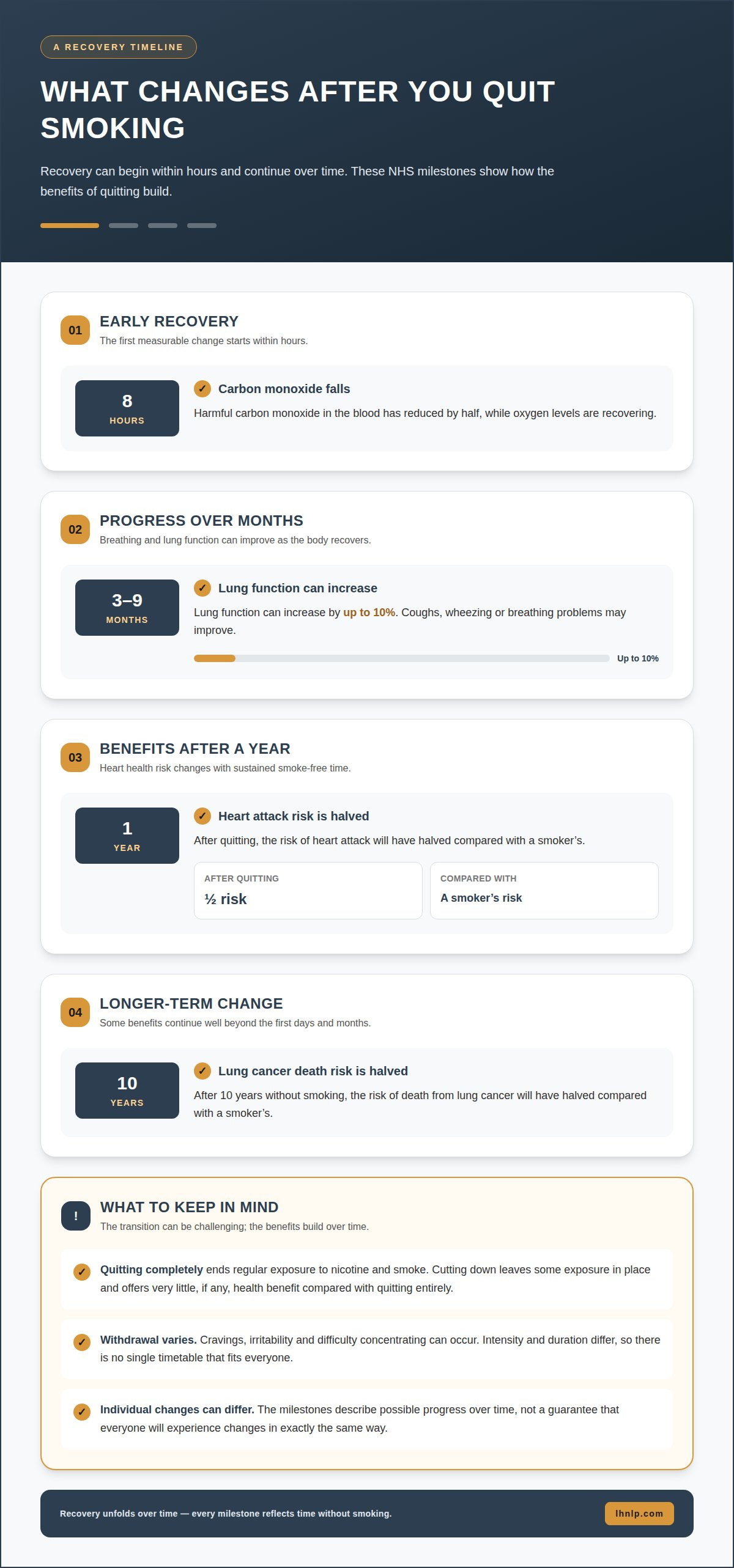
Quitting starts changing your body within hours, while continuing to smoke prolongs exposure to harmful chemicals and raises the risk of serious illness. The risks of continuing to smoke vs quitting are stark: according to the NHS, after 8 hours without smoking, the harmful carbon monoxide level in your blood has reduced by half, and after 3 to 9 months, lung function can increase by up to 10%. These changes build over time, even if quitting feels difficult at first.
It’s understandable to want a clear picture of what stopping smoking can do, and what may continue if you smoke. The effects reach beyond your own health: second-hand smoke can put other people at risk.
This article explains how smoking affects the body, what can change after quitting, and how smoking contributes to stroke risk and the dangers of second-hand smoke. It offers a grounded comparison, without suggesting you have to make the change all at once.
Key Takeaways
- Learn how smoking can affect blood pressure and make clot formation more likely.
- See how the body begins to recover after quitting, and why progress can continue over time.
- Understand how smoking contributes to heart disease and stroke, including the risks after a stroke.
- Find out how second-hand smoke can affect others and how smoking cessation hypnotherapy may support your next steps.
What are the health effects of smoking?
Smoking can harm blood vessels, lungs and other organs, with damage building through repeated exposure. In the UK, nearly 78,000 people die each year from smoking-related causes. Understanding the risks of continuing to smoke vs quitting starts with how tobacco affects circulation, even before symptoms appear.
Blood Pressure and Clotting Effects
Smoking raises blood pressure, damages blood vessel linings and makes blood stickier, increasing the chance of clots. A clot can block blood flow to the heart, brain or legs. Carbon monoxide also reduces oxygen in the blood, adding strain to circulation. These effects can occur even when a cigarette feels like a way to manage stress.
Cumulative Damage From Long-Term Smoking
Long-term smoking repeatedly exposes the body to harmful chemicals. The NHS says cigarette smoke contains more than 7,000 chemicals. Smoking increases the risk of developing at least 16 types of cancer and can damage the lungs and airways. The risks of continuing to smoke vs quitting are shaped by ongoing exposure: harm may accumulate before noticeable symptoms prompt concern.
Effects of Smoking Fewer Cigarettes
Smoking fewer cigarettes reduces how many you smoke, but does not remove your exposure to tobacco smoke. There is no safe level of cigarette use, and cutting down offers very little, if any, health benefit compared with quitting entirely. Even someone who smokes less inhales chemicals that can harm blood vessels and lungs. Stopping completely, rather than simply reducing your daily count, is the meaningful change.
Heart Disease and Stroke
Smoking increases heart disease and stroke risk by damaging blood vessels and making clots more likely. A clot can interrupt blood flow to the heart or brain, causing a heart attack or stroke. People who smoke 20 or more cigarettes a day may have up to six times the stroke risk of non-smokers. The more someone smokes, the greater their stroke risk, so continued exposure keeps the danger present.
Benefits and timeline of quitting
When you stop smoking, recovery can begin, although nicotine withdrawal may make the first stage challenging. Changes unfold over time, offering clear reasons to quit completely.
Health Benefits of Quitting
Quitting reduces continued exposure to cigarette smoke, allowing the body to recover gradually. According to the NHS, after 8 hours without smoking, oxygen levels are recovering and harmful carbon monoxide in the blood has reduced by half. This matters because improved oxygen availability supports the body’s normal functions. The risks of smoking are ongoing; withdrawal symptoms are temporary challenges during the transition.
Benefits of Quitting Completely
Quitting completely ends regular exposure to nicotine and smoke, while cutting down leaves some exposure in place. After quitting, a person’s risk of heart attack will have halved compared with a smoker’s after 1 year, according to the NHS. A UK smoker’s financial savings depend on their usual cigarette spending: they can estimate them by adding up what they would otherwise spend during smoke-free periods.
Health Changes After Quitting
Recovery follows a timeline, though individual changes can differ. According to the NHS, after 3 to 9 months without smoking, lung function can increase by up to 10% as coughs, wheezing or breathing problems improve. After 10 years without smoking, a person’s risk of death from lung cancer will have halved compared with a smoker’s, according to the NHS. These milestones show how benefits continue beyond the first days.
Withdrawal Symptoms and Duration
Nicotine withdrawal is your body adjusting to the absence of nicotine. Cravings, irritability and difficulty concentrating can occur, and symptoms vary in intensity and duration, so there is no single timetable that fits everyone. Withdrawal is a temporary part of quitting, while the health benefits accumulate and the risks of smoking continue. If support would help you work through cravings, hypnotherapy for smoking cessation may be one option to consider.
What is stroke and how does smoking increase the risk?
A stroke occurs when blood flow to part of the brain is interrupted, often by a clot. Its effects depend on which area loses oxygen and how long circulation is disrupted. Smoking raises stroke risk by harming the blood vessels that supply the brain and heart.
Smokers have twice the risk of stroke as non-smokers, and the more a person smokes, the greater the risk. Chemicals in tobacco smoke can damage blood vessel walls and contribute to atherosclerosis, a condition in which arteries narrow. If a clot blocks an artery supplying the brain, brain tissue is deprived of oxygen. Smoking’s effects therefore reach beyond breath and lung health.
The same changes can affect the heart. Smoking raises blood pressure and makes blood more likely to form clots, increasing the chance of a heart attack. People under 50 who smoke may be five times more likely to have a heart attack than non-smokers. The risk applies even before chronic heart disease is diagnosed, so feeling well does not mean blood vessels are unaffected.
Continuing to smoke after a stroke increases the risk of another stroke, and that risk rises with heavier smoking. It also raises the risk of dying from a stroke or having a heart attack. After a first stroke, stopping smoking lowers the risk of another stroke, dying from a stroke or having a heart attack. Nicotine withdrawal can make quitting difficult, but it is a short-term challenge compared with continued exposure to tobacco smoke. Complete cessation matters: cutting down alone offers very little, if any, health benefit compared with quitting.
Second-hand smoke risks
Second-hand smoke is tobacco smoke breathed in by someone who isn’t smoking. It includes smoke from a burning cigarette and smoke exhaled by another person, and it is dangerous to health. People can therefore be harmed without choosing to smoke. A shared living room, car journey or visit where someone lights a cigarette can expose others nearby. Being a bystander doesn’t make tobacco smoke harmless.
Unlike the person holding the cigarette, someone nearby may have little control over when exposure begins or ends. Smoke in a shared space can affect people working, relaxing or travelling with someone who smokes. The same concern applies to everyday routines, such as spending time indoors with a smoker. Recognising these settings makes the risk visible: tobacco smoke’s effects are not limited to the person smoking.
Practical boundaries can reduce other people’s exposure. Keep the home and car smoke-free, and don’t smoke beside others or in shared indoor spaces. If you smoke, move away from other people before lighting a cigarette. These steps protect shared air, but they don’t make smoking safe for you. The clearest way to stop exposing others is to stop smoking.
Cravings, stress and familiar routines can make stopping harder, especially when smoking is part of social time. Planning a different response, such as taking a short break without a cigarette, can help interrupt the pattern. If support would help you work towards stopping, get in touch about smoking cessation support. A smoke-free home and car are practical boundaries; quitting addresses the source of exposure.
London Hypnotherapy & NLP
London Hypnotherapy & NLP offers personalised, solution-focused support for people considering a change in their smoking habits. If cravings, stress or familiar routines make quitting difficult, Hypnotherapy for Smoking Cessation can help you work towards changing those patterns. The aim is to support your efforts, not to promise a particular health outcome or replace medical care.
Support may also help when anxiety or other personal challenges affect your readiness to stop. Sessions give you space to explore what makes change difficult and consider a practical way forward that fits your situation. You can take the next step at your own pace.
If you’d like to discuss support for changing your smoking habits, contact London Hypnotherapy & NLP.
Take a manageable step towards change
The risks of continuing to smoke versus quitting can make the decision feel weighty, but you don’t have to tackle every challenge at once. Start by noticing what tends to prompt a cigarette, such as stress, a familiar routine or time with others. That awareness can help you identify the kind of support that may suit your situation.
London Hypnotherapy & NLP offers Hypnotherapy for Smoking Cessation, Hypnotherapy for Anxiety and Hypnotherapy for Weight Loss. If smoking feels connected with anxiety or other personal challenges, discussing your goals can help clarify what support you’re looking for. Change is personal, and taking time to consider your next step is part of the process.
If you’d like to explore support, contact London Hypnotherapy & NLP. A thoughtful first step can open the way to lasting change.
Frequently Asked Questions
What happens to your body when you stop smoking?
Your circulation and senses begin responding after your last cigarette. After 20 minutes without smoking, your pulse rate starts returning to normal; within two days, your sense of taste can improve. In the early smoke-free period, nicotine-related urges may arise around familiar routines, such as a break or after a meal. Planning a different response to those moments can make the transition more manageable.
Do lungs repair after smoking?
Lungs can recover in some ways after smoking stops, but not all damage reverses. In the weeks after quitting, inflammation and mucus production in the lungs and airways calm, and cilia can regenerate over the following months. Destroyed alveoli, the tiny air sacs involved in breathing, do not grow back. Stopping can support lung function without restoring every lasting structural change.
What are the benefits of stopping smoking?
Stopping smoking supports circulation and reduces continued exposure to tobacco smoke. After 2 to 12 weeks without smoking, circulation improves, helping blood pump to the heart and muscles more effectively. Over time, quitting also reduces the risks associated with ongoing smoking. The benefits are not limited to breathing: better circulation can make ordinary movement, such as walking or climbing stairs, feel easier as the body recovers.
What happens when you quit?
When you quit, your body begins adjusting to life without regular nicotine, and familiar smoking routines may feel different. Your body processes nicotine and excretes it in urine within a few hours of smoking a cigarette. Cravings can still arise when you encounter familiar cues, such as finishing a meal or taking a break. Noticing these patterns helps you prepare alternative ways to respond.
What are the health risks of continuing to smoke in the UK?
In the UK, smoking can affect more than the lungs and heart. It increases the likelihood of type 2 diabetes, even for people who don’t smoke every day, and can make diabetes harder to control. Smoking is also linked with cataracts and macular degeneration, which can threaten sight, as well as tooth loss and hearing damage. These harms can develop alongside better-known cancer and circulation risks.
How does smoking affect life expectancy and risk of premature death?
Smoking reduces average life expectancy by 10 years. After age 40, each additional year of smoking reduces life expectancy by another three months. These are population-level figures, not a personal forecast: an individual’s health, smoking history and other circumstances affect their outlook. Quitting stops adding further exposure and can improve health prospects, making a change worthwhile at different stages of life.