

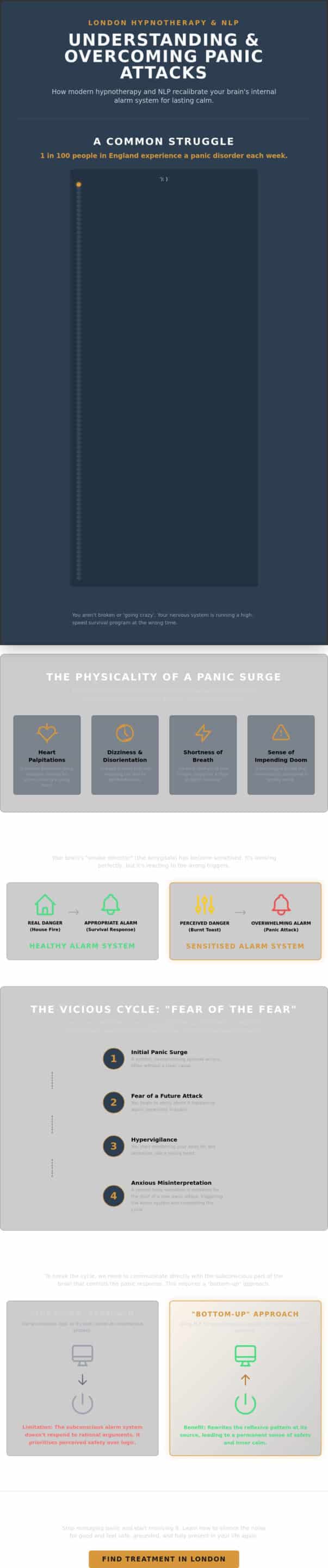
Did you know that in any given week in England, 1 in 100 people is wrestling with the suffocating alarm of a panic disorder? If you’ve spent your morning searching for panic attack treatment near me in London, you’re likely all too familiar with the physical exhaustion that follows a sudden adrenaline spike or the paralyzing fear of losing control while out in public. It’s a heavy burden to carry, especially when you feel like your own body has turned into an unpredictable environment. You aren’t “going crazy,” and you aren’t broken; your nervous system is simply running a high-speed survival program at the wrong time.
We understand that true relief requires more than just a deep breath; it requires a fundamental shift in how your mind processes stress. By using expert NLP and hypnotherapy, you can learn to recalibrate your internal alarm and silence the noise of panic for good. This article explores how to move from a state of constant vigilance to a place of lasting calm, providing you with immediate tools to regain your autonomy. We’ll guide you through the process of rewriting these reflexive patterns so you can finally feel safe, grounded, and fully present in your life again.
Key Takeaways
- Understand the mechanics of your brain’s internal alarm system and why it triggers overwhelming physical responses even when no immediate danger is present.
- Explore how subconscious-focused methods like hypnotherapy provide a “bottom-up” approach to healing, addressing the root of the panic response rather than just the symptoms.
- Learn how to select the right panic attack treatment near me by looking for practitioners in London who specialize in pattern interruption and nervous system recalibration.
- Discover the power of Neuro-Linguistic Programming to halt the cycle of “fear of the fear,” allowing you to navigate public spaces with newfound confidence.
- Shift from feeling out of control to mastering immediate coping tools that lead to a permanent sense of safety and inner calm.
Understanding the Surge: What a Panic Attack Really Is
A panic attack is far more than a moment of heightened stress; it is a profound, sudden surge of overwhelming fear that arrives without an invitation or an obvious cause. While general anxiety might feel like a low-level hum in the background of your day, a full-scale panic event is an ambush that demands your entire attention. It’s a psychological signal masquerading as a physical emergency, a loud alarm meant to save your life that is simply ringing in an empty room. Understanding What a Panic Attack Really Is helps us realize that the body isn’t failing or “breaking down.” Instead, it is executing an ancient survival script at a time when there’s no physical predator to fight.
When you search for panic attack treatment near me in a city as fast-paced as London, you’re often looking for more than just a temporary fix; you’re seeking a way to build a lasting internal sanctuary. You want to know why your body has chosen this specific way to communicate its distress. By reframing these episodes as a miscommunication between your mind and your nervous system, the path to recovery becomes a process of translation and recalibration rather than a battle against yourself.
To better understand this concept and why our instinctive reactions to panic can sometimes keep us stuck, watch this helpful video:
The Physicality of Panic: Why Your Body Reacts This Way
The heart palpitations, shortness of breath, and sudden dizziness you experience are the direct results of a massive adrenaline dump. Your brain’s “smoke detector” has detected a threat and instructed your heart to pump faster to prepare your muscles for action. This can lead to the terrifying sensation of an “impending doom,” a neurological misfire that convinces you something is fundamentally wrong. It’s common to wonder, “Am I having a heart attack?” but it’s vital to recognize that while the sensations are real, the physical danger is not. Your body is simply over-preparing for a battle that isn’t happening, leaving you exhausted once the surge finally recedes.
When Panic Becomes a Pattern
Panic often transitions from a one-off event into a recurring challenge through a process called “fear of the fear.” You begin to monitor your body for the slightest sign of a racing heart, which inadvertently triggers the very stress you’re trying to avoid. Living in London can amplify this feedback loop significantly. The sensory overload of a crowded Central Line carriage or the high-pressure expectations of a city office can become “triggers” that reinforce the pattern. What started as a single surge becomes a learned response, a mental habit that your nervous system now performs automatically whenever it feels slightly overwhelmed. Breaking this cycle requires moving beyond logic and addressing the subconscious patterns that keep the alarm stuck on high alert.
Why Your Internal Alarm is Stuck on High Alert
Think of your brain as having a dedicated security guard known as the Amygdala. Its primary role is to act as a smoke detector, constantly scanning your environment for potential threats. When it’s functioning correctly, it keeps you safe. However, after periods of intense stress or a sudden shock, this alarm system can become “sensitised.” It begins to perceive everyday situations as life-threatening emergencies. It’s not that your brain is broken; it’s simply miscalibrated. Your internal alarm is working perfectly, but it’s being triggered by the metaphorical burnt toast of a busy day rather than an actual house fire.
If you’ve been searching for panic attack treatment near me, you likely want to understand why your brain feels like it’s perpetually on edge. While you know intellectually that you’re safe in a coffee shop or on the Tube, your subconscious mind remains in survival mode. This deeper part of the mind doesn’t respond to logic or rational arguments; it only prioritises protection. This is a vital realization for anyone Finding the Right Panic Attack Treatment in London. You cannot simply talk yourself out of a physiological surge that originates in the subconscious parts of your brain.
The Neuro-Linguistic Loop of Panic
The specific words we use in our internal dialogue act as fuel for the fire. When a small physical sensation occurs, the mind often asks, “What if I collapse?” or “What if I can’t get out?” These aren’t just idle thoughts; they are direct commands that tell your brain to release more adrenaline. Mental imagery plays an equally powerful role. Visualising a worst-case scenario creates the same chemical response as if that event were happening right now. This is why “just relaxing” feels like an impossible task. Your subconscious is convinced you’re in a life-or-death struggle, and it won’t let down its guard until it feels fundamentally safe again.
Modern Triggers in an Ancient Brain
Our fight-or-flight response evolved for a world of physical predators, not for the sensory overload of a 21st-century city. The “always-on” culture of London, with its constant noise and high-pressure expectations, keeps our nervous systems in a state of perpetual activation. Many people seeking panic attack treatment near me find that traditional methods only scratch the surface because they don’t address this subconscious alarm. Sensitization of the nervous system is a learned but reversible response where the threshold for triggering a panic attack becomes significantly lower over time. If you’re tired of living on high alert, exploring specialized NLP and hypnotherapy treatments can help you finally recalibrate that internal alarm and find peace.
Beyond Traditional Talk Therapy: NLP and Hypnotherapy for Panic
Many people searching for panic attack treatment near me have already explored traditional talk therapies. While approaches like Cognitive Behavioural Therapy (CBT) provide helpful logical frameworks, they primarily function as a “top-down” intervention. They ask your rational, conscious mind to talk your body out of a physical crisis. But when you’re in the middle of a surge, logic is often the first thing to disappear. This is exactly Why Your Internal Alarm is Stuck on High Alert; the primal parts of your brain have taken over, and they don’t speak the language of reason. Hypnotherapy and Neuro-Linguistic Programming (NLP) offer a “bottom-up” alternative by working directly with the subconscious patterns that trigger the alarm in the first place.
Instead of spending months dissecting historical traumas or analyzing your childhood, these methods are relentlessly solution-focused. We don’t need to spend hours discussing why the panic started years ago to change how your nervous system reacts today. Clinical hypnosis is a safe, collaborative process where you remain in complete control at all times. You aren’t “losing” your mind; you’re gaining the tools to steer it. By addressing the subconscious “coding” of your fear, we can help you find a sense of safety that feels natural rather than forced. It’s about moving from a state of constant vigilance to a place of quiet confidence.
How Hypnotherapy Silences the Alarm
Hypnotherapy acts as a direct gateway to the subconscious, allowing us to “update” the outdated safety software that causes panic. It’s not just about feeling relaxed for an hour. We use a state of focused attention as a bridge to reach the neurological pathways where the panic response is stored. By doing this, we can teach the brain that the high-pressure environments of London aren’t genuine threats. For those wanting a deeper look into these methods, you can explore our hypnotherapy london guide. This approach transforms relaxation from a temporary escape into a permanent foundation for neurological change.
NLP Techniques for Immediate Pattern Breaking
Neuro-Linguistic Programming (NLP) focuses on the “how” of your experience. If a panic attack is a specific program your brain runs, NLP allows us to interrupt that sequence before it reaches a crescendo. Techniques like the “Swish” pattern help your mind automatically redirect from a fearful mental image to a calm, empowered one. We also use “anchoring,” which is essentially creating a physical “safety switch” you can trigger anywhere, from a crowded bus to a boardroom. The secret lies in changing the structure of the thought rather than just the content. When you change how your brain processes the information, the old panic response simply can’t survive. It’s a practical, methodical way to reclaim your autonomy in any situation.
Finding the Right Panic Attack Treatment in London
Finding the right panic attack treatment near me isn’t just about proximity; it’s about finding a sanctuary where the relentless noise of London finally fades away. In a city that never stops, your nervous system needs a dedicated space to exhale. When you’re searching for panic attack treatment near me, you deserve a practitioner who understands both the intricate science of the mind and the unique pressures of the city. The right environment acts as a physical cue to your brain that the “emergency” is over, allowing the deeper work of subconscious recalibration to begin in earnest.
London’s diverse professional population often faces high-stakes demands that don’t fit into a standard therapy box. You need a bespoke strategy that respects your schedule and your specific triggers. This is why many find success by combining intensive in-person sessions with online hypnotherapy. This hybrid model ensures that your progress remains consistent, whether you’re at home, in the office, or traveling for work. It’s about building a portable toolkit of calm that you can carry with you through every London borough.
Therapy in the Heart of the City: Harley Street and Beyond
Harley Street has long been a beacon of clinical excellence, offering a sense of professional safety that many find deeply reassuring. However, accessibility is also key to reducing stress. Locations like Ealing and Tokenhouse Yard provide local, high-quality support for residents and city workers alike. The physical environment of the clinic should feel like a safe harbor. When you step into a space designed for psychological wellbeing, your brain receives an immediate signal that it can safely lower its guard, making the transition from panic to peace feel much more attainable.
What to Ask Your Potential Therapist
Choosing a guide for your recovery is a significant step that shouldn’t be rushed. Don’t be afraid to ask direct questions about their experience specifically with panic disorder and how they handle the “fear of the fear” loop. Inquire about the typical number of sessions they suggest for initial relief. Rapport is the most vital element of this partnership; you should feel a sense of “intellectual elegance” and genuine empathy from the first conversation. Most experienced practitioners offer an initial consultation to ensure that you feel comfortable and confident in the process before you begin.
If you’re ready to move beyond management and toward a permanent solution, exploring our specialized hypnotherapy and NLP treatments is the first step in reclaiming your autonomy. You don’t have to navigate this journey alone; expert support is closer than you think.
Reclaiming Your Calm with London Hypnotherapy & NLP
When you search for panic attack treatment near me, you aren’t just looking for a clinical diagnosis or a temporary distraction; you’re looking for a partner in your evolution. Kamalyn Kaur’s approach at London Hypnotherapy & NLP is deeply rooted in the belief that you already possess the internal resources necessary for change. This isn’t about “fixing” a broken person, but about helping a capable individual move beyond a misaligned survival response. The process is professional, empathetic, and relentlessly result-oriented, focusing on how quickly we can help you regain your sense of autonomy in the middle of a bustling city.
Your first session marks a pivotal shift from fear to understanding. Instead of feeling like a victim of unpredictable biological surges, you begin to see the mechanics of your own mind. We move away from the “why” of the past and focus on the “how” of the future. You’ll learn how your subconscious has been trying to protect you and, more importantly, how to give it a better set of instructions. This is where the transition begins, moving you from merely surviving the daily grind of London to truly thriving within it. You deserve to walk through Covent Garden or sit in a high-pressure meeting without the shadow of panic looming over you.
A Personalised Path to Relief
Every individual experiences panic differently, which is why a “one size fits all” approach often fails in the long term. At LHNLP, we design a multi-layered recovery plan that addresses your specific triggers, whether they are rooted in the sensory overload of the Underground or the performance pressures of a corporate office. By combining the precision of NLP with the deep-reaching impact of clinical hypnosis and coaching, we address the panic at its source. To learn more about the philosophy behind our practice and the experience Kamalyn brings to every session, you can visit our about us page. We believe that when you change the internal coding of your experience, the outward symptoms must follow suit.
Take the First Step Toward Peace
Seeking help is never an admission of weakness; it is a profound act of self-leadership and a declaration that you’re ready to reclaim your life. The weight of constant vigilance is exhausting, and you don’t have to carry it for another day. Booking a consultation is a simple, stress-free way to discuss your specific needs and see how a tailored panic attack treatment near me can provide the lasting calm you’ve been searching for. Contact London Hypnotherapy & NLP today to begin your journey back to yourself. The peace you seek is not just a possibility; it is a methodical process that starts with a single conversation.
Your Journey Back to an Inner Sanctuary
You’ve discovered that panic is not a permanent flaw in your character, but a protective program that has simply lost its sense of timing. By addressing the root of the alarm through the subconscious mind, you can move beyond the exhausting cycle of “fear of the fear” and reclaim your natural sense of safety. Whether you’re navigating the high-pressure demands of a London office or the sensory overload of a crowded commute, your nervous system can be recalibrated for lasting peace. Finding effective panic attack treatment near me is the first step toward this profound internal shift, allowing you to move from a state of constant vigilance to one of quiet confidence.
With over 20 years of practitioner experience and a commitment to Harley Street clinical excellence, we provide personalized, solution-focused NLP and hypnotherapy designed to create rapid change. You don’t have to wait for the world to slow down to find your calm; you only need to update the way your mind responds to it. Book your consultation for panic attack relief in London and discover how it feels to be safe in your own body again. Your future of lasting calm is a methodical process, and it begins the moment you decide to take the lead.
Frequently Asked Questions
Is hypnotherapy safe for treating panic attacks?
How many sessions will I need before I see an improvement?
The number of sessions varies depending on your individual history, but many people experience a significant reduction in symptoms within three to six sessions. Because this approach is solution-focused, we aim for the most efficient path to relief rather than years of open-ended analysis. We focus on building your internal resources as quickly as possible so you can return to your life with confidence.
Can NLP stop a panic attack while it is actually happening?
NLP techniques are specifically designed to interrupt a panic response in real-time by changing the “coding” of the thought. By using tools like “anchoring,” you can create a physical safety switch that signals your brain to return to a state of calm the moment a surge begins. These tools empower you to stop the cycle of “fear of the fear” before it reaches its peak intensity.
What is the difference between a panic attack and an anxiety attack?
A panic attack is a sudden, intense surge of overwhelming fear that often peaks within minutes and includes severe physical symptoms like heart palpitations or shortness of breath. An anxiety attack is typically a slower build-up of persistent worry and tension that may last for hours or days. While both are distressing, a panic attack feels like a sudden physical emergency, whereas anxiety feels like a constant mental weight.
Do I need a referral from my GP to see a private hypnotherapist in London?
You don’t need a formal referral from a GP to access private panic attack treatment near me in London. You can book directly with a practitioner to begin your recovery immediately. However, if you plan to use private health insurance, your provider may require a GP referral before they approve coverage for your sessions, so it’s always wise to check your policy first.
Can I have therapy sessions online if I’m too anxious to travel into Central London?
Virtual hypnotherapy is a highly effective option if traveling into Central London feels overwhelming right now. Many clients find that starting their treatment in the comfort of their own home helps them build the initial confidence they need to move forward. Once your nervous system begins to recalibrate, you may find that traveling into the city becomes much easier and less stressful.
Will I be in control during a hypnotherapy session for panic?
You remain in complete control throughout every hypnotherapy session. Clinical hypnosis is simply a state of deep, focused attention, similar to being completely absorbed in a great book or a piece of music. You can hear the therapist’s voice, you can speak if you need to, and you can bring yourself out of the state at any moment you choose.
How much does panic attack treatment in London typically cost?
The cost of therapy in London varies based on the practitioner’s specialization and clinical location. Private therapy sessions in the city generally range from £80 to £150, while clinical psychologists may charge between £100 and £180. It’s best to check with your chosen practitioner during an initial consultation to understand their specific fee structure and how their method can best support your recovery.