

You are standing on the platform at Ealing Broadway, watching the doors of the Central line slide shut, while a familiar wave of heat rises from your chest to your throat. Even though the next train is only minutes away, the mere thought of being suspended in the darkness between stations feels like a physical weight. Many Londoners believe this overwhelming dread is an inevitable tax on city life; they accept the heart palpitations and the expensive Uber receipts as a permanent reality. You aren’t alone in the quiet shame of stepping off a train early just to find a breath of cool air or a momentary sense of escape.
Managing anxiety on the London underground is not about white-knuckling your way through the commute, but about retraining your nervous system to recognize that you are safe. This guide transforms your journey from a source of panic into a manageable, even peaceful, experience by blending professional psychological insights with practical transit strategies. We will explore how to master your physical response to crowds, utilize London’s evolving infrastructure like the new air-conditioned Piccadilly line trains, and use solution-focused techniques to travel from Zone 4 to Zone 1 without ever needing to check for the nearest exit.
Key Takeaways
- Understand why the sensory intensity of deep-level lines triggers a “trapped” sensation and how to distinguish environmental heat from your body’s automatic panic response.
- Learn to navigate the physical symptoms of the Tube by decoupling external triggers from your internal stress signals to regain a sense of physical control.
- Discover practical travel hacks, including strategic carriage placement and the use of sub-surface lines, to make managing anxiety on the London underground a structured and predictable process.
- Transition from temporary coping mechanisms to long-term relief by exploring how clinical hypnotherapy and NLP can reprogram your subconscious associations with travel.
- Gain professional insights into reframing your commute from a daily ordeal into a neutral, manageable experience using proven psychological strategies.
Understanding Why the London Underground Triggers Anxiety
The London Underground is a marvel of engineering, yet for many, it functions as a high-pressure sensory chamber that can strip away a sense of personal agency. When we talk about managing anxiety on the London underground, we are addressing a complex intersection of environmental stressors. It is not merely about the crowds; it is a specific psychological cocktail of enclosed spaces, rapid movement, and the perceived inability to exit at will. For some, this manifests as a one-off moment of discomfort during a heatwave. For others, it evolves into a structured phobia where the brain begins to categorize the entire TfL network as a zone of imminent danger.
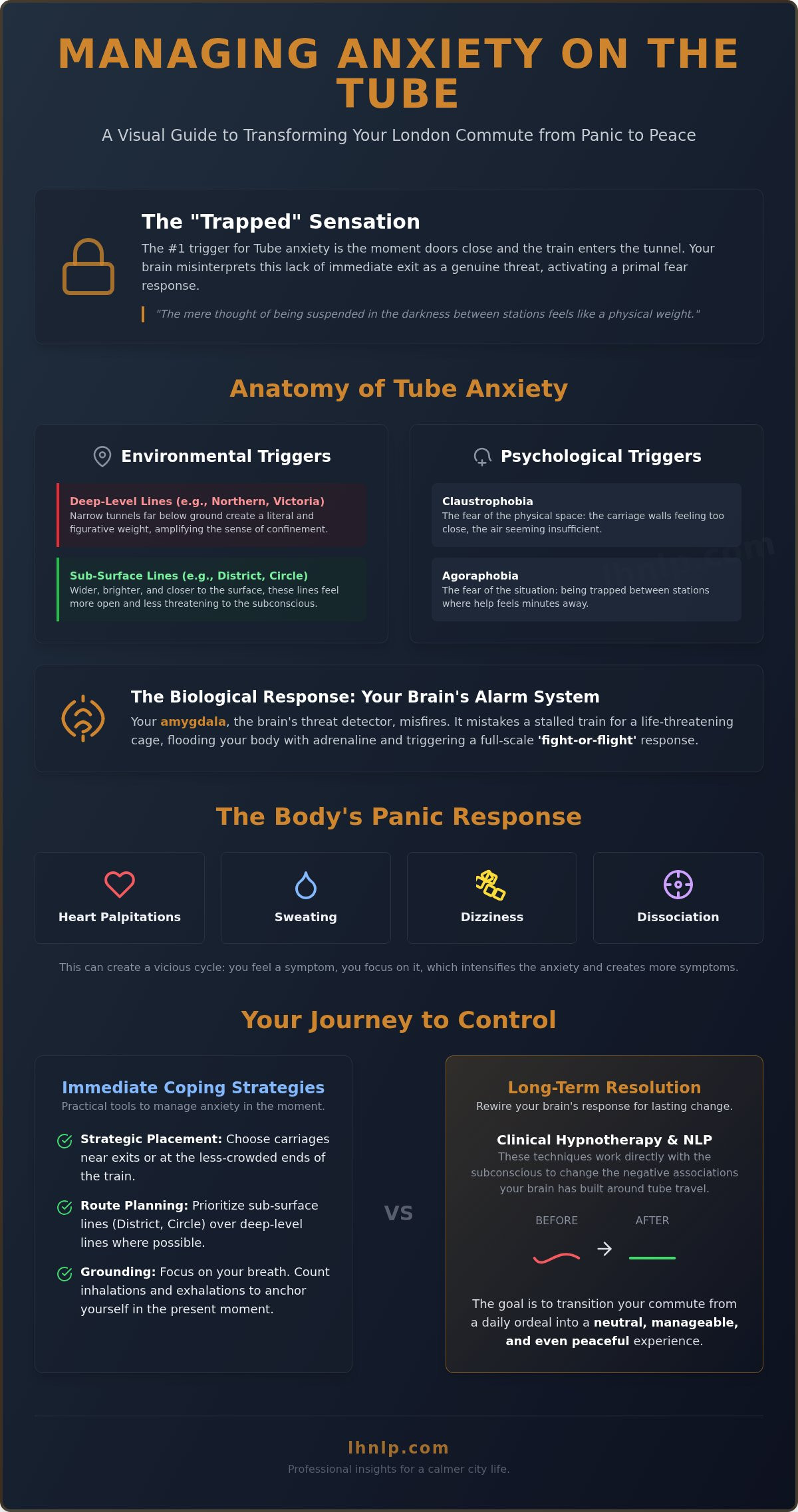
The sensation of being trapped is often more pronounced on deep-level lines, such as the Northern or Victoria lines, compared to sub-surface lines like the District or Circle. Deep-level tunnels are narrower and sit much further below the earth’s surface, creating a literal and figurative weight of soil and concrete above the carriage. This physical reality feeds the subconscious mind’s fear of confinement. The #1 trigger for most commuters is the precise moment the doors chime, the rubber seals meet, and the train plunges into the darkness of the tunnel. In that second, the option to leave is removed, and the mind must grapple with the reality of being “between stations.”
Claustrophobia vs. Agoraphobia on the Tube
While often used interchangeably, these two conditions drive different internal narratives. Understanding Claustrophobia is essential because it focuses on the physical confinement of the carriage itself; the feeling that the walls are too close or the air is insufficient. Agoraphobia, however, is frequently about the distance between safe points. On the Tube, an agoraphobic response is triggered by the knowledge that the next station is two minutes away, and help cannot reach you until the doors open again. Recognizing which fear is dominant allows for a more tailored approach in professional anxiety treatments, as we can address either the fear of the space or the fear of the “trap.”
The Role of the Amygdala in Commuter Panic
The amygdala acts as your brain’s primitive smoke detector, a small almond-shaped structure designed to scan for threats and initiate the fight-or-flight response. When a train stops unexpectedly in a tunnel, your amygdala doesn’t see a signal failure; it sees a life-threatening cage. This misfire sends an immediate surge of adrenaline through your system. You might feel your heart race or your palms sweat as your body prepares to fight a threat that isn’t there. This physiological cascade happens in milliseconds, turning a simple transport delay into a full-scale internal emergency. Understanding that this is a biological error, rather than a personal weakness, is the first step in managing anxiety on the London underground effectively.
Common Physical Symptoms of Tube-Induced Anxiety
The physical manifestation of anxiety on the Tube often begins as a subtle shift in your internal environment. It might start with a light flutter in the stomach or a slight dampness on the palms. As the train moves deeper into the network, these “butterflies” can escalate into a full-scale panic attack. One of the most challenging aspects of managing anxiety on the London underground is the way the environment mimics the body’s alarm system. The stagnant air and rising temperatures in the carriages cause sweating and dizziness, which the brain then misinterprets as a sign of an impending medical emergency.
In more intense moments, you might experience dissociation. This is a protective mechanism where the carriage, the rattling sounds, and even the other commuters begin to feel surreal or distant. It’s a disorienting state, but it’s simply your mind’s way of trying to create distance from a perceived threat. If you’ve ever wondered if these reactions are normal, you can explore more about the Physical Symptoms of Anxiety: Are You Just Nervous? to understand how your body processes stress.
The Vicious Cycle of Symptom Checking
When you feel vulnerable, your attention naturally turns inward. You might find yourself constantly checking your pulse or monitoring the depth of your breath. This hyper-vigilance creates a feedback loop; the more you check, the more your brain assumes there is something worth worrying about. Many commuters also fall into the “Exit-Scanning” habit, where they obsessively track their progress on the Tube map. While this feels like it provides control, it actually keeps your nervous system in a state of high alert. Breaking this loop requires shifting your focus away from the internal “threat” and toward a neutral, grounded state.
Why You Won’t Actually Faint or Lose Control
A common fear among those struggling with Tube travel is the dread of fainting or “making a scene” in a crowded carriage. Biologically, however, fainting is usually caused by a sudden drop in blood pressure. During a panic response, your blood pressure actually spikes as your body prepares for action. This makes fainting highly unlikely. For more expert psychiatric insights on transport anxiety, it’s clear that while the sensations are intense, they are not dangerous. Your body is designed to survive these surges of adrenaline, not to collapse under them. If you feel that these physical responses have become unmanageable, exploring solution-focused anxiety therapy can help you regain your sense of composure and quiet the body’s alarm.
Immediate Coping Strategies vs. Long-Term Resolution
When you are in the middle of a panic response, your primary goal is survival. Many commuters rely on “Band-Aid” fixes like listening to loud music, scrolling mindlessly through a phone, or clutching a book. While these distractions might get you through a single stop, they often function as safety behaviors that reinforce the underlying problem. By relying on these tools, you are inadvertently telling your brain that the Tube is indeed a dangerous place you must hide from. To truly master managing anxiety on the London underground, we must distinguish between these temporary shields and the psychological work required for a permanent resolution.
A more effective approach involves Exposure with Response Prevention. This means staying on the train even when the urge to flee at the next station is overwhelming. By remaining in the environment until the peak of the fear naturally subsides, you prove to your nervous system that the threat is illusory. Tools like Transport for London’s Tube map for anxious passengers can help you plan routes with fewer tunnels, but the ultimate goal is to move beyond the need for such maps entirely.
Short-Term ‘SOS’ Techniques for the Tunnels
If you feel a surge of panic while between stations, sensory grounding can pull your focus back to the present. Try the 5-4-3-2-1 technique: identify five things you can see (the pattern on the seat, a specific advert), four things you can touch, three things you can hear, two you can smell, and one you can taste. Pair this with box breathing; inhale for four seconds, hold for four, exhale for four, and hold again. This rhythmic cycle forces your parasympathetic nervous system to engage, physically overriding the “fight or flight” response. In NLP coaching, we also use “anchoring,” where you learn to trigger a previously installed state of calm simply by pressing your thumb and forefinger together.
Why Professional Intervention is the Permanent Solution
While grounding techniques are vital for the moment, professional Anxiety Therapy in London seeks to uncouple the “train” from the “terror” at a subconscious level. Clinical hypnotherapy allows us to access the deeper parts of the mind where these automatic responses are stored. Instead of years of talk therapy, NLP and hypnotherapy work rapidly to recode how your brain interprets the closing of a carriage door. The objective isn’t just to “survive” your commute from Zone 4 to Zone 1, but to reach a point where the journey becomes a non-event. When the subconscious no longer perceives the tunnel as a trap, you regain the freedom to travel across the city with genuine indifference.
The Londoner’s Toolkit: Practical Tips for a Calmer Journey
While psychological reprogramming is the foundation of lasting change, your immediate experience can be significantly improved by mastering the environment itself. Managing anxiety on the London underground is often a matter of strategic choices. For instance, choosing the very front or very back carriage can provide a noticeable difference in airflow. These areas are frequently less congested and benefit from the train’s movement through the tunnel vents. If your route allows, prioritize the “sub-surface” lines like the District, Circle, or Hammersmith & City. These lines operate in larger tunnels with better ventilation and modern, air-conditioned trains, offering a far more spacious atmosphere than the deep-level tubes. For those who find that cycling is a better alternative for maintaining personal space and autonomy, you can check out Foundation Bike Fit to ensure your setup is optimized for a comfortable journey across London.
The Central and Northern lines present unique challenges due to their depth and the intensity of the heat. If you find yourself on these routes, remember that many Zone 1 stations are surprisingly close together. Knowing that Leicester Square is only a short walk from Covent Garden can provide a mental safety net, as you’re never truly “trapped” far from an exit. You should also view your journey as a “Badge of Honor.” It’s helpful to remember that many of the people sitting around you are likely experiencing similar levels of discomfort or sensory overload. You aren’t an outlier; you’re a resilient part of a shared city experience.
Creating a Positive Commuter Ritual
Instead of passive scrolling, which can increase feelings of fragmentation and anxiety, try using your journey for active meditation or focused listening. Curate a specific “Safe Journey” playlist or an audiobook that brings you a sense of calm and familiarity. Setting small, achievable goals is a powerful way to build confidence. Perhaps today you stay on for just one more stop than you did yesterday. Each successful minute on the train is a victory for your nervous system. If you’re ready to move beyond these practical tips and address the root cause of your fear, consider exploring professional phobia treatment to reclaim your commute.
How Hypnotherapy and NLP Can Rewire Your Commute
Most travel advice focuses on avoidance, suggesting you take the bus or walk instead of facing the tunnels. While these choices provide temporary relief, they ultimately shrink your world and reinforce the idea that the city is a place of danger. True mastery in managing anxiety on the London underground comes from addressing the neurological pathways that link the Tube to a sense of terror. Kamalyn Kaur utilizes Neuro-Linguistic Programming (NLP) to help you reframe the Underground as a neutral transport tool. Through a process of subconscious re-coding, we can replace the automatic “trap” response with a calm, indifferent state. Many clients who once lived with agoraphobic avoidance now commute daily without a second thought, having reclaimed their agency.
This internal shift is not about willpower; it’s about changing the data your brain processes. When you work with a London NLP Practitioner, you learn to interrupt the panic loop before it gains momentum. By addressing the root cause rather than just the symptoms, you move from a state of constant vigilance to one of quiet confidence. You deserve to move through London without the weight of an invisible cage holding you back.
The Power of Visualisation and Anchoring
Visualization allows you to build a “mental safe space” that remains accessible even on a packed Jubilee Line train at rush hour. By using the NLP “Swish Pattern,” we replace the vivid, intrusive image of a potential panic attack with a compelling, detailed image of yourself arriving at your destination feeling composed. We also employ anchoring, a technique where a specific physical touch triggers a flood of calm sensations on command. These methods often work significantly faster than traditional talk therapy because they communicate directly with the subconscious mind, where phobias reside. These tools ensure that managing anxiety on the London underground becomes an automatic, effortless process.
Taking the Next Step Toward Freedom
In a clinical hypnotherapy session with Kamalyn, you aren’t just discussing your fear; you are actively dismantling its structure. We explore the internal architecture of your anxiety to ensure that your brain no longer misinterprets the closing of a carriage door as a threat. For those who find the prospect of traveling to Harley Street or Ealing initially overwhelming, Virtual Hypnotherapy offers a bridge to recovery from the safety of your own home. If you are ready to stop letting the Tube map dictate your career and social life, Contact London Hypnotherapy & NLP to begin your journey toward lasting freedom of movement.
Reclaiming Your Freedom Across the Capital
The journey from feeling trapped in a tunnel to traveling with a sense of indifference is a path of methodical inner change. You have learned that while environmental hacks and sensory tools provide immediate relief, the true resolution lies in addressing the subconscious triggers that misinterpret transit as a threat. Managing anxiety on the London underground is no longer a matter of white-knuckling your way through the morning rush; it’s about realigning your nervous system to recognize your inherent safety.
Kamalyn Kaur brings over 20 years of clinical experience as a specialist in anxiety and phobia resolution to help you navigate this transition. Whether you visit our centrally located clinics in Harley Street and Ealing or prefer the comfort of virtual sessions, the goal remains the same: to move through the city without the weight of panic. You don’t have to settle for a life of avoidance or expensive detours. Take the first step toward a calm, confident commute and Book a Consultation with Kamalyn Kaur to Reclaim Your Commute. Your world is ready to expand again, and the freedom to travel is closer than it feels.
Frequently Asked Questions
Is it common to have panic attacks on the London Underground?
It is remarkably common for commuters to experience panic attacks while traveling through the city. The combination of deep-level tunnels, high temperatures, and the dense proximity of other passengers creates a high-sensory environment that can easily trigger the brain’s alarm system. You aren’t alone in this experience; many Londoners manage similar feelings of dread every day. Acknowledging that this is a shared urban challenge is a vital first step in managing anxiety on the London underground effectively.
Can hypnotherapy really cure a phobia of the Tube?
Hypnotherapy is a powerful tool for resolving travel phobias because it works directly with the subconscious mind where automatic fear responses are stored. Instead of just managing symptoms, clinical hypnotherapy helps you uncouple the association between the Tube and a sense of danger. By reprogramming these deep-seated neurological pathways, you can reach a state where boarding a train becomes a neutral, non-event. Many clients find this solution-focused approach provides lasting freedom from avoidance.
What is the best Tube line to take if you have anxiety?
Generally, the sub-surface lines like the District, Circle, and Hammersmith & City are the most comfortable for anxious travelers. These lines use larger tunnels and modern, air-conditioned trains that feel more spacious than the deep-level routes. If you must use a deep-level line, the Elizabeth line is an excellent alternative due to its wide platforms and high-ceilinged stations. Choosing these routes can significantly reduce the physical sensations of being trapped or overheated.
What should I do if I feel a panic attack starting between stations?
If you feel panic rising while the train is in motion, focus on grounding your senses immediately. Press your feet firmly into the floor and identify three specific sounds you can hear over the engine noise. Use a rhythmic breathing pattern, such as inhaling for four seconds and exhaling for six, to signal to your nervous system that you are safe. Remember that the sensation is temporary and your body is biologically designed to survive this surge of adrenaline.
How many NLP sessions do I need to feel comfortable on the Tube again?
The number of sessions required varies depending on the individual, but NLP is known for its speed compared to traditional talk therapies. Most clients begin to notice a significant shift in their comfort levels within two to four sessions. Because we focus on recoding the brain’s automatic response rather than analyzing the past, the process is efficient and goal-oriented. We aim to get you back to your normal routine as quickly as possible.
Will I lose control or embarrass myself during a Tube panic attack?
It is highly unlikely that you will lose control or faint during a panic attack. While you feel a surge of energy, your blood pressure actually rises during a “fight or flight” response, which prevents the drop in pressure that causes fainting. Most other commuters are deeply absorbed in their own phones or thoughts and won’t notice your internal struggle. Your body is working hard to protect you, not to cause you to collapse.
Is it safe to use noise-cancelling headphones if I’m anxious?
Yes, noise-cancelling headphones are an excellent tool for sensory management on the network. Reducing the intense auditory “screech” of the tracks can prevent your nervous system from becoming over-stimulated. By creating a controlled auditory environment, you allow your mind to stay grounded in your chosen music or meditation. This simple adjustment can make the difference between feeling overwhelmed and feeling in control of your immediate surroundings during the journey.
Can I have therapy for Tube anxiety online if I can’t travel to the clinic?
Virtual hypnotherapy sessions are a highly effective option if you aren’t yet ready to travel into central London. We use Zoom or Skype to conduct full clinical sessions that are just as impactful as in-person appointments. This allows you to begin the work of managing anxiety on the London underground from the safety of your home. Once your confidence grows, you may then feel ready to visit our Harley Street or Ealing clinics.