

The first step in learning how to stop being so critical of myself isn’t to silence every harsh thought. It’s to notice the thought without treating it as the truth. Pause and ask what evidence supports it, then consider a more balanced response. A kinder inner voice doesn’t excuse mistakes. It helps you learn from them without turning one difficult moment into a judgement about your whole self.
If your inner critic seems to be protecting you from failure or other people’s disapproval, simply telling yourself to “be positive” may not feel convincing. Change can begin more gently: notice the thought, understand the feeling beneath it and choose how to respond. This article explores common patterns such as all-or-nothing thinking, the value of spending time with supportive people and ways to speak to yourself with the care you’d offer a friend. It also explains why criticising yourself for having critical thoughts can prolong the cycle, and how to meet those thoughts with patience instead. You don’t need to get it right every time. Start by noticing what’s happening inside, then practise a more compassionate response.
Key Takeaways
- Explore how earlier relationships may shape your inner critic, without treating the past as a fixed verdict on who you are.
- Notice patterns such as all-or-nothing judgements, overgeneralising and comparing yourself with idealised standards.
- Make room for supportive connections and small, regular moments of contact when you’re tempted to withdraw.
- Let self-kindness include the moments when you fall back into criticism; noticing the pattern is part of changing it.
How Do I Stop Self-Criticism?
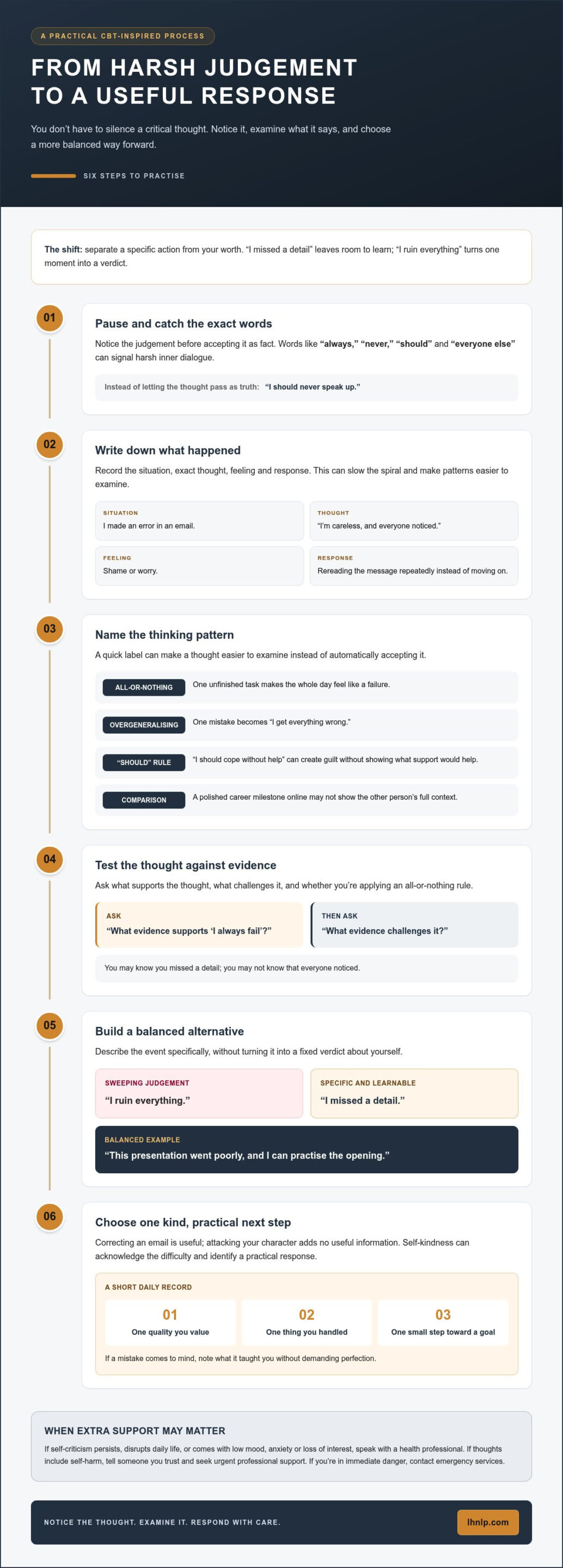
Start by noticing a harsh thought, separating a specific action from your worth, and choosing a useful response. “I missed a detail” leaves room to learn; “I ruin everything” turns one moment into a verdict. It’s easier to approach how to stop being so critical of myself when you examine a thought rather than obey it.
To explore how self-compassion can change your relationship with self-judgement, watch this TEDx talk:
Origins and Protective Role of Self-Criticism
Self-criticism is a harsh way of evaluating yourself, and early relationships may shape its tone. Controlling, less affectionate parenting is associated with greater self-criticism in adulthood, and people who have experienced abuse tend to be more self-critical. The habit may also feel protective: criticising yourself first can seem like a way to prevent rejection or soften the impact of someone else’s criticism. Recognising this possible function can help you ask whether the response still serves you today.
Identifying Feelings and Recording Critical Thoughts
Look for the feeling beneath a judgement, because it can point to what needs attention. If “I’m greedy” comes up after comfort eating, pause and ask whether you feel stressed, lonely, tired or deprived. Write down the situation, exact thought and emotion. This can slow the spiral and make patterns easier to examine. If self-criticism persists, disrupts daily life, or comes with low mood, anxiety or loss of interest, speak with a health professional. If thoughts include self-harm, tell someone you trust and seek urgent professional support. If you’re in immediate danger, contact emergency services.
Challenging Negative Thoughts With CBT
Cognitive behavioural therapy (CBT) techniques can help you test thoughts rather than accept them as facts. Ask what evidence supports “I always fail,” what evidence challenges it, and whether you’re applying an all-or-nothing rule. Then form a balanced alternative: “This presentation went poorly, and I can practise the opening.” If you’re wondering how to stop being so critical of myself, this approach shifts attention from a sweeping judgement to a specific behaviour and a useful next step.
Daily Exercises for Self-Esteem and Self-Acceptance
Build self-esteem with a short daily record of effort, progress and personal strengths. Note one quality you value, one thing you handled and one small step towards a goal. If a mistake comes to mind, write what it taught you without demanding perfection. Practise self-acceptance by speaking to yourself as you might speak to a friend: acknowledge the difficulty, then identify a kind, practical response. Accepting a limitation doesn’t stop you changing what you can.
Recognising critical thoughts and behaviours
Self-criticism often arrives as a quick judgement rather than a considered assessment. You miss a deadline and think, “I’m useless,” instead of, “I underestimated how long this task would take.” The difference matters: one describes a changeable situation, while the other turns it into a fixed verdict about you. Notice the exact words your mind uses before deciding whether they’re fair.
Absolute terms can make a thought sound more certain than the evidence allows. Words such as “always,” “never,” “should” and “everyone else” can signal harsh inner dialogue. After stumbling over an answer in a meeting, you might conclude, “I should never speak up.” One awkward moment has become a rule for every future conversation. Ask whether the thought describes this event or predicts every event to come.
Look for common thinking patterns. All-or-nothing thinking treats a partly successful day as a total failure because one task remains unfinished. Overgeneralising turns a single mistake into “I get everything wrong.” A “should” statement, such as “I should cope without help,” can create guilt without identifying what support would be useful. Naming the pattern makes it easier to examine instead of automatically accepting it.
Comparison can distort your perspective, too. You might compare your ordinary Tuesday with someone else’s polished career milestone online. Those snapshots don’t show the same context. Ask what you actually know about the other person’s circumstances and what you’re assuming. Then bring your attention back to your own priorities, such as completing a report or resting after a demanding day.
Notice what you do after a critical thought. Do you replay a conversation, avoid a task or dismiss praise? After receiving positive feedback, for example, you might decide the other person was “just being nice.” Record the situation, thought, feeling and response to see what the criticism leads you to do.
- Situation: I made an error in an email.
- Thought: I’m careless, and everyone noticed.
- Feeling: Shame or worry.
- Response: I reread the message repeatedly instead of moving on.
Review your note and separate evidence from assumption. Perhaps you know you missed a detail, but you don’t know that everyone noticed. Correcting the email is a practical response; attacking your character adds no useful information. If you’re asking how to stop being so critical of myself, start by describing the event precisely. That gives you something specific to address.
Try this check when a judgement appears: “What happened, what am I telling myself, and what would I say if a friend made the same mistake?” Returning to those questions can help you notice how to stop being so critical of myself in everyday moments, without expecting every negative thought to disappear. If self-judgement repeatedly fuels anxiety and makes daily tasks harder, support for anxiety may help you consider a next step.
Spending time with supportive people
Self-criticism can make reaching out feel risky, so you may withdraw when you most need connection. A supportive conversation can offer another perspective without dismissing what you feel. After a difficult meeting, for example, a trusted friend might help you distinguish one awkward comment from the belief that you failed completely. Their response won’t decide your worth, but it can interrupt solitary, repetitive thinking.
Choose people who listen, respect boundaries and respond to mistakes with care. Support doesn’t mean agreeing with everything you say or offering instant solutions. It might mean a friend asking, “What would help right now?” instead of telling you to stop worrying. Notice how you feel after spending time together: calmer and able to think clearly, or more ashamed and on edge? That can help you decide which relationships feel supportive.
Make connection practical instead of waiting until you feel confident enough to ask. A weekly phone call, a short lunch together or a walk after work can create regular points of contact. If anxiety makes a long conversation feel difficult, send a message such as, “I’ve had a hard day. Could we talk this week?” A small invitation is still a meaningful step away from isolation.
- Ask for listening: “Could you hear me out before offering advice?”
- Name what helps: “A reminder of what went well would help me see this more clearly.”
- Choose a manageable plan: Suggest a brief call or lunch, rather than an open-ended commitment.
Pay attention to repeated interactions, not one imperfect conversation. Regular exposure to people who criticise, belittle or compare you with others can reinforce a harsher view of yourself. If someone responds to a mistake with “You always get things wrong,” you can set a boundary: “I’m willing to discuss what happened, but not through insults.” Then notice whether their behaviour changes.
Sometimes a relationship becomes a continuing source of suffering and unhappiness. In that situation, creating distance or leaving may be healthier over the long term, especially when attempts to set boundaries bring no change. Consider the pattern, its effect on your daily life and whether you feel safe. You don’t have to make a major decision after one disagreement. Focus on repeated behaviour and seek trusted support as you weigh your options.
Supportive relationships can help you practise a fairer view of yourself, but you don’t have to hide difficult feelings. Try sharing one specific experience with someone you trust, then notice what changes in your thinking. Connection can begin with a small step: a message, a call or simply accepting an invitation.
Using a supportive inner voice
A supportive inner voice is honest about difficulty without attacking your character. If you miss a train after leaving late, “I’m hopeless” offers no useful direction. “I’m frustrated, and I can leave earlier next time” recognises the mistake and points towards a change. Self-compassion can support behaviour change more effectively than self-criticism because it lets you learn without adding shame.
Try interrupting the first wave of blame with a simple word: “Stop.” Then ask what a supportive inner cheerleader might say. After a work presentation feels clumsy, that voice could answer, “You lost your place, but you finished and can practise the opening.” The aim isn’t to pretend everything went perfectly. It’s to describe what happened fairly and choose a next step.
Speaking to yourself as you would to a friend makes compassion practical. Imagine a friend telling you, “I made a mistake and feel embarrassed.” You probably wouldn’t call them a failure. You might acknowledge their feelings, offer perspective and help them decide what to do. Use that same sequence with yourself: name the feeling, respond with understanding, then identify one manageable action.
- Name the moment: “I’m worried about the conversation I had.”
- Offer empathy: “It makes sense that I’m unsettled.”
- Choose a response: “I can clarify my meaning tomorrow.”
If harsh thoughts pull you away from the present, take three deep breaths and notice your feet on the floor. This brief pause can create space between a thought and your reaction. You might then picture a supportive person offering empathy and forgiveness for an ordinary mistake. Ask what they would notice: perhaps you apologised, corrected an error, or kept trying despite feeling nervous.
Make self-support visible with a gratitude diary. Each day, write down one quality you appreciate, one effort you made and one small sign of progress. For example, you might value your patience, record that you asked for help and note that you returned to a task after a setback. These entries build a more balanced account than a mental record that contains only mistakes.
Keep the language believable. If “I’m brilliant at everything” feels false, try “I’m learning to handle this” or “One mistake doesn’t define the whole day.” A kinder inner voice doesn’t remove responsibility. It helps you take responsibility without treating self-punishment as the price of improvement.
Avoiding meta-criticism
Meta-criticism means judging yourself for having a self-critical thought. You might think, “I’m useless,” then add, “I shouldn’t think like this.” That second judgement creates another layer of blame instead of helping you respond to the first thought. Notice both as mental events, not instructions you have to follow.
Your inner critic may have developed for a reason. If criticism once seemed likely at home, for example, blaming yourself first might have felt like a way to prepare or protect yourself. Recognising that possible purpose doesn’t mean agreeing with the critic or keeping its old rules. It means approaching the habit with curiosity and asking whether it helps you now.
Try gently naming the process: “There’s the self-critical voice again.” This creates distance without pretending the thought has vanished. If you make an error in a work email, you might notice, “I’m criticising myself because I’m worried about being judged.” That observation identifies a concern beneath the blame, while leaving you free to correct the email and continue your day.
When the thought appears, you don’t have to argue with it immediately. Let it pass without responding, then return to the task in front of you. If your mind says, “You’re terrible at this,” while you’re cooking, notice the sentence and bring your attention back to chopping vegetables. The point isn’t to force calm. It’s to avoid giving every critical thought a prolonged debate.
Some people find it helpful to use their own name or speak in the third person. Instead of “I always mess things up,” try, “Sam is worried about getting this wrong.” The change can make the thought feel less like a fact and more like a reaction. Then choose one useful action, such as checking the instructions or asking a clear question.
If you criticise yourself for falling back into criticism, use a simple reset:
- Notice: “I’m judging myself for having that thought.”
- Allow: “This pattern may have tried to protect me.”
- Redirect: “What needs my attention right now?”
For instance, after snapping at a family member, you might first blame yourself for the reaction, then blame yourself for feeling guilty. A reset can help you focus on repairing the conversation instead. You could acknowledge your sharp tone, apologise and consider what made you feel overwhelmed. That is accountability without self-punishment.
Practising this response can help you develop a less hostile relationship with difficult thoughts. If anxiety makes self-judgement difficult to manage, explore support for anxiety as a possible next step.
London Hypnotherapy & NLP: Hypnotherapy for Anxiety
London Hypnotherapy & NLP offers Hypnotherapy for Anxiety for people whose anxious thoughts and self-criticism are affecting everyday life. If you’ve practised noticing critical thoughts and responding more kindly, but still feel caught in recurring patterns, personalised, solution-focused sessions can help you explore what you’d like to change and work towards practical ways forward. The focus is on your concerns and goals, rather than judging yourself for finding change difficult. Hypnotherapy is one option for anxiety support; it doesn’t mean you’ve failed at self-help or need to silence every difficult thought. You can discuss whether this approach fits your needs and what you hope to work on. Contact London Hypnotherapy & NLP to take the next step.
Choose a Kinder Next Step
You don’t have to become free of difficult thoughts before you begin making changes. The next time self-judgement appears, try responding with curiosity rather than treating it as a command. If the question “how to stop being so critical of myself” still feels difficult to answer alone, support can help you explore the patterns behind it and decide what you’d like to work on next.
London Hypnotherapy & NLP offers Hypnotherapy for Anxiety, Hypnotherapy for Weight Loss and Hypnotherapy for Smoking Cessation. Its personalised sessions can help you explore patterns that affect your wellbeing and goals. Seeking support is a considered choice, not a sign that you’ve failed to make progress by yourself.
Contact London Hypnotherapy & NLP to discuss a possible next step. A more compassionate relationship with yourself can begin with one small, deliberate choice.
Frequently Asked Questions
Why do I criticise myself so much?
Self-criticism can feel like a way to stay in control or avoid being judged. If you expect a mistake to bring disapproval, blaming yourself first may seem protective, even when it leaves you feeling worse. Ask what the critical voice is trying to prevent in a specific situation, such as a difficult conversation or a new responsibility. Understanding its intention can help you choose a response that fits your present circumstances.
What causes harsh self-criticism and negative self-talk?
Harsh self-talk can grow from learned expectations, perfectionism, overthinking or fear of rejection. For instance, someone who believes they must never disappoint colleagues may interpret a routine request for revisions as proof of failure. Repeated comparisons can also make personal standards feel impossible. Rather than searching for a single cause, notice when the pattern grows stronger, such as before feedback, after conflict or while taking on unfamiliar work.
How can I recognise when I am being overly critical of myself?
You may be overly critical when a small setback becomes a sweeping judgement or stops you taking reasonable action. After forgetting an appointment, for example, you might avoid making another because you expect to fail again. Notice whether you dismiss praise, repeatedly seek reassurance or spend longer reviewing a mistake than correcting it requires. These patterns can show when self-evaluation has shifted into self-punishment.
What practical steps can help reduce self-critical thoughts?
Choose one recurring situation and make a short written plan. If feedback at work triggers self-blame, note what you want to clarify, what action you can take and when you’ll move on. You could ask a trusted colleague which part needs changing, rather than guessing what they think. A specific plan turns your attention towards the task and helps prevent one concern from taking over your decisions.
How can I practise self-compassion and positive self-talk?
Use language that is kind but believable, especially after a setback. Instead of “I’m perfect as I am,” try, “I can be disappointed and still treat myself fairly.” You might also write yourself a brief note before a challenging event, in the tone you’d use for someone you care about. This supports self-respect without denying responsibility, making encouragement feel more grounded than forced positivity.
What professional help is available in the UK for persistent self-criticism?
If self-criticism persists, increases anxiety or interferes with daily life, consider speaking with a GP or mental health professional about suitable support. In London, London Hypnotherapy & NLP offers Hypnotherapy for Anxiety and NLP Coaching. These options can be considered in relation to your needs, but they aren’t substitutes for urgent help if you’re at risk of harming yourself. If you’re in immediate danger, contact emergency services.