
What if the “side effects” you’re worried about aren’t caused by hypnotherapy at all, but by the nicotine your body is finally being freed from? It’s a reframe worth sitting with, especially if concerns about hypnotherapy to stop smoking side effects have been quietly holding you back from making the decision you already know you want to make.
That hesitation is completely understandable. The idea of being hypnotized carries decades of theatrical baggage, and the prospect of quitting smoking brings its own set of fears: the irritability, the cravings, the creeping anxiety about weight gain. These are real concerns, and they deserve honest answers rather than reassuring dismissal.
This article gives you exactly that. You’ll find a clear, grounded explanation of what clinical hypnotherapy actually does to the mind and body, why it’s considered safe, and how a skilled practitioner uses it not to create discomfort, but to significantly ease the withdrawal experience that makes quitting so difficult for so many people. By the end, you’ll also have a practical sense of what a session looks like when you’re ready to take that step in London.
Key Takeaways
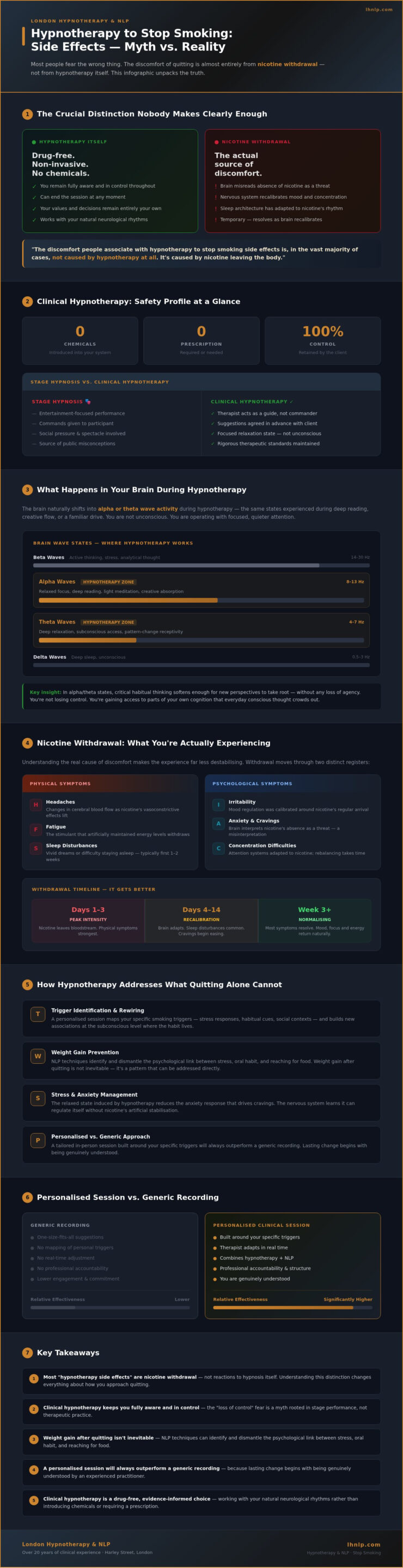
- Most hypnotherapy to stop smoking side effects are actually symptoms of nicotine withdrawal — not reactions to hypnosis itself — and understanding this distinction changes everything about how you approach quitting.
- Clinical hypnotherapy keeps you fully aware and in control throughout the session; the “loss of control” fear is a myth rooted in stage performance, not therapeutic practice.
- Weight gain after quitting isn’t inevitable — NLP techniques can identify and dismantle the psychological link between stress, oral habit, and reaching for food.
- A personalised session built around your specific smoking triggers will always outperform a generic recording, because lasting change begins with being genuinely understood.
- With over 20 years of clinical experience, Kamalyn Kaur at London Hypnotherapy & NLP combines hypnotherapy and NLP into a tailored, in-person approach that gives your commitment the professional structure it deserves.
Is Hypnotherapy to Stop Smoking Safe? Addressing Common Fears
Safety is the right question to ask. And the honest answer is that clinical hypnotherapy, when practised by a qualified therapist, is one of the most gentle interventions available for behavioural change. It introduces no chemicals into your system, requires no prescription, and leaves no physical trace. What it does introduce is something far more valuable: a structured opportunity for your mind to work differently.
Clinical hypnosis is a collaborative therapeutic process, not a state of unconsciousness. You remain aware, responsive, and entirely capable of ending the session at any moment you choose. That distinction matters enormously, and it’s the foundation on which every concern about hypnotherapy to stop smoking side effects deserves to be examined.
Clinical Hypnosis vs. Stage Hypnosis
The image most people carry into a first session comes from television: a swinging pocket watch, a commanding voice, a volunteer clucking like a chicken. Stage hypnosis is entertainment, carefully constructed around willing participants and social expectation. It has almost nothing in common with what happens in a professional clinical environment.
In a London clinic, particularly in settings like Harley Street where therapeutic standards are rigorously maintained, the therapist functions as a facilitator rather than a commander. Kamalyn Kaur’s role, for instance, is to guide you into a state of focused relaxation where your own mind becomes more receptive to change. Nothing is imposed. The suggestions offered during a session are ones you’ve agreed to in advance, aligned with your specific goal of stopping smoking. Your values, your boundaries, and your decisions remain entirely your own throughout.
The Science of Suggestibility
During a hypnotherapy session, the brain naturally shifts into alpha or theta wave activity. These are the same states you move through when you’re deeply absorbed in a book, or when you’ve driven a familiar route and arrived without consciously registering every turn. You weren’t unconscious during those moments. You were simply operating with a quieter, more focused quality of attention.
This is precisely what makes the hypnotic state both safe and therapeutically useful. The critical, habitual thinking that keeps old patterns locked in place softens just enough for new perspectives to take root. There’s no loss of agency in that process. There’s actually a gain of it, because you’re accessing parts of your own cognition that everyday conscious thought tends to crowd out.
For anyone weighing up hypnotherapy to stop smoking side effects against the known harms of continued smoking, this context reframes the risk calculation entirely. A drug-free, non-invasive approach that works with your natural neurological rhythms isn’t a gamble. It’s a considered, evidence-informed choice.
Hypnosis vs. Withdrawal: Distinguishing the Side Effects
Here’s the distinction that almost no one makes clearly enough: the discomfort people associate with hypnotherapy to stop smoking side effects is, in the vast majority of cases, not caused by hypnotherapy at all. It’s caused by nicotine leaving the body. These are two entirely different processes, and conflating them is one of the main reasons people approach the idea of quitting with more dread than the method itself warrants.
Nicotine is a powerfully adaptive substance. Over time, your nervous system reorganises itself around its presence, calibrating mood regulation, concentration, and even sleep architecture to assume nicotine will arrive at regular intervals. When it doesn’t, the brain interprets that absence not as freedom, but as a threat. It reads the gap as something wrong. That misinterpretation is where almost all of the discomfort originates.
Common Nicotine Withdrawal Symptoms
Understanding what you’re actually dealing with makes the experience far less destabilising. Withdrawal tends to move through two distinct registers:
- Physical symptoms: Headaches are common in the first few days, driven by changes in cerebral blood flow as the vasoconstrictive effects of nicotine lift. Fatigue follows, as the stimulant that was artificially maintaining your energy levels withdraws. Sleep disturbances, including vivid dreams or difficulty staying asleep, are also frequently reported during the first one to two weeks.
- Emotional symptoms: Irritability, low mood, and a restless inability to concentrate tend to peak within the first seventy-two hours and gradually ease over two to four weeks in those quitting without support. Anxiety is particularly common, often because smoking had become the default response to stress, and the psychological void it leaves feels disproportionately large.
That void is worth pausing on. It’s not just a craving for nicotine. It’s the sudden absence of a ritual, a rhythm, a coping mechanism that may have been in place for years or even decades. The body heals relatively quickly. The mind takes longer, because it’s grieving a habit that once felt like a friend.
How Hypnotherapy Acts as a Buffer
This is precisely where hypnotherapy earns its place in the process. Rather than leaving you to white-knuckle through withdrawal, a skilled therapist works at the level where these signals are generated and interpreted. One of the most effective techniques involves cognitive reframing: guiding the subconscious mind to recognise a craving not as a demand, but as a healing signal. The body is recalibrating. The discomfort is evidence of recovery in progress. That shift in meaning changes everything about how the experience is felt.
Hypnotherapy also directly addresses the heightened fight-or-flight response that quitting can trigger. By inducing a state of deep, focused relaxation, the session trains the nervous system to find calm without the chemical prompt of nicotine. The anxiety that withdrawal provokes becomes less overwhelming when the mind has been given an alternative pathway to steadiness.
It’s this combination of neurological reframing and emotional recalibration that makes clinical hypnotherapy genuinely different from simply deciding to stop. You’re not just removing something. You’re rebuilding the internal architecture around its absence. Learn more about the smoking cessation treatments available at London Hypnotherapy & NLP to understand how this approach is structured in practice.
Managing Post-Quitting Side Effects: Weight Gain and Stress
Weight gain after quitting smoking isn’t a metabolic inevitability. It’s the predictable result of habitual substitution, and it’s precisely the kind of pattern that hypnotherapy can identify and dismantle before it takes hold. Understanding why it happens is the first step toward making sure it doesn’t happen to you.
When a cigarette disappears from someone’s life, it doesn’t just take nicotine with it. It takes a rhythm. A pause. A socially acceptable reason to step away from a desk, a difficult conversation, or a moment of boredom. The mouth, the hands, the nervous system: all of them have been trained to expect something at regular intervals. When that something is removed, the brain begins scanning for a replacement. And food, particularly anything quick, sweet, or salty, is almost always the nearest available candidate.
This is what clinicians call the oral substitution trap. It’s not weakness. It’s a conditioned response, and it operates largely beneath conscious awareness, which is exactly why willpower alone so rarely prevents it.
Preventing Weight Gain After Quitting
The psychological hunger that follows quitting isn’t really about food. It’s about reward. Cigarettes delivered a reliable dopamine signal, and the brain, suddenly deprived of that signal, begins seeking it elsewhere. A skilled hypnotherapist works at this level directly, using suggestion and NLP techniques to redirect that reward-seeking behaviour toward responses that genuinely serve you: a glass of water, a short walk, a few deliberate breaths. These aren’t consolation prizes. They become anchored, automatic responses that satisfy the same neurological need without the caloric consequence. Explore the full range of treatments available at London Hypnotherapy & NLP, including how weight management and smoking cessation work together within the same integrated framework.
Stress Management Without the Cigarette
One of the most persistent myths in the quitting conversation is that smoking relieves stress. It doesn’t. Nicotine creates the very anxiety it appears to soothe, by raising heart rate and cortisol levels, then temporarily easing the withdrawal it caused in the first place. The relief smokers feel is the partial resolution of a problem the cigarette itself created.
Breaking that loop requires more than information. It requires the subconscious to genuinely believe that calm is available through other means. NLP anchoring techniques, practised during sessions and reinforced through self-hypnosis between appointments, give the nervous system exactly that: a reliable, drug-free pathway to steadiness. A specific breath pattern, a physical gesture, a mentally rehearsed image can all be conditioned to trigger the same parasympathetic response that smokers mistakenly attribute to their cigarettes.
For people working in London’s high-pressure professional environments, this is particularly valuable. When the 11am deadline hits and the old reflex fires, having an anchor that works in thirty seconds, without leaving your desk or your dignity, changes the entire experience of being a non-smoker. Addressing hypnotherapy to stop smoking side effects like stress reactivity at this level is what separates a genuinely transformative session from a temporary fix.
What to Expect During Your Smoking Cessation Session in London
No two smokers are identical. The person who lights up with their morning coffee has a completely different psychological relationship with cigarettes than the one who smokes only under deadline pressure, or the one who’s tried patches, gum, and sheer willpower three times already. A generic recording can’t account for any of that. A skilled clinician can.
This is the fundamental reason why working with Kamalyn Kaur at London Hypnotherapy & NLP produces results that pre-recorded hypnosis sessions rarely replicate. The process isn’t a script delivered to a passive recipient. It’s a carefully constructed conversation between a trained practitioner and the specific mind sitting across from her, one that begins long before the formal hypnosis starts.
The Initial Consultation and Goal Setting
The first part of your session is dedicated entirely to understanding your history. Kamalyn will explore when you started smoking, what triggers are most deeply embedded, whether previous quit attempts revealed particular patterns of relapse, and what your relationship with cigarettes has actually been serving. That last question is more important than it sounds. For many people, smoking has been managing something: anxiety, boredom, social discomfort, or a need for structured pauses in the day. Identifying that function is what allows the session to address the root rather than just the symptom.
Together, you’ll also establish a clear Quit Date, not as an arbitrary deadline, but as a psychological anchor. When the subconscious mind has a specific, agreed-upon point of change to orient toward, the work of the session becomes far more precise. Ambiguity is the enemy of lasting change; clarity accelerates it. Contact us to book your initial consultation and begin that process with the structure it deserves.
The Hypnosis and NLP Integration
Once the groundwork is laid, the session moves naturally into a deeper register. Kamalyn guides you into a state of focused relaxation through a gradual induction process, not a dramatic shift, but a gentle settling, similar to the quality of attention you have just before sleep arrives. You remain aware throughout.
Within this receptive state, NLP techniques are woven into the therapeutic work. Swish patterns redirect the mental image associated with craving toward a more empowering alternative. Anchoring installs a physical or mental cue that can trigger calm on demand, which directly addresses one of the most persistent hypnotherapy to stop smoking side effects concerns: what to do when stress hits and the old reflex fires.
Emerging from a session, most clients describe feeling unexpectedly clear-headed and settled, sometimes lighter than they’ve felt in years. That quality of calm isn’t a side effect. It’s the point. Understanding how hypnotherapy to stop smoking side effects are managed within this integrated framework is far easier when you can explore the full approach firsthand. Sessions are available in Ealing, Harley Street, and online via Zoom, making professional support accessible wherever you are in London or beyond.
Choosing a Professional Path to Freedom with London Hypnotherapy & NLP
Twenty years of clinical practice teaches you things that training alone never can. It teaches you which patterns of relapse are most common, which triggers clients consistently underestimate, and how to read the difference between someone who’s genuinely ready to change and someone who’s still negotiating with themselves. That depth of experiential knowledge is what Kamalyn Kaur brings to every smoking cessation session at London Hypnotherapy & NLP, and it’s precisely what separates a truly personalised intervention from a competent but generic one.
The solution-focused approach at the heart of Kamalyn’s practice is worth understanding clearly. The goal isn’t to help you become a smoker who’s trying not to smoke. It’s to guide your identity across a threshold: from someone who smokes, to someone who simply doesn’t. That distinction sounds subtle. It isn’t. The smoker who’s resisting a cigarette is fighting themselves every hour. The non-smoker who’s moved past the habit has nothing left to resist. Hypnotherapy and NLP, working together, are uniquely equipped to facilitate that shift at the level where identity actually lives: beneath conscious reasoning, in the subconscious patterns that govern automatic behaviour.
For those concerned about hypnotherapy to stop smoking side effects, this identity-level work matters enormously. Cravings lose their grip when they’re no longer addressed to someone who still considers themselves a smoker.
Our London Locations: Harley Street and Ealing
London Hypnotherapy & NLP operates from two carefully chosen locations. Harley Street carries a well-established reputation for clinical excellence and discretion, providing an environment that immediately communicates seriousness of purpose. The Ealing clinic extends that same professional standard to West London, making high-quality support more accessible across the city. Both settings offer the kind of calm, confidential atmosphere that allows therapeutic work to happen at genuine depth. Read more about our London practice and the values that shape how sessions are conducted.
In-person sessions also carry something that recordings and apps simply can’t replicate: accountability and rapport. When a skilled clinician is present with you, reading your responses and adjusting the session in real time, the therapeutic relationship itself becomes part of the intervention. That human attunement is not incidental. It’s central to why the results hold.
Long-term Support and Multi-Session Benefits
Some clients achieve a clean break in a single session. Others benefit from returning to reinforce new habits as they encounter the specific situations, the social occasions, the stressful afternoons, where old reflexes once operated automatically. A multi-session approach isn’t a sign that something isn’t working. It’s a sign that lasting behavioural change is being built properly, layer by layer, rather than hoped for in a single sitting.
The commitment at London Hypnotherapy & NLP is always to long-term transformation rather than temporary relief. View our definitive guide to hypnotherapy in London for a fuller picture of how clinical hypnosis and NLP work across different therapeutic goals.
For those outside London, virtual sessions via Zoom bring the same personalised, solution-focused approach to wherever you are. The quality of the therapeutic relationship doesn’t diminish with distance. What matters is the skill of the practitioner and the readiness of the person in the chair, whether that chair is in Harley Street or at home. Explore online hypnotherapy options and find the format that works best for you.
Addressing hypnotherapy to stop smoking side effects with professional support isn’t a luxury. It’s the difference between quitting and staying quit.
Your Decision to Stop Smoking Deserves Professional Support
The concerns that brought you to this article, whether about safety, withdrawal discomfort, or what happens to your stress levels without a cigarette, all have clear, honest answers. Hypnotherapy to stop smoking side effects are, in the vast majority of cases, symptoms of nicotine leaving your body rather than anything the therapy itself creates. That distinction matters, because it means the method working with you is gentle, drug-free, and built around your own mind’s capacity to change.
What makes the difference between quitting temporarily and staying quit permanently is the quality of support around that decision. Kamalyn Kaur brings over 20 years of clinical experience to every session, integrating NLP and hypnotherapy into a personalised approach that addresses your specific triggers, not a generic script. Sessions are available at Harley Street, Ealing, and online via Zoom.
You already know you want to stop. Now you have the structure to make it last. Book your smoking cessation session with London Hypnotherapy & NLP and take that step with the professional support it deserves.
Frequently Asked Questions About Hypnotherapy to Stop Smoking
Can hypnotherapy for smoking have negative side effects?
Genuine negative side effects from clinical hypnotherapy itself are rare. Some people notice mild, temporary drowsiness or a dreamlike quality of mind immediately after a session, both of which pass within minutes. What clients more commonly experience are symptoms of nicotine withdrawal: headaches, irritability, and disrupted sleep. These aren’t caused by the hypnotherapy. They’re evidence that your body is clearing a substance it no longer needs.
Will I be ‘stuck’ in hypnosis or lose control of my mind?
You won’t be stuck, and you won’t lose control. Hypnosis is a naturally occurring state of focused attention, not unconsciousness. You remain aware throughout, you can hear everything in the room, and you can end the session at any point you choose. No suggestion can be implanted against your values or wishes. The therapeutic relationship depends entirely on your willing participation, which means control stays with you from start to finish.
How many sessions of hypnotherapy are needed to stop smoking?
This varies depending on how long you’ve smoked, how deeply embedded your triggers are, and whether previous quit attempts revealed particular patterns. Some clients achieve a lasting shift in a single session. Others benefit from returning to reinforce new responses as they encounter high-pressure situations where the old habit once operated automatically. Kamalyn Kaur tailors the number of sessions to your specific circumstances rather than following a fixed formula.
Does hypnotherapy to stop smoking help with anxiety and irritability?
Yes, and this is one of the most clinically meaningful aspects of the approach. Hypnotherapy to stop smoking side effects like anxiety and irritability are addressed directly within the session by training the nervous system to access calm through its own resources rather than through nicotine. NLP anchoring techniques give you a reliable, portable tool for managing stress responses in real time, which is particularly valuable in the first few weeks after quitting when those responses are most acute.
Is it possible to quit smoking in just one session of hypnotherapy?
It’s genuinely possible, and it does happen. A single well-structured session with an experienced clinician can be enough to shift the subconscious relationship with smoking decisively, particularly when the client arrives with clear motivation and a specific Quit Date already in mind. That said, it’s more accurate to think of the first session as the foundation rather than the whole building. Whether one session is sufficient becomes clearer in the weeks that follow.
What happens if I don’t feel ‘hypnotized’ during the session?
Most people don’t feel dramatically different during hypnosis, and that’s completely normal. The hypnotic state feels less like a trance and more like being deeply absorbed in something, relaxed but aware. If you were expecting a switch to flip, the subtlety of the experience can feel anticlimactic. But the therapeutic work is still happening. Many clients who report feeling “not very hypnotized” during a session notice meaningful changes in their cravings and responses in the days that follow.
Can I drive home after a smoking cessation hypnotherapy session?
Is hypnotherapy for smoking cessation covered by health insurance in the UK?
Coverage varies significantly between insurers and individual policy terms. Some private health insurance providers in the UK do include hypnotherapy as a recognised complementary therapy, particularly when it’s delivered by a qualified clinician, but many standard policies don’t cover it as standard. The most reliable approach is to contact your insurer directly before booking and ask specifically whether smoking cessation hypnotherapy is included under your plan. London Hypnotherapy & NLP can confirm session details that you may need to provide to your insurer.