

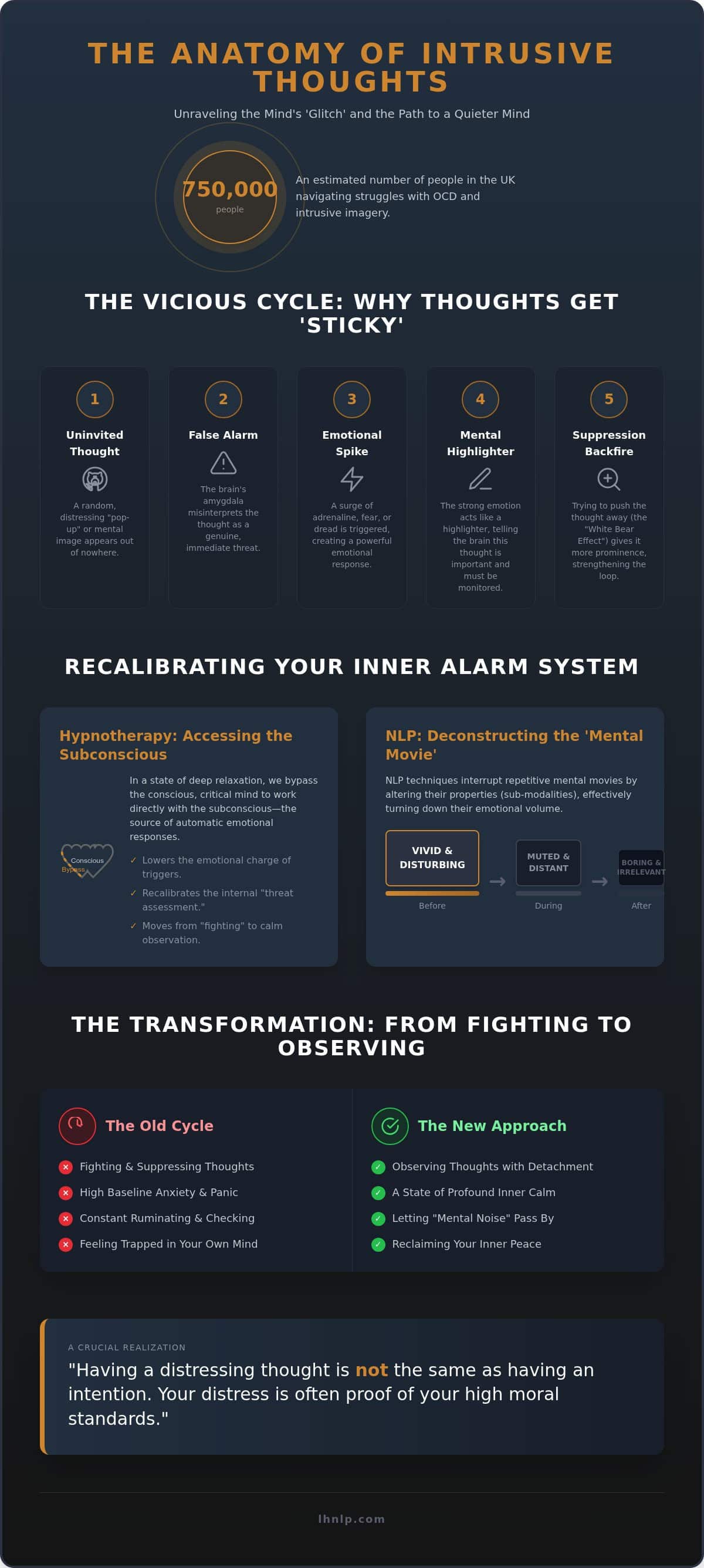
What if the most distressing images flashing through your mind aren’t a dark reflection of your character, but simply a “glitch” in your brain’s protective alarm system? It’s a heavy burden to carry, especially when an estimated 750,000 people in the UK are navigating similar struggles with OCD and intrusive imagery. You likely feel exhausted from the constant “checking” or ruminating, perhaps even fearing that these thoughts make you a “bad” person. It’s a lonely experience that often leads to high levels of baseline anxiety and a sense of being trapped within your own consciousness.
If you’re searching for hypnotherapy for intrusive thoughts London based practitioners can offer a transformative way to quiet the noise and regain control. You’ll learn how clinical hypnotherapy and NLP work together to retrain your subconscious, allowing you to dismiss distressing thoughts without the typical surge of panic. This article explores how to move toward a “boring” mind and find freedom from the shame that has held you back for too long. By understanding the mechanics of your mind, you can begin the methodical process of reclaiming your inner peace.
Key Takeaways
- Understand why suppressing distressing mental “pop-ups” often makes them stronger and how to break the cycle of the “white bear” effect.
- Discover how clinical hypnotherapy for intrusive thoughts London allows you to access the subconscious and recalibrate the brain’s internal threat assessment.
- Learn how Neuro-Linguistic Programming (NLP) techniques can interrupt repetitive “mental movies” by altering the sub-modalities of your intrusive imagery.
- Explore the journey of a personalised treatment plan within a safe, non-judgemental clinical space designed to lower the emotional charge of your triggers.
- Gain insight into why proactive subconscious retraining is more effective than waiting for thoughts to resolve on their own.
Understanding Intrusive Thoughts: Why Your Mind Won’t Let Go
Intrusive thoughts often arrive as uninvited guests, mental “pop-ups” that disrupt your daily flow with distressing imagery or repetitive questions. For many, these experiences feel like a betrayal of the self, yet they’re a common facet of the human condition. Understanding Intrusive Thoughts involves recognizing that they’re often the brain’s way of scanning for danger. While most people experience fleeting, odd ideas that pass within seconds, those seeking hypnotherapy for intrusive thoughts London based specialists often find these patterns have become “sticky” and persistent. This happens because of the “white bear” effect; the harder you try to suppress a thought, the more prominence your brain gives it. Your mind begins to believe that the thought itself is the danger, creating a relentless cycle of checking and anxiety. While many clinical approaches immediately link these experiences to an OCD diagnosis, it’s essential to recognize that intrusive thoughts can exist as standalone anxiety patterns without formal compulsions.
To gain a deeper perspective on how to manage these mental patterns and quiet the internal noise, watch this helpful guide:
Common Types of Intrusive Thoughts
These mental interruptions vary widely, yet they often target what we value most. Relationship “what-ifs” can create a constant cycle of social anxiety and doubt, leading you to ruminate on whether you said the “wrong” thing. Others face harm-based or “taboo” thoughts that feel deeply disturbing because they conflict with their true character. This is often seen in “Pure O,” where the obsessions are mental rather than visible physical compulsions. It’s vital to remember that having a thought isn’t the same as having an intention; your distress is actually proof of your high moral standards.
The Anxiety Loop: How Thoughts Become Sticky
The brain’s amygdala acts as a smoke detector. When a random, unpleasant thought occurs, the amygdala may misinterpret it as a genuine threat. This triggers an emotional “spike” of adrenaline or fear. This surge of feeling acts like a highlighter, telling your brain that this specific thought is important and must be monitored at all costs. If you have high moral standards, you’re more likely to be horrified by these thoughts, which provides the emotional fuel that keeps the loop running. Breaking this cycle requires a methodical recalibration of the subconscious mind to recognize these thoughts as the “boring” noise they truly are.
By understanding that these “glitches” are simply your brain over-functioning in its attempt to protect you, you can begin the process of letting go. If you’re ready to explore how this works, you can learn more about us and our clinical approach to mental clarity.
How Hypnotherapy for Intrusive Thoughts Works in London
The persistent nature of intrusive thoughts often stems from a disconnect between your conscious logic and your subconscious alarm system. You likely know, intellectually, that these thoughts are irrational or do not reflect your true self, yet your body continues to react with a surge of adrenaline and dread. This is because the subconscious mind is operating on outdated “threat assessment” software. To understand How Hypnotherapy Works, we must look at how it bypasses the critical conscious mind to reach the deeper layers where these automatic responses are stored. By utilizing a gentle, therapeutic trance, we can lower the emotional charge of specific triggers, allowing you to move from a state of “fighting” your mind to one of observing it from a place of profound calm.
In our clinical sessions, we adopt the role of a compassionate guide rather than a distant expert. This “wise mentor” approach ensures that you aren’t just a passive recipient of therapy, but an active participant in your own recalibration. When seeking hypnotherapy for intrusive thoughts London clients often find that the most significant breakthrough comes when they realize they no longer need to fear their own imagination. It’s a methodical process of proving to your nervous system that you are safe, even when a “glitchy” thought appears on the horizon.
Recalibrating Your Subconscious Alarm System
Your subconscious mind is currently treating every intrusive thought like an emergency siren that demands immediate action. Through clinical hypnosis, we teach the deeper mind to recognize these mental events as “junk mail” rather than “urgent alerts.” Hypnotherapy acts as a bridge between the conscious desire for peace and the subconscious habit of worry. By breaking the conditioned response of panic that follows a thought, we allow the brain’s amygdala to stand down. Over time, the thoughts lose their “stickiness” because they no longer trigger the emotional spike that once kept them cemented in your awareness.
The Power of Therapeutic Suggestion
Once the baseline anxiety is lowered, we use bespoke suggestions to reinforce your true identity and core values. These are not generic affirmations; they are carefully crafted narratives that align with who you actually are, creating a protective barrier against distressing imagery. We help you build “mental filters” that allow intrusive thoughts to pass through your awareness without sticking or causing a disruption to your day. This clarity is essential for reclaiming your mental space. You can learn more about our treatments and how they are tailored to individual needs to ensure lasting change.
Combining NLP and Hypnosis for Mental Clarity
While deep subconscious work is the foundation of hypnotherapy for intrusive thoughts London sessions often become significantly more effective when paired with Neuro-Linguistic Programming (NLP). NLP allows us to dissect the specific language patterns and mental structures that keep anxiety alive. Have you ever noticed that your intrusive thoughts often appear as vivid, loud, or overwhelming “mental movies”? By identifying the sub-modalities of these images, we can consciously alter their impact. We might turn a bright, terrifying image into a small, grainy, black-and-white photograph that sits far off in the distance. This isn’t about ignoring the thought; it’s about changing its “technical settings” so it no longer triggers a visceral emotional response.
Kamalyn Kaur integrates clinical intervention with solution-focused coaching to ensure you aren’t just “fixed,” but truly empowered. Many traditional therapies spend months dwelling on the “why” behind a thought, which can inadvertently reinforce the loop by giving it more attention. We focus on the “how.” How does the thought start? How does your body react? By focusing on the mechanics of the mind, we can implement practical changes immediately. This dual approach bridges the gap between deep subconscious healing and the conscious, day-to-day management of your mental state. It’s a methodical way to reclaim your focus.
Pattern Interrupts and Reframing
Intrusive loops thrive on repetition. We use NLP pattern interrupts to “scramble” these cycles before they gain momentum. It’s also helpful to reframe the experience entirely. What if your mind isn’t broken, but simply over-active and highly creative? Your brain is trying to protect you, albeit in a misguided way. We also teach “anchoring,” a technique where you can trigger a state of instant calm by touching a specific point on your hand. This is particularly useful for those navigating the high-pressure environments of busy London commutes or stressful office settings. You learn to stop the loop before it starts.
Building Cognitive Resilience
The ultimate goal is a profound shift in identity. You move from being a “victim” of your thoughts to being the “director” of your own mind. NLP provides the conscious toolkit that supports the deep subconscious work of hypnosis. This ensures that even after your sessions end, you have the skills to maintain your mental peace. If you find that these thoughts are part of a broader pattern of worry, you might also benefit from exploring Therapy for Anxiety in London to address the underlying baseline stress. You deserve a mind that feels like a sanctuary, not a source of distress.
What to Expect: Your Journey at Our London Clinics
Stepping into a therapy room should feel like entering a sanctuary rather than a clinical interrogation. When you seek hypnotherapy for intrusive thoughts London based sessions with Kamalyn Kaur are designed to be a partnership of mutual respect and deep understanding. We recognize that the nature of these thoughts can often feel shameful or frightening to voice. Because of this, our approach focuses on creating a non-judgemental space where you can exhale. You aren’t here to be judged for the content of your mind; you’re here to recalibrate the mechanics of how you process it.
Your journey begins with a thorough understanding of your unique experience. We don’t believe in one-size-fits-all solutions because every mind has its own rhythm and its own way of “glitching.” By identifying your specific triggers and the emotional weight they carry, we can build a roadmap toward a quieter, more predictable internal life. It’s a methodical process that respects your individual boundaries while pushing toward meaningful change.
Your First Session with Kamalyn
The initial consultation is where we lay the groundwork for your mental peace. We’ll discuss your specific patterns and set clear, achievable goals for what “control” looks like to you. One of the most common myths we address is the idea of “mind control.” In reality, clinical hypnosis is a collaborative state where you remain fully in charge throughout the session. Importantly, you do not need to share every detail of your thoughts for the therapy to be effective. We can work with the structure and the emotional “spike” of the thought without you ever having to describe the imagery itself if it feels too distressing to do so.
A Multi-Location Approach for Busy Londoners
London is a city that demands much of our time and energy, which is why we offer flexibility in how and where we meet. You might prefer the clinical excellence and prestige of our Harley Street location, or perhaps the neighborhood accessibility of Ealing or the central convenience of Tokenhouse Yard. Each clinic provides a quiet, professional environment tailored to deep focus. For those with demanding schedules or who prefer the comfort of their own home, virtual hypnotherapy provides the same level of efficacy via Zoom or Skype. You can learn more about our London practice and Kamalyn’s background to see how we can best support your journey. Whether you visit us in person or online, our goal remains providing the most effective hypnotherapy for intrusive thoughts London can offer. If you’re ready to quiet the noise and reclaim your focus, contact us today to take that first step.
Take the First Step Toward a Quieter Mind
Reclaiming your mental peace is a methodical journey that begins with a single, decisive step. Throughout this exploration, you’ve seen how the brain’s alarm system can misfire, turning harmless “mental noise” into a source of profound distress. You now understand that these thoughts aren’t a reflection of your character, but a habit of the subconscious that can be broken. By choosing hypnotherapy for intrusive thoughts London, you’re opting for a structured, clinical approach that moves beyond temporary relief toward lasting mental clarity. The path from a mind filled with “mental movies” to one that is quiet and predictable is not only possible; it’s a process we navigate together with care and precision.
It’s a common mistake to believe that these patterns will simply fade with time. In reality, the more we ruminate or “check” our thoughts, the more we reinforce the neural pathways that keep anxiety alive. Waiting for clarity to arrive on its own often leads to deeper exhaustion and a more entrenched sense of fear. Investing in professional, clinical-grade hypnotherapy allows you to interrupt these cycles at their root. You deserve to experience a day where your mind is a supportive ally rather than a source of constant vigilance.
The Cost of Inaction vs. the Value of Peace
Consider how much of your daily energy is currently diverted into managing intrusive imagery or repetitive “what-if” scenarios. This mental tax affects your productivity at work, your presence with your family, and your overall quality of life. A solution-focused approach doesn’t just quiet the thoughts; it frees up that hijacked energy for the things that truly matter to you. When you choose to address these patterns, you’re building long-term cognitive resilience that will serve you in every area of your life. For more information on the breadth of our clinical techniques, you can explore our Hypnotherapy London Guide.
Contact Kamalyn Today
Taking the first step toward change can feel daunting, but you’ll be supported by a practitioner who understands the intricate “glitches” of the human mind. You can begin your journey by using the contact form on our website to share a few brief details about your experience. Whether you choose to meet at our Harley Street, Ealing, or Tokenhouse Yard clinics, or prefer the flexibility of virtual sessions, the goal remains the same: reclaiming your focus. Peace of mind is a skill that can be learned through the right methodology and guidance. If you’re ready to experience the relief of a quieter mind, Book your session with Kamalyn today and start your transformation.
Your Path to Lasting Mental Clarity
Living with a mind that feels like an adversary is exhausting, but it doesn’t have to be your permanent reality. We’ve explored how these mental “pop-ups” are simply misfiring signals that can be retrained through a methodical and compassionate process. By integrating clinical hypnosis with the practical strategies of NLP, you move from reacting with panic to observing with calm. You’ve learned that your distress is actually a sign of your high values, and that professional hypnotherapy for intrusive thoughts London provides the specific framework needed to reclaim your focus and silence the noise.
Kamalyn Kaur brings over 20 years of expertise to this journey, offering a non-judgemental and solution-focused approach at our prestigious Harley Street and Ealing clinics. You don’t have to navigate these dark mental loops alone. Peace is a skill that can be mastered with the right guidance and a commitment to your own well-being. Book your initial consultation with Kamalyn today to begin recalibrating your subconscious alarm system. You deserve a future where your thoughts are finally “boring” and your mind is a place of genuine rest.
Frequently Asked Questions
Is hypnotherapy for intrusive thoughts safe?
Clinical hypnotherapy is entirely safe and non-invasive, as you remain in complete control of your mind throughout the session. It isn’t a form of sleep or mind control; rather, it’s a state of deep, focused relaxation similar to being engrossed in a compelling movie. You cannot be made to do or say anything that contradicts your core values or true character during the process.
Will I have to talk about the specific content of my “bad” thoughts?
You are not required to disclose the specific, distressing details of your thoughts for the therapy to be successful. We focus on the mechanics of the anxiety loop and the emotional “spike” the thoughts trigger. By addressing the structure of your internal “mental movies” rather than their content, we can lower the distress levels while maintaining your total privacy and comfort.
How many sessions will I need to see results?
Most clients start to notice a meaningful shift in their mental clarity within 3 to 6 sessions. Because our approach is solution-focused and integrates NLP, we prioritise efficient and lasting results over long-term analysis. The exact number of sessions depends on your individual goals and the complexity of your current thought patterns, but we always work toward a “boring,” quiet mind.
Can hypnosis help with Pure O (Obsessional thoughts without compulsions)?
Yes, hypnotherapy for intrusive thoughts London is particularly effective for Pure O because it targets the subconscious loops where obsessions reside. We work to recalibrate your brain’s threat assessment, teaching your mind to treat these “pop-ups” as irrelevant noise. By lowering the emotional charge of the thoughts, we break the cycle of rumination and help you find a sense of lasting inner peace.
What is the difference between hypnotherapy and CBT for intrusive thoughts?
CBT works with your conscious logic, while hypnotherapy addresses the subconscious patterns where the automatic panic response is triggered. While CBT helps you understand the “why,” hypnotherapy helps your nervous system feel the “how” of letting go. Many people find that accessing the subconscious allows for a more profound emotional reset that conscious willpower alone often finds difficult to achieve in isolation.
Do you offer hypnotherapy for intrusive thoughts in Harley Street?
We offer specialist sessions at our prestigious Harley Street clinic, providing a discreet and professional setting for your recovery. This Central London location is ideal for those seeking clinical expertise in a world-renowned medical district. We also provide hypnotherapy for intrusive thoughts London at our Ealing and Tokenhouse Yard offices, ensuring you can access high-quality support in a location that feels most convenient for you.
Can I do hypnotherapy sessions online if I live outside London?
Virtual sessions via Zoom or Skype offer the same clinical efficacy as in-person appointments, allowing you to access support from anywhere. This is an excellent option if you live outside London or find that your anxiety makes travelling to a clinic feel overwhelming. You’ll receive the same compassionate, solution-focused care from the safety and familiarity of your own home, which often facilitates deeper relaxation.
This flexibility ensures that even if you are traveling or seeking VIP concierge holistic healing Fort Lauderdale, you can maintain a consistent focus on your mental health and cognitive resilience from any location.
What happens if I cannot be hypnotised?
Hypnosis is a natural state of focused attention that almost everyone can experience. If you’ve ever been “lost” in a book or missed a motorway exit while daydreaming, you’ve already been in a trance. We use a variety of induction methods tailored to your specific personality and learning style. Even a light state of relaxation is sufficient to begin making significant, positive changes to your mental well-being.