

Imagine it’s two weeks before your long-awaited family holiday, but instead of feeling excitement, you’re gripped by a familiar, cold dread that makes you consider cancelling the entire trip. If you’ve been searching for hypnotherapy for fear of flying London, you already know that logical facts about aviation safety do little to quiet a racing heart or a mind filled with “what-if” scenarios. It’s a frustrating paradox where your rational mind knows you’re safe, yet your subconscious triggers a full-scale survival response. You aren’t alone in this struggle. Recent data suggests that up to 30% of adults experience flight anxiety, a figure that has risen significantly in our post-pandemic world.
I understand that relying on medication or alcohol just to endure a journey isn’t the true freedom you’re looking for. You want to walk onto that plane feeling empowered, focusing on the memories you’re about to make rather than the turbulence you’re trying to avoid. This article explores how clinical hypnotherapy and NLP can effectively reprogram your subconscious response to flying, allowing you to board your next flight with calm, unshakeable confidence. We’ll examine how a solution-focused approach can help you reclaim your independence and finally embrace the gift of travel without the heavy weight of anticipatory anxiety.
Key Takeaways
- Understand why your rational mind can’t talk your body out of a panic response and how to bridge the gap between logic and emotion.
- Discover how your subconscious acts as an outdated security system, mistakenly anchoring fear to the flying experience.
- Compare the limitations of temporary coping mechanisms with the deep, lasting transformation offered by hypnotherapy for fear of flying London.
- Learn a practical five-step sensory framework to manage anxiety spikes during turbulence or take-off in real-time.
- Explore a solution-focused approach that combines clinical expertise with empathy to achieve rapid results in just a few sessions.
What is Aerophobia? Why Logic Fails to Ground the Fear
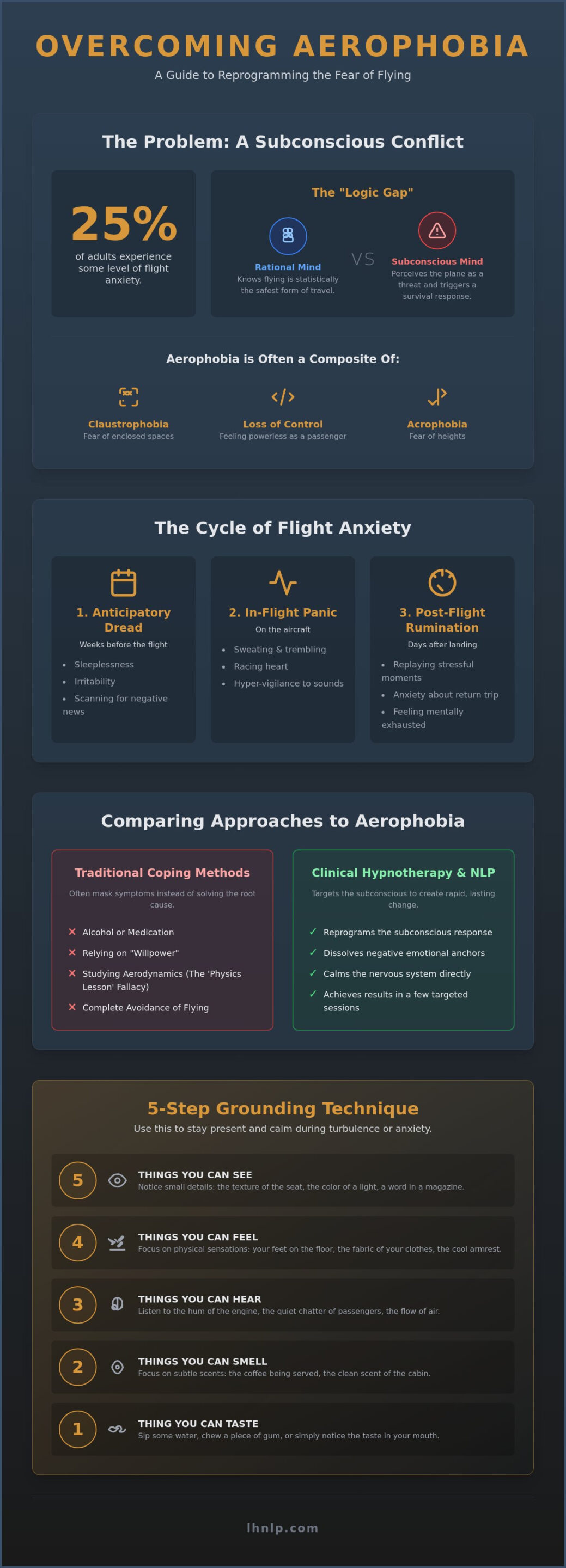
Aerophobia is rarely a standalone issue. It is often a complex psychological structure that weaves together various threads of anxiety. For many, Fear of flying is closely intertwined with other specific triggers, such as claustrophobia, the fear of enclosed spaces, or acrophobia, the fear of heights. When you seek hypnotherapy for fear of flying London, you’re likely struggling with the “Logic Gap.” This is the frustrating disconnect where your rational mind understands that aviation is statistically the safest mode of transport, yet your nervous system responds as if you’re facing an immediate, life-threatening predator. Your heart races and your breath quickens despite the calm voice of the pilot over the intercom.
This internal conflict is often exacerbated by the “Spotlight Effect.” While sitting in the cabin, you might feel a crushing sense of self-consciousness, convinced that every passenger and crew member is observing your mounting panic. For professionals in the City or Canary Wharf, this fear carries a heavy price. It isn’t just about a missed holiday; it often leads to avoided international conferences, lost networking opportunities, and stalled career milestones. To learn more about how Sheikh Najam provides premium commissioner for oaths services for urgent travel documents in Central London, you can ensure your logistics are as prepared as your mindset. The world becomes smaller as your professional reach is limited by the boundaries of a railway map.
To better understand how the mind can transform these fears and how professional support makes a difference, watch this helpful video:
Common Symptoms: From Anticipatory Dread to Panic
The experience of aerophobia begins long before you reach the boarding gate. Anticipatory dread can manifest weeks in advance, resulting in pre-flight sleeplessness and a constant state of irritability. On the day of travel, physical symptoms like trembling, nausea, and sweating become dominant. You might find yourself in a state of hyper-vigilance, where every slight change in engine pitch or a routine “ding” from the galley sends a jolt of adrenaline through your body. This reaction often masks a deeper psychological need for total control. When you can’t “drive” the situation, your subconscious triggers a primal survival response that ignores all rational evidence of safety.
The ‘Physics Lesson’ Fallacy
Well-meaning friends often suggest reading books on aerodynamics to “cure” the fear. However, learning how a wing generates lift rarely resolves a deep-seated phobia because the fear doesn’t live in the rational, intellectual part of your brain. There is a vast difference between being a “nervous flyer” who feels a bit uneasy during turbulence and someone suffering from a clinical phobia that prevents them from functioning. If you find that knowing the facts does nothing to lower your pulse, it’s time to consider specialized phobia treatment in London. By using hypnotherapy for fear of flying London, we can address the emotional root of the response rather than just the intellectual symptoms, bridging the gap between what you know and what you feel.
The Subconscious Blueprint: How Your Mind Creates the Fear
Your subconscious mind is not your enemy; it is a dedicated, albeit occasionally misguided, security system. It operates on a blueprint designed for survival, but sometimes that blueprint contains outdated information. Imagine trying to run modern, complex tasks on faulty software from decades ago. When you step into an aircraft cabin, this internal software triggers a deafening alarm in an environment that is objectively safe. This is why hypnotherapy for fear of flying London is so effective. It doesn’t just silence the alarm; it updates the underlying software to reflect your current reality.
A phobia often begins with an “anchor.” This might be a single episode of severe turbulence, but it can also be a period of high stress in your personal life, such as a difficult career transition or a health scare, that your mind has mistakenly linked to the act of travel. Your Amygdala, the brain’s emotional sentry, doesn’t distinguish between a physical threat and a psychological one. It simply initiates the “Fight, Flight, or Freeze” response, flooding your system with adrenaline and cortisol. Research into The Power of Suggestion shows that we can use these same neurological pathways to heal rather than hinder, replacing panic with a sense of calm composure.
The Paradox of Control
High-achieving individuals often find the “passenger” status particularly distressing. In your professional life in London, you are likely the one in the driver’s seat, making decisions and managing outcomes. The subconscious interprets “letting go” as a life-threatening danger because it associates safety with active control. The Subconscious Protective Mechanism is a biological survival script that prioritises perceived safety over logical reality, often resulting in hyper-vigilance during air travel. If you feel ready to address these deep-seated patterns, exploring solution-focused treatments can be the first step toward lasting change.
The Power of Visualisation and Imagination
Your mind is a master filmmaker. It cannot easily distinguish between a real external threat and a vividly imagined internal “movie” of a catastrophe. Catastrophic thinking reinforces the phobic response by rehearsing disaster over and over, training your body to react to a crisis that isn’t happening. NLP (Neuro-Linguistic Programming) identifies these internal movies, helping you change their structure. By making these mental images smaller, quieter, and less impactful, we can neutralise their emotional charge. This process shifts your internal narrative from one of inevitable doom to one of quiet, confident indifference, allowing you to board your flight without the burden of an overactive imagination.
Hypnotherapy vs. Traditional Methods for Flying Phobias
Many people spend years relying on “Conscious Coping” strategies like prescribed medication or slow-breathing exercises. While these tools can help you survive a specific journey, they rarely address why the panic exists in the first place. They are essentially emotional bandages. This is where hypnotherapy for fear of flying London offers a distinct advantage by shifting the focus from managing symptoms to achieving “Subconscious Transformation.” You don’t just want to endure a flight; you want to reach a state where the fear simply no longer occurs.
Cognitive Behavioural Therapy (CBT) is often the first port of call for many, yet for rapid phobia release, it can feel like a slow process of intellectual negotiation. It requires you to consciously challenge thoughts that are being generated at a much deeper, subconscious level. Clinical hypnosis bypasses this critical faculty to facilitate change where the phobia actually lives. It’s a safe, clinical process where you remain fully awake and in complete control. You aren’t “under a spell”; you’re in a state of focused relaxation that allows for profound mental recalibration.
How Clinical Hypnosis ‘Rewires’ the Response
During a session, your brain enters the Alpha and Theta brainwave states. These are natural windows for rapid learning and neuroplasticity, similar to the state of mind you experience just before falling asleep. In this receptive space, we can use Clinical Hypnotherapy for Fear of Flying to replace old, reflexive associations. For instance, the subconscious can be guided to reframe “turbulence = danger” as “turbulence = movement,” much like a car driving over a slightly uneven road. For a deeper look at how this process works, you can explore our Definitive Guide to Hypnotherapy London.
NLP Techniques: Reframing the Flying Experience
Neuro-Linguistic Programming (NLP) provides a toolkit of practical techniques to distance yourself from fearful memories. One such method is the “Movie Screen” technique, which helps you visualise past stressful flights as if they’re playing on a distant, black-and-white screen, effectively draining them of their emotional power. We also utilise “Anchoring,” a process of creating a physical trigger, such as pressing your thumb and finger together, that instantly floods your system with a pre-programmed sense of calm and confidence. This is particularly useful for Londoners who need to maintain their composure while navigating the high-pressure, bustling environments of Heathrow or Gatwick. By combining these methods, results are often achieved in just 1 to 3 sessions, providing a swift return to your freedom of movement.
Practical Steps: Managing Flight Anxiety in Real-Time
While seeking hypnotherapy for fear of flying London provides the long-term solution by addressing the subconscious root, having a psychological first-aid kit for the journey itself is essential. When the cabin door closes, the mind often attempts to retreat into a fortress of fear. To counter this, we use a structured approach to remain present and composed. If you feel a spike of panic during take-off or turbulence, follow this five-step framework to regain your internal balance:
- Step 1: Sensory Grounding. Use the “5-4-3-2-1” technique. Identify five things you can see, four things you can touch, three things you can hear, two things you can smell, and one thing you can taste. This process pulls your attention away from internal panic and anchors it back into the physical environment of the cabin.
- Step 2: The Observing Mind. Distinguish between your “Inner Critic,” which generates fearful narratives, and your “Observing Mind.” Recognise that the thought “we are in danger” is merely a mental event, not an objective reality.
- Step 3: Activate Your Anchor. Trigger the NLP “Calm Anchor” we established in your sessions. By pressing your chosen physical trigger, you flood your nervous system with a pre-programmed state of confidence.
- Step 4: Vagal Breathing. Engage in diaphragmatic breathing by making your exhales longer than your inhales. This sends a direct physiological signal to the Vagus nerve that you are safe, effectively slowing your heart rate.
- Step 5: External Focus. Shift your attention from internal bodily sensations to a specific task. Count the number of passengers wearing glasses or read the safety card with clinical detail.
Taming Anticipatory Anxiety
The weeks leading up to a flight are often more exhausting than the journey itself. You might find yourself trapped in a “what if” loop, mentally rehearsing every possible disaster. To break this cycle, we use a technique called “Future Pacing.” Instead of imagining a crisis, you vividly rehearse the entire experience as a calm, successful event. You see yourself boarding with ease, enjoying a book, and landing with a sense of triumph. Research suggests that ten minutes of daily mental rehearsal can fundamentally alter how your nervous system interprets the flight experience. This proactive mental preparation prevents the “rebound anxiety” that many Londoners face after a period of not travelling.
The ‘Safe Haven’ Mental Exercise
For long-haul flights, creating a subconscious “safe space” allows you to retreat into a state of deep relaxation. This isn’t just a distraction; it’s a profound application of Stress Management in London. By lowering your overall baseline anxiety through these techniques, you ensure that your “cup” isn’t already full before you even reach the airport. This integrated approach is a cornerstone of professional hypnotherapy for fear of flying London. If you’re ready to stop surviving your flights and start enjoying your freedom to travel, contact Kamalyn Kaur today to begin your transformation.
The LHNLP Approach: Professional Flying Phobia Treatment in London
At London Hypnotherapy & NLP, we recognize that your relationship with travel is deeply personal. Kamalyn Kaur brings over 20 years of experience to her practice, offering a solution-focused philosophy that prioritizes rapid, lasting change over long-term analysis. We don’t just want to talk about your fear; we want to help you outgrow it. By choosing hypnotherapy for fear of flying London, you’re partnering with a specialist who understands the intricate architecture of the human mind and the specific pressures of modern travel.
Accessibility is a cornerstone of our service. Whether you prefer the clinical excellence of our Harley Street location, the convenience of our Ealing clinic, or the professional atmosphere of Tokenhouse Yard in the City, we provide a supportive environment for your transformation. Providing professional hypnotherapy for fear of flying London means meeting you where you are, both emotionally and geographically. For those who are already on the move or based internationally, our online hypnotherapy services offer the same high level of clinical care from the comfort of your own home. Each bespoke session typically lasts 50-60 minutes, and our goal is always to achieve rapid results, with most clients finding their freedom in just 1 to 3 sessions.
Bespoke Plans for Every Flyer
A “one size fits all” approach is often why traditional treatments fail to address complex fears like aerophobia. Your triggers might be rooted in a need for control, while another person’s might stem from claustrophobia or a previous traumatic experience. We integrate advanced NLP coaching to tailor every session to your specific neurological blueprint. This is particularly vital for high-stakes business travelers who cannot afford to let anxiety dictate their career trajectory. You can explore our full range of specialist treatments to see how we address the layers of anxiety that often accompany phobias.
Taking the First Step to Freedom
I understand that even the act of booking a session can trigger a wave of anticipatory anxiety. It’s a brave step to admit that a fear is holding you back, and we’ve designed our intake process to be as safe and supportive as possible. For individuals dealing with multiple related issues, such as a fear of heights or general social anxiety, we offer multi-session packages that allow for a comprehensive “mental reset.” Your journey toward unshakeable confidence starts with a single conversation. If you’re ready to reclaim your freedom to travel, book a consultation with London Hypnotherapy & NLP today and discover what life feels like when the sky is no longer a barrier.
Your Journey Toward Unrestricted Travel Starts Here
The sky doesn’t have to be a source of dread. We’ve explored how your mind creates these anchors of fear and why traditional logic often fails to provide lasting relief. By addressing the subconscious blueprint through a blend of clinical hypnosis and NLP, you can fundamentally transform your physiological response to air travel. You’ve learned that this fear is a misguided protective mechanism, one that can be updated to reflect your true safety and competence.
Whether you choose to visit our clinics in Harley Street, Ealing, or the City, Kamalyn Kaur’s 20 years of expertise ensures a solution-focused approach designed for rapid results. You have the inner resources to replace panic with a sense of calm, unshakeable confidence. Reclaiming your freedom to travel isn’t just about the flight; it’s about the life you can lead when the world is open to you once more. If you’re ready to leave anticipatory anxiety behind, professional hypnotherapy for fear of flying London offers a proven path toward empowerment. Your next journey could be the start of a new chapter of freedom; to ensure your travel documentation is also in order, you can explore Notarial and Private Client Legal Services with Staple Inn Notaries.
Ready to fly with confidence? Book your London or Virtual session today
Frequently Asked Questions
How many sessions of hypnotherapy will I need for fear of flying?
Most clients achieve profound and lasting shifts in just 1 to 3 sessions. Because our approach is solution-focused, we aim for rapid results that allow you to reclaim your freedom as quickly as possible. While a single session can often neutralize a specific trigger, a short series of sessions helps to consolidate your new sense of calm and ensures your subconscious blueprint is fully updated for your next journey.
Is hypnotherapy for fear of flying safe if I have general anxiety?
Clinical hypnotherapy is entirely safe and is often highly beneficial for individuals who struggle with broader anxiety. By addressing the specific phobia of flying, we often find that a client’s overall baseline stress levels begin to decrease. The process works in harmony with your nervous system, teaching your mind how to process perceived threats more effectively and building a foundation of internal resilience that carries over into other areas of life.
Will I be ‘put under’ or lose control during the session?
You won’t be “put under” or lose control at any point during clinical hypnosis. It’s a state of focused relaxation and heightened awareness where you remain fully aware of your surroundings and the therapist’s voice. You’re always the one in control of your own mind; the hypnotherapist simply acts as a professional guide to help you access the inner resources and subconscious pathways that are usually hidden by conscious stress.
Can hypnotherapy help with the fear of turbulence specifically?
Hypnotherapy is exceptionally effective for specific triggers like the fear of turbulence. We use NLP techniques to reframe the physical sensation of movement, shifting your subconscious interpretation from “imminent danger” to “routine motion.” By changing how your brain processes these sensory inputs, we can neutralize the automatic panic response, allowing you to experience the bumps of a flight with the same indifference as a car driving over a slightly uneven road.
Does hypnotherapy work for children who are afraid to fly?
Children are often the most receptive subjects for this work because of their naturally active imaginations and flexible mindsets. We adapt our techniques to be age-appropriate, helping them build a “mental toolkit” of safety and confidence through storytelling and visualization. Addressing these fears early can prevent a childhood worry from developing into a clinical aerophobia, ensuring they grow up with a healthy, unrestricted relationship with global travel.
What is the success rate for hypnotherapy and fear of flying?
While individual results vary based on your personal history, the vast majority of clients report a significant improvement in their ability to board and enjoy a flight. The UK Civil Aviation Authority recently reported that overall satisfaction with air travel reached 88% in June 2026. Our goal is to align your internal experience with this objective safety, helping you join the 31% of UK consumers who plan to fly more frequently this year.
Can I have a session online via Zoom before my flight?
Yes, virtual sessions are a highly effective way to prepare for an upcoming trip. Many clients find that engaging in therapy from their own familiar environment helps them feel more relaxed and receptive to the process. This flexibility is particularly useful for busy Londoners who need a session shortly before departure, providing a convenient way to access professional hypnotherapy for fear of flying London without the need for additional travel.
How does NLP differ from a standard ‘fear of flying’ course?
Standard courses often focus on technical education, such as aerodynamics and pilot training. While helpful, hypnotherapy for fear of flying London addresses the emotional root that logic cannot reach. NLP focuses on the “how” of your thinking, identifying the internal movies and sounds that trigger your panic. Instead of just learning why a plane stays in the air, you’re actively rewiring your brain’s reflexive response to the entire experience.