

Imagine standing on the platform at Oxford Circus, watching three Tube trains pass because the thought of stepping into that metal carriage feels like a physical weight on your chest. You might feel like the city was designed to trigger your deepest anxieties, but professional hypnotherapy for claustrophobia London offers a gentle yet profound way to recalibrate your mind’s response to these confined spaces. This isn’t a matter of logic or willpower; it’s about addressing the subconscious signals that tell your body you are in danger when you are simply commuting to work.
It is exhausting to live your life constantly scanning for the nearest exit or taking the stairs to the twelfth floor just to avoid a thirty-second lift journey. You aren’t broken; your subconscious is simply over-protecting you with an outdated safety script that no longer serves your urban life. By combining clinical hypnotherapy with the precision of NLP, we can update that internal narrative, allowing you to reclaim your freedom. This article explores how these modern therapeutic techniques transform your physiological response, so you can enter an MRI machine or a crowded carriage with a neutral heart rate and a quiet, confident mind.
Key Takeaways
- Understand that claustrophobia is a misfired survival instinct rather than a personal failing, allowing you to approach healing with self-compassion.
- Discover how clinical hypnotherapy for claustrophobia London updates the subconscious “software” that triggers panic in high-speed lifts or deep Underground tunnels.
- Learn why logical reasoning cannot stop an “Amygdala Hijack” and how to bypass the conscious mind’s Critical Factor to create lasting calm.
- Explore the difference between surface-level symptom management and the deep, safe hypnotic desensitisation that transforms your physiological response.
- Gain clarity on what to expect during a professional session, from the initial trigger mapping to the rhythmic induction of focused inner awareness.
Understanding Claustrophobia in the Heart of London
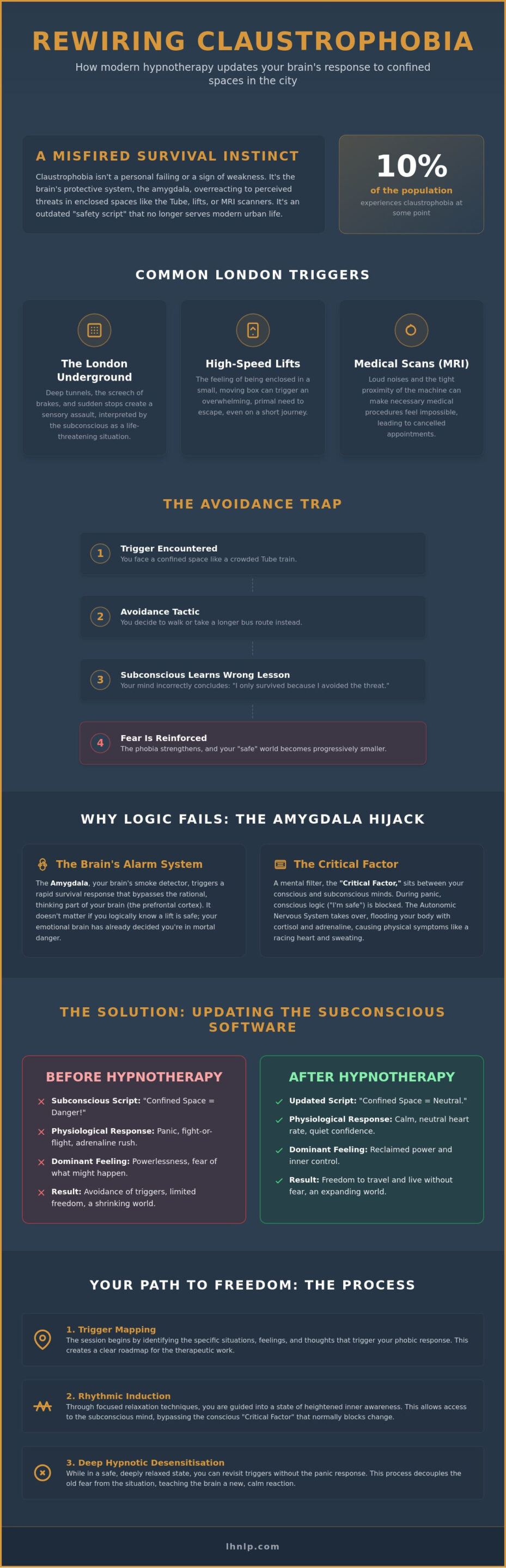
Living in a metropolis often feels like a series of tight spaces. For many, the sensation of being enclosed triggers an immediate, visceral reaction that can halt a day in its tracks. This is Understanding Claustrophobia at its most raw. It isn’t a character flaw or a sign of weakness. Instead, it’s a misfired survival instinct. Your brain is trying to protect you from a perceived threat that doesn’t actually exist. In a city where approximately 10% of the population experiences these feelings at some point, the environment itself acts as a constant catalyst.
From the deep, narrow tunnels of the Northern Line to the high-speed glass lifts of the City, London presents unique architectural hurdles. You might experience a spectrum of symptoms that range from a mild, nagging unease to an overwhelming, primal need to escape. Seeking hypnotherapy for claustrophobia London is often the first step toward breaking this cycle. It allows you to address the root of the panic rather than just managing the symptoms after they’ve already begun.
To better understand how your mind processes these signals and how hypnosis can help, watch this helpful video:
Most people cope by practicing avoidance. They walk up twenty flights of stairs or spend an extra hour on a bus to avoid the Tube. While this provides temporary relief, it actually feeds the phobia. Every time you avoid a space, your subconscious mind believes you only survived because you ran away. This strengthens the fear, making the “safe” world feel smaller and smaller over time.
The London Underground: A Unique Trigger
The Tube is more than just transport; it’s a sensory assault. The screech of brakes, the stagnant heat, and the sudden stop between stations can feel suffocating. Your subconscious interprets these physical sensations as a threat to your life. Professional phobia treatment helps you decouple these sensory inputs from the panic response. It’s about teaching your mind that you are safe, even when the doors are closed and the train is deep underground.
Medical Claustrophobia: The MRI Scan Hurdle
The Science of Panic: Why Your Subconscious Triggers Fear
To understand why panic feels so uncontrollable, we must look at the brain’s hardware. At the centre of this experience is the amygdala, a small, almond-shaped structure that acts as your internal smoke detector. When you enter a confined space, the amygdala can trigger what is known as an “Amygdala Hijack.” This is a rapid-fire survival response that bypasses the rational, thinking part of your brain. It doesn’t matter if you logically know the lift is safe; the emotional brain has already decided you are in mortal danger. Supporting scientific research on hypnotherapy demonstrates how these clinical interventions can help recalibrate this neurological alarm system.
Why does logical reasoning fail to stop a panic attack? The answer lies in the “Critical Factor,” a metaphorical filter that sits between your conscious and subconscious mind. During a claustrophobic episode, your conscious mind is shouting instructions that the subconscious simply cannot hear. Your Autonomic Nervous System takes over, flooding your body with cortisol and adrenaline. Your heart races, your palms sweat, and your breath becomes shallow. These are not signs of a “broken” mind, but of a highly efficient system responding to an outdated blueprint. Often, this blueprint was created by a past “anchor” event, a moment of perceived trappedness that your mind has used as a template for all future enclosed spaces.
The Subconscious Software: A Misfired Safety Program
Think of your subconscious as a dedicated security guard who is still following a manual written twenty years ago. The guard is trying to keep you safe, but the rules are no longer relevant to your life in the city. Through hypnotherapy for claustrophobia London, we can effectively “update” this manual. We communicate directly with the emotional brain to show it that the “danger” is a false positive. Because the brain is plastic, it’s capable of unlearning these fear responses at any age. You aren’t stuck with this software; it’s simply waiting for a more accurate set of instructions.
Neuro-Linguistic Programming (NLP) and Thought Patterns
NLP allows us to examine the internal “map” you use to navigate the world. Most people struggling with claustrophobia are excellent at “catastrophizing.” They create vivid, high-definition internal movies of the worst-case scenario. You might see yourself trapped, the walls closing in, or the air running out. These mental images are so powerful that your body reacts as if they are happening in real time. NLP techniques allow you to “edit” these movies. By changing the colour, size, or distance of these internal images, we can strip them of their emotional power. If you feel your internal narrative is working against you, exploring personalized phobia treatment can help you rewrite those subconscious scripts for good.
Hypnotherapy vs. Conventional Phobia Treatments
When seeking a way out of the cycle of panic, many people first encounter Cognitive Behavioural Therapy (CBT). While CBT is an excellent tool for managing surface-level thoughts and identifying triggers, it often requires a significant amount of conscious effort and “homework.” You are essentially asked to use your logical mind to argue with your emotional brain. In contrast, hypnotherapy for claustrophobia London works at the level where the fear actually lives. According to the National Council for Hypnotherapy, this approach is particularly effective because it addresses the root cause rather than just teaching you how to cope with the symptoms.
Traditional “In-Vivo” exposure therapy involves physically placing yourself in the environments that terrify you. For a Londoner, this might mean forced trips on the Underground or intentional lift journeys. This can be deeply traumatising and may even reinforce the fear if the experience isn’t managed perfectly. Hypnotic desensitisation offers a far gentler path. It allows you to face these triggers safely within the sanctuary of your own mind. By rehearsing calm in a trance state, you “pre-teach” your nervous system how to react before you ever step into a confined space.
Kamalyn Kaur’s approach at London Hypnotherapy & NLP is fundamentally solution-focused. We don’t believe in staying stuck in the past or dissecting the “why” indefinitely. Instead, we bypass the ego’s natural resistance to change. This often leads to faster results because we aren’t asking for your permission to be brave; we are updating the subconscious blueprint that makes bravery a natural, effortless response. It is a methodical transition from fear to neutrality.
The Gentleness of Clinical Hypnosis
The most frequent question people ask is whether they will lose control during a session. It is vital to understand that all hypnosis is actually self-hypnosis. You remain the director of your own experience. By guiding you into Alpha and Theta brainwave states, we access the optimal frequencies for emotional recalibration. This is a state of deep, focused inner awareness, not a loss of consciousness. If you feel hesitant about the process, you can explore more about common misconceptions and FAQs to put your mind at ease.
Why ‘White-Knuckling’ It Doesn’t Work
Trying to force yourself to be calm is often counterproductive due to the “Law of Reverse Effort.” The harder you consciously try to suppress panic, the more power you give to the anxiety. Hypnotherapy removes this internal friction. It transforms calm from a difficult goal into a default subconscious setting. For complex phobias that have existed for years, a multi-session package is usually the most effective route. This ensures the new neural pathways are strong enough to withstand the genuine pressures of a busy London commute without reverting to old patterns.
Your Path to Freedom: What to Expect in a Session
Every journey toward lasting internal change begins with a deep, focused conversation. In our first meeting, we don’t just list your symptoms; we map the unique architecture of your fear. Why does one lift feel safe while another feels like a trap? By identifying these specific nuances, we create a bespoke strategy for your hypnotherapy for claustrophobia London. This is a collaborative process where your past experiences are acknowledged with empathy, but your future freedom remains the primary focus. We look at the triggers you’ve previously avoided and begin to see them through a lens of potential neutrality.
Once we understand the triggers, we move into the induction phase. This isn’t like the stage hypnosis you see on television; it’s a rhythmic, guided relaxation that shifts your brain into a state of focused inner awareness. In this calm space, we use NLP “Fast Phobia” techniques to decouple the physical environment from the emotional panic. We essentially rewire the brain’s response so that a small space becomes just a space, rather than a threat to your life. Finally, we establish mental anchors. These are physical or mental cues you can activate instantly on the Northern Line or in a windowless office to maintain a sense of grounded, quiet control.
Personalized Treatment at Harley Street or Ealing
Our clinics are designed to be sanctuaries of calm in the midst of the city’s chaos. Whether you visit us at Harley Street or Ealing, the professional atmosphere ensures you feel secure from the moment you arrive. Face-to-face sessions allow for a deep therapeutic rapport, where subtle non-verbal cues help us fine-tune the intervention to your specific needs. You can meet Kamalyn Kaur and learn more about her clinical experience since 2005 to ensure you feel completely comfortable with your guide on this journey.
Virtual Hypnotherapy: Overcoming the Travel Barrier
We recognize a common paradox. The very travel required to reach a London clinic can be the source of your anxiety. If the prospect of a Tube journey currently feels impossible, virtual sessions offer a powerful alternative. Through Zoom or Skype, you can receive high-quality phobia treatment from the safety of your own home. These sessions are just as effective as in-person appointments because the work happens within your own subconscious mind. If you’re ready to start but can’t travel yet, explore our online hypnotherapy services to begin your transformation today.
If you’re ready to reclaim your freedom and navigate the city with confidence, book your initial consultation here to start your journey.
Taking the First Step: Booking Your Session in London
It’s easy to feel that the boundaries of your life have been permanently set by your fear. You might have spent years adapting your schedule to avoid the Central Line or climbing stairs to avoid a thirty-second lift journey. However, living with this constant state of alert is an optional burden, not a life sentence. Imagine a Tuesday morning in London where the Underground is simply a convenient way to get from A to B. Imagine entering a lift at your office and continuing your conversation without your heart rate spiking or your eyes searching for the emergency button. This level of freedom is not just a dream; it’s an achievable reality through professional hypnotherapy for claustrophobia London.
True transformation often requires more than a single conversation. While some shifts happen quickly, the most profound and lasting changes usually occur through a methodical, multi-session process. This allows us to layer the new subconscious safety signals and ensure they remain robust even during the most crowded rush hour. By committing to a multi-session package, you are giving your mind the space it needs to fully integrate these new patterns of calm and control. If you’re ready to begin this transition, Kamalyn Kaur is available for a confidential discussion to explore how we can tailor this process to your specific history and goals. It is about moving from a state of survival to a state of thriving.
Convenient London Locations
We provide professional clinical environments across the city to ensure your sessions are held in a space that feels secure and accessible. Our locations include:
- Harley Street (W1): Situated in the heart of London’s prestigious medical district.
- Ealing (W5): A calm, professional setting in West London.
- Tokenhouse Yard (EC2R): Conveniently located for those working within the City.
While we understand that using major transport hubs to reach these locations may currently feel daunting, each clinic is positioned near primary routes to make your journey as straightforward as possible. As your confidence grows, these journeys will become the very evidence of your success. You can find full details and book your appointment through our contact page.
A Commitment to Your Wellbeing
The philosophy at London Hypnotherapy & NLP is built upon a foundation of clinical excellence and deep human empathy. We don’t see you as a set of symptoms to be managed, but as an individual ready to reclaim their autonomy. Our work combines the precision of NLP with the gentle depth of clinical hypnosis to create a path forward that feels natural and sustainable. Your world is as big as you allow it to be. Let’s start expanding those boundaries together. For more insights into how these methods work, explore our definitive guide to clinical hypnosis and NLP.
Reclaiming Your Urban Freedom
Living in London shouldn’t feel like a series of obstacles to be navigated with caution. We have explored how the intersection of clinical hypnosis and NLP allows you to recalibrate your internal safety signals, moving from a state of constant alert to one of quiet, natural confidence. By addressing the root of the panic rather than just managing the symptoms, you can transform your relationship with the Tube, lifts, and medical scans. This isn’t just about coping; it’s about updating your subconscious software so that calm becomes your default response.
With clinical expertise in hypnotherapy for claustrophobia London and a practice rooted in Harley Street standards, Kamalyn Kaur has been helping individuals expand their boundaries since 2005. Whether you choose to meet in person at our prestigious clinics or through a virtual session, the path to a larger, more accessible world is open to you. It’s time to stop letting small spaces dictate the size of your life.
Book your confidential claustrophobia consultation with Kamalyn Kaur today and take the first step toward a city experience defined by freedom rather than fear. You have the inner resources to change, and we are ready to help you mobilise them.
Frequently Asked Questions
Is hypnotherapy for claustrophobia safe?
Yes, clinical hypnotherapy is a completely safe and non-invasive therapeutic process. You are always in control of the experience; it’s impossible to be forced to do anything against your will or your moral compass. We simply use a state of focused relaxation to help you unlearn the panic response that has become associated with small spaces in your mind.
How many sessions will I need to overcome my fear of lifts?
Most clients experience a significant shift in their response within three to six sessions. While every individual journey is unique, targeted hypnotherapy for claustrophobia London is designed for efficiency. For long-standing phobias, a multi-session package ensures these new neural pathways are fully integrated into your daily life, making calm your new default setting.
Can I be hypnotized if I have a very analytical mind?
Yes, analytical thinkers often find hypnosis deeply effective because the process relies on following specific mental sequences with precision. Your ability to focus on detail actually helps during the induction phase. We don’t bypass your intelligence; we use it to help you understand and rewrite the subconscious scripts that currently trigger your anxiety.
What happens if I have a panic attack during the hypnotherapy session?
You are in a safe, controlled environment where we can pause or pivot the session instantly. If a panic response begins, we use immediate grounding techniques to return you to a state of calm. This actually provides a valuable opportunity to practice your new mental anchors under professional guidance, proving to your subconscious that you can remain safe.
Will I remember everything that happens during the hypnosis?
Yes, you will typically remember the entire experience quite clearly. Hypnosis is a state of heightened, focused awareness rather than a loss of consciousness or sleep. You will be able to recall the suggestions and the imagery we use; this conscious memory helps reinforce the positive changes and new perspectives after you leave the clinic.
Can hypnotherapy help with an upcoming MRI scan if I only have a week to prepare?
Yes, even a single intensive session can provide you with the essential mental tools to navigate a medical scan. We focus on creating a powerful mental escape and teaching you physiological grounding techniques. This allows you to maintain a neutral heart rate and a quiet mind while in the machine, even with limited preparation time.
Do you offer evening or weekend appointments in London?
We provide flexible scheduling at our Harley Street, Ealing, and Tokenhouse Yard locations to accommodate the needs of busy professionals. While specific availability varies, we strive to offer appointments that work around your commute and office hours. Please contact us directly to check the current calendar for evening or weekend slots.
What is the difference between hypnosis and NLP for phobias?
Hypnosis uses relaxation and trance to communicate with the subconscious, while NLP focuses on the specific structure of your thought patterns. Professional hypnotherapy for claustrophobia London often combines both for maximum effect. NLP allows us to edit the terrifying internal movies you play, while hypnosis ensures these changes are accepted at a deep, emotional level.