

If you’ve searched for how to stop comparing myself to others after a social media scroll or an everyday conversation left you feeling behind, you’re not alone. “Just stop comparing” is easier said than done. A more practical starting point is to notice when comparison is happening and question what you’re using it to tell yourself about your worth.
Comparison is a familiar way to judge where we stand. It can become painful, though, when you see someone else’s polished highlights and use them to criticise your own unfinished story. You don’t need to blame yourself for comparing or pretend other people’s successes don’t matter. Instead, notice what triggers the habit and bring your attention back to what matters in your own life.
This article explores why comparison takes hold and offers practical ways to respond, from recognising unhelpful patterns to reconnecting with your values, needs and progress. You’ll also learn when extra support may be useful. The aim isn’t to rank yourself more kindly. It’s to find a steadier point of reference in your own experience.
Key Takeaways
- Notice when comparison shows up around work, appearance, relationships or life milestones, without judging yourself for it.
- Remember that social media often shows selected moments, not the full context of someone’s everyday life.
- Distinguish inspiration, which can clarify what matters to you, from self-judgement that turns differences into a verdict.
- Practise how to stop comparing myself to others with five small steps: pause, name the comparison, check the evidence, reconnect with your values and choose one action.
- If comparison keeps affecting your mood, relationships or daily choices, consider whether speaking with a qualified professional could help.
Why do I keep comparing myself to others?
Comparison can surface in ordinary moments: a colleague shares a promotion, a photo prompts doubts about your appearance, or a friend reaches a relationship or family milestone you’re still hoping for. These thoughts don’t mean you’re vain or ungrateful. People naturally evaluate aspects of their lives in relation to others, a process known as social comparison. Social comparison theory describes this as one way people assess themselves when there’s no clear measure of their own progress.
The difficulty is that you rarely see the whole picture. You might know someone’s job title, holiday photos or engagement news, but not the uncertainty, effort, setbacks or support behind them. Comparing your everyday experience with another person’s visible highlight is like judging two books by their covers.
Ordinary comparison means noticing how your circumstances or progress differ from someone else’s. It becomes unhelpful when repeated comparisons lead you to judge your worth, undermine your wellbeing or shape choices that don’t fit your needs.
What happens when comparison becomes a habit?
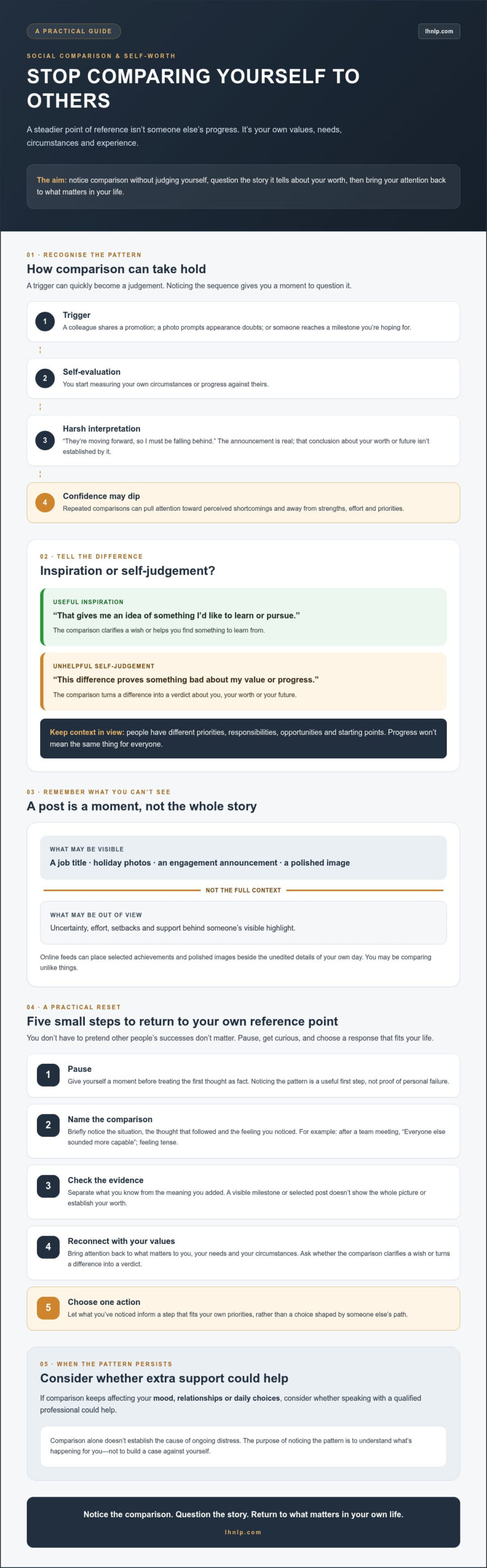
A trigger can quickly lead to self-evaluation, a harsh interpretation and a dip in confidence. For example, you see a colleague announce a new role and think, “They’re moving forward, so I must be falling behind.” The announcement is real. The conclusion about your worth or future isn’t established by it.
Noticing that sequence is a useful first step, not proof of personal failure. It gives you a moment to question the story before treating it as fact.
Is comparing yourself to others always bad?
Not necessarily. Seeing how someone handles a challenge can give you an idea to learn from or help you recognise something you’d like to pursue. The difference lies in what happens next: does the comparison clarify a wish, or turn a difference into a verdict on your value?
Context matters. Two people may have different priorities, responsibilities, opportunities and starting points, so progress won’t mean the same thing for both. A career change, a period of caring for family or a decision to focus on health can each shape what moving forward looks like. If you’re asking how to stop comparing myself to others, the aim isn’t to ignore everyone around you. It’s to use comparison as information, then return to your own values and circumstances.
How comparison works: triggers, social media and self-esteem
Comparison often starts when you notice someone who seems to be doing better in an area that matters to you. This is called upward comparison. It might happen when you see a friend’s fitness milestone, hear someone describe a confident presentation or receive feedback that leaves you wondering how you measure up. The thought can bring motivation, envy or discouragement. Your response depends on the person, the situation and what the comparison means to you. It isn’t automatic or inevitable.
People use comparison to make sense of their own abilities and circumstances. This psychological basis of comparison can help explain why a passing detail sometimes feels like a measure of personal progress. Online feeds can intensify that effect by placing selected achievements and polished images alongside the unedited details of your own day.
A curated online post shows a moment someone chose to share, not the full context of their life. Remembering this doesn’t require you to dismiss another person’s success. It simply makes room for the possibility that you’re comparing unlike things.
Which situations tend to trigger self-comparison?
Triggers differ from person to person. You might notice the pattern while scrolling, after receiving work feedback or at a social gathering where conversations turn to relationships, travel or future plans. For someone else, comparison may arise in a different context.
When it happens, briefly note three things: the situation, the thought that followed and the feeling you noticed. For example: “After the team meeting, I thought everyone else sounded more capable; I felt tense.” Keep it short and curious. The purpose is to spot a pattern, not build a case against yourself.
How does comparison affect confidence and mood?
Repeatedly ranking yourself against others can draw attention to perceived shortcomings and away from your own strengths, efforts and priorities. You may feel envy, embarrassment or discouragement. These reactions don’t mean you have a mental health condition, and comparison alone doesn’t establish the cause of ongoing distress.
If you’re asking how to stop comparing myself to others, noticing what happens before and after a comparison is a practical starting point. If persistent anxiety or distress is affecting your wellbeing, you could explore information about hypnotherapy for anxiety and consider whether that option feels appropriate for you.
Unhelpful comparison versus useful inspiration: how to tell the difference
Confidence doesn’t mean becoming unaware of other people’s achievements. You can admire someone’s work, appearance or choices and still feel grounded in your own worth. Ask what the comparison leads you to believe and do: does it offer a direction to explore, or become a judgement about who you are?
Inspiration points towards a possibility; harmful comparison treats difference as proof of lesser worth. This distinction can help you respond without trying to suppress every thought of comparison.
| Pattern | Trigger | Inner response | Likely next action |
|---|---|---|---|
| Useful inspiration | You notice someone doing something you admire. | “I’d like to explore that, too.” | Identify a small step that fits your circumstances. |
| Unhelpful comparison | You focus on a difference between their life and yours. | “This means I’m not good enough.” | Withdraw, criticise yourself or pursue a goal that doesn’t feel like yours. |
When does comparison become discouraging rather than motivating?
Pause and ask: has this comparison given me a useful idea, or left me feeling mainly ashamed, resentful or hopeless? Consider what you actually know about the other person’s circumstances. You may see an outcome without knowing the choices, support or trade-offs behind it.
There’s no fixed threshold for when comparison becomes a concern. Pay attention if the pattern keeps affecting your wellbeing or steers your decisions away from what matters to you. That’s a cue to respond with care, not a reason to blame yourself.
What can comparison reveal about your own values?
Admiration or envy can prompt reflection; they aren’t evidence of a character flaw. Instead of asking, “Why don’t I have what they have?”, try asking, “What quality in this catches my attention?” Perhaps a colleague’s career change brings up a wish for creativity, or a friend’s close relationships remind you that connection matters.
Then translate the value into a direction of your own. If you admire someone’s creative work, you might make time for a project that interests you rather than copy their career. If you long for security, consider one practical step that supports it. The goal isn’t to reproduce another person’s life, but to let what you notice clarify your priorities. If you’re working out how to stop comparing myself to others, this shift can turn a painful ranking into a more personal question: what do I want to move towards?
How to stop comparing myself to others: five practical steps
If you’re wondering how to stop comparing myself to others, start with a response you can use in the moment, not a rule that expects you never to compare. Try these five steps when a post, conversation or work situation sparks self-criticism. You can move through them in a few breaths; there’s no need to get them perfect.
Pause, name the comparison, check the evidence, reconnect with your values, then choose one action. That sequence creates space between a trigger and what you do next.
- Pause. Take one slow breath or feel your feet on the floor. A brief pause can help you respond deliberately instead of following the first harsh thought.
- Name the comparison. Try a neutral label: “I’m comparing my career progress with theirs.” You’re noticing a thought, not declaring it true or telling yourself off for having it.
- Check the evidence. Ask, “What information do I actually have, and what am I assuming?” You may know someone reached a milestone, but not everything that shaped their circumstances or what that milestone means to them.
- Reconnect with your values. Ask what matters to you in this area. Is it learning, stability, creativity, connection or something else? Your priorities are a more relevant guide than another person’s timeline.
- Choose one action. Pick a small step that meets your needs. If you want to develop a skill, you might set aside time to practise. If you need rest, taking a break may be the right next move. It doesn’t have to look impressive to anyone else.
If a particular account repeatedly leaves you feeling inadequate, consider muting or unfollowing it, or taking a short break from that feed. This isn’t a judgement of the person who posted. It’s a way to shape what you see while you work out what supports your wellbeing.
How can I measure progress on my own terms?
Keep a simple record of actions and changes that matter to you, rather than tracking only public milestones such as promotions or purchases. You might note that you asked for feedback, kept a commitment to yourself or made time for someone important. These details can be easy to overlook when your attention is fixed on what others have achieved.
Let your measures stay flexible. Circumstances change, and priorities may shift, so revisit what you value from time to time. Progress isn’t a competition or a scorecard. It’s a way to notice whether your choices are moving you towards a life that feels more like your own.
If confidence is an area you’d like help working on, confidence-building sessions may be one option to explore.
When self-comparison persists: support and next steps
Self-comparison doesn’t have to disappear completely for you to seek support. Consider extra help if the pattern keeps affecting your mood, relationships or everyday choices, such as making you avoid situations, lose sight of what matters to you or feel stuck in harsh self-criticism. The key is its ongoing impact, not whether you meet a checklist or have a particular diagnosis.
If the distress feels difficult to manage, consider speaking with an appropriate health professional. If stress is part of what you’re experiencing, you can also look into stress management options. Asking for support is a choice, not an admission that you’ve failed to handle things on your own.
How do I know whether I might benefit from support?
Notice whether comparison is repeatedly shaping how you feel or the decisions you make. You might find that you’re turning down opportunities because you expect to fall short, or that relationship conversations keep becoming a source of self-judgement. You don’t need to wait until things feel unmanageable to discuss what’s going on with a suitable professional.
What might an initial conversation about support involve?
You can ask about a practitioner’s qualifications and experience, the approach they use, what the service can and can’t help with, and how they handle boundaries or situations outside their scope. A good fit should allow you to understand what’s being offered and make a considered choice. You can also ask whether the approach seems suitable for your needs before deciding whether to continue.
London Hypnotherapy & NLP offers individual hypnotherapy and NLP sessions, including confidence-building support. In-person appointments are available at London locations including Harley Street, Ealing and Tokenhouse Yard, as well as virtual consultations via Zoom and Skype. Ask about the arrangements and whether a service suits your needs before making plans.
If you’re considering support with how to stop comparing myself to others, you can explore the available treatment options and ask whether an approach may be suitable. Understanding what a service involves can help you decide what feels right for you.
Take the next step towards your own path
Learning how to stop comparing myself to others isn’t about never noticing what other people achieve. It’s about recognising when comparison has become a verdict, checking the assumptions behind it and bringing your attention back to what you value. Small, personally meaningful actions can offer a steadier measure of progress than someone else’s timeline.
Try the five-step pause when comparison arises, and adjust your feeds or priorities if they’re no longer supporting you. If the pattern continues to affect your wellbeing, asking for support is another option, not a requirement. London Hypnotherapy & NLP offers confidence-building sessions and NLP coaching, with in-person appointments in London and virtual consultations via Zoom and Skype.
To ask about available support and whether it suits your needs, explore London Hypnotherapy & NLP. Your progress doesn’t need to look like anyone else’s to matter. Keep returning to what feels meaningful for you, one step at a time.
Frequently Asked Questions
How do I stop comparing myself to others on social media?
Make your time on social media more intentional rather than expecting yourself to stop noticing other people. Before opening an app, decide what you’re there to do, and notice how you feel afterwards. If a particular account regularly leaves you feeling diminished, mute or unfollow it, or take a break from that feed. You could also avoid scrolling when you’re tired or already feeling vulnerable. These choices help you shape your online environment.
Is comparing yourself to others always unhealthy?
No. Noticing another person’s choices or achievements can offer ideas, help you recognise what you value or inspire you to try something new. It becomes less helpful if you treat a difference as proof that you’re not good enough, or if it repeatedly pulls you away from your own priorities. Ask whether the comparison leaves you with a useful possibility to consider or mainly self-criticism. Your response can help you decide what to do next.
Can I stop comparing myself to others completely?
You may not be able to prevent every comparison from arising, and you don’t need to make that the measure of success. A more realistic aim is to notice the thought, question what it’s based on and choose whether it deserves your attention. With practice, comparison may feel less like an unquestionable verdict and more like a passing thought. Progress can mean returning to your own priorities sooner, even if the comparison still appears sometimes.
How can I build confidence when I keep comparing myself?
Build confidence by gathering evidence of your own choices and abilities, not by waiting until you feel certain. Keep a note of actions that matter to you, such as speaking up in a meeting, learning from feedback or following through on a personal commitment. When comparison appears, ask what you’d say to someone you care about in the same situation. A fairer inner response can help you recognise your efforts without needing to outperform someone else.
What should I do if comparing myself to others is affecting my mental health?
If comparison is persistently affecting your mood, relationships, sleep or everyday decisions, consider talking with your GP or an appropriate mental health professional. You don’t need to wait for things to become unbearable. It may help to describe when the pattern occurs, how it affects you and what you’ve already tried. If stress is part of the picture, mention that too. A professional can help you consider what support may fit your circumstances.
Can therapy help with constant comparison?
Speaking with a professional may help you explore the thoughts and feelings behind comparison and practise responding in ways that better fit your needs. There’s no guarantee that a particular approach will stop comparison, so ask about the practitioner’s experience, methods and whether their service is suitable for you. London Hypnotherapy & NLP offers confidence-building sessions and NLP coaching, with in-person appointments in London and virtual consultations. Ask about current arrangements and raise any questions before deciding.