

What if the most significant obstacle to your personal breakthrough isn’t the complexity of your mind, but the difficulty of knowing who to trust with it? In a city that never stops demanding your attention, the search for internal peace often leads to a maze of confusing acronyms and unregulated claims. You might worry about losing control or falling for a polished marketing veneer that lacks clinical depth. It’s a valid concern. Your mental well-being deserves more than just a vague promise; it requires a practitioner who understands the high-pressure reality of London life. If you want to find a qualified hypnotherapist in London, you need a clear map through the professional bodies like the NCH and GHR.
We understand that the step toward seeking help is both a vulnerable and courageous one. You likely believe that deep, lasting change is possible, yet you’re hesitant to commit without knowing your safety is guaranteed. This essential 2026 guide is designed to replace that uncertainty with absolute confidence. We’ll show you exactly how to verify credentials, establish genuine rapport, and identify the signs of a truly effective therapeutic partnership. You’ll gain the tools to choose a mentor who doesn’t just offer a passive experience, but a methodical path toward the results you seek.
Key Takeaways
- Understand the self-regulated nature of the UK industry and why voluntary accreditation is your primary safety net for mental well-being.
- Learn how to find a qualified hypnotherapist in London by verifying memberships in respected professional bodies like the NCH, GHR, or the PSA Accredited Register.
- Discover why the modern London standard integrates clinical hypnosis with NLP to bridge the gap between deep-seated insights and tangible, daily action.
- Follow a methodical three-step process to define your specific goals and shortlist practitioners who possess the specialized expertise you require.
- Identify the essential markers of professional rapport and ethical practice that ensure your therapeutic journey is both safe and effective.
Why Finding a Qualified Hypnotherapist in London is a Critical Decision
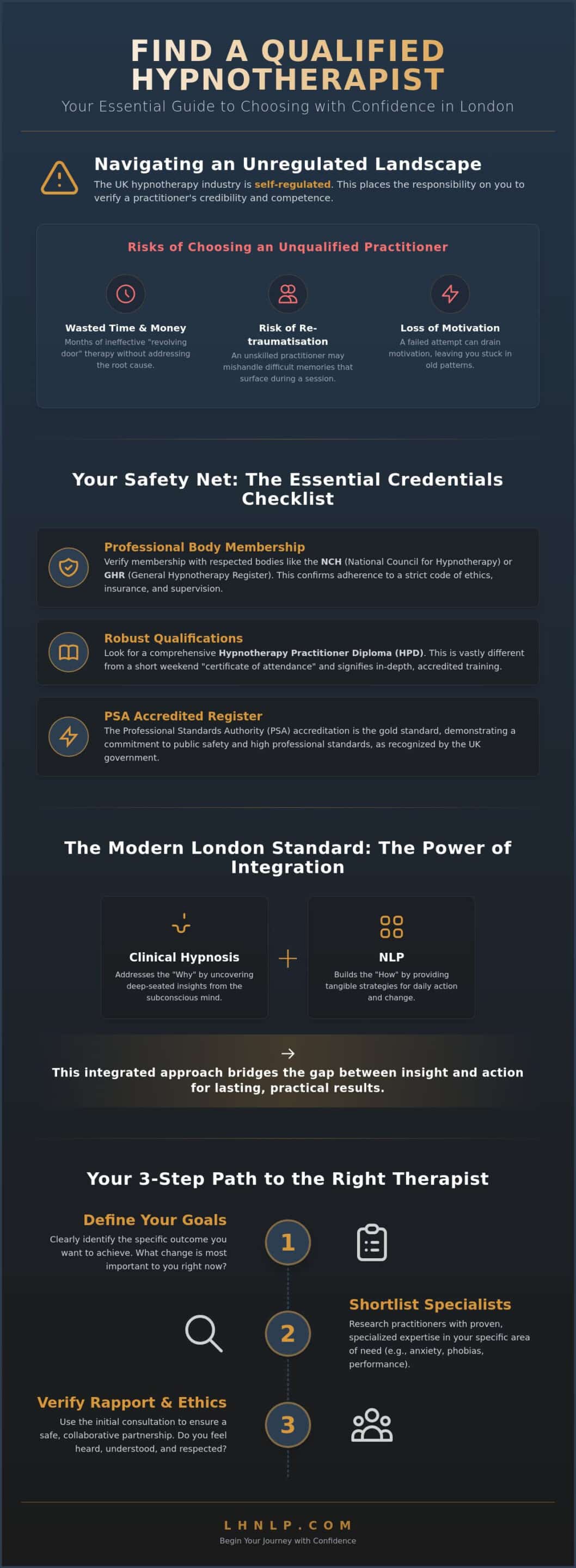
Choosing to work with your subconscious mind is an act of profound trust. It is a decision to step into a space of vulnerability in the hope of emerging stronger, yet the path to that transformation is often obscured by a lack of formal oversight. As of 2026, the UK hypnotherapy industry remains self-regulated, meaning there is no statutory requirement for practitioners to meet specific standards before they open their doors. When you seek to learn more about hypnotherapy, you quickly realize that while the science is robust, the professional landscape is varied. This lack of regulation places the burden of due diligence squarely on your shoulders. It’s not just about finding a therapist; it’s about ensuring that the person you invite into your mental landscape is equipped to handle what they find there.
London presents a unique paradox. As a global hub for therapeutic excellence, the capital attracts some of the world’s most gifted practitioners, yet it also hosts a high concentration of individuals with minimal training. The pressure of the London lifestyle often drives a demand for “quick fixes,” which can lead some toward the flashy promises of stage-style entertainment rather than clinical care. True clinical hypnotherapy is a collaborative, evidence-based process designed for behavioral change, not a theatrical display of “mind control.” To find a qualified hypnotherapist in London, you must look past the polished social media profiles and focus on the bedrock of clinical accreditation.
To help clarify your search criteria, this video offers practical advice on selecting the right practitioner in the capital:
Defining a ‘Qualified’ Practitioner in 2026
In the current professional climate, a “certificate of attendance” from a weekend seminar is vastly different from a comprehensive Hypnotherapy Practitioner Diploma (HPD). A truly professional clinic in London will also prioritize Continuing Professional Development (CPD) to stay abreast of the latest neurological research. A qualified hypnotherapist is one who holds accredited training, insurance, and regular supervision. These pillars ensure that the clinical treatments you receive are grounded in safety and ethical practice rather than just intuition.
The Risks of Choosing the Wrong Therapist
The consequences of an unskilled intervention go beyond a simple lack of results. Ineffective treatment can lead to a “revolving door” of therapy, where you spend months chasing symptoms without ever addressing the root cause. More concerning is the risk of re-traumatisation; an untrained practitioner may lack the skills to safely ground a client if a difficult memory surfaces during a session. Finally, there is the emotional and financial cost. When a therapeutic attempt fails because of poor practitioner quality, it often drains the client’s motivation to seek further help, leaving them stuck in the very patterns they were desperate to break. Your journey toward change is too important to leave to chance.
The Essential Credentials Checklist: What to Look For
The journey toward inner transformation requires a guide who is not only empathetic but also rigorously vetted. While the previous section highlighted the lack of statutory oversight, this reality doesn’t mean you’re left without protection. Instead, it means you must look for specific markers of excellence that distinguish a professional clinician from a hobbyist. The UK government’s position on hypnotherapy regulation confirms that the profession relies on voluntary registers, making your personal due diligence the most important step in the process. When you seek to find a qualified hypnotherapist in London, these credentials serve as your compass.
Understanding Professional Bodies (NCH, GHR, CNHC)
The “alphabet soup” of associations can feel overwhelming, yet these acronyms represent a commitment to high standards. The National Council for Hypnotherapy (NCH) and the General Hypnotherapy Register (GHR) are two of the most respected bodies in the UK. Membership in these organizations isn’t granted simply by paying a fee. It requires proof of comprehensive training, typically involving at least 450 hours of study with 120 hours of face-to-face or live online instruction. For the highest level of assurance, look for a practitioner on the CNHC (Complementary and Natural Healthcare Council) register. This body is overseen by the Professional Standards Authority (PSA), providing an additional layer of accountability that mimics the regulation of traditional healthcare roles. Always verify a therapist’s status by checking their name directly on the association’s public directory.
Insurance and Ethical Codes of Conduct
Safety in therapy is built on clear boundaries and professional accountability. Professional Indemnity Insurance is non-negotiable; it ensures that both you and the therapist are protected should any issues arise during the course of treatment. This insurance is often a prerequisite for membership in the major professional bodies mentioned above. Equally important is the therapist’s adherence to a strict Code of Ethics. This code governs everything from client confidentiality to the maintenance of professional boundaries. It also dictates that a therapist must have a clear complaints procedure and, crucially, regular supervision. Even the most experienced practitioners need a mentor to review their work, ensuring they remain objective and effective. If you’re looking for support for a minor or a vulnerable adult, you should also confirm the therapist holds a valid, enhanced DBS check.
Your mental well-being is a delicate landscape that deserves the utmost respect and protection. By insisting on these standards, you ensure that your investment in yourself is placed in capable hands. If you have questions about how these professional standards apply to your specific needs, reviewing our frequently asked questions can provide further clarity on what to expect from a high-standard clinical environment. Finding the right fit is about more than just a search result; it’s about finding a partner who values your safety as much as your success.
Clinical Hypnosis vs. NLP: Why the Combination is the London Standard
While professional accreditation from organizations like the National Council for Hypnotherapy provides the necessary safety net, the specific methodology used by your therapist determines how quickly you’ll see a return on your investment. In the fast-paced environment of the capital, many people find that traditional, passive suggestion therapy lacks the “teeth” required for rapid change. This realization has led to a shift toward a more robust model. When you look to find a qualified hypnotherapist in London, you’ll notice the most effective practitioners often blend clinical hypnosis with Neuro-Linguistic Programming (NLP). It’s a combination that addresses both deep-seated subconscious beliefs and the conscious linguistic patterns that keep us stuck.
The Power of Neuro-Linguistic Programming
NLP is often described as the “user manual for the brain.” It focuses on the language we use to construct our reality and how those internal “programs” drive our behaviors. Traditional hypnotherapy can sometimes feel like planting seeds in a garden; it’s a gentle process of suggestion. NLP, by contrast, provides the tools to pull the weeds and redesign the landscape. For example, a technique known as “anchoring” allows a client to trigger a state of calm or confidence instantly. This is invaluable during high-stakes city meetings or stressful commutes. It’s the missing piece that turns a relaxing session into a practical toolkit for daily life.
Solution-Focused Therapy: A Modern Approach
One of the greatest misconceptions about therapy is that you must spend months dissecting your childhood to find relief. A solution-focused approach challenges this by asking “how” rather than just “why.” While understanding the origin of a problem has value, knowing why you have a phobia won’t necessarily help you step onto a plane tomorrow. By focusing on the desired outcome, an integrated therapist helps you build new neural pathways that support your future rather than just analyzing your past. When you seek to find a qualified hypnotherapist in London, look for someone who understands that your time is as valuable as your mental health.
This methodology is particularly effective for complex issues. In providing help for anxiety or smoking cessation, the dual-modality approach works by first quieting the nervous system through hypnosis and then using NLP to re-code the specific triggers that lead to the behavior. It’s about moving from insight to action. This efficiency is why the integrated model has become the standard for those who don’t have time for a “revolving door” of sessions but need measurable, behavioral change. By bridging the gap between deep trance and active strategy, you create a foundation for change that is both profound and practical.
A Step-by-Step Guide to Finding Your Ideal London Therapist
Finding the right partner for your subconscious work is a methodical process. It’s not just about proximity; it’s about alignment. To find a qualified hypnotherapist in London, you must first define what success looks like for you. Are you looking to quiet the noise of social anxiety, or do you need the focused discipline required for smoking cessation? Once your goal is clear, shortlist three practitioners who specialize in that specific area. Don’t settle for a generalist when your needs are specific. Use the credentials we discussed in previous sections to filter your search, ensuring every name on your list holds the necessary accreditations.
The next phase is the discovery call. This is your opportunity to move beyond the screen and feel the resonance of their voice and approach. You’re testing for rapport, a sense of safety, and that “gut feeling” that tells you this person understands the weight of your experience. Finally, evaluate their logistics and professional social proof. Review their success stories and testimonials to see how they’ve helped others with similar challenges. A therapist’s track record is a window into their clinical effectiveness.
The Discovery Call: 5 Questions You Must Ask
A professional will always welcome your curiosity. Use these questions to gauge if they’re the right fit for your journey:
- Question 1: “What is your specific experience with [my issue]?” Look for depth rather than just a “yes.”
- Question 2: “Can you explain your therapeutic approach in plain English?” You should understand the process without being buried in jargon.
- Question 3: “How do you measure progress during our sessions?” Change should be observable and trackable.
- Question 4: “What are your fees and what is included (e.g., recordings)?” Professionalism includes clear financial boundaries.
- Question 5: “How do you integrate NLP or coaching into your hypnosis?” This ensures you get the modern, integrated standard we’ve explored.
Location Matters: Central London vs. Online Hypnotherapy
London offers a variety of therapeutic environments, each with its own energy. You might find the prestige and clinical history of Harley Street or the professional focus of Tokenhouse Yard in the City to be exactly what you need to feel “in safe hands.” Conversely, some clients prefer the more relaxed, neighborhood atmosphere of local clinics in Ealing, where the pace feels slightly more grounded. However, the modern lifestyle often demands even more flexibility. If your schedule is unpredictable or you feel most secure in your own home, you may choose Online Hypnotherapy for maximum convenience. Digital sessions offer the same clinical efficacy while removing the stress of the Central London commute.
Choosing a therapist is the first step in taking responsibility for your own evolution. If you’re ready to see how a tailored approach can work for you, contact us today to schedule your initial consultation and begin your journey toward lasting change.
Why London Hypnotherapy & NLP is the Logical Choice for Your Change
When you seek to find a qualified hypnotherapist in London, you’re searching for a partnership that respects both your intellect and your intuition. At London Hypnotherapy & NLP (LHNLP), we believe that your transformation should be as unique as the life you’ve built in this vibrant city. Kamal, our lead practitioner, brings over 20 years of experience to every session. He doesn’t just apply techniques; he understands the intricate dance between the conscious and subconscious mind. This depth of knowledge is why Kamal is recognized as a senior practitioner who mentors others in the field, ensuring that the highest standards of the profession are passed on to the next generation of therapists. You aren’t just working with a practitioner; you’re working with a guide who has dedicated his life to the art and science of change.
Our LHNLP methodology isn’t a one-size-fits-all solution. Instead, it’s a sophisticated blend of clinical hypnosis, NLP, and strategic coaching designed to meet the demands of a high-pressure London lifestyle. We understand that your time is your most precious resource. By combining these three powerful modalities, we move beyond simple relaxation. We address the root causes of your challenges while giving you the practical tools to handle the immediate stresses of the city. This commitment to excellence is reflected in our alignment with PSA-accredited registers and our adherence to the strict ethical codes you’ve learned to look for in this guide. To find a qualified hypnotherapist in London means looking for this level of transparency and clinical rigor.
Accessibility is a cornerstone of our practice. Whether you find comfort in the historic clinical excellence of Harley Street, the professional energy of Tokenhouse Yard in the City, or the quiet, residential calm of our Ealing clinic, we’re here for you. We’ve structured our locations to ensure that your path to relief is as seamless as possible, removing the logistical barriers that often stand in the way of personal growth. Your environment should support your healing, and we provide the space for that to happen.
A Personalized, Solution-Focused Experience
Every session at LHNLP is tailored to your specific challenges, from the subtle nuances of city-induced stress to deeply ingrained behavioral patterns. We don’t believe in long-term dependency. Our focus is on rapid, sustainable change that allows you to reclaim your autonomy and move forward with confidence. We look at the “how” of your future success rather than just the “why” of your past struggles. This methodical approach ensures that every hour you spend with us is an investment in a better version of yourself.
Booking Your Path to Relief
Taking the first step is often the most significant part of the process. Your journey begins with a confidential consultation where we explore your goals and determine the best approach for your specific needs. In your first session at our London clinics, you’ll experience a safe, supportive environment where your privacy and progress are our only priorities. If you’re ready to experience a methodical, empathetic approach to change, contact us today to book your initial consultation and begin your evolution.
Your Journey Toward Lasting Transformation Starts Here
Whether you choose the historic prestige of Harley Street or the quiet calm of our Ealing clinic, your well-being remains our singular focus. You don’t have to navigate your challenges alone. By choosing a practitioner who understands the high-pressure reality of city life, you’re investing in a future defined by clarity and resilience. It’s time to bridge the gap between where you are and where you wish to be. Book your consultation with a qualified London Hypnotherapist today and take the first step toward a more empowered version of yourself. Your breakthrough is closer than you think.
Frequently Asked Questions
Is hypnotherapy in the UK regulated by law?
Hypnotherapy is not statutorily regulated by law in the UK as of 2026. Instead, the profession relies on a system of self-regulation where practitioners voluntarily join professional bodies to demonstrate their commitment to high standards. This is why it’s vital to find a qualified hypnotherapist in London who is registered with an accredited organization like the NCH or GHR, as these bodies require proof of rigorous training and insurance.
How many sessions of hypnotherapy will I need for anxiety?
Most clients typically require between three and six sessions to achieve measurable, lasting relief from anxiety. While every individual’s mental landscape is unique, a solution-focused approach prioritizes efficiency and the rapid development of coping tools. Your therapist will work with you to monitor your progress, ensuring that you’re moving toward your goals without creating a long-term dependency on the sessions.
Can I be hypnotized against my will or made to do things I don’t want to?
You cannot be hypnotized against your will or compelled to act in a way that violates your personal ethics or values. Hypnosis is a state of focused attention and deep relaxation where you remain fully aware and in control of your choices. The process is a collaborative partnership; the therapist acts as a guide, but you’re the one who ultimately accepts the suggestions that lead to change.
What is the difference between a hypnotherapist and a psychologist?
Psychologists are healthcare professionals who study the science of the mind and often focus on clinical diagnosis or long-term talk therapy. A hypnotherapist focuses specifically on working with the subconscious mind to interrupt negative patterns and install positive new behaviors. Many people find that while psychology helps them understand the “why” of their behavior, hypnotherapy provides the “how” for making the actual change happen.
Are online hypnotherapy sessions as effective as in-person London appointments?
Online hypnotherapy is just as effective as in-person sessions for the vast majority of therapeutic goals, including anxiety and stress management. Since the process relies on auditory guidance and internal focus, the physical location is often secondary to the skill of the practitioner. Many busy Londoners actually prefer the online format because it removes the stress of travel and allows them to relax in a familiar, safe environment.
How much does a qualified hypnotherapist in London typically charge?
Fees in the capital vary significantly based on the therapist’s level of experience and the location of their clinic, such as Harley Street versus a suburban setting. When you seek to find a qualified hypnotherapist in London, it’s important to view the cost as an investment in your mental health rather than just a transaction. An experienced senior practitioner may charge more per hour but often achieves the desired results in fewer sessions than a less experienced therapist.
What should I do if I don’t feel a ‘connection’ with my therapist after the first session?
If you don’t feel a sense of rapport or safety after your initial meeting, you should trust your intuition and consider speaking with a different practitioner. The quality of the “therapeutic alliance” is one of the most important factors in achieving a successful outcome. A professional therapist will understand that personal chemistry is essential and will support your decision to find the guide who feels right for you.
Does insurance (like Bupa or AXA) cover hypnotherapy in London?
Most major private health insurers like Bupa or AXA do not currently include hypnotherapy in their standard coverage, though some specialized health cash-back plans may offer partial reimbursement. You should always contact your insurance provider directly to verify the specifics of your policy before beginning treatment. If your plan does offer coverage, they will usually require the practitioner to be registered with a recognized body like the CNHC.