

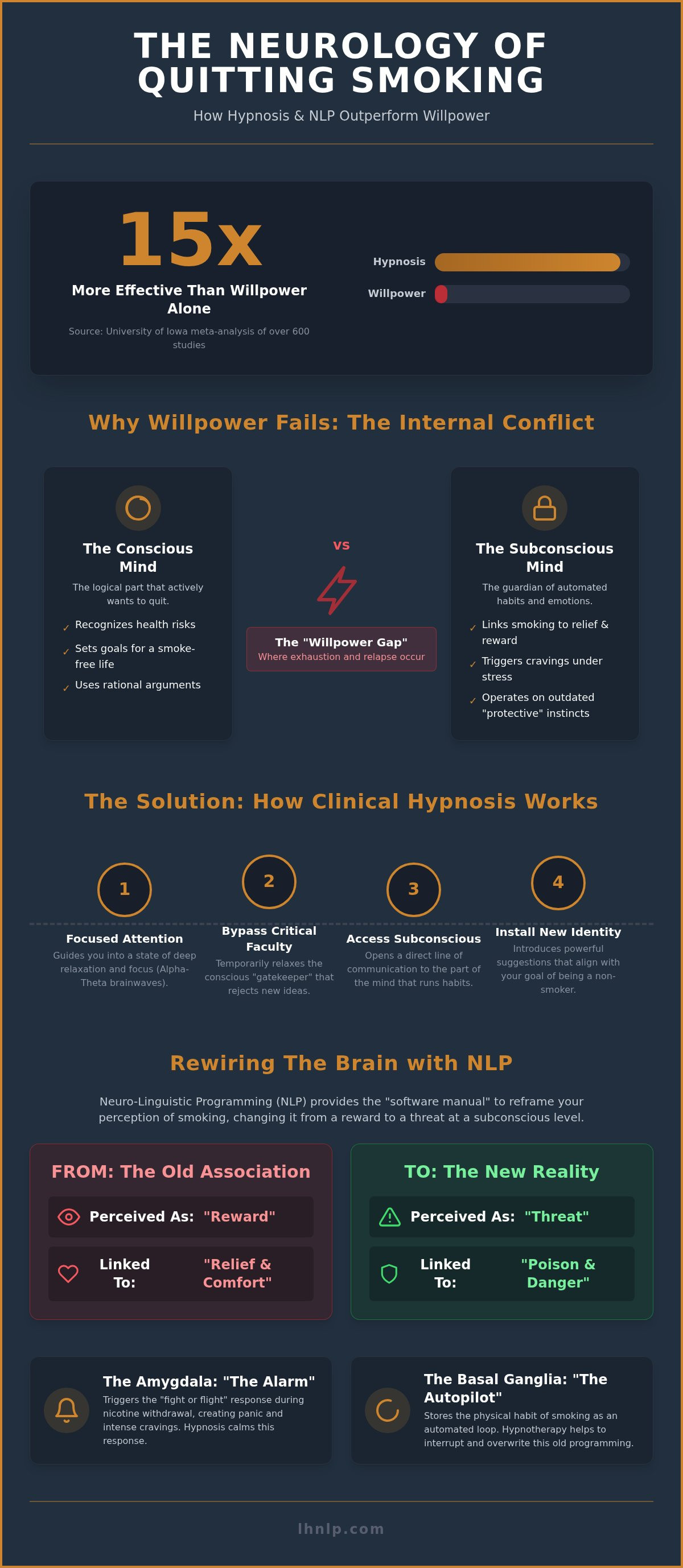
Research from the University of Iowa, spanning over 600 studies, reveals that hypnosis is 15 times more effective than willpower alone when it comes to quitting. If you’ve spent years caught in a cycle of “one last cigarette” followed by the crushing weight of a relapse, you aren’t a failure; you’re simply fighting a battle on the wrong terrain. To find lasting freedom, you need to understand how does hypnosis work for smoking at a neurological level. It isn’t a magic trick or a loss of control, but a method of aligning your deepest subconscious patterns with your conscious desire for health.
You likely know the anxiety of imagining a life without your usual crutch, fearing that the cravings will haunt you forever. We’ll explore the biological and psychological mechanisms that allow clinical hypnotherapy to dissolve these urges before they even surface. This article explains how the blend of NLP and clinical hypnosis creates a bridge between your logical mind and your protective habits. By the end, you’ll see why the shift from smoker to non-smoker doesn’t have to be a constant struggle of resistance, but a natural evolution of your inner self.
Key Takeaways
- Recognize that the struggle to quit is rarely about a lack of strength, but rather a conflict between your conscious goals and your subconscious protective instincts.
- Gain clarity on how does hypnosis work for smoking by creating a state of focused attention that allows you to bypass the mental filters blocking lasting change.
- Learn how combining NLP with clinical hypnotherapy provides a “software manual” for the mind, effectively reframing cigarettes as a threat rather than a reward.
- Understand the importance of client readiness and why a solution-focused, professional approach offers a more sustainable path than the struggle of “cold turkey” methods.
The Internal Conflict: Why Willpower Fails Most Smokers
Quitting smoking is rarely a matter of simple logic. If it were, every person who read a health warning would stop instantly. Instead, you face a profound internal divide. Your conscious mind, the rational seat of your goals and values, recognizes the damage. Yet, your subconscious mind remains anchored in the past. It’s the silent guardian of your habits. Understanding how does hypnosis work for smoking requires looking at this “Willpower Gap,” the point where mental exhaustion sets in because your two minds are pulling in opposite directions.
This conflict exists because of a misguided “Protective Instinct.” Your subconscious has spent years associating cigarettes with relief, social connection, or a moment of peace. It views the cigarette as a tool for survival. When you try to quit through force, your subconscious feels threatened and triggers intense cravings to “save” you from stress. This explains how does hypnosis work for smoking; it stops the internal war by serving as the essential bridge, aligning these conflicting parts so they finally move toward the same goal.
To better understand this concept, watch this helpful video:
The Myth of the “Addictive Personality”
Many clients arrive at my London practice believing they possess an “addictive personality” that makes change impossible. This is a limiting belief rather than a biological destiny. Habits aren’t part of your character; they are neural loops stored in the basal ganglia, a region of the brain dedicated to automation. Clinical hypnosis and NLP-based treatments target these specific pathways. By accessing this deeper level, we can begin to untangle the wiring that keeps the habit alive, proving that you aren’t “born a smoker,” you’ve simply been running an outdated mental program. This is why hypnotherapy for smoking cessation is so effective; it addresses the root of the automation rather than just the symptoms.
Conscious Effort vs. Subconscious Response
Have you ever wondered why you can’t simply “think” your way out of a craving? When you’re deprived of nicotine, the amygdala often triggers a “fight or flight” response. Your brain perceives the lack of a cigarette as a crisis. This is the subconscious protective mechanism in action: an automated psychological response that maintains a harmful habit because the mind perceives it as a necessary tool for emotional regulation. Because this happens below the level of conscious thought, logical arguments fail. Hypnosis allows us to communicate directly with the source of the response, calming the amygdala and replacing the panic with a sense of quiet confidence.
The Mechanics of Change: How Hypnosis Works for Smoking
Clinical hypnosis is often misunderstood as a loss of control. In reality, it’s a state of profound, focused attention. It allows you to access the deeper layers of your mind while remaining fully aware of your surroundings. To understand how does hypnosis work for smoking, we must look at a mental barrier called the “Critical Faculty.” This is the gatekeeper that filters new information based on your current beliefs. When you tell yourself “I am a non-smoker” while using willpower alone, this gatekeeper rejects the idea because it contradicts your existing habit. Hypnosis provides a gentle way to temporarily bypass this filter; this allows us to plant the seeds of a new identity directly into the subconscious.
You might worry about being vulnerable during this state. Rest assured, your subconscious mind is highly protective. It will never accept a suggestion that goes against your core values or safety. You aren’t a passive recipient of commands. Instead, you’re an active participant in a process of internal realignment. Think of it as a deep conversation with the part of you that has been running the smoking habit on autopilot for too long. By speaking the language of the subconscious, we can update the “software” that keeps you reaching for a cigarette.
Brainwaves and Receptivity
Our brains operate at different frequencies throughout the day. Most of our waking life is spent in Beta, a state of high-frequency alertness. Hypnotherapy guides you into the Alpha and Theta states. These are slower rhythms that mimic the peaceful moments just before you fall asleep. In this space, the mind becomes exceptionally receptive. This isn’t just about relaxation. It’s about neuroplasticity. We’re using this state to weaken the old, nicotine-stained associations and build new, healthy pathways that view cigarettes with indifference. It’s in this Theta state that the subconscious is most plastic, allowing for a genuine shift in how you perceive your relationship with tobacco.
The Role of the Practitioner as a Guide
You remain in the driver’s seat throughout the process. A therapist doesn’t “control” you. They act as a skilled navigator for your internal landscape. The success of the session relies heavily on the rapport you build with your guide. When you work with a professional London hypnotherapist, the relationship is one of mutual trust. It’s a collaborative effort where the practitioner provides the tools, and you provide the willingness to transform. This partnership ensures that the suggestions made are bespoke to your specific triggers and life circumstances. A guide helps you find the door, but you are the one who chooses to walk through it.
If you’re ready to see how this approach can work for you, exploring our virtual hypnotherapy sessions can be the first step toward a smoke-free life.
Beyond Suggestion: The Power of NLP in Smoking Cessation
While hypnosis creates a receptive state, Neuro-Linguistic Programming (NLP) acts as the software manual that reconfigures your mind’s internal logic. It’s one thing to be relaxed; it’s another to change the very meaning of a habit. This is a crucial layer in understanding how does hypnosis work for smoking. We don’t just ask you to stop; we use NLP to “reframe” the cigarette. Instead of your subconscious seeing it as a hard-earned reward or a companion during stress, we help the mind recognize it as a toxic intruder. This shift in perception is vital. You simply cannot crave something that you genuinely find repulsive.
We also address the “Secondary Gain.” Every habit, no matter how destructive, usually serves a hidden purpose in the mind’s eye. Perhaps smoking gives you a valid reason to step away from your desk or a way to bond with colleagues. If we don’t find healthy ways to satisfy these needs, the mind will resist change. Through NLP, we identify these benefits and “anchor” new, positive responses. Anchoring involves creating a physical trigger, like touching two fingers together, that instantly floods your system with the calm you once sought from nicotine. By replacing the old hand-to-mouth habit with a mental anchor, you regain control over your emotional state.
Interrupting the Pattern
Habitual smokers often have “chained” behaviors where one action automatically leads to another, such as having a cigarette with coffee or after a meal. We use pattern interrupts to break these links. By scrambling the mental imagery you associate with these moments, we make the old routine feel “wrong” or physically impossible to follow. Pattern interrupts effectively stop a craving before it starts by short-circuiting the brain’s automated response system. This ensures that the old trigger-response loop is permanently severed, allowing you to enjoy your coffee without the ghost of a cigarette haunting the experience.
Future Pacing: Living as a Non-Smoker
The most profound shift happens when you stop seeing yourself as an “ex-smoker” who is constantly resisting temptation. An ex-smoker is someone who has given something up; a non-smoker is someone who simply doesn’t smoke. We use a technique called “Future Pacing” to help you mentally step into a future where you’re already free. You experience the pride, the clean breath, and the vitality of your new life before you even leave the session. To explore how these techniques apply to various areas of life, you can view our full range of Treatments. This identity shift is the cornerstone of a permanent solution that feels like a natural evolution rather than a daily fight.
What to Expect: A Professional London Hypnosis Session
Entering a professional session is the first step toward reclaiming your autonomy. It begins not with a trance, but with a meaningful conversation. We explore your unique relationship with tobacco, identifying the specific triggers that have kept you bound to the habit. By understanding your personal motivations, we ensure the subsequent work is deeply relevant to your life. Many clients ask how does hypnosis work for smoking in a practical, minute-by-minute sense. It’s a collaborative process where your history and goals form the foundation of the change.
Once we’ve mapped your triggers, we move into the “Induction.” This is a rhythmic, calming transition where I lead you into a state of deep relaxation. Your heart rate slows, your muscles loosen, and your mind becomes quiet. In this space, we perform the “Therapeutic Work,” using tailored metaphors and suggestions that resonate with your specific experiences. Unlike a generic recording, this approach adapts to your responses in real-time. Finally, the “Emergence” brings you back to full alertness. You leave the session feeling refreshed, empowered, and often surprised by the newfound indifference you feel toward cigarettes. This personalized attention is the answer to how does hypnosis work for smoking so much more effectively than one-size-fits-all programs.
Harley Street Standards: Clinical Excellence in London
Operating from professional clinics in London, specifically Harley Street and Ealing, provides a sanctuary for this transformation. This setting ensures the highest clinical standards, where confidentiality and a non-judgmental atmosphere are paramount. A bespoke, one-to-one session is significantly more effective than generic recordings because it addresses the nuances of your individual psychology. We don’t use scripts; we use a solution-focused strategy tailored to you. This professional environment fosters the trust necessary for deep, subconscious change to take root.
Virtual Sessions: Hypnosis via Zoom
You don’t need to be physically present in a London office to experience these results. Hypnosis is just as effective via Zoom or Skype, as the primary tools are vocal guidance and your own internal focus. Many find that being in the comfort of their own home allows for even deeper relaxation, which can actually accelerate the process of letting go. If you’re ready to begin, our Online Hypnotherapy Services offer the same professional rigour and personal connection as our in-person sessions. You can achieve lasting freedom from the comfort of your favourite armchair.
Contact our London clinic to schedule your personalized smoking cessation session and take the first step toward a healthier future.
Maximising Success: Is Hypnotherapy Right for You?
The most sophisticated psychological tools require a foundation of genuine intent. You must be at the point where you’re quitting for yourself, not because of external pressure, family nagging, or a sense of guilt. When this internal alignment is present, the results can be truly transformative. Research from Texas A&M University found that 81% of participants in a three-session hypnosis intervention had stopped smoking by the end of the treatment. This data often leads people to ask how does hypnosis work for smoking when other methods like nicotine patches or willpower have failed. The answer lies in the depth of the intervention; while “cold turkey” methods rely on a finite supply of conscious willpower, hypnotherapy taps into the infinite resources of your subconscious mind.
We should also address the common myth that every smoker is a “one-session” success story. While many do experience an immediate shift, others benefit from a structured package of sessions. This isn’t a sign of failure. It’s a recognition that some habits are complex and well-established, requiring multiple layers of reframing to ensure every trigger is neutralized. A professional approach respects the depth of your history. When you finally grasp how does hypnosis work for smoking by addressing the subconscious identity rather than just the physical symptoms, the fear of lifelong cravings begins to evaporate. You aren’t just “giving up” a habit; you’re reclaiming your freedom.
Combining Hypnosis with Other Support
Hypnosis doesn’t exist in a vacuum. It works best when viewed as part of a total lifestyle shift toward health and vitality. During the initial 72 hours, as your body clears out the physical nicotine, hypnotherapy provides the mental tools to navigate this window without the usual panic or anxiety. Unlike old-fashioned aversion therapy that tries to make you feel ill at the thought of a cigarette, our modern approach focuses on making you feel indifferent. For a deeper look at the logistical side of treatment and how to prepare, read our sibling article: Stop Smoking Hypnotherapy in London: A Professional Guide to Quitting for Good.
Taking the First Step
Preparation for your first session is simple: arrive with an open mind and a clear understanding of your “why.” Choosing a therapist registered with recognized bodies like the GHR or CNHC ensures you’re working with a practitioner who adheres to strict clinical and ethical standards. This professional oversight gives you the confidence to let go and trust the process. This isn’t just about stopping a harmful habit; it’s about starting a new chapter where you breathe easily and feel fully in control of your choices. Your future as a non-smoker is a reality that’s well within your reach. Book your discovery call today to see how we can guide you through this methodical and life-changing process.
Step Into Your Future as a Non-Smoker
The journey to becoming a non-smoker isn’t a test of your character; it’s a process of profound mental realignment. By bridging the gap between your conscious goals and your subconscious protective instincts, you can finally silence the internal noise that makes quitting feel like a constant struggle. Understanding how does hypnosis work for smoking is the first step toward a life where you no longer feel defined by a habit. We’ve explored how the combination of clinical hypnosis and NLP allows you to reframe your identity, moving from a person who is “trying to quit” to someone who simply doesn’t smoke.
Drawing on over 20 years of experience in London clinical practice, I specialize in combining NLP with hypnotherapy to achieve faster, more sustainable results. Whether you choose the professional setting of our Harley Street or Ealing clinics, or the convenience of a virtual session, the focus is always on your unique triggers. You don’t have to carry the weight of previous failures into your future. A smoke-free life is a methodical, achievable reality that begins when you decide to empower your subconscious mind.
Ready to quit for good? Book your London or Virtual session today.
Frequently Asked Questions
How many sessions of hypnosis does it take to stop smoking?
Most clients achieve success in one to three sessions, though the exact number depends on your individual history and the complexity of your habit. While some find immediate freedom after a single appointment at our London clinic, others benefit from a multi-session package to address deeply layered behaviors. This methodical approach ensures that every subconscious trigger is neutralized. We focus on a solution-based timeline, allowing you to move forward as a non-smoker with confidence.
Can anyone be hypnotised to quit smoking?
Almost anyone can enter a hypnotic state, provided they have a genuine desire to change. Hypnosis is a natural human capacity for focused attention, similar to being absorbed in a good book. Success isn’t about being “susceptible” to a spell, but about your willingness to follow the guide’s instructions. If you’re open to the process and ready to quit for yourself, your mind will naturally accept the suggestions needed to dissolve the old smoking habit forever.
What happens if I crave a cigarette after the session?
If a craving arises, you’ll have specific mental tools and NLP anchors to instantly neutralize the urge. We teach you how to interrupt the old pattern before it takes hold. Most clients find that their cravings feel “distant” or irrelevant after we’ve addressed how does hypnosis work for smoking at a subconscious level. These brief moments of desire are simply echoes of an old habit that your new, non-smoker identity can easily observe and dismiss.
Is hypnosis for smoking cessation safe?
Yes, clinical hypnotherapy is a safe, non-invasive, and drug-free method for quitting. You remain in a state of relaxed awareness throughout the session and cannot be made to do anything against your will. At London Hypnotherapy & NLP, we follow strict professional standards to ensure a supportive environment. Because it doesn’t involve chemicals, it avoids the side effects often associated with traditional nicotine replacement therapies or pharmaceutical interventions, making it a gentle choice for your body.
Will I lose control or say things I don’t want to during hypnosis?
You never lose control or surrender your privacy during a session. Hypnosis is not a “truth serum” or a state of unconsciousness; you are fully aware of what’s being said. You can open your eyes or speak at any time if you wish. The therapist acts as a mentor who guides your focus, but you are always the one in charge of your own mind. You won’t say or do anything that contradicts your personal values.
How does the success rate of hypnosis compare to nicotine patches?
Clinical data suggests that hypnosis is significantly more effective than traditional nicotine replacement methods. For example, a meta-analysis from the University of Iowa found hypnosis to be three times more effective than patches for long-term cessation. This is because patches only address the physical addiction, while hypnotherapy targets the underlying psychological triggers. By resolving the internal conflict, we provide a more comprehensive solution than patches or gum can offer alone, ensuring the change is permanent.
Can hypnosis help with the weight gain often associated with quitting smoking?
Yes, we specifically address the fear of weight gain by ensuring you don’t replace one oral habit with another. Through NLP and suggestion, we help your subconscious find healthy ways to manage stress without turning to food. By understanding how does hypnosis work for smoking cessation and metabolic confidence, we can install new patterns of vitality. This ensures your transition to a non-smoker is a holistic improvement to your health, rather than a trade-off between two different habits.
Do I need to be in a deep trance for the therapy to work?
A “deep” trance is not necessary for effective change to occur. Most therapeutic work happens in light to medium states of relaxation, known as Alpha or Theta brainwave states. In these levels of focused attention, your subconscious is already receptive to new suggestions and reframing techniques. As long as you’re relaxed and engaged with the process, your mind can successfully update its old programs and embrace your new identity as a non-smoker, regardless of the depth of trance.