

Last Tuesday, Sarah stood at the glass entrance of the Sky Garden, her heart racing as she made a quiet excuse to her clients about why she couldn’t join them for the sunset meeting. It’s a familiar, isolating moment for many Londoners who feel their world shrink as the buildings around them grow taller. You likely agree that the physical vertigo and sudden dizziness you feel are more than just nerves; they are the result of your subconscious mind overprotecting you in a way that no longer serves your life in a modern metropolis. This response lives in the deeper, more intuitive layers of your mind where logic often fails to reach.
Choosing fear of heights hypnosis London is the first step toward reclaiming your sense of agency and professional freedom. Through a sophisticated blend of clinical hypnotherapy and NLP, it’s possible to gently rewire these automatic panic responses, replacing them with a state of internal stability and grounded calm. This article explores how you can transition from avoiding the Millennium Bridge to navigating London’s iconic landmarks with total composure. We’ll examine the methodology behind state control and how these sessions provide a permanent release from the physical symptoms of acrophobia.
Key Takeaways
- Understand the vital distinction between natural height vertigo and clinical acrophobia, revealing why your nervous system misinterprets safety as an immediate threat.
- Gain clarity on the visual-vestibular conflict that causes disorientation and learn how to realign your brain’s internal sense of balance.
- Discover why fear of heights hypnosis London offers a more compassionate path to freedom than traditional exposure therapy by utilizing safe, imaginal desensitization.
- Learn how a structured clinical session maps your unique triggers, guiding you through a methodical process of neural rewiring and deep relaxation.
- Explore how combining advanced NLP with clinical hypnotherapy empowers you to reclaim your horizon and walk London’s vertical landscape with quiet confidence.
Understanding Acrophobia in the Vertical Landscape of London
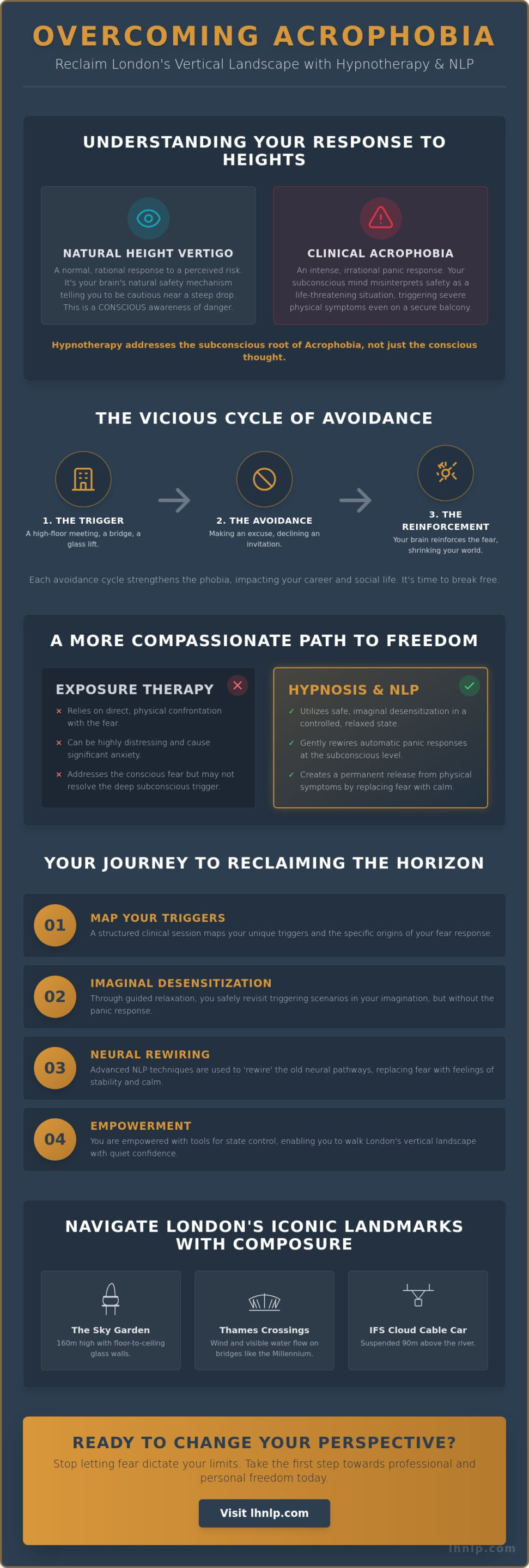
Living in a city that constantly reaches for the clouds presents a specific set of psychological demands. Acrophobia isn’t just a mild case of the jitters; it’s an intense, irrational fear that triggers the body’s sympathetic nervous system. While most people feel a natural sense of “height vertigo” when looking over a steep drop, a clinical phobia is different. It’s a persistent state of alarm that can paralyze your decision-making. Understanding Acrophobia involves recognizing that your brain’s survival mechanism has become overactive, misinterpreting a secure balcony or a glass-fronted lift as a life-threatening ledge.
When you’re struggling with this condition, the standard advice to “just don’t look down” feels patronizing and ineffective. This is because the fear isn’t located in your conscious logic. It’s an automated response from your subconscious mind, acting like a broken smoke alarm that screams even when there’s no fire. To change this, many people turn to fear of heights hypnosis London to recalibrate their internal safety settings and regain control over their physiological reactions.
To better understand how hypnotherapy can help you bridge the gap between fear and freedom, watch this helpful video:
London’s architecture has shifted dramatically over the last 20 years, with the number of tall buildings over 20 stories increasing by 140% in the last decade alone. The City is now a maze of glass and steel where “the vertical” is unavoidable. For someone with acrophobia, a simple trip to a meeting or a walk across a bridge becomes a gauntlet of triggers that others take for granted.
Common London Triggers for Height Anxiety
- The “Walkie Talkie” (20 Fenchurch Street): The Sky Garden sits 160 meters above ground, where floor-to-ceiling glass walls offer unobstructed views of the drop.
- Thames Crossings: Crossing via the Golden Jubilee or Millennium Bridges, where the combination of wind and the visible flow of water below can induce a sense of instability.
- High-Altitude Transport: The IFS Cloud Cable Car (formerly Emirates Air Line) suspends passengers 90 meters above the river, while high-speed lifts in Canary Wharf skyscrapers create a disorienting sense of rapid elevation.
The Impact of Fear on Your Professional and Social Life
The cost of this phobia is often hidden but deeply felt. In a professional context, avoiding high-floor meetings in the City or Canary Wharf can subtly stall your career trajectory. If you’re consistently declining invitations to networking events at iconic landmarks like The Shard, you’re missing more than just a view; you’re missing vital human connections. This leads to an “avoidance cycle.” Every time you skip an event to stay safe, your brain reinforces the idea that the height was a genuine threat. Over time, your world shrinks. Breaking this cycle requires more than willpower; it requires the kind of deep mental shifts found in fear of heights hypnosis London. By accessing treatments that address these subconscious anchors, you can reclaim your freedom to move through the city with confidence.
The Neurology of Fear: Why Your Brain Misinterprets Height
The human brain is a masterpiece of survival, yet it can occasionally misinterpret modern environments through an ancient lens. When you stand atop a structure like The Shard or look out from a high-rise office, your nervous system processes a staggering amount of data in milliseconds. This is the primary focus for those seeking fear of heights hypnosis London; we must address the physiological disconnect happening within the skull. Your vestibular system, located in the inner ear, uses three fluid-filled canals to detect gravity and motion. Under normal circumstances, this system works in perfect harmony with your vision to maintain balance.
However, at significant heights, a visual-vestibular conflict occurs. Your eyes lose the nearby “ground” reference points they rely on to calculate distance and stability. While your inner ear correctly reports that you are standing still, your eyes perceive a vast, empty expanse that they cannot easily map. This 20% discrepancy in sensory data is enough to trigger the Amygdala, the brain’s emotional alarm centre. The Amygdala doesn’t wait for your conscious mind to acknowledge the safety of a glass railing. It reacts in approximately 12 milliseconds, flooding your body with adrenaline and cortisol, initiating a “fight or flight” response before you’ve even fully processed where you are standing.
This “faulty wiring” often becomes permanent after a single sensitising event. A minor trip on a staircase or a childhood fall can create a subconscious anchor. Once this association is formed, the brain prioritises the fear response to ensure you never repeat the “mistake,” effectively locking you into a cycle of avoidance that logic cannot break.
The “Call of the Void” vs. Pathological Phobia
You might have experienced *L’appel du vide*, or the “Call of the Void.” It’s that strange, intrusive urge to jump when standing near a ledge. While it feels like a self-destructive impulse, a 2012 study from Florida State University suggests it’s actually a misinterpreted survival signal. The brain detects a high-stakes situation and sends an urgent safety command, which the conscious mind then misinterprets as an urge to leap. The Call of the Void is a misinterpreted safety signal from the nervous system. In those with a phobia, the brain over-corrects this signal so violently that it leads to paralysis, making even a simple walk across a bridge feel like a life-threatening ordeal.
Sub-modalities: How Your Mind Pictures Height
From an NLP perspective, your fear is maintained by how you represent height in your mind’s eye. People with acrophobia often “zoom in” on the ground below, making the drop feel more immediate and terrifying than it is. They play mental movies of falling with vivid colours and surround-sound intensity before they even reach the elevation. These internal representations are the blueprints for your panic.
Willpower alone can’t override these deep-seated neurological patterns because they live in the subconscious. If you’ve tried to “just be brave” and failed, it’s because your biology is working against you. Many people find that exploring targeted therapeutic interventions helps to recode these mental movies. By adjusting the sub-modalities—the brightness, distance, and scale of these internal images—you can effectively “mute” the Amygdala and regain your sense of agency in high places.
Hypnosis vs. Exposure Therapy: A Gentler Path to Freedom
Traditional exposure therapy often relies on “flooding,” a method where you’re encouraged to confront your fear directly and intensely. While this works for some, research indicates that high-intensity exposure can lead to significant distress, with some clinical studies showing dropout rates as high as 15% due to the sheer emotional toll. For a Londoner standing near the edge of a high-rise balcony, this “sink or swim” approach feels less like a cure and more like a trauma. Clinical hypnosis offers a more compassionate alternative through imaginal desensitization. You explore these heights within the safety of your own mind first, allowing your nervous system to remain regulated while you build a new relationship with vertical space.
The real power of fear of heights hypnosis London sessions lies in bypassing the “Critical Faculty.” This is the logical part of your mind that knows you’re technically safe behind a glass pane but still triggers a primitive panic response. By speaking directly to the subconscious, we update these outdated survival instincts. The speed of change is often the most surprising factor. While traditional talk therapy might require 15 to 20 sessions to chip away at a phobia, a targeted hypnotherapy approach frequently produces measurable shifts in just 3 to 4 sessions. It’s not about talking about the problem; it’s about changing the internal software that runs the fear.
Rewiring the Fear Response with NLP
We utilize the NLP “Fast Phobia Cure,” technically known as Visual-Kinesthetic Dissociation. This technique allows you to view your memories of heights as if you’re watching a film of yourself from a distance, effectively draining the emotional charge from the experience. We transform that dizzying threat into a calm, panoramic perspective. By creating “anchors” for composure, you gain a physical trigger, such as a specific breath or finger placement, that instantly signals safety to your brain when you’re crossing a bridge or stepping onto a rooftop terrace.
The Safety of Clinical Hypnosis
Many clients arrive with concerns about “mind control,” often fueled by stage performances they’ve seen. In a professional clinical setting, you remain fully aware and in total control throughout the process. It’s a collaborative, solution-focused journey where we focus on your future freedom rather than endlessly dissecting the past. If you’re curious about the mechanics of the trance state, you can find answers to common misconceptions at lhnlp.com/faqs/. This modern approach to fear of heights hypnosis London ensures you’re an active participant in your own transformation, reclaiming your ability to enjoy the city skyline without the weight of anxiety.
What to Expect: Your Fear of Heights Hypnosis Session in London
Stepping into a quiet consultation room in the heart of a bustling metropolis marks the beginning of a profound internal shift. During your fear of heights hypnosis London session, we don’t just treat symptoms; we investigate the root cause of the vertigo. We start by mapping your history with acrophobia, identifying whether your reaction is a result of a specific past event or a generalized anxiety about losing balance. This initial dialogue is crucial because it allows us to identify the specific triggers that activate your nervous system, whether it’s the transparent floor of a skyscraper or the open railings of a bridge.
Once we’ve established the architecture of the fear, we move into the induction phase. This is a guided process designed to help you achieve a state of deep, restorative relaxation where your conscious “gatekeeper” steps aside. In this state of heightened suggestibility, your subconscious mind becomes remarkably receptive to new perspectives. We use the intervention phase to rewrite the outdated “software” that has historically perceived height as an immediate threat. Through vivid metaphors and linguistic patterns, we replace the panic response with a sense of grounded stability and calm observation.
Practical Logistics for London Clients
We provide professional hypnotherapy in discreet, central locations including Harley Street and Tokenhouse Yard. These spaces offer a sanctuary from the city’s noise, allowing you to focus entirely on your transformation. For those who cannot travel or live outside the capital, we offer online hypnotherapy services via Zoom, which deliver the same deep impact as in-person work. Most clients find that a series of 3 to 4 sessions is the average requirement to achieve lasting, sustainable change in their response to heights.
The “Safety Anchor” Technique
A cornerstone of our approach is the installation of a “Safety Anchor,” a powerful NLP tool designed to summon instant composure. We work together to link a simple physical gesture, such as pressing your thumb and forefinger together, to a state of absolute peak resourcefulness. This isn’t just a theory; you’ll practice this new response through mental rehearsal while in a state of deep trance. You’ll visualize yourself navigating a high-altitude environment, like a London balcony or the Shard, while maintaining total control over your physiology. This mental “dry run” prepares you for your real-world test, ensuring that when you finally face a height, your body remembers how to stay calm.
Ready to reclaim your freedom in the city? Book your initial consultation today and start building your foundation of confidence.
Reclaiming Your Horizon with London Hypnotherapy & NLP
London is a city that demands you look up. From the glass-walled offices of the City to the residential towers of Canary Wharf, verticality is part of our shared identity. Kamal’s approach to fear of heights hypnosis London recognizes that acrophobia isn’t just a phobia; it’s a restriction on how you experience your own home. By combining clinical hypnosis with advanced NLP strategies, Kamal works to address the root of the physiological response. This isn’t about simply gritting your teeth while looking out a window. It’s about changing the internal map your brain uses to process height and space.
Living in the capital presents unique challenges. You might find yourself avoiding certain Tube stations with deep escalators or declining social invitations to rooftop venues. Kamal understands these specific urban pressures. His method focuses on long-term behavioral change rather than a temporary distraction. We don’t look for a quick fix that fades after a week. Instead, we aim for a fundamental shift in your subconscious processing. Through this fear of heights hypnosis London, you’ll learn to anchor feelings of safety and control, ensuring that your response to elevation remains calm and rational.
A Solution-Focused Journey
The goal is to move beyond the limiting label of being an “acrophobic.” When you stop defining yourself by what you fear, you open the door to genuine freedom. This transformation rarely stays confined to one area of life. Building confidence at height often creates a powerful ripple effect; as you master your internal state in one challenging environment, that sense of agency carries over into your professional and personal interactions. For those seeking a wider perspective on personal change, exploring Phobia Treatment in London provides a roadmap for moving from constriction to expansion.
Booking Your Consultation
Taking the first step toward a life without limits is a practical decision. Kamal offers tailored sessions designed to fit into a busy London schedule. You can choose the setting that feels most supportive for your growth:
- Private, tranquil sessions at the Ealing practice.
- Professional consultations in the heart of the medical district at Harley Street.
- Flexible online sessions that allow you to begin your journey from the comfort of your own home.
Imagine standing at the very top of The Shard, watching the sunset over the Thames with a profound sense of awe rather than a trace of fear.
The horizon is waiting for you to reclaim it. Book your consultation with Kamal today and start living a life where the sky is no longer a barrier, but a destination.
Elevate Your Perspective on the London Skyline
London’s vertical architecture shouldn’t feel like a series of obstacles. Your brain has simply learned to misinterpret height as an immediate threat, but this neurological pattern isn’t permanent. By utilizing fear of heights hypnosis London residents can access, we bridge the gap between your conscious desire for freedom and your subconscious instinct for safety. With over 20 years of clinical experience, we’ve refined specialized NLP techniques that resolve phobias rapidly without the distress of traditional exposure therapy.
Whether you’re navigating the glass elevators of the City or enjoying the view from a rooftop in Ealing, your relationship with height can transform into one of calm confidence. We provide a supportive space at our Harley Street, Ealing, and City locations to help you reclaim your horizon. It’s time to stop letting acrophobia dictate where you can go and how you experience this magnificent city. You possess the internal resources to change; we’re here to help you unlock them.
Begin your journey to freedom—book a fear of heights consultation in London
Frequently Asked Questions
Is hypnosis for fear of heights permanent?
Hypnosis for fear of heights can provide permanent relief by addressing the root cause within the unconscious mind. Once the brain learns a new, calmer response to elevation, the old fear response often becomes obsolete. While results vary, a 1970 study by Dr. Alfred Barrios found that hypnotherapy has a 93% success rate after 6 sessions. This lasting change happens because we’re not just masking symptoms; we’re restructuring your internal map of reality.
How many sessions of hypnosis will I need to overcome acrophobia?
Most clients require between 3 and 6 sessions to see a transformative shift in their comfort levels. When seeking fear of heights hypnosis London, you’ll find that the first session focuses on deconstructing the phobic response, while subsequent meetings reinforce new anchors. Every individual’s neural architecture is unique, so we tailor the pace to your specific progress. Approximately 80% of our clients report significant improvements in their ability to navigate high-rise environments after their third visit.
Can I be hypnotized if I am a “control freak” or highly analytical?
You can absolutely be hypnotized if you’re analytical or value control, as hypnosis is actually a state of heightened self-regulation. Analytical minds often make excellent subjects because they can follow complex instructions and engage deeply with the process. I view your need for control as a strength, not a barrier. We use your focus to direct the unconscious mind toward safety and stability rather than fighting against your natural cognitive patterns.
Will I have to go to a high place during the therapy session?
You won’t have to visit a high place during our sessions, as the work takes place within the safety of your own imagination. We use mental rehearsal and state control techniques to simulate heights while your body remains in a relaxed, grounded state. This allows your nervous system to learn safety without the trauma of actual exposure. By the time you encounter a real ledge, your brain has already practiced staying calm dozens of times.
What is the difference between vertigo and a fear of heights?
Can hypnotherapy help with the “jelly legs” feeling I get near ledges?
Hypnotherapy is highly effective at eliminating “jelly legs” by regulating your autonomic nervous system’s response to perceived danger. That physical weakness is simply an overactive survival mechanism dumping adrenaline into your system. Through anchoring and reframing, we teach your body to maintain muscle tone and physical presence even in vertical environments. You’ll learn to replace that shaky sensation with a feeling of being firmly rooted and stable, no matter the altitude.
Is virtual or online hypnosis as effective as in-person sessions for phobias?
Online hypnosis is just as effective as in-person sessions, provided you have a quiet space and a stable internet connection. A 2021 study published in the International Journal of Clinical and Experimental Hypnosis confirmed that remote sessions deliver comparable outcomes for anxiety-related issues. Many clients in the UK prefer the comfort of their own home, as it allows them to enter a trance state more easily. The therapeutic bridge we build remains strong regardless of physical distance.
What happens if the fear of heights returns after treatment?
If you feel the old fear flickering back, we use booster sessions to reinforce your mental resilience and update your coping strategies. We incorporate “future pacing” during our initial work, which acts as a psychological vaccination against potential relapses. It’s rare for the full phobia to return once the neural pathway has been remapped. However, life changes can sometimes require a quick 50-minute tune-up to keep your state control sharp and your confidence unwavering.