

Imagine standing on a crowded platform at Oxford Circus, not scanning the faces around you for signs of illness, but simply wondering what you’ll order for dinner at that new restaurant you’ve finally booked. For many, this simple act of presence feels impossible because the mind is locked in a state of constant, exhausting surveillance. If you’ve spent years searching for effective fear of being sick (emetophobia) treatment London, you understand that this isn’t just a simple dislike of being unwell; it’s a hyper-active subconscious safety programme that dictates where you go, what you eat, and how you move through the world.
It’s wearying to feel misunderstood by professionals or to miss out on social life because the threat of a stomach bug feels like an ever-present shadow. You deserve to reclaim the freedom that anxiety has quietly stolen. This article explores how clinical hypnotherapy and NLP coaching provide a methodical path to lasting relief by addressing the deep-seated roots of your fear. We’ll look at how these sessions help you update your internal responses, so you can travel the Tube and dine out with a genuine sense of calm and inner security.
Key Takeaways
- Understand why your phobia acts as an “invisible prison” and how it subtly dictates your social life, travel, and daily dining choices.
- Discover why logic alone cannot quiet a hyper-active amygdala and why effective fear of being sick (emetophobia) treatment London must address the subconscious alarm system.
- Compare the methodologies of CBT, NLP, and clinical hypnotherapy to find the therapeutic path that resonates most deeply with your personal journey toward recovery.
- Learn how the LHNLP approach integrates solution-focused mindset shifts with deep relaxation to help you reclaim a sense of internal safety and peace.
- Explore the practicalities of seeking specialist help in London, including the choice between face-to-face sessions and the flexibility of virtual hypnotherapy.
Understanding Emetophobia: Why the Fear of Being Sick is So Restrictive
Emetophobia is often misunderstood as a simple “dislike” of being unwell, yet for those living with it, the reality is a pervasive clinical anxiety that colours every waking moment. It involves an intense, often paralyzing fear of vomiting, witnessing others vomit, or even the subtle, natural sensation of nausea. While most people find illness unpleasant, the emetophobic mind perceives it as a catastrophic, life-threatening event that must be avoided at all costs. This deep-seated preoccupation transforms every public space into a potential threat, making the search for effective fear of being sick (emetophobia) treatment London a vital step toward reclaiming a sense of internal peace. Change is possible.
The “invisible prison” of this condition manifests as a constant, subconscious scanning of your environment. Every meal, every commute, and every social interaction is filtered through a rigorous lens of risk assessment. Understanding Emetophobia requires acknowledging that this isn’t a choice; it’s a sophisticated, albeit misplaced, survival mechanism. It dictates where you sit in a cinema or which restaurant you feel safe visiting. It slowly shrinks your world until only the most controlled spaces remain. You aren’t just avoiding a virus; you’re avoiding the feeling of losing control.
To gain a deeper perspective on the lived experience of this condition, watch this insightful talk:
Common Safety Behaviours in Emetophobia
The Impact on Life in the City
London life presents specific triggers that can make the phobia feel insurmountable. The close quarters of a morning commute or the bustling atmosphere of a Soho restaurant become sources of deep distress rather than part of a vibrant lifestyle. This leads to profound social isolation and the “Winter Dread,” where the seasonal rise of norovirus creates a state of permanent high alert. Your world deserves to be larger.
The Subconscious Loop: Why Logic Alone Cannot Cure Emetophobia
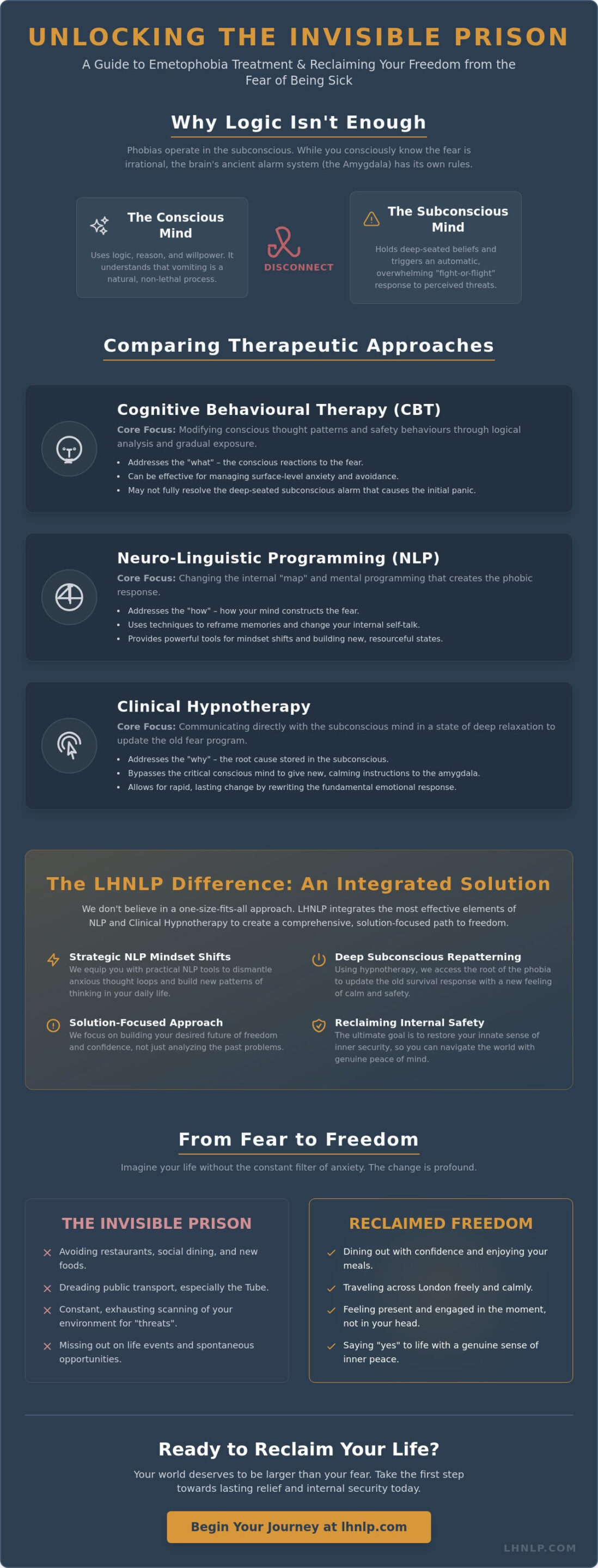
Logic is a tool of the conscious mind, yet phobias reside in a much deeper, more instinctive layer of our being. You might repeat the mantra that “vomiting is natural” a thousand times, but this intellectual understanding rarely quiets the pounding heart or the cold sweat of a panic attack. Why does the body refuse to listen to reason? It’s because the amygdala, your brain’s ancient sentinel, has classified a simple biological process as a mortal threat. When you seek emetophobia treatment, it’s essential to recognise that your internal fire alarm is stuck on high alert. It doesn’t need more facts; it needs a different kind of communication to reset the system.
This disconnect creates an exhausting internal friction. You may feel “irrational” or “weak,” yet the physical symptoms of panic are undeniably real and overwhelming. For many people searching for fear of being sick (emetophobia) treatment London, the greatest frustration is this gap between what they know and what they feel. This isn’t a lack of willpower or intelligence. It’s a sophisticated, albeit misplaced, safety programme that has become a habit of the mind. To find lasting relief, we must move beyond the surface of conversation and address the neural pathways where the fear is actually stored.
The Role of the Subconscious Mind
The subconscious is the storehouse of all learned fears and responses. It acts as a silent operating system, running scripts designed to keep you safe based on past experiences or perceived dangers. Sometimes, a single traumatic event or a period of high stress creates a “safety programme” that views any stomach sensation as a crisis. Willpower is rarely enough to override these files because the subconscious always prioritises survival over comfort. It’s not enough to want to change; you have to update the software that runs the response.
Breaking the Nausea-Anxiety Cycle
One of the most challenging aspects of this condition is psychosomatic nausea. When you feel anxious, your body’s “fight or flight” response redirects blood away from the digestive system, which causes real, physical churning. Your mind then interprets this discomfort as a sign of impending illness, which spikes the anxiety even further. NLP coaching helps you interrupt this loop by changing the mental imagery and internal dialogue associated with these sensations. By re-coding these internal responses, you can teach your brain to remain calm even when your stomach feels momentarily unsettled.
Comparing Emetophobia Treatments: CBT, NLP, and Hypnotherapy
Choosing the right path for fear of being sick (emetophobia) treatment London can feel overwhelming, especially when traditional options seem clinical or even intimidating. Cognitive Behavioural Therapy (CBT) is often the first recommendation, focusing on identifying thought distortions and introducing gradual exposure to triggers. While effective for some, the process can be slow and sometimes focuses heavily on the logic we’ve already established isn’t enough to break the subconscious loop of emetophobia. You might understand your thoughts perfectly, yet still find yourself frozen in panic when a colleague mentions feeling unwell.
In contrast, Neuro-Linguistic Programming (NLP) and clinical hypnotherapy offer a solution-focused alternative that respects your time and emotional energy. NLP examines the “how” of your fear, decoding the specific mental imagery, internal sounds, and physical anchors that trigger your panic response. When combined with hypnotherapy, we can bypass the critical conscious mind to install new, calmer responses directly into the subconscious. This multi-modal approach doesn’t just manage the symptoms; it seeks to transform the underlying neural architecture of the phobia. It’s about changing the internal movie you play for yourself so that the frightening scenes no longer have the power to move you.
Is Exposure Therapy Necessary?
The most common concern for those seeking fear of being sick (emetophobia) treatment London is the fear of being forced to witness vomiting. It’s a valid worry that often prevents people from starting therapy. However, recovery does not require traumatic exposure. Hypnotherapy provides a profoundly safe space to process these fears through gentle desensitisation and mental rehearsal. We work with the mind’s ability to reframe experiences, allowing you to build resilience without ever feeling pushed beyond your limits. This method respects your boundaries while effectively teaching your nervous system that you are safe in the present moment.
Efficiency and Speed of Treatment
Time is a precious resource, and living in a state of hyper-vigilance is exhausting. Standard CBT protocols often suggest 12 to 20 sessions to see meaningful change. The LHNLP approach is designed for greater efficiency, with many clients experiencing significant shifts in their perspective and physical comfort within just 3 to 6 sessions. For a broader look at how these methods compare to other interventions, you might find our Phobia Treatment in London guide helpful. This accelerated path allows you to return to the life you love much sooner than you might have thought possible, freeing you from the constant scanning and avoidance that once defined your days.
Finding Emetophobia Treatment in London: Your Options
The city offers a wealth of choice, yet this abundance can often feel like another layer of complexity for someone already managing high anxiety. You need a partner who understands the specific pressures of London life, from the sensory overwhelm of the Underground to the social expectations of a high-pressure career. When searching for fear of being sick (emetophobia) treatment London, the decision often comes down to finding a balance between specialist expertise and practical accessibility. You aren’t just looking for a clinic; you’re looking for a space where your experience is validated and your progress is prioritised.
Selecting a qualified practitioner is the foundation of your recovery. In the UK, look for professionals registered with the Complementary and Natural Healthcare Council (CNHC) or similar accredited bodies, as this ensures a commitment to professional standards and ongoing development. Private therapy costs in the capital vary significantly depending on the location and the practitioner’s level of specialisation. While some may feel drawn to the historic prestige of certain districts, others find that the most profound shifts happen where they feel most at ease. Trust your intuition when choosing a guide for this journey.
London Locations for Therapy
Harley Street remains the historic heart of private healthcare, offering a level of discretion and specialist focus that many find reassuring for sensitive phobia work. It’s a place where you can step away from the noise of the city to focus entirely on your internal landscape. Conversely, seeking support in local hubs like Ealing in West London provides a different kind of ease. Shorter travel times often mean less stress before a session begins. Both paths lead to the same destination: a life no longer dictated by fear.
Online vs. In-Person Consultations
Modern therapy has evolved to match the pace of city life, making phobia treatment more accessible than ever. Many clients find that working via Zoom or Skype is exceptionally effective for emetophobia because it allows them to remain in their own safe environment while doing deep subconscious work. This removes the immediate trigger of traveling while you are still building your internal resources. If you are based outside the capital or simply prefer the convenience of your own home, explore our Online Hypnotherapy Services to see how we can support you remotely.
Reclaiming your freedom starts with a single, courageous conversation. If you’re ready to explore how a tailored approach can help you move past hyper-vigilance, get in touch with us today to discuss your path forward.
The LHNLP Approach: Overcoming Emetophobia with Kamalyn Kaur
The LHNLP approach, developed by Kamalyn Kaur, offers a departure from the sterile, often clinical atmosphere of hospital-based interventions. It’s a methodology that prioritises your comfort and agency, moving away from the idea that you must simply “cope” with your anxiety. Instead, we focus on a profound mindset-first shift. By combining Clinical Hypnotherapy with NLP Coaching, we address both the conscious patterns and the subconscious drivers that keep the phobia alive. This isn’t just about managing symptoms; it’s about reclaiming the freedom to live without a constant, internal risk assessment. You deserve a life that feels expansive rather than restricted.
Your experience of emetophobia is unique to you. Perhaps your fear is most intense during pregnancy, or maybe it’s the sensory overwhelm of a crowded London bus that triggers your panic. Kamalyn’s approach ensures that every session is tailored to these specific nuances. We don’t use a one-size-fits-all script. We look at the specific “map” of your fear to understand how your brain has constructed this safety programme. This level of personalisation is what makes fear of being sick (emetophobia) treatment London so effective when delivered through the LHNLP lens. We work with your mind, not against it.
What to Expect in Your Sessions
Our work begins with a deep-dive initial consultation. During this time, we map out the triggers and internal dialogues that sustain your fear. We then move into active change work using NLP techniques. These methods allow us to “scramble” the old, frightening mental imagery associated with your triggers. By changing how you represent the fear internally, we reduce its emotional charge. This is followed by clinical hypnotherapy, which facilitates a state of deep relaxation. In this receptive state, we work to reprogram the subconscious with calmer, more resilient responses.
- Identifying the root triggers and safety behaviours that keep you stuck.
- Interrupting the panic loop with rapid NLP shifts to change your mental imagery.
- Reinforcing new, positive neural pathways through gentle hypnosis and subconscious work.
Next Steps to Freedom
The most important element of any therapeutic journey is the relationship between you and your guide. You need to feel safe, heard, and understood before deep change can occur. This is why we encourage an initial conversation to ensure this solution-focused approach resonates with your needs and goals. You aren’t meant to carry this burden forever. The path to eating out, travelling freely, and enjoying the winter months with peace of mind is closer than you think. It’s a methodical process that leads to genuine, lasting transformation.
If you’re ready to start this transformation, contact Kamalyn Kaur today to discuss how we can help you break free from the invisible prison of emetophobia.
Reclaiming Your Freedom and Presence
The journey toward recovery begins when you acknowledge that your fear is not a permanent character trait; it is a learned response that can be unlearned. We’ve explored how the subconscious loop maintains your anxiety and why a multi-modal approach, combining NLP and clinical hypnotherapy, offers a more efficient path than traditional talk therapies alone. By addressing the “how” of your fear rather than just the “why,” you can finally break the cycle of hyper-vigilance and return to the social experiences you once loved. Choosing the right fear of being sick (emetophobia) treatment London is about finding a specialist who understands both the complexity of the mind and the unique pressures of life in the city.
With over 20 years of experience as a specialist in anxiety and phobia treatment, Kamalyn Kaur provides the expert guidance needed to navigate this internal shift. Whether you prefer the privacy of a Harley Street session or the comfort of virtual hypnotherapy from your own home, the support is available to meet you where you are. You don’t have to manage this alone any longer. Book a Consultation for Emetophobia Treatment in London to start your journey toward a life defined by peace of mind rather than avoidance. Your future self is waiting for you to take this first, vital step.
Frequently Asked Questions
Can emetophobia really be cured or just managed?
Lasting relief from emetophobia is absolutely achievable through the right therapeutic approach. While management techniques offer temporary reprieve, clinical hypnotherapy aims to update the underlying subconscious safety programme that triggers the panic. By addressing the root cause and the habituated neural pathways, you can reach a point where the fear no longer dictates your choices or thoughts. This isn’t just about coping; it’s about a fundamental shift in how your brain processes the concept of illness.
Is hypnotherapy for emetophobia safe for pregnant women?
Clinical hypnotherapy is a safe, non-invasive, and drug-free option for managing anxiety during pregnancy. Many women find it particularly helpful for navigating the specific fears associated with morning sickness or the perceived loss of control during childbirth. Because it focuses on deep relaxation and positive mental rehearsal, it provides a gentle way to support your emotional well-being without any risk to the baby. It’s a supportive tool for an empowering pregnancy journey.
How many sessions will I need to see a difference in my fear?
Most clients begin to notice a profound shift in their internal responses within 3 to 6 sessions. While every individual’s journey is unique, the solution-focused nature of NLP and hypnotherapy often produces results more rapidly than traditional talk therapies. This efficiency is a hallmark of fear of being sick (emetophobia) treatment London when using the LHNLP approach. We focus on creating tangible changes in your daily life as quickly and comfortably as possible.
Will I be forced to look at pictures of sick or vomit during therapy?
You will never be forced to look at distressing images or witness vomit during your sessions. Our methodology prioritises your sense of safety and uses gentle NLP techniques to “scramble” the fear response mentally. We believe that recovery shouldn’t be a traumatic experience. By working with your mind’s internal representations in a controlled and supportive environment, we help you build resilience and calm without the need for traditional, high-stress exposure therapy.
Can NLP help with the nausea I feel when I’m anxious?
NLP is exceptionally effective at interrupting the cycle of psychosomatic nausea caused by anxiety. By changing your internal dialogue and the mental “movies” you play, you can prevent the fight-or-flight response from triggering digestive upset. When you learn to re-code these physical sensations, the nausea loses its power to spark panic. This creates a new sense of trust in your body, allowing you to remain present and calm even in challenging environments.
What is the difference between emetophobia and OCD?
Emetophobia is classified as a specific phobia, though it frequently presents with symptoms that overlap with OCD. Both conditions involve intrusive thoughts and ritualistic safety behaviours, such as excessive cleaning or restrictive eating, designed to prevent a perceived catastrophe. However, while OCD can involve a wide range of themes, emetophobia is specifically focused on the act or sight of vomiting. Understanding these nuances helps us tailor your treatment to address the exact mechanics of your anxiety.
How do I know if my fear of being sick is a phobia or just a normal dislike?
A normal dislike of being sick doesn’t interfere with your ability to live a full life. If your concern has become a preoccupation that dictates where you eat, how you travel, or whether you attend social events, it has likely crossed the threshold into a phobia. When the “invisible prison” of avoidance begins to shrink your world, seeking professional fear of being sick (emetophobia) treatment London is a proactive step toward reclaiming your freedom and peace of mind.
Are the sessions at Harley Street more expensive than in Ealing?
Costs for private therapy in London vary depending on the practitioner’s specialisation and the clinic’s location. While Harley Street is known for its historic prestige and specialist focus, local clinics in areas like Ealing offer a different kind of accessibility and ease. It’s always best to check with your chosen practitioner regarding their specific fee structure for different locations. The most important factor is finding a therapist with whom you feel a genuine sense of trust and safety.