

What if the reason you haven’t quit smoking yet isn’t because you lack strength, but because you’ve been fighting a battle in the wrong part of your mind? It’s a heavy burden to carry, that feeling of failure each time a relapse occurs, especially when you’re caught between mounting anxiety about your health and a deep-seated fear of what life would even look like without a cigarette in your hand. When you’re searching for what to do when you can’t quit smoking, it’s common to label yourself as having an addictive personality and resign yourself to a lifetime of struggle. However, the truth is far more supportive: your conscious desire to stop is simply being outvoted by a subconscious script that’s still trying to protect you in its own misguided way.
This article promises to show you why willpower alone is often a recipe for exhaustion and how addressing the subconscious mind can finally break the cycle of smoking for good. You’ll discover how to move past the battle phase and into a state of genuine clarity. We’ll explore the psychological mechanics of habit, why your previous attempts likely faltered, and how to achieve a permanent shift in your relationship with tobacco that feels like a relief rather than a sacrifice.
Key Takeaways
- Understand why relying solely on willpower creates an internal conflict that often leads to the ‘abstinence violation effect’ and feelings of failure.
- Discover what to do when you can’t quit smoking by uncovering the ‘Secondary Gains’-the hidden emotional needs your subconscious is trying to meet through tobacco.
- Learn how clinical hypnotherapy and NLP work together to update the automatic habit loops stored in the brain, making change feel more natural.
- Master immediate cognitive shifts, such as the ‘Five-Minute Rule’, to navigate cravings as temporary waves rather than permanent states of distress.
- Explore how a personalised psychological approach can transform your identity, allowing you to reclaim your freedom without the constant internal battle.
Understanding Why Willpower Often Fails the ‘Stuck’ Smoker
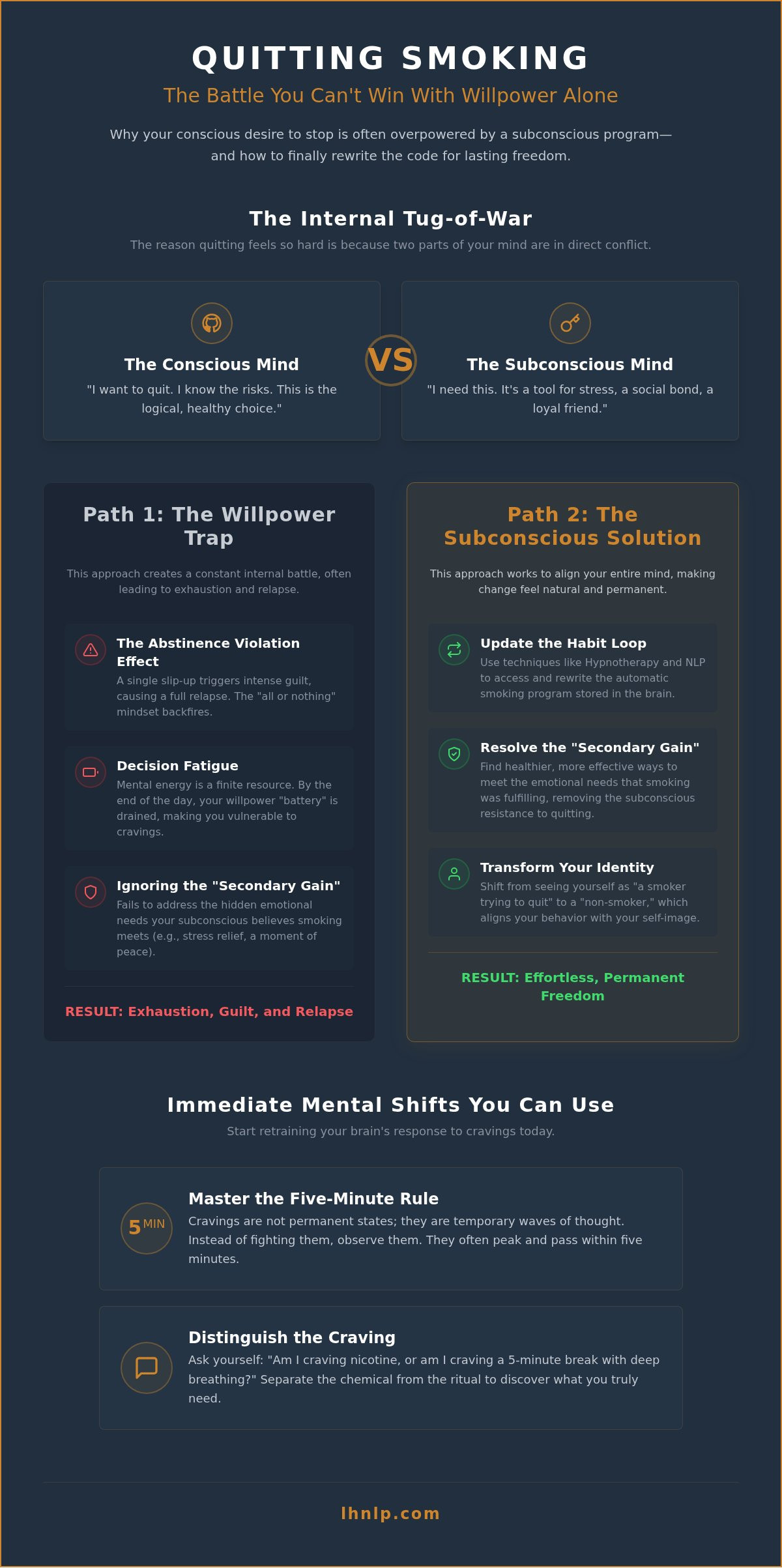
Many individuals find themselves trapped in a cycle of resolve and relapse, wondering exactly what to do when you can’t quit smoking despite knowing the risks. This struggle isn’t a reflection of your character; it’s the result of the willpower gap. This gap represents the friction between your conscious desire for health and a subconscious mind that still views smoking as a necessary tool. When these two parts of the mind disagree, the subconscious almost always wins because it operates on autopilot. It’s a conflict between a logical intention and a deeply rooted survival programme.
Trying harder often backfires through the abstinence violation effect. This is the psychological phenomenon where a single slip leads to intense guilt, causing you to abandon your efforts entirely. You tell yourself that because you had one puff, you’ve failed, so you might as well smoke the whole pack. This guilt-driven relapse is a strategic error, not a moral one. True recovery requires psychological support for quitting smoking to bridge this gap. It’s also vital to distinguish between physical nicotine withdrawal, which is often quite mild and short-lived, and the “phantom” craving, which is a purely mental projection of a past habit.
The Science of Decision Fatigue
In a high-pressure environment like London, your mental energy is a finite resource. From navigating a crowded commute on the Northern Line to managing back-to-back meetings in the City, every choice you make drains your willpower battery. Decision fatigue is the cognitive decline in the quality of choices made by an individual after a long period of decision-making. This is why most relapses happen at 6:00 PM rather than 9:00 AM. By the end of a demanding UK workday, the part of your brain responsible for long-term goals is simply too tired to argue with the subconscious urge for a cigarette.
Nicotine Addiction vs. Ritual Addiction
While nicotine patches or gum address the chemical dependency, they often ignore the ritualistic side of the habit. The hand-to-mouth motion is frequently used as a grounding mechanism, a way to create a private bubble in a chaotic world. Many smokers confuse the need for a mental break with the need for nicotine. You might think you’re craving a cigarette, but your brain is actually desperate for the five minutes of deep breathing and solitude that the cigarette usually provides. Understanding this distinction is a crucial step in discovering what to do when you can’t quit smoking through sheer force of will alone.
The Subconscious Habit Loop: Why Your Brain Resists Quitting
If you find yourself wondering what to do when you can’t quit smoking, the answer often lies within the hidden architecture of your subconscious mind. Your brain isn’t sabotaging you out of malice; it’s operating on a principle known as ‘Secondary Gain’. This means the subconscious believes the cigarette is providing a vital service, such as a moment of peace during a frantic day or a sense of belonging in social circles. To the deeper parts of your mind, giving up tobacco feels like losing a loyal friend or a necessary coping mechanism. This perceived sense of loss creates an internal resistance that no amount of conscious logic can easily overcome.
The Basal Ganglia, a region of the brain responsible for motor control and executive functions, stores the smoking habit as an automatic survival programme. Over years of repetition, this part of the brain has hardwired the act of smoking so deeply that it requires no conscious thought. When you try to quit through willpower alone, you’re essentially fighting against your brain’s own efficiency. This conflict is often exacerbated by your ‘Smoker Identity’. If you still view yourself as a smoker who is ‘trying’ to stop, your subconscious will work tirelessly to bring your behaviour back into alignment with that self-image.
Identifying Your Personal Smoking Triggers
Triggers are rarely just about the nicotine. They’re often situational, emotional, or social cues that tell your brain it’s time for a ‘reward’. For a busy London professional, these might include the walk from the station to the office or the first coffee of the morning. While many generic guides suggest avoiding these cues, this is a fragile strategy in a city where stress is a constant companion. Real change comes from understanding the mental health benefits of quitting smoking and learning to decouple the trigger from the response.
How Habits Become Hardwired
Neural pathways are like well-worn paths through a forest. The more you smoke, the deeper those paths become, making it the easiest route for your brain to take. To succeed, you must focus on ‘unlearning’ the habit rather than just suppressing it. This involves creating new, healthier pathways that the subconscious eventually accepts as the new normal. If you’re ready to explore how this psychological shift works, you can learn more about personalised habit change sessions to begin your journey. Knowing what to do when you can’t quit smoking starts with acknowledging that your brain is simply following an outdated map.
Beyond NRT: Exploring NLP and Hypnotherapy for Smoking Cessation
When traditional aids fail to deliver the lasting freedom you seek, it’s easy to feel you’ve reached a dead end. If you’re currently exploring what to do when you can’t quit smoking, the answer often lies in addressing the psychological architecture of the habit rather than just the chemistry. Clinical hypnotherapy and Neuro-Linguistic Programming (NLP) offer a sophisticated alternative to Nicotine Replacement Therapy. While patches and gum focus on the physical symptoms, these therapies address the “software” of your mind. Hypnotherapy is a state of deep, focused attention that allows for rapid habit change by communicating directly with the subconscious. Similarly, NLP acts as a user manual for the brain, providing practical ways to recode how you think and feel about tobacco.
These methods are effective because they bypass the critical conscious mind. Usually, your conscious mind acts as a gatekeeper, rejecting new ideas that don’t match your current identity as a smoker. By quieting this analytical layer, we can reach the deeper levels where the habit is stored. This approach is often significantly more efficient than months of traditional counselling. Instead of just talking about the problem, we’re actively updating the neural responses that drive the urge to smoke, making the transition feel natural rather than forced.
How Hypnotherapy Rewires the ‘Stuck’ Brain
Hypnotherapy allows us to reframe the cigarette. Instead of seeing it as a source of comfort, your subconscious can learn to view it as something undesirable or entirely irrelevant to your life. We use a technique called future pacing, where you vividly experience the vitality and freedom of a smoke-free future as if it were happening now. This creates a powerful mental blueprint for your brain to follow. It’s important to remember that you remain in complete control throughout this process. Hypnosis is a collaborative state, not a loss of autonomy or awareness.
NLP Techniques for Instant Craving Management
NLP provides a practical toolkit for managing the moments when an old urge resurfaces. The Swish Pattern is a rapid-fire technique that teaches your brain to replace the image of a cigarette with a compelling image of your healthy, vibrant self. Another powerful tool is anchoring. By creating a specific physical gesture, you can instantly trigger a state of calm or confidence, providing a natural alternative to the grounding effect of a smoke. For those seeking Stop Smoking Hypnotherapy in London, these techniques offer a practical way to reclaim your freedom immediately and permanently.
Immediate Mental Shifts to Take When You Feel Hopeless
When the weight of repeated attempts feels overwhelming, the first step is often a linguistic one. Instead of focusing on what you’re losing by “quitting,” focus on what you’re gaining by reclaiming your autonomy. This shift in perspective transforms a perceived sacrifice into a powerful act of becoming free. If you’re searching for what to do when you can’t quit smoking, start by observing the nature of your urges. An urge is not a command; it’s simply a wave of neurological activity that peaks and then inevitably recedes. By applying the Five-Minute Rule, you allow this wave to pass without acting on it, proving to your subconscious that the discomfort is temporary.
True transformation requires moving away from fear-based motivations. While anxiety about health is valid, fear is an exhausting long-term fuel. Instead, align your journey with your core values, such as vitality, presence, or freedom. You might also find it helpful to practice mindful smoking as a temporary bridge. This involves smoking without any distractions, such as your phone or a drink, and focusing entirely on the physical sensations. Often, this exercise reveals that the experience is far less rewarding than the subconscious mind remembers, effectively breaking the autopilot loop. If you’re ready to accelerate this process, you can book a personalised consultation to align your conscious goals with your inner blueprint.
Reframing the Relapse
A single cigarette is not a sign of failure. It’s a vital data point that reveals exactly where your current strategy needs adjustment. Perhaps it was a specific social pressure or a spike in work stress that triggered the response. By viewing a slip as a lesson rather than a catastrophe, you shorten the recovery time and return to your path with greater insight. Self-compassion is the essential lubricant for the machinery of neurological change. Without it, the friction of guilt often grinds your progress to a halt.
Creating a ‘Smoke-Free’ Environment in London
Living and working in a fast-paced city like London presents unique challenges, from the “pub culture” to the stress of the daily commute. However, the landscape is shifting in your favour. The Tobacco and Vapes Act 2026 is actively creating a smoke-free generation, making non-smoking the new cultural standard across the UK. When you’re out with friends who still smoke, remember that you aren’t being deprived of a “treat.” You’re simply choosing a different experience of freedom. Knowing what to do when you can’t quit smoking in a social setting involves preparing your mental response before you even arrive at the venue.
Professional Smoking Cessation in London: How We Help You Break Free
When self-help tools and generic mobile apps reach their limit, a tailored clinical approach becomes the most effective path forward. This is precisely what to do when you can’t quit smoking and feel trapped in a loop of failed attempts that drain your confidence. At London Hypnotherapy & NLP, we don’t offer a one-size-fits-all programme. Instead, Kamalyn Kaur draws upon over 20 years of practitioner experience to identify the unique psychological hooks that keep you tethered to the habit. Whether you choose to visit our quiet consulting rooms in Harley Street or Ealing, or prefer the convenience of virtual sessions from elsewhere in the UK, the focus remains entirely on your specific triggers and subconscious associations.
A professional session is a space for deep reflection and rapid recalibration. We don’t just talk about the problem; we work to dismantle the mental structures that make smoking feel like a necessity. By addressing the root causes in a supportive environment, we help you transition from the identity of a “struggling quitter” to that of a confident non-smoker. This shift is not about losing something you enjoy, but about gaining a level of freedom and health that impacts every area of your life.
The Power of a Solution-Focused Session
Traditional therapy often spends significant time dissecting the past, but our approach is strictly solution-focused. We move beyond the “why” to focus on the “how”-specifically, how to install a new, healthier response in your subconscious mind. By integrating NLP coaching with clinical hypnosis, we address the habit on multiple cognitive layers. This ensures that the change isn’t just a temporary conscious effort but a permanent subconscious shift. You can learn more About London Hypnotherapy & NLP and our commitment to providing a personalised, evidence-based alternative to willpower alone.
Booking Your Path to Freedom
Taking the first step often feels like the most significant hurdle. However, a consultation provides the clarity needed to see that a smoke-free life is a tangible reality rather than a distant dream. Investing in professional support is an investment in your future vitality and long-term financial freedom. Considering that the average cost of NRT prescription items in England was £33.05 in the 2024/25 period, the cumulative savings of a successful, permanent intervention are substantial. If you’re ready to break the cycle and reclaim your autonomy, please Contact London Hypnotherapy & NLP to discuss how we can support your transformation. Our sessions are designed to empower you, providing the psychological tools to navigate the pressures of London life without ever needing to reach for a cigarette again.
Reclaiming Your Freedom Beyond Willpower
As a specialist with over 20 years of experience in behavioural change, Kamalyn Kaur offers a solution-focused path in Harley Street and Ealing. As an accredited NLP practitioner and clinical hypnotherapist, she helps you bypass the critical mind to install lasting change. Whether you’re in London or joining virtually, the opportunity for a smoke-free life is within reach. Book your clinical smoking cessation session in London today and begin the process of reclaiming your autonomy. You don’t have to fight this alone. The path to freedom is already open to you.
Frequently Asked Questions
Is hypnotherapy for smoking cessation more effective than nicotine patches?
Hypnotherapy is often more effective for long-term change because it addresses the mental habit, whereas nicotine patches only target physical withdrawal. Data from 2025 shows that while NRT success rates hover around 55.9%, many people relapse once the chemical aid is removed. By resolving the psychological hook, you ensure that the desire to smoke is removed at its source. This makes it a more robust solution for those wondering what to do when you can’t quit smoking.
What happens if I’m not ‘susceptible’ to hypnosis?
Hypnosis is a natural state of focused attention, similar to being absorbed in a good book or dreaming during a commute. Almost everyone can enter this state if they are willing to participate in the process. It’s not a matter of being controlled by the therapist, but rather your own ability to focus on positive suggestions. If you can follow simple instructions and have a genuine desire to change, the method will be effective for you.
How many sessions does it typically take to quit smoking with NLP?
Most clients achieve their desired outcome in just one or two intensive sessions. NLP and clinical hypnotherapy are designed for rapid, permanent shifts rather than long-term talking therapy. These sessions are highly focused, identifying your unique triggers and swapping the old habit for a new, healthier response. This efficiency is why many busy professionals in London choose this path when they feel they’ve run out of time and patience with other traditional methods.
Can I quit smoking if my partner or colleagues still smoke?
You can certainly remain a non-smoker even if those around you continue the habit. The key is to change your internal perception so that you no longer view their smoking as a missed treat, but as something you are simply finished with. When your subconscious mind is fully aligned with your new identity, the sight or smell of a cigarette in a social or domestic setting becomes a neutral event rather than a trigger for a craving.
Will I gain weight if I stop smoking through hypnotherapy?
Weight gain is not an inevitable part of the process when you use a psychological approach. Many people eat more after quitting because they are subconsciously searching for a replacement for the oral fixation or stress relief. During our sessions, we specifically address these underlying needs. By installing new, healthy ways to manage stress and grounding, we ensure that your body doesn’t feel the need to compensate with food or other habits.
Is online hypnotherapy as effective as in-person sessions in London?
Virtual sessions are just as effective as meeting in our Harley Street or Ealing rooms. The success of the therapy relies on the quality of the communication and your ability to relax in a quiet space, which many people find easier to do in their own homes. As long as you have a stable internet connection and a comfortable chair, the results of online hypnotherapy for smoking cessation are identical to those of in-person consultations.
What if I use smoking to manage my anxiety or stress?
If you’re looking for what to do when you can’t quit smoking because of stress, it’s vital to address the secondary gain. Your brain has mistakenly linked a cigarette with a sense of calm. In our sessions, we uncouple these two things and teach your subconscious mind new, effective ways to manage anxiety. You’ll learn to access a state of relaxation naturally, proving that you never actually needed the tobacco to cope with life’s daily pressures.