

What if the heavy silence following a failure isn’t a sign of your inadequacy, but a quiet space where your mind is waiting for a new direction? When things don’t go as planned, it’s natural to feel the physical grip of anxiety or the repetitive sting of intrusive thoughts that question your every move. You might feel like you’re standing on the edge of a cliff, frozen by the fear of taking another step. Understanding how to build confidence after a setback requires more than just superficial positive thinking; it demands a deep, rhythmic shift in how your subconscious processes the experience.
You deserve to feel the solid ground of self-assurance beneath your feet again. In this guide, we’ll explore the psychological mechanics of why setbacks feel so personal and how you can use the principles of NLP and hypnotherapy to dissolve those mental barriers. We’ll walk through a methodical framework to rebuild your inner strength, providing you with practical tools to transform your current stagnation into a clear, inspired path forward. By the end, you’ll have the techniques to not only recover but to remain unshakeable when the next storm arrives.
Key Takeaways
- Recognise that a setback is simply a temporary misalignment between your expectations and reality, allowing you to stop the cycle of self-criticism.
- Explore how to build confidence after a setback by understanding how your subconscious ‘tags’ past failures as threats, and learn the methods to unlock these mental barriers.
- Gain access to powerful NLP tools like ‘Reframing’ and the ‘Circle of Excellence’ to transform your perspective and access your inner resources on demand.
- Follow a structured 5-step roadmap that prioritises radical acceptance and the power of micro-wins to rebuild your momentum with clinical precision.
- Understand why a solution-focused approach to coaching can be the catalyst for lasting change, especially within the demanding pace of professional life in London.
Understanding the Emotional Anatomy of a Setback
A setback is rarely just a singular event; it is the painful chasm that opens between your expectations and the reality you currently face. When you experience this gap, your internal narrative often shifts from objective observation to personal indictment. This is where the process of learning how to build confidence after a setback begins: by acknowledging that your self-worth is not a variable of your performance. You aren’t failing; you are simply navigating a moment where the map didn’t match the terrain.
The human brain is biologically wired to prioritise negative experiences over positive ones to ensure our survival in a world that was once far more physically dangerous than it is today. This evolutionary trait means a single professional or personal stumble can feel disproportionately heavy. It breaks the “Confidence-Competence Loop,” a psychological cycle where small successes build the belief needed to try again. When a setback occurs, this loop stalls, leaving you feeling stuck. It is natural to feel a significant ego-bruise after a fall. Your mind is simply trying to protect you from further perceived harm.
The Difference Between Failure and Feedback
Our culture frequently makes the mistake of confusing “doing” something wrong with “being” wrong. If a business venture fails or a presentation falters, the subconscious mind might internalise this temporary event as a permanent character trait. You are not your mistakes. Within the framework of solution-focused coaching, we view these moments as data points rather than defeats. By identifying the specific trigger, whether it was a harsh comment from a colleague or a missed deadline, you can begin to separate your identity from the outcome. Feedback provides a path forward; failure provides a dead end. Which one will you choose to believe?
Common Symptoms of a Confidence Setback
Recognising the symptoms of a confidence dip is the first step toward regaining your equilibrium. These signs often manifest in three distinct ways that can paralyse your progress if left unaddressed:
- Cognitive: Constant rumination, “what-if” scenarios, and a relentless internal critic that replays the event on a loop.
- Behavioural: Avoiding similar challenges, procrastinating on new projects, or withdrawing from social circles to prevent further exposure.
- Emotional: A visceral sense of hollowness, impending dread, or a sudden lack of motivation for things you once enjoyed.
Identifying these patterns allows you to observe them with a sense of detached curiosity rather than being consumed by them. Understanding how to build confidence after a setback requires this initial layer of self-awareness. Once you name the symptom, you can begin to apply the remedy.
The Subconscious Mechanic: Why Your Confidence ‘Locks’ After a Fall
While your conscious mind might rationally understand that one mistake doesn’t define your career, your subconscious often has a different agenda. The amygdala acts as an emotional archivist, tagging the setback with a “danger” label to ensure you don’t repeat the perceived threat. This biological response creates a protective barrier that manifests as a sudden, heavy drop in self-belief. You might find yourself logically knowing you are capable, yet feeling a visceral resistance to taking the next step. This is the core of how to build confidence after a setback; you must address the internal alarm system before you can move forward with genuine ease.
In the high-pressure environments of the UK’s professional sectors, repeated setbacks can sometimes lead to a state of learned helplessness. This psychological phenomenon occurs when the mind concludes that its efforts are futile, leading to a “locked” state of inaction. It isn’t a lack of will or talent. Instead, it is a sophisticated, albeit misplaced, survival mechanism designed to keep you safe from further disappointment. Breaking this lock requires more than just “trying harder.” It requires a methodical recalibration of your inner landscape, perhaps through solution-focused sessions that target these deep-seated patterns.
The Role of the Inner Critic
When confidence dips, the inner critic often steps into the spotlight, using the setback as “evidence” for old limiting beliefs. Have you ever noticed that this critical voice often sounds like someone else? It might be the echo of a demanding teacher, a past manager, or a critical parent. By identifying whose “voice” is actually speaking, you can begin to distance yourself from the narrative. The critic isn’t stating facts; it is simply projecting old fears onto a current, temporary event. Distancing yourself from this internal dialogue allows you to see the situation for what it truly is: a singular moment in time, not a permanent character flaw.
How NLP Views the Setback
Neuro-Linguistic Programming (NLP) offers a refreshing presupposition: there is no failure, only feedback. This shift in perspective transforms a painful event into a valuable data point. The brain stores the “image” of a setback with specific qualities, such as brightness, size, and distance. Mental sub-modalities influence the emotional intensity of your memories, meaning that a large, vivid mental image of a failure will feel far more overwhelming than a small, faded one. By learning to “shrink” the mental representation of the setback, you strip it of its power to paralyse you. This isn’t about ignoring what happened, but about changing how your brain encodes the experience so it no longer triggers a stress response.
NLP Techniques for Reframing Failure as Growth
Once you understand the subconscious mechanics of your internal alarm system, you can begin to use specific tools to recalibrate it. Reframing is one of the most elegant methods in the NLP toolkit. It involves consciously changing the context or meaning you assign to an event. Instead of viewing a missed promotion as a dead end, you might reframe it as a necessary pause that allows you to refine a specific skill set. This isn’t about false positivity. It is about choosing a perspective that serves your growth rather than your stagnation. Learning how to build confidence after a setback is often a matter of changing the lens through which you view your history.
To shift your state instantly, practitioners often use the “Circle of Excellence” technique. Imagine a circle on the floor in front of you, filled with the colour and energy of your most confident self. When you step into that circle, you allow those feelings to wash over you, anchoring the state to your physical presence. Complement this with “Perceptual Positions,” where you mentally step out of your own body to view the setback from a neutral, third-person perspective. From this detached vantage point, the emotional sting dissipates, leaving only the objective data you need to improve. Finally, use “Future Pacing” to mentally rehearse succeeding in a similar future scenario. This bridges the gap between your current state and your desired outcome.
Willpower vs. Subconscious Alignment
Many people attempt to “white-knuckle” their way back to confidence, but relying solely on willpower is exhausting. It is like trying to drive a car with the handbrake firmly engaged. When your conscious goals conflict with your subconscious fears, the subconscious usually wins. True resilience comes from alignment. By using NLP and solution-focused coaching, you move beyond mere effort into a state of flow.
| Feature | Conscious Willpower | NLP & Hypnotherapy |
|---|---|---|
| Energy Drain | High; requires constant focus. | Low; becomes an automatic response. |
| Sustainability | Temporary; fails under stress. | Permanent; shifts the underlying pattern. |
| Mechanism | Force and repetition. | Neurological recalibration. |
Anchoring Your Best Self
The science of Pavlovian responses shows that we can pair a physical stimulus with an emotional state. This is called anchoring. You can create a “Confidence Anchor” by recalling a time you felt powerful and, at the peak of that feeling, pressing your thumb and forefinger together. Repeat this several times until the touch alone triggers the feeling. This tool is invaluable for the busy London professional. You might fire your anchor while standing on a crowded Jubilee Line train or just before walking into a high-stakes meeting in the City. It provides an immediate, discreet way to access your inner resources. It turns a chaotic external environment into a controlled internal experience.
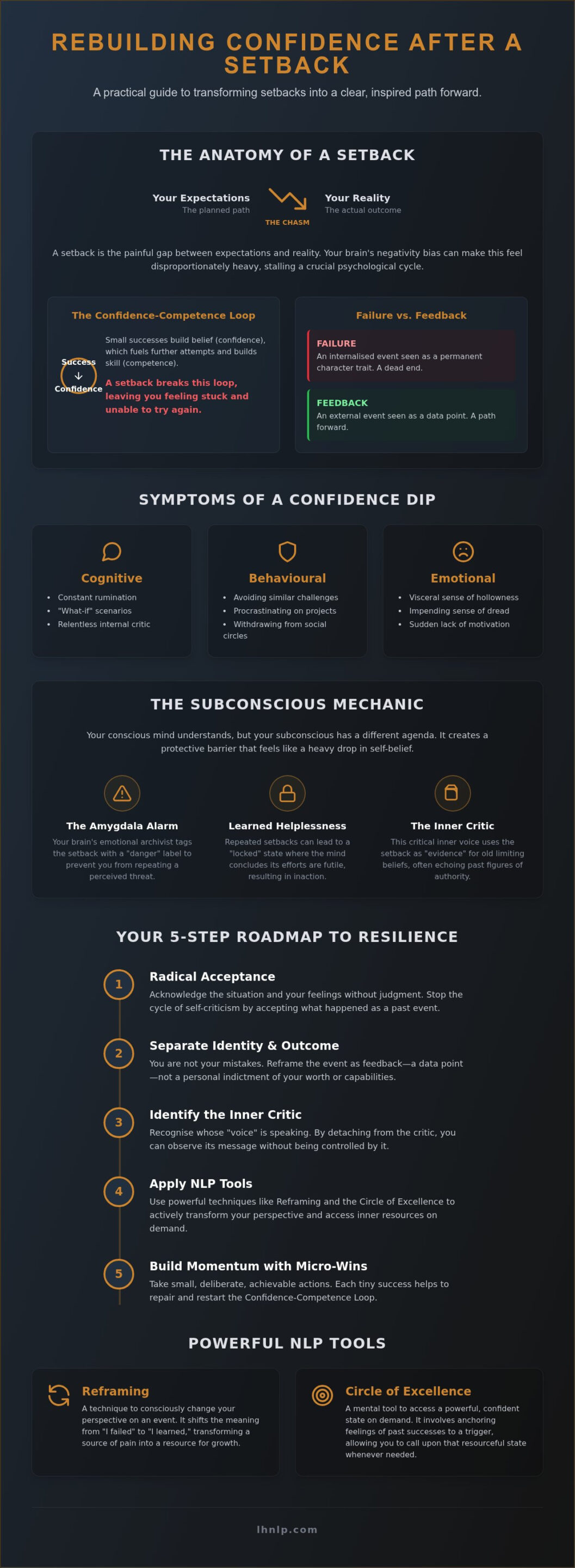
Your 5-Step Roadmap to Resilience and Renewed Self-Belief
Moving from the “locked” state of a subconscious alarm to a place of active recovery requires more than just hope. It requires a sequence. This framework is a structured roadmap that outlines how to build confidence after a setback through deliberate, sequential action. We begin with Radical Acceptance. This isn’t about liking the outcome; it’s about acknowledging the event without the weight of judgment. When you stop fighting the reality of what happened, you free up the mental energy needed to change your future.
The second step involves Micro-Wins. Set goals so small they are virtually impossible to fail, such as sending one email or reading two pages of a professional journal. These tiny victories provide the dopamine your brain needs to start the recovery process. Next, implement Linguistic Shifts. Change your internal dialogue from “I failed” to “I am learning how to navigate this challenge.” This subtle shift in syntax moves you from a fixed identity to a growth process. The fourth step is an Environmental Audit. Surround yourself with growth-mindset influences and limit your exposure to voices that reinforce your doubt. Finally, embrace Professional Integration. Working with a mentor or coach allows you to clear the subconscious blocks that logic alone cannot reach. This is the final, essential stage in how to build confidence after a setback; moving from self-help to expert-led recalibration.
Building a ‘Setback Survival Kit’
The first 48 hours after a fall are critical. During this time, focus on physiological regulation rather than making major life decisions. A practical tool for this window is the “Done List.” Unlike a traditional “To-Do List” that can feel overwhelming when your energy is low, a Done List tracks every small accomplishment you finish. Did you make the bed? Write it down. Did you attend a scheduled meeting despite feeling anxious? Write it down. This visual evidence of your agency is vital for Stress Management in London, where the pace of life often demands an immediate bounce-back that isn’t always healthy.
Cultivating Long-Term Resilience
Resilience is a mental muscle that grows through resistance. It is important to view self-compassion not as a weakness, but as a high-performance tool that allows you to stay in the game longer. Resilience is the speed of your recovery, not the total absence of falling. By treating yourself with the same professional empathy you would offer a colleague, you shorten the time spent in the “confidence gap.” If you feel your recovery has stalled, consider booking Confidence Building Sessions to identify and dissolve the deeper patterns holding you back.
Accelerating Your Recovery with Confidence Coaching in London
London is a city that rarely pauses. The relentless pace of the financial hubs, creative sectors, and medical districts means that a professional or personal fall can feel amplified by the high-achieving environment surrounding you. When the pressure to “bounce back” is immediate, it is easy to settle for a shallow recovery that leaves the underlying subconscious alarm system intact. Truly understanding how to build confidence after a setback in such a demanding landscape requires more than just resilience; it requires a specialised, solution-focused intervention that addresses the root of the hesitation.
Kamalyn Kaur’s approach elegantly bridges the gap between clinical precision and deeply empathetic coaching. With over 20 years of experience as a practitioner, she recognises that a setback is not a character flaw but a neurological “lock” that needs a specific key. In a Confidence Building Session, the focus shifts from merely discussing the problem to actively re-coding your response to it. By combining the strategic tools of NLP with the deep-reaching impact of hypnotherapy, these sessions facilitate rapid mindset shifts. You move beyond the logical knowledge of your worth and begin to experience a visceral, unshakeable sense of self-belief once again.
Bespoke Support in the Heart of London
Accessibility is vital for the busy professional. Whether you seek the prestigious clinical excellence of Harley Street or the local accessibility of Ealing and Tokenhouse Yard, there is a dedicated space for your transformation. For those whose schedules demand maximum flexibility, Virtual Hypnotherapy Sessions provide the same depth of care and efficacy from any location. The journey begins with an initial consultation, where your specific triggers are mapped out to ensure your roadmap to recovery is as unique as your own experience. This first step is often the most transformative, as it marks the moment you choose action over stagnation.
Investing in Your Most Valuable Asset: Your Mindset
Your mindset is the primary engine of your success. Investing in its restoration offers a profound return on investment, manifesting as sharper decision-making, increased earning potential, and a significant improvement in your overall well-being. While many choose to wait for “time to heal” a confidence wound, this passive approach often allows limiting beliefs to settle and harden. Proactive therapy ensures you don’t just wait for the storm to pass; you learn to navigate the next one with far greater ease. If you are ready to dissolve the barriers holding you back, contact London Hypnotherapy & NLP today to reclaim your confidence and step back into your life with renewed purpose.
Reclaiming Your Narrative and Moving Forward
If you find that the weight of a recent failure still feels insurmountable, you don’t have to navigate this recovery alone. With over 20 years of experience and a solution-focused NLP methodology, I provide the clinical precision and empathetic guidance needed to clear hidden subconscious blocks. Whether we meet at my Harley Street or Ealing locations, or through virtual sessions, the focus remains on your rapid and lasting transformation. It’s time to stop waiting for time to heal and start choosing a proactive path toward your most resilient self. Book Your Confidence Discovery Session in London today and begin the journey of reclaiming your inner strength. You have the resources within you; it is simply a matter of unlocking them.
Frequently Asked Questions
How long does it typically take to rebuild confidence after a major setback?
The timeline for recovery depends on the depth of the event, but most clients begin to feel a significant shift within three to six weeks. While traditional talk therapy might take months to unpick the past, solution-focused NLP and hypnotherapy target the subconscious “lock” immediately. This accelerated approach allows you to rebuild your momentum quickly, ensuring you don’t stay in the confidence gap longer than necessary.
Can hypnotherapy really help with confidence if I’m naturally shy?
Hypnotherapy is highly effective even if you consider yourself naturally shy, as it works directly with the subconscious patterns that govern your social responses. Shyness is often a protective mechanism that can be recalibrated to allow your authentic self to emerge. By changing the internal blueprint of how you perceive social interactions, you can develop a quiet, unshakeable confidence that feels natural rather than forced.
What is the first thing I should do immediately after a professional failure?
The first thing you should do is regulate your nervous system through deep breathing or grounding exercises to exit the “fight or flight” state. Avoid making any major life decisions or engaging in self-criticism during the first 48 hours. This pause allows your amygdala to settle, giving you the mental space needed to begin the process of how to build confidence after a setback with a clearer perspective.
Is there a difference between confidence and self-esteem?
Confidence is generally related to your belief in your ability to perform specific tasks, while self-esteem is your overall sense of self-worth. You can be a confident public speaker but still struggle with low self-esteem. My sessions address both layers, ensuring that your external competence is supported by a deep, internal foundation of self-belief that doesn’t crumble when a specific project or task doesn’t go as planned.
How many NLP sessions are usually needed to see a change in mindset?
Most clients see a tangible change in their mindset within three to six sessions. Because the methodology is solution-focused rather than problem-oriented, we don’t spend years analysing the past. Instead, we focus on the neurological recalibration required for your specific goals. Each 50 to 60 minute session is designed to provide immediate tools that you can integrate into your professional and personal life right away.
Can I do confidence building exercises at home effectively?
You can certainly perform confidence building exercises at home, such as the Circle of Excellence or physical anchoring techniques. These practices are excellent for maintaining momentum between professional sessions. However, guidance from an experienced practitioner is often necessary to identify the specific subconscious blocks you might be blind to. Combining home practice with expert-led hypnotherapy ensures your progress is both deep and sustainable.
What if my setback was caused by my own mistake, can I still recover?
Recovery is entirely possible, and often more profound, when the setback was caused by your own mistake. In the framework of NLP, we view every error as feedback rather than a failure of character. By taking radical responsibility without judgment, you can extract the necessary lessons and update your internal map. This process transforms the mistake into a foundation for future competence, proving that your worth is independent of any single action.