

What if the end of your smoking habit didn’t feel like a constant battle of willpower, but rather like the quiet, natural closing of a door? Many people arrive at their first session fearing they’ll spend the rest of their lives “missing” something, especially during those vulnerable moments in a London pub or on a stressful afternoon break. It’s completely normal to feel anxious about whether a change this deep can truly last. Understanding what to expect after hypnotherapy for smoking is the key to moving past these fears, as it allows you to see the process not as a loss, but as a profound neurological realignment.
In this article, we’ll walk through your 2026 timeline to freedom, detailing the specific psychological and physical shifts that occur once the session ends. You’ll discover how the initial “click” of change transforms into a permanent state of being, providing you with a clear roadmap for your journey. We’ll explore how your mind learns to navigate old triggers with ease, giving you the tools to manage stress and reclaim your energy without the need for nicotine. By the time you finish reading, you’ll have the confidence to step into your future as a permanent non-smoker.
Key Takeaways
- Learn why the first 24 hours often bring a surprising sense of indifference as your brain’s addiction signals begin to quiet.
- Gain a clear roadmap of what to expect after hypnotherapy for smoking, including how to manage the “ghost habits” that surface during your first week of freedom.
- Discover how the 21-day rule helps solidify your new identity as a permanent non-smoker, moving beyond the temporary struggle of “quitting” into a lasting state of being.
- Master practical strategies for navigating high-pressure London social situations, such as City pubs or West End commutes, without relying on nicotine as a crutch.
- Understand why combining NLP with clinical hypnosis creates a dual-modality approach that addresses the deep-seated language of addiction for permanent behavioural change.
The Immediate Shift: Your First 24 Hours After the Session
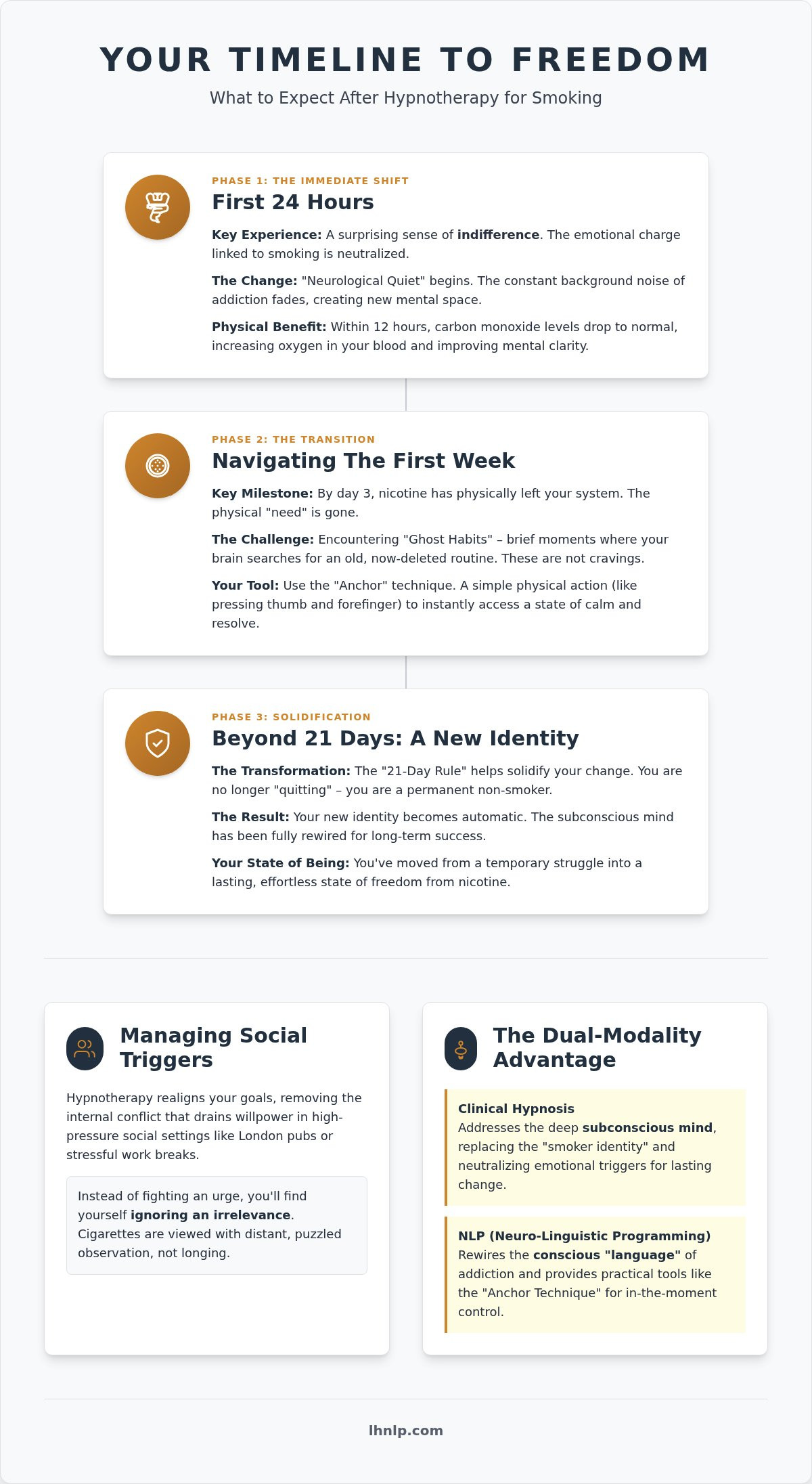
The moment you step back into the bustling streets of London after your session, the world might look exactly the same, yet your internal response to it has fundamentally altered. One of the most striking aspects of what to expect after hypnotherapy for smoking is a profound sense of indifference. For many, the smell of a cigarette, once a powerful and irresistible trigger, suddenly feels neutral or even slightly repellent. By understanding hypnotherapy as a tool for deep cognitive change, we can see why this shift occurs so rapidly. It isn’t that you’ve forgotten you used to smoke; it’s that the emotional charge attached to the act has been neutralized.
This transition is often characterized by what we call neurological quiet. The constant “background noise” of addiction, that nagging mental ticker tape asking when you can next escape for a break, begins to fade into silence. Your post-hypnotic state acts as a recalibrated subconscious filter that prioritises health over the outdated and harmful “need” for nicotine. Instead of a void where the habit used to be, there’s a newfound mental space. You’re no longer negotiating with yourself. The internal debate has simply ended.
Your first morning as a non-smoker is perhaps the most symbolic milestone of this initial 24-hour window. Waking up without the immediate reach for a lighter is a powerful anchor for the work done in the session. It’s a quiet, private victory. This ritual of rising, breathing deeply, and noticing the absence of that familiar morning cough sets the tone for your new identity. You aren’t someone trying to quit; you’re someone who simply doesn’t smoke.
Physical Sensations and Mental Clarity
You might expect a wave of “white-knuckle” anxiety, but the reality is usually a deep, grounded sense of calm. As your body begins its rapid repair process, carbon monoxide levels in your blood drop to normal within just 12 hours, allowing oxygen levels to rise. This physiological shift often manifests as improved mental clarity and a steadier pulse. To support this transition and anchor the suggestions made during your session, hydration is essential. Drinking plenty of water helps flush out residual toxins and provides a simple, healthy physical action to replace the old hand-to-mouth habit.
Addressing the ‘Willpower’ Myth
The beauty of the approach used in our smoking cessation treatments lies in the removal of internal conflict. Willpower is a finite resource that eventually runs dry, which is why “cold turkey” methods often fail during moments of high stress. Hypnotherapy aligns your subconscious desires with your conscious goals. You won’t feel like you’re fighting an urge; instead, you’ll find yourself ignoring an irrelevance. Kamalyn Kaur’s method focuses on this alignment, ensuring that the “smoker identity” is replaced by a version of yourself that views cigarettes with a sense of distant, puzzled observation rather than longing.
Navigating the First Week: The Physical and Mental Transition
By the third day of your journey, a significant milestone occurs: nicotine has physically left your system. While traditional methods often frame this as the “hardest part,” understanding what to expect after hypnotherapy for smoking allows you to see this peak differently. The physical “need” is gone, leaving behind only the habit architecture, the mental blueprints of where you used to smoke. You might notice “Ghost Habits,” which are those brief three-minute windows where your brain briefly searches for the old routine. These aren’t cravings in the traditional sense; they’re simply your subconscious mind tidying up old files.
To navigate these moments, you can use the “Anchor” technique established during our session. This tool allows you to instantly access a state of calm and resolve. When you feel a flicker of the old habit, follow these steps:
- Touch your chosen anchor point, such as pressing your thumb and forefinger together, to trigger the neurological association.
- Take one deep, intentional breath, imagining the air filling the space where smoke used to be.
- Recall the specific “future self” image we created, seeing yourself vibrant and free.
- Exhale and release the hand anchor, returning to your task with a clear mind.
During this first week, you may also experience more vivid dreams. This is a positive sign that your subconscious is actively processing the change and “re-filing” your identity. As your brain integrates the shift, it uses the dream state to solidify the new boundaries you’ve set for yourself. Research into hypnosis to quit smoking suggests that this mental work is a core part of why the method is so effective compared to willpower alone.
Breaking the Routine Association
Your morning coffee or the commute to Ealing or Harley Street might feel slightly different as you redefine these moments. The key is using NLP “pattern interrupts.” If you usually reach for a cigarette the moment you step outside, change your physical routine. Carry your bag in the other hand or take a slightly different route. These small shifts stop an old thought before it has the chance to become a desire. If you feel you need more support in these transitions, exploring professional Stop Smoking Hypnotherapy in London can provide the specific cognitive tools needed to rewrite these daily scripts.
The Emotional Release
It’s not uncommon to feel a brief sense of grief for the “old self” around day four or five. You are, after all, saying goodbye to a long-term companion, however toxic it may have been. Acknowledge this feeling without judgment. By day five, this is usually replaced by a surge in energy and a dramatic increase in your sensitivity to taste and smell. When colleagues or friends ask if you’ve “quit,” practice maintaining your new identity. Instead of saying “I’m trying to stop,” simply say “I don’t smoke.” This subtle shift in language reinforces the reality of your new life. If you find yourself curious about how these changes continue to evolve, you might find our frequently asked questions helpful for further clarity on the process.
Beyond the Habit: Rewiring Your Subconscious for Long-Term Success
As you move past the first ten days, the focus of your journey shifts from managing immediate changes to solidifying a permanent way of being. The subconscious mind operates on the principles of repetition and consistency, and it typically takes about 21 days for the brain to build robust new neural pathways. During this period, the suggestions planted during your session begin to weave themselves into the very fabric of your daily life. Understanding what to expect after hypnotherapy for smoking during this month long transition helps you stay grounded as your mind completes its “software update.”
The most profound shift you’ll notice is in your internal dialogue. You’ll find yourself moving away from the language of “quitting,” which implies a difficult, ongoing struggle, and toward the quiet certainty of “I don’t smoke.” This is a fundamental identity shift. Neuro-Linguistic Programming reinforces hypnotherapy results by giving you the specific mental syntax to reframe old triggers as irrelevant data points rather than calls to action. To support this deep architectural change, many clients find that listening to follow up audio recordings or attending a “top up” session acts as a powerful reinforcement, cementing the new non smoker identity until it becomes as natural as breathing.
Managing the ‘Extinction Burst’
Around the third week, you might experience what psychologists call an “extinction burst.” This is essentially the brain’s last ditch effort to return to a familiar, albeit harmful, routine. You might have a sudden, vivid thought about smoking out of nowhere. Do not mistake this for a failure or a sign that the hypnotherapy is “wearing off.” On the contrary, it’s a sign of profound healing. Think of it as a dying radio station sending out one final, loud burst of static before falling silent forever. When this happens, simply observe the thought with a sense of curious indifference and watch it dissolve.
The Ripple Effect of Smoking Cessation
The benefits of this change rarely stay confined to your lungs. As you reclaim control over one of the most challenging habits, you’ll likely notice a significant boost in your overall confidence and ability to manage stress. You’ve proven to yourself that deep, internal change is possible through methodical effort. There is also a very practical “London freedom fund” to celebrate. After just one month, the financial savings from not buying cigarettes in the City or West End can be substantial, often enough to fund a luxury dinner or a weekend retreat. To understand the philosophy behind our approach and how we support this total life transformation, you can read more About London Hypnotherapy & NLP.
Managing Social Triggers and London Life Without Cigarettes
London is a city that never truly stops. For many, the rhythm of urban life is punctuated by cigarettes: the quick puff before entering the Tube, the mid-morning break in a City courtyard, or the long evening in a West End pub. When considering what to expect after hypnotherapy for smoking, it’s vital to address these very specific urban triggers. You aren’t just quitting a habit; you’re redesigning how you interact with the capital itself. The “Pub Test” is often the most feared milestone, yet clients frequently report a surprising sense of detachment. Instead of feeling like you’re missing a vital component of your social experience, you’ll likely notice the smell of stale smoke on others or simply enjoy the freedom of not having to stand outside in the rain.
This is where the Harley Street standard of clinical support proves its worth. By working with a professional who understands the high-pressure demands of London’s corporate and social spheres, you’re equipped with more than just a suggestion. You’re given a psychological shield. Workplace culture is often the final frontier. You don’t have to lose your social circle just because you’ve lost the habit. You can still join the “smoking break” for the conversation, but you’ll find that after a few minutes, your desire to return to the fresh air of the office is stronger than the desire to stay in the huddle.
Social Resilience Strategies
Navigating your social circle requires a blend of honesty and boundary setting. It’s often helpful to tell friends you’ve had hypnotherapy. This isn’t just an explanation; it’s a declaration of your new identity. You might encounter “saboteur” friends, those who still smoke and may jokingly offer you one. In these moments, your subconscious alignment allows you to decline without effort. Before a big event, use the visualisation techniques we practiced during your session. See yourself moving through the room, drink in hand, engaged in conversation, and completely indifferent to the cigarettes around you.
Stress Management in the Busy City
Commuter stress is a reality of London life. Whether it’s a signal failure at Oxford Circus or gridlock in Ealing, these moments used to be prime triggers. Now, you can replace that frantic “need” with actual mindful breathing. Smoking was often just a forced way to take a deep breath. By learning to do this without the toxin, you reclaim the benefit without the cost. We often integrate NLP “swish” patterns to help you instantly pivot from a state of frustration to one of grounded calm. If you find that the pace of the city continues to challenge your resolve, exploring our Stress Management treatments can offer deeper insights into maintaining your equilibrium. To begin your own transition into this level of freedom, you can contact our team today to discuss your specific triggers.
The Role of NLP and Hypnosis in Permanent Behavioural Change
The journey to becoming a permanent non smoker is rarely about willpower alone; it’s about shifting the very foundations of how your brain processes the concept of a cigarette. At London Hypnotherapy & NLP, we employ a dual modality approach because we recognize that while clinical hypnosis addresses the deep subconscious roots of the habit, Neuro Linguistic Programming (NLP) provides the conscious tools to manage your daily reality. This combination ensures that what to expect after hypnotherapy for smoking isn’t just a temporary reprieve, but a fundamental rewiring of your internal narrative. NLP specifically addresses the “language” of your addiction, helping you identify and dismantle the subtle linguistic cues that once led you to reach for a pack.
Our philosophy is rooted in being solution focused. Rather than spending hours dwelling on why you started smoking twenty years ago, we direct your mental energy toward the future. We focus on the person you are becoming: someone who breathes easily, has more energy, and feels in total control of their choices. This forward looking perspective is what makes the transition feel like an evolution rather than a sacrifice. If you ever experience a “slip,” it’s vital to remember that our support at lhnlp.com is entirely non judgmental. A single moment of weakness isn’t a failure; it’s a data point that helps us further refine your strategy for long term success.
Why Choose Kamalyn Kaur’s Practice?
Kamalyn Kaur brings over 20 years of experience to every session, ensuring that your treatment is as unique as your own life story. We don’t believe in “one size fits all” scripts. Instead, we tailor each session to your specific triggers, whether those are corporate stress in the City or social habits in West London. For your convenience, we offer sessions at several prestigious locations:
- Harley Street: A world renowned centre for clinical excellence.
- Ealing: A quiet, accessible sanctuary for focused change.
- Tokenhouse Yard: Perfectly situated for professionals working in the City.
- Virtual Sessions: High quality support via Zoom, allowing you to undergo transformation from the comfort of your own home.
Taking the Next Step Toward Freedom
To ensure maximum efficacy, we recommend arriving at your session with an open mind and a clear list of the moments you find most challenging. Whether you’re in your 30s, 40s, or 50s, the health benefits of quitting are immediate and profound. Within months, your lung function improves and your risk of heart disease begins to drop significantly. You aren’t just adding years to your life; you’re adding life to your years. When you are ready to leave the weight of nicotine behind, you can Book Your Smoking Cessation Session with London Hypnotherapy & NLP and begin your 2026 timeline to true freedom.
Your Journey to Lasting Freedom Starts Now
The path to becoming a permanent non-smoker is not defined by what you give up, but by what you reclaim. We’ve explored how the initial indifference of the first 24 hours matures into a solid, unshakeable identity over 21 days. By understanding what to expect after hypnotherapy for smoking, you have already begun the process of mental preparation. You now possess the roadmap to navigate the unique pressures of London life, from the morning commute to evening social gatherings, with a sense of calm and quiet confidence. This transition is a methodical, supported evolution of your own inner strength.
With over 20 years of experience helping Londoners achieve lasting change, our practice provides the specialist clinical hypnotherapy and NLP tools required for this profound shift. Whether you choose to visit us in Harley Street, Ealing, or the City, you’ll receive personalized support tailored to your specific lifestyle and triggers. Ready to quit for good? Book your session at our London clinics today. True freedom is closer than you think, and the version of yourself that no longer needs a cigarette is ready to emerge.
Frequently Asked Questions
Will I be ‘under’ or lose control during the smoking hypnosis session?
You remain fully aware and in total control throughout the entire session. Hypnosis is not a state of sleep or unconsciousness; it is a state of deep relaxation and focused attention, much like being absorbed in a compelling book. You cannot be made to do anything against your will. Instead, you are a conscious participant working with the therapist to guide your subconscious toward your goal of freedom.
How many sessions of hypnotherapy are usually needed to stop smoking for good?
Most clients achieve their goal in a single, intensive session designed for lasting impact. While some people find a follow up session helpful to reinforce their new identity, the solution focused nature of our approach aims for immediate and permanent results. Every journey is unique, so the process is always tailored to your specific history and the depth of your habit architecture.
What happens if I have a cigarette a few days after my hypnotherapy session?
A single cigarette is a temporary slip rather than a permanent failure of the process. If this happens, it’s a signal to examine the specific trigger rather than an excuse to return to the habit. Understanding what to expect after hypnotherapy for smoking includes knowing that your brain is still learning. We offer non-judgmental support to help you re-anchor your non-smoker identity and move forward immediately.
Can hypnotherapy for smoking help if I’ve been a heavy smoker for decades?
Yes, hypnotherapy is highly effective for long term heavy smokers because the subconscious mind can be rewired regardless of how long a habit has existed. The length of time you’ve smoked doesn’t make the neural pathways permanent; it just means they are well-worn. We focus on the quality of your commitment today rather than the quantity of cigarettes you smoked in the past.
Will I gain weight after I stop smoking with hypnotherapy?
Weight gain is not an inevitable part of quitting when you use hypnotherapy. Unlike willpower based methods that often lead to “substitution” habits like snacking, hypnosis addresses the underlying psychological need. By resolving the root cause of the habit, we ensure your mind doesn’t feel the need to replace nicotine with food. You’re learning to manage stress and emotions through healthy, natural neurological pathways.
Is online or virtual hypnotherapy as effective as in-person sessions in London?
Virtual sessions via Zoom are just as effective as in-person appointments at our London clinics. The core of the work happens within your own mind through the power of suggestion and cognitive realignment. As long as you have a quiet space where you won’t be disturbed, the neurological impact and success rates remain identical to a face-to-face session in Harley Street or Ealing.
How does NLP differ from standard hypnosis for quitting smoking?
Hypnosis focuses on the state of your mind, while NLP addresses the structure and language of your thoughts. NLP provides practical pattern interrupts to stop cravings before they start, while hypnosis plants deep subconscious seeds of change. When considering what to expect after hypnotherapy for smoking, this dual modality approach ensures you have both the subconscious resolve and the conscious tools to remain smoke free.
What is the success rate of smoking cessation hypnotherapy?
Success rates vary between individuals, but research supports the efficacy of this approach over traditional methods. For example, a 2014 study found that hypnotherapy groups had higher quit rates at 26 weeks than those using nicotine replacement therapy. While no method can offer a 100% guarantee, combining clinical hypnosis with NLP significantly increases your chances of permanent freedom compared to trying to quit on your own.