

Imagine walking through St. James’s Park where, instead of scanning the sky for the next woodpigeon, you’re actually present in the moment. For many Londoners, the simple act of sitting at an outdoor cafe or crossing a busy square feels like navigating a minefield of unpredictable triggers. It’s exhausting to live in a state of constant hyper-vigilance, feeling that sharp spike of adrenaline every time a wing flaps nearby. You might even feel a quiet sense of embarrassment about a fear that others don’t seem to understand, yet for you, the panic is undeniably real.
You deserve to reclaim your freedom in the city. Seeking a professional fear of birds treatment London is the first step toward recalibrating your mind’s internal safety response so it no longer misfires at the sight of a seagull. By combining the gentle depth of clinical hypnotherapy with the practical, linguistic patterns of NLP, this article explores how you can transform your emotional reactions. We’ll look at how these methods work together to help you move from a place of fear to one of calm control, allowing you to enjoy London’s green spaces with total peace of mind.
Key Takeaways
- Understand how your brain’s amygdala misinterprets bird encounters as immediate threats and why this loop of hyper-vigilance persists in urban environments.
- Discover how a tailored fear of birds treatment London uses clinical hypnotherapy and NLP to gently update your subconscious safety responses.
- Learn about the structured session process at London Hypnotherapy & NLP, focusing on identifying your unique triggers to replace panic with calm control.
- Explore the “ripple effect” of overcoming ornithophobia, where reclaiming your freedom in London’s parks builds lasting confidence in other areas of your life.
Understanding Ornithophobia: Why the Streets of London Can Feel Overwhelming
Living in London often means sharing the pavement with millions of feathered residents. For most people, a pigeon pecking at a crumb in a square is mere background noise. For those seeking a deeper Understanding Ornithophobia, however, these encounters are a source of profound distress. This condition isn’t just a mild dislike or a quirk of personality. It is an intense, persistent fear that triggers a primitive fight or flight response in the brain. When this happens, your nervous system reacts to a sparrow as if it were a genuine predator, leaving you feeling vulnerable in your own city.
The capital presents a unique challenge due to its high bird density. Whether it is the woodpigeons of St. James’s Park, the scavenging gulls of the South Bank, or the surprisingly bold parakeets in West London, birds are everywhere. When your mind misidentifies these animals as a lethal threat, the city stops being a place of opportunity and starts feeling like a gauntlet. This constant state of alert is exhausting, yet it is a common experience that responds remarkably well to the right professional intervention.
To better understand how these deep-seated fears are addressed through professional support, watch this helpful video:
Common Triggers in the Capital
Navigating pigeon-heavy areas like Leicester Square or local London parks requires a level of tactical planning that others simply don’t see. The sudden, chaotic movement of a bird under a railway bridge or the frantic flapping of wings in a Tube station can cause an immediate spike in anxiety. This is precisely why specialized fear of birds treatment London focuses on the specific urban triggers that make city life so taxing. Outdoor dining, once a pleasure, becomes a source of dread as birds hover near tables. You find yourself unable to focus on conversation because you are too busy monitoring the sky.
The Physical and Emotional Toll
The symptoms of this phobia are visceral and often immediate. You might experience heart palpitations, sweating, or an overwhelming urge to flee the scene entirely. Beyond the immediate panic, there is the heavy weight of anticipatory anxiety. You spend your morning commute mentally mapping out routes that avoid specific squares or garden shortcuts. This constant mental effort leads to significant fatigue. Over time, it can result in social isolation as you turn down invitations to rooftop bars or outdoor events. It’s important to recognise that while this fear feels all-consuming, it is a learned response of the mind. Through dedicated phobia treatment, you can begin to unlearn these patterns and move through the city with a sense of renewed agency.
The Mechanics of Fear: How Your Mind Creates the Bird Phobia Loop
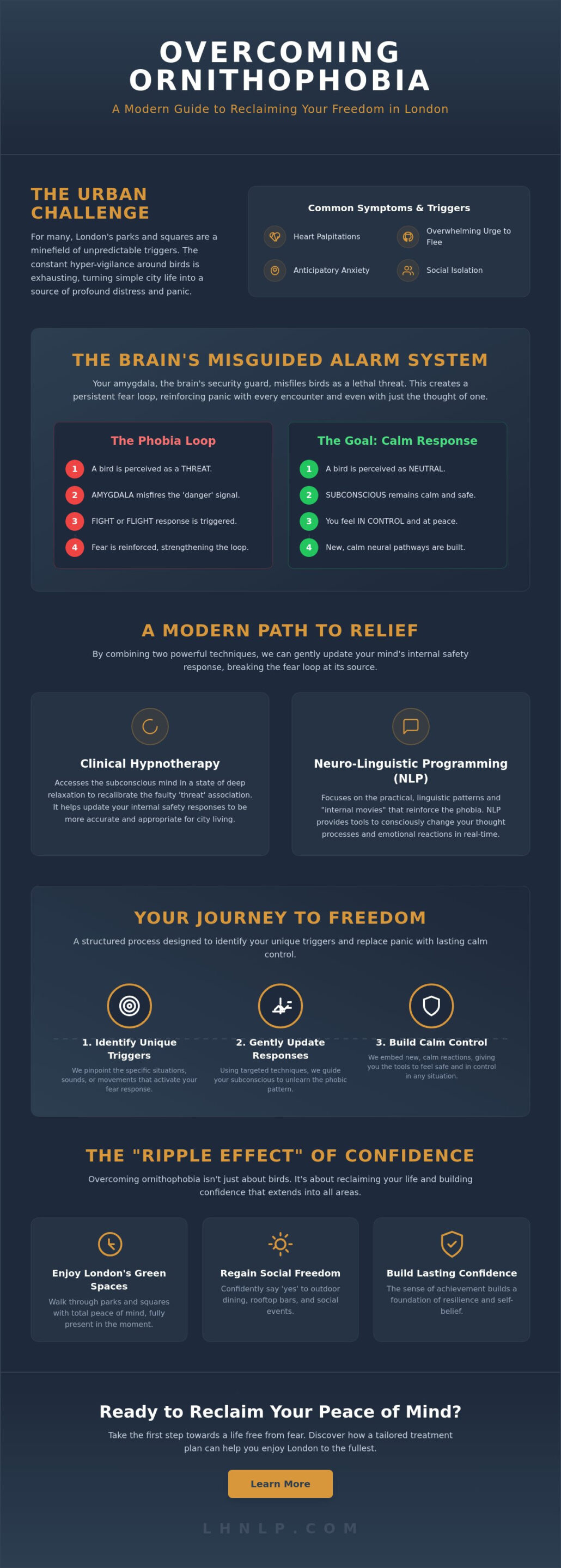
Why does your body react so violently to something as small as a sparrow? To understand why ornithophobia feels so insurmountable, we must look at the way the brain processes perceived threats. Your amygdala, the almond-shaped cluster in the temporal lobe, acts as a vigilant security guard. Its primary job is to keep you alive by filing every experience into ‘safe’ or ‘dangerous’ categories. In a phobic mind, this filing system has experienced a glitch. Instead of seeing a pigeon as a neutral urban co-habitant, the amygdala misfiles it as a life-threatening predator.
Once this error is logged, your brain enters a loop where it begins to generalise. What might have started as a single startling encounter with a seagull eventually expands until every bird, regardless of size or distance, triggers the same visceral panic. This loop is often reinforced by what we call the ‘internal movie.’ Long before you even step outside, your subconscious is already rehearsing the encounter. You can see the birds flapping, feel the air from their wings, and predict their unpredictable movements. This mental rehearsal is actually an attempt by your mind to protect you by preparing for the worst. However, it only serves to sensitise your nervous system further. When seeking a fear of birds treatment London, the goal is to interrupt this movie and update the subconscious files with more accurate, calm information.
The Subconscious ‘Safety’ Error
Your subconscious mind always prioritises survival over logic. This is why rational arguments, such as ‘it’s just a small bird’ or ‘it’s more afraid of you,’ rarely provide relief during a panic attack. A rational dislike is a conscious choice, but a phobic reaction is an automatic subconscious reflex. Telling someone with a deep-seated phobia to ‘just relax’ is like telling someone to stop their heart from beating through willpower alone. It simply doesn’t work because the response is happening at a level deeper than conscious thought. Your mind is trying to save you; it’s just using an outdated and over-sensitive map to do so.
The Role of Learned Behaviour
Many people find that their fear is rooted in early life. Perhaps you were pecked as a child, or you witnessed a parent’s genuine terror during a walk in the park. These moments act as blueprints for your future reactions. Even the media we consume, from films to sensationalist news stories about ‘aggressive’ birds, can reinforce the idea that feathered creatures are a source of danger. While there are various evidence-based treatments for these anxiety disorders, addressing the unique way your mind has constructed this fear is essential for lasting change. If you feel ready to explore how these patterns can be shifted, you might find it helpful to learn more about our specific phobia treatment options.
Hypnotherapy and NLP: A Modern Path to Bird Phobia Relief
If the mechanics of fear represent a glitch in your internal security system, then a modern approach to recovery involves updating the software itself. Kamalyn Kaur’s methodology does not rely on willpower or forced exposure. Instead, it creates a synergistic blend of clinical hypnotherapy and Neuro-Linguistic Programming (NLP) to address the phobia at its source. This isn’t the ‘stage hypnosis’ you might have seen on television; it’s a professional, solution-focused process designed to give you back your autonomy. When you seek a fear of birds treatment London, you aren’t just looking for a temporary fix. You’re looking for a way to change how your brain interprets feathered creatures on a fundamental level.
By utilising hypnotherapy London, we can bypass the critical conscious mind and speak directly to the subconscious. If hypnotherapy is the tool for deep system updates, NLP serves as the user manual for your brain. It teaches you how to consciously steer your thoughts away from panic and toward composure. This dual approach ensures that both the automatic reflex and the conscious thought patterns are addressed simultaneously, providing a comprehensive path to relief that feels natural and sustainable.
Rewiring the Subconscious with Hypnosis
The process begins by guided entry into a state of deep, restorative relaxation. In this space, the mind becomes more receptive to new, calm associations. We work on desensitising the fear in the safety of your imagination before you ever have to face a bird in reality. It’s about building ‘inner resources’ so that if a pigeon suddenly takes flight near you in Covent Garden, your body remains steady. You’ll learn to view these encounters as neutral events rather than personal threats, allowing your nervous system to remain in a state of ease even in bird-heavy environments.
NLP Techniques for Rapid Change
NLP provides the practical tools to interrupt the ‘internal movie’ of fear we discussed earlier. One powerful method is the ‘Swish’ pattern, where we train your brain to rapidly replace an image of a bird-related threat with a picture of yourself feeling calm and in control. We also work on reframing your internal dialogue. Instead of your mind shouting ‘danger,’ we recalibrate that voice to be a neutral observer. Finally, we use anchoring. This involves creating a physical trigger, such as pressing two fingers together, that instantly floods your system with a feeling of peace. It’s a tool you can carry with you anywhere, from the South Bank to the quietest London square, ensuring you always have a way to regain your emotional balance.
This combined approach offers a gentle yet profound shift. It’s about moving away from the exhaustion of hyper-vigilance and toward a life where your movements are no longer restricted by the presence of birds. If you’re curious about how this process might look for you personally, exploring our frequently asked questions can provide more clarity on the journey ahead.
What to Expect: Your Fear of Birds Treatment in London
Embarking on a journey to change a deep-seated fear can feel like a significant step. It is natural to wonder how the process actually unfolds. At London Hypnotherapy & NLP, we begin with a thorough initial consultation. This isn’t just a formality; it’s a vital conversation where we map out your specific landscape of fear. We explore the triggers we discussed earlier, such as the sound of wings or the sight of birds in close proximity, to understand how your mind has constructed its unique ‘safety’ loop. This understanding allows us to build a bridge from where you are now to where you want to be.
One of the most encouraging aspects of this work is the timeline. Unlike traditional talk therapies that may span years, a professional fear of birds treatment London is typically solution-focused and efficient. Most clients find that they only need a few focused sessions to achieve a lasting shift in their emotional response. We offer the flexibility of meeting at several professional clinics across the city, including Harley Street, Ealing, and Tokenhouse Yard, ensuring that your path to recovery is as convenient as it is effective.
A Tailored Treatment Plan
Every mind is different, and so is every phobia. During our sessions, we identify whether your fear is specific, perhaps limited to pigeons or seagulls, or a more general anxiety toward all feathered creatures. We then set clear, achievable goals. For some, success means being able to eat lunch in a London square; for others, it’s the ability to walk through a park without checking the sky. Because phobias often exist alongside general tension, we frequently integrate stress management techniques. This holistic approach ensures that your nervous system feels supported and resilient throughout the entire process of change.
In-Person vs. Virtual Sessions
Choosing where to conduct your sessions is an important part of feeling safe. Many clients value the physical presence and professional atmosphere of a face-to-face session in one of our London clinics. There’s a particular sense of commitment that comes with stepping into a therapeutic space. However, online hypnotherapy services have proven to be just as effective for phobia treatment. Virtual sessions allow you to remain in the comfort of your own home, which can be particularly beneficial if your anxiety makes travelling through bird-heavy areas difficult. The choice is entirely yours, based on where you feel most supported and at ease.
If you feel ready to reclaim your freedom and walk through the city with a sense of calm, the first step is simply to reach out. You can book your initial consultation here to begin your transformation.
Reclaiming Your Freedom: Life After Bird Phobia Treatment
Imagine a Saturday afternoon where the sun is reflecting off the Thames, and you’re walking toward a terrace for lunch. For the first time in years, you aren’t calculating the distance to the nearest bird or feeling that cold knot of dread in your stomach. This is the ‘new normal’ that follows a successful fear of birds treatment London. It’s a quiet, profound shift where the environment remains the same, but your internal map has been completely redrawn. You’re no longer a spectator of your own life, restricted by the flight paths of pigeons; you’re a participant, fully present in the beauty of the city.
To ensure these results are permanent, we equip you with self-hypnosis and NLP tools that you can use independently. These techniques act as a mental maintenance kit, allowing you to reinforce your new associations whenever you feel the need. It’s about moving from a state of being ‘fixed’ to a state of being ‘resilient.’ You’ll carry the anchors and reframing patterns we developed in our sessions, ensuring that your sense of calm remains unshakable regardless of where your London adventures take you. You’ve learned to lead your mind, rather than being led by its outdated fears.
The Joy of Outdoor London
London’s green spaces are among its greatest treasures. After treatment, places like Hampstead Heath or the botanical wonders of Kew Gardens become yours to explore without hesitation. You can enjoy the freedom of spontaneous outdoor plans, perhaps a picnic in Greenwich or a walk through the rose gardens of Regent’s Park, without ever needing to scan the sky. The exhausting habit of crossing the street to avoid a flock of pigeons simply falls away, replaced by a sense of ease that you might have once thought impossible. You’re finally free to look up and enjoy the architecture and the trees, rather than looking up in fear.
Your Path to Relief Starts Here
Kamalyn Kaur is a solution-focused practitioner who understands that your time is valuable and your desire for change is urgent. By choosing to engage with phobia treatment in London, you’re making a significant investment in your overall quality of life and mental well-being. You weren’t born with this fear; it’s a learned response that your mind once created for your protection, and it’s a response that can be unlearned through methodical, empathetic guidance. If you’re ready to leave hyper-vigilance behind, a professional fear of birds treatment London offers a proven path to a more peaceful, unrestricted life. The city is waiting for you to enjoy it fully.
Step Into a Calmer Urban Life
Your journey through London doesn’t have to be defined by the flight paths of birds. We’ve explored how your mind’s internal safety response, while well-intentioned, can become over-sensitive to urban triggers. By addressing these subconscious patterns through a personalized blend of clinical hypnotherapy and NLP, you can replace hyper-vigilance with a steady sense of control. This methodical approach allows you to update the ‘software’ of your mind, ensuring that the sight of a pigeon in a busy square no longer dictates your emotional state.
Since 2005, Kamalyn Kaur has specialized in providing effective fear of birds treatment London, helping countless individuals reclaim their freedom. Whether you choose to meet at our clinics in Harley Street, Ealing, or Tokenhouse Yard, you’ll receive expert guidance tailored to your specific triggers. You weren’t born with this fear, and you certainly don’t have to carry it through the rest of your life. The city is waiting for you to experience its beauty without restriction. Are you ready to take the first step toward a bird-free mind? Book Your Consultation for Fear of Birds Treatment in London and begin your transformation today.
Frequently Asked Questions
How many sessions will I need for fear of birds treatment in London?
Most individuals experience significant and lasting change within three to five sessions. Because we use a solution-focused approach, we target the specific neural pathways responsible for your panic rather than spending months exploring the past. This efficiency makes our fear of birds treatment London a practical choice for busy people who need to see results quickly. We always adjust the pace to ensure you feel comfortable and secure throughout the process.
Is hypnotherapy for ornithophobia safe?
Yes, hypnotherapy is a completely safe and natural process where you remain in total control at all times. It is simply a state of focused attention, similar to being deeply absorbed in a good book. You cannot be made to do anything against your will or values. Our practitioners create a supportive environment where your subconscious can safely update its old, outdated fear responses without any risk of side effects.
Will I be forced to touch a bird during the session?
No, you will never be forced to have physical contact with a bird during your sessions. Our methodology relies on mental desensitization and cognitive reframing rather than forced exposure or “flooding” techniques. We work within your imagination to build inner resources and calm associations first. This allows you to regain your confidence at a pace that feels entirely safe, ensuring you never feel overwhelmed or retraumatized.
Can NLP really work for a fear I’ve had for 20 years?
Yes, NLP is highly effective regardless of how long you have carried the fear. The brain doesn’t differentiate between a new habit and one that is twenty years old; it simply follows the neural pathways it has built. By using specific NLP patterns, we can interrupt these old loops and create new, calmer responses. Many clients find that even a decades-old phobia can be resolved surprisingly quickly once the underlying mental movie is updated.
What is the difference between a fear of birds and a phobia?
A fear is a manageable dislike or caution, whereas a phobia is an intense, irrational, and debilitating reaction. While a fear might make you feel slightly uncomfortable, a phobia triggers a full fight or flight response, often leading to panic attacks. If your reaction to birds is restricting your movement through the city or causing physical symptoms like heart palpitations, it has likely crossed the threshold into a clinical phobia.
Can I have my sessions for bird phobia via Zoom?
Yes, you can absolutely have your sessions via Zoom from the comfort of your own home. Virtual hypnotherapy is just as effective as in-person sessions because the primary work happens within your own mind. Many clients prefer this option as it eliminates the stress of traveling through bird-heavy areas before they have built their new calm associations. It offers a flexible way to access professional fear of birds treatment London.
Does the NHS provide fear of birds treatment in London?
The NHS typically offers Cognitive Behavioural Therapy (CBT) for phobias, but waitlists in London can be quite long. While some local mental health services might provide support, specialized treatments like hypnotherapy and NLP are generally accessed through private practitioners. Choosing a private route allows for a more personalized and rapid intervention, ensuring you don’t have to wait months to start reclaiming your freedom in the city’s parks.
How do I know if I’m a good candidate for hypnotherapy?
You are an excellent candidate if you are genuinely motivated to change and open to the process of inner reflection. Hypnotherapy works best for individuals who are ready to take responsibility for their emotional well-being and are willing to engage with the techniques provided. If you find that your fear is no longer serving you and you feel a strong desire to walk through the city with peace of mind, you have the right mindset.