

What if the invisible wall standing between you and your highest ambitions isn’t a lack of talent, but a misplaced survival instinct that’s simply trying too hard to keep you safe? While research indicates that 31% of adults struggle with a fear of failing, for many, this atychiphobia manifests as a paralyzing cycle of perfectionism that eventually leads to burnout. You might find yourself avoiding the very career-advancing opportunities you crave because the “what if” anxiety feels too heavy to carry. It’s an exhausting way to live, especially when your inner ambition is calling you toward something greater. Integrating fear of failure hypnosis into your personal development allows you to communicate directly with the subconscious parts of your mind that equate risk with danger.
You likely recognize the frustration of knowing you’re capable of more, yet feeling held back by a silent, internal anchor. I understand that this struggle isn’t a character flaw, but a deeply rooted protection mechanism that can be gently recalibrated. This article will show you how clinical hypnotherapy and NLP can rewire your subconscious response to failure, turning paralysis into purposeful action. We’ll explore the mechanics of shifting your perspective on setbacks and the path toward reclaiming unshakeable self-confidence. By understanding these tools, you can finally learn to take calculated risks without panic and build a healthier, more resilient relationship with your own success.
Key Takeaways
- Recognize the subtle boundary where healthy caution becomes atychiphobia, a persistent fear that stifles your potential and prevents you from embracing new challenges.
- Explore the mechanics of fear of failure hypnosis, a process that gently rewires your subconscious responses to transform paralyzing anxiety into purposeful, focused action.
- Learn how the integration of NLP coaching provides practical mental frameworks to complement the deep emotional shifts achieved through clinical hypnotherapy.
- Gain clarity on the therapeutic journey, discovering how a structured approach of consultation and induction creates a safe space for lasting internal change.
- Reclaim your ambition by developing a healthier relationship with setbacks, allowing you to move forward with the confidence to take risks without the weight of panic.
What is Atychiphobia? Understanding the Deep Roots of the Fear of Failure
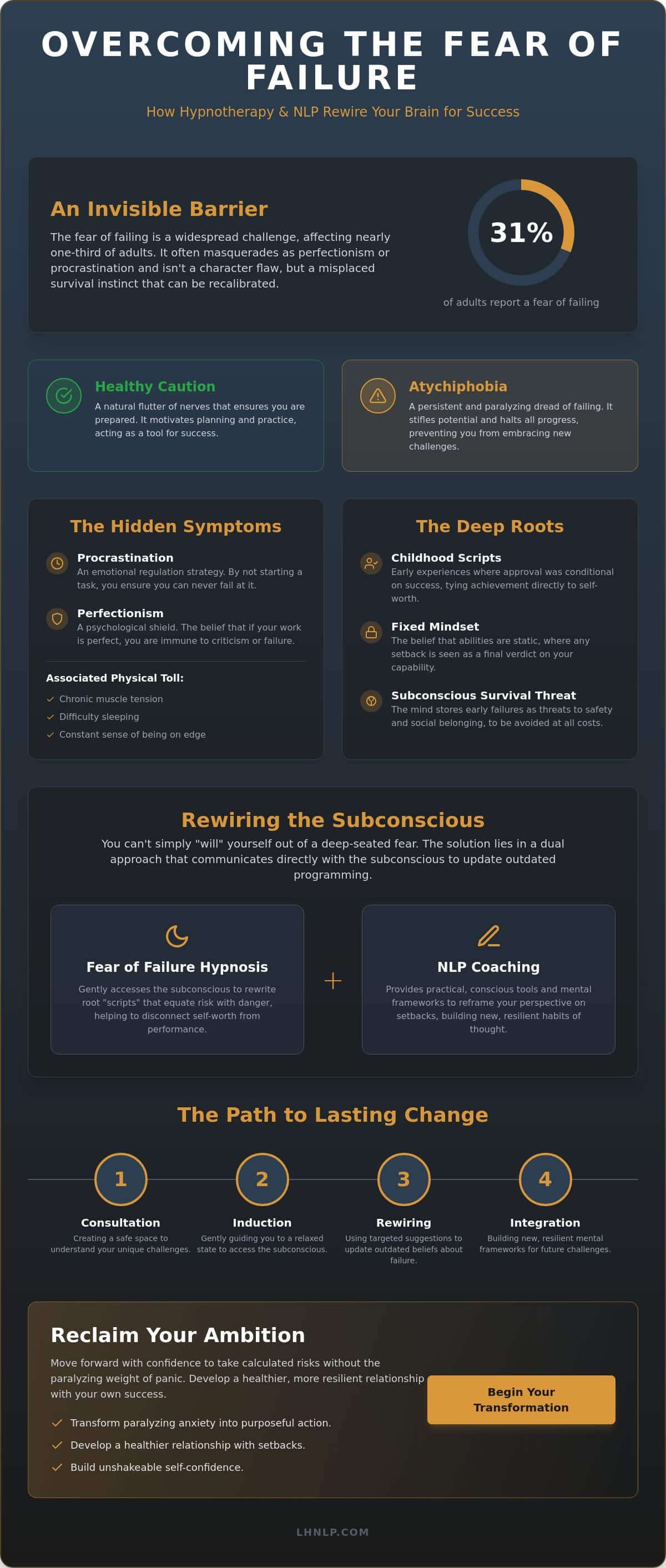
Most of us feel a flutter of nerves before a big presentation or a significant career pivot. That’s healthy caution; it’s the mind’s way of ensuring we’re prepared. However, for an estimated 2 to 5 percent of the population, this feeling evolves into atychiphobia, a persistent and paralyzing dread of failing that effectively halts all progress. A 2015 survey found that 31% of adults were afraid of failing, highlighting just how pervasive this issue is. It’s not merely about the risk of a project not working out. Instead, it’s often a deeply rooted fear of negative evaluation from peers, mentors, or family members. In a fast-paced environment like London, where hustle culture and constant social comparison are the norms, this anxiety can become a constant background noise that drowns out your actual potential.
To better understand how this mindset takes hold and how it can be addressed, watch this helpful video:
This fear often masks more complex anxieties about loss of status or rejection. When your identity is tied to your professional output, a mistake feels like a threat to your very existence. This is why many high achievers eventually seek out fear of failure hypnosis to disconnect their self-worth from their performance. If you’re ready to explore how these patterns can be shifted, you can learn more about our hypnotherapy treatments.
The Hidden Symptoms: Procrastination and Perfectionism
Procrastination is rarely about being lazy or having poor time management skills. It’s an emotional regulation strategy. If you don’t start the task, you can’t fail at it. Similarly, perfectionism acts as a psychological shield, convincing you that if you’re perfect, you’re beyond the reach of criticism. This mindset takes a significant physical toll, often manifesting as:
- Chronic muscle tension in the neck and shoulders.
- Difficulty falling asleep due to an overactive inner critic.
- A constant sense of being on edge or waiting for the other shoe to drop.
Childhood Scripts and the Success-Worth Equation
These patterns often begin with early childhood scripts where academic success or athletic achievement was the primary currency for parental approval. This creates a fixed mindset, where you believe your abilities are static and every setback is a final verdict on your intelligence. You begin to believe that love and belonging are conditional on being the best. The subconscious mind stores these early failure memories as survival threats that must be avoided at all costs to ensure safety and social belonging. Overcoming this requires more than just willpower; it requires a method like fear of failure hypnosis to access the subconscious and rewrite these outdated survival codes.
How Hypnosis for Fear of Failure Works: Rewiring the Subconscious
If your conscious mind is the interface you interact with daily, your subconscious is the intricate operating system running every background process. Logic often fails to reach these deeper layers; this is why you can’t simply “will” yourself out of a phobia. You might intellectually know that a mistake won’t end your career, yet your body still reacts as if it’s a life-threatening event. This disconnect happens because the subconscious is designed to protect you, even if its methods are outdated. Through fear of failure hypnosis, we can access these internal scripts and update them to reflect your current reality and goals.
Hypnosis facilitates a state of focused relaxation, often called a trance. It isn’t a loss of consciousness or a surrender of your will. Instead, it’s a heightened state of internal awareness where the outside world fades into the background. Research on Hypnosis for stress and anxiety shows how this method allows the mind to become more open to transformative ideas. In this quiet space, we begin the process of “reframing.” We take the concept of failure and strip away its heavy emotional charge. It stops being a threat to your identity and becomes a neutral data point; it’s feedback, not a final judgment.
Bypassing the Critical Factor
Your mind possesses a “Critical Factor.” It’s a vigilant gatekeeper that analyzes new information against your existing beliefs. If you try to tell yourself “I am confident” while your subconscious firmly believes “I am inadequate,” this gatekeeper rejects the new thought immediately. Hypnosis gently encourages this guard to step aside for a moment. This bypass allows empowering suggestions to take root directly in the subconscious where they can actually create lasting change. It’s a methodical way to plant seeds of resilience without the interference of your everyday doubts.
Neuroplasticity: The Science of Change
The human brain is remarkably adaptable, a quality known as neuroplasticity. Through repeated suggestions and mental rehearsal, we can physically strengthen the neural pathways associated with calm and confidence. Your brain struggles to distinguish between a vividly imagined success during a session and a real-world victory. This makes clinical hypnotherapy a potent, evidence-based tool for building a track record of “mental wins.” By the time you face a real challenge, your mind already feels familiar with the sensation of success. If you’re ready to start this journey, exploring our frequently asked questions can help clarify how we tailor this process to your specific needs.
Hypnosis vs. NLP: A Dual Approach to Building Confidence
Have you ever wondered why your conscious mind can agree with a professional goal while your inner self remains frozen in place? This disconnect often stems from the fact that our fears aren’t just feelings; they’re coded patterns of information. NLP, or Neuro-Linguistic Programming, acts as the manual for how we code our internal reality. While hypnosis addresses the deep emotional roots of atychiphobia, NLP provides the tactical tools to restructure your daily thoughts. By combining these two modalities, we move beyond simple relaxation into a sophisticated process of mental architecture. This dual-layer approach is precisely why fear of failure hypnosis succeeds even for those who feel they’ve tried everything else without success.
Generic audio recordings often fail because they don’t account for your unique “success-worth” equation or the specific triggers that spark your anxiety. A personalized strategy is essential because your mind’s protective mechanisms are as individual as your fingerprint. Scientific studies on Hypnosis for treating fear suggest that these interventions can significantly alter brainwave activity, promoting emotional control where there was once only panic. We don’t just want you to feel better during a session; we want you to possess a reliable mental toolkit for the real world.
The Power of Reframing and Anchoring
NLP introduces the concept of “anchoring,” a technique where we associate a specific physical gesture with a state of profound, unshakeable calm. Imagine being able to trigger a sense of centeredness just by touching your thumb and forefinger together during a high-stakes meeting. We also focus on “reframing,” which changes the internal movie you play about failure. Instead of a horror film where a mistake leads to catastrophe, we edit the footage into a learning documentary. This shift in perspective is reinforced by changing your internal dialogue. We work to subconsciously swap the restrictive “I can’t” for the expansive “How can I?”, opening up neural pathways for problem-solving rather than threat-detection.
Future Pacing for Success
Future pacing is essentially a mental dress rehearsal conducted while you’re in a receptive hypnotic state. We guide your mind through a challenging upcoming event, but instead of the usual script of avoidance, you experience yourself responding with curiosity and poise. This process “pre-programs” your subconscious to recognize the situation as an opportunity for growth rather than a survival threat. By the time the actual event occurs, your brain already has a successful blueprint to follow. This methodology is a core pillar of our Confidence Building Sessions, helping you bridge the gap between where you are and where your ambition calls you to be. It’s a methodical way to ensure that your inner resources are fully mobilized when you need them most.
What to Expect in a Fear of Failure Hypnosis Session
Stepping into a session is a collaborative act of courage. It’s a space where your professional ambitions and personal fears are met with empathy and clinical precision. We begin with an initial consultation to map the specific landscape of your anxiety. What are the precise triggers that cause you to hesitate? Is it the fear of being judged by a senior partner, or perhaps a deep-seated worry about losing the status you’ve worked so hard to build? By identifying these history-laden scripts, we ensure that your fear of failure hypnosis is tailored to your unique psychological architecture rather than a generic template.
Once we’ve established your goals, the induction process begins. You’ll move into a state of focused, comfortable relaxation where the analytical mind steps back. In this trance, the therapeutic work truly starts. We use vivid metaphors and direct suggestions to dissolve the emotional charge attached to the idea of “failing.” You might experience this as a internal softening or a sense of mental “unclenching.” When the session concludes, the awakening leaves you feeling refreshed and noticeably lighter. To ensure these shifts endure, we provide practical NLP homework, such as specific language patterns or anchoring exercises, to reinforce your new mindset between visits.
A Solution-Focused Environment
It’s important to understand that this process is something we do together; it’s never something “done to” you. This partnership ensures you remain in control and fully aligned with the changes we’re making. Most clients begin to feel a significant shift in their perspective within just 2 to 3 sessions. For those who aren’t located near our Harley Street or Ealing offices, we offer virtual hypnotherapy sessions that provide the same level of depth and efficacy from the comfort of your own home. This flexibility allows you to prioritize your growth regardless of your schedule or location.
Measuring Your Progress
The success of our work isn’t just measured by how you feel during the session, but by how you act in the days that follow. You’ll likely notice subtle shifts in your daily habits. Perhaps you stop “doom-scrolling” to avoid a difficult task, or you find yourself speaking up in a meeting where you previously would have stayed silent. This is the transition from “avoidance motivation,” where you run from pain, to “approach motivation,” where you move toward your goals with curiosity. Ultimately, the true metric of success is your newfound freedom to act without the heavy weight of panic holding you back. If you’re ready to experience this shift for yourself, you can reach out to schedule a consultation and begin the process of reclaiming your ambition.
Transform Your Mindset with London Hypnotherapy & NLP
At London Hypnotherapy & NLP, we view your ambition as a vital force that deserves to burn brightly, unhindered by the shadows of atychiphobia. Kamalyn Kaur’s approach is built on a foundation of clinical expertise and empathic mentorship, recognizing that professional success is deeply intertwined with internal peace. We don’t just treat symptoms; we partner with you in a journey of evolution. Our locations in Harley Street and Ealing are designed for the busy professional who demands excellence and requires a sanctuary for change. Overcoming the fear of failure isn’t just about avoiding mistakes. It’s the master key to unlocking peak performance across your career, your personal life, and your sense of self-worth.
Bespoke Therapy for the London Professional
A one-size-fits-all approach inevitably fails when dealing with the complex layers of a fear like atychiphobia. Your history, your triggers, and your specific goals are unique, so your therapy must be equally tailored. We often integrate Stress Management techniques to help you navigate high-stakes environments with a steady hand and a clear mind. This integration ensures you’re equipped for both deep subconscious shifts and immediate, real-world challenges. If you’d like to understand the philosophy behind our work and our commitment to professional standards, I invite you to visit our About Us page to learn more about Kamalyn’s background and methodology.
Take the First Step Toward Fearless Action
You might be asking yourself if now is truly the right time to begin this work. The truth is that the “perfect moment” is a psychological myth often used by the subconscious to maintain the status quo. By deciding to address your fear today, you’re making a powerful statement that your future is worth more than your current comfort zone. You don’t need to wait for the fear to vanish on its own. Instead, you can take the action that makes the fear irrelevant. We’re ready to support your transition into a life where setbacks are merely feedback and your potential is no longer a source of anxiety. If you’re ready to reclaim your ambition, you can book your initial consultation today and start the process of becoming truly fearless in your pursuits.
Step Into Your Potential with Lasting Confidence
The transition from being paralyzed by “what if” to moving forward with “how can I” is a profound shift in your internal architecture. By recognizing that atychiphobia is simply a survival mechanism that’s trying too hard to protect you, you’ve already begun the process of reclaiming your ambition. We’ve discussed how the subconscious mind can be gently updated to view setbacks as neutral feedback rather than existential threats. Integrating fear of failure hypnosis with the tactical tools of NLP provides a comprehensive path to unshakeable self-assurance, allowing you to navigate high-stakes environments with a steady hand and a clear mind.
With over 20 years of clinical experience specializing in high-performance coaching and NLP, I’m here to support your professional and personal evolution. Whether you choose to visit our London locations in Harley Street and Ealing or prefer the flexibility of global Zoom consultations, our work together will be focused on your specific triggers and goals. It’s time to stop letting the pursuit of perfection keep you from the success you’ve earned. Book Your Consultation with London Hypnotherapy & NLP Today and begin the journey toward a life of fearless, purposeful action. Your future self is waiting for you to take this step.
Frequently Asked Questions
Can hypnosis really cure a lifelong fear of failure?
Hypnosis is remarkably effective for addressing deep-seated atychiphobia because it works directly with the subconscious layers where these fears are anchored. By updating the outdated “childhood scripts” that link your self-worth to your achievements, we can dismantle the survival threat response. While every individual’s journey is unique, many clients find that lifelong patterns of avoidance begin to dissolve once the underlying emotional triggers are recalibrated through professional intervention.
How many sessions of hypnotherapy will I need to see results?
Most individuals begin to notice a significant shift in their internal perspective within just 2 to 3 sessions. While the total number of sessions depends on the complexity of your specific triggers, research often suggests that substantial, subjective improvement can occur within a relatively short timeframe. We focus on a solution-oriented approach that prioritizes sustainable change, ensuring you have the mental tools to maintain your progress independently.
Is fear of failure the same as social anxiety?
While they often overlap, they’re distinct psychological constructs. Social anxiety is primarily concerned with being judged or scrutinized in social situations, whereas the fear of failure is specifically focused on the act of not meeting a standard. However, both conditions often share a root cause in the fear of negative evaluation. Our dual approach using hypnosis and NLP addresses these overlapping layers to build a foundation of core confidence.
What if I am too analytical or “strong-willed” to be hypnotised?
Analytical and strong-willed individuals often make the best candidates for hypnotherapy because they possess high levels of focus and mental discipline. Hypnosis isn’t a surrender of your will; it’s a collaborative process where you use your natural intelligence to follow specific mental instructions. Your analytical mind doesn’t need to “switch off.” Instead, we work with your cognitive strengths to facilitate deeper subconscious insights and lasting change.
Are the results of fear of failure hypnosis permanent?
The changes achieved through fear of failure hypnosis are designed to be long-lasting because they involve rewiring your subconscious response at a neural level. By utilizing neuroplasticity, we strengthen new neural pathways associated with resilience and curiosity. When combined with practical NLP integration exercises, these new mental habits become your brain’s default setting, allowing you to face challenges without reverting to old patterns of panic.
Can I do hypnotherapy for fear of failure online via Zoom?
Virtual hypnotherapy is highly effective and offers the same clinical benefits as in-person sessions. As long as you have a quiet, comfortable space where you won’t be interrupted, the process of induction and therapeutic suggestion works perfectly through a stable video connection. This flexibility allows busy professionals to prioritize their mental growth and access specialized support from any location without the added stress of a commute.
Will I lose my motivation to work hard if I stop fearing failure?
You won’t lose your drive; instead, your motivation will become healthier and more sustainable. Fear-based motivation often leads to burnout and chronic procrastination because the “fuel” is stress. By removing the paralyzing dread of failing, you transition into “approach motivation.” This means you’ll pursue your goals out of genuine ambition and curiosity, allowing you to work with greater clarity, creativity, and consistent energy.
Is clinical hypnotherapy safe for everyone?
Clinical hypnotherapy is a safe, non-invasive, and natural therapeutic tool for the vast majority of people. It’s simply a state of focused attention, much like being deeply absorbed in a film or a creative project. You remain in control throughout the entire process. However, as with any psychological intervention, individuals with certain severe psychiatric diagnoses should consult their primary medical professional to ensure this approach is suitable for their specific needs.