

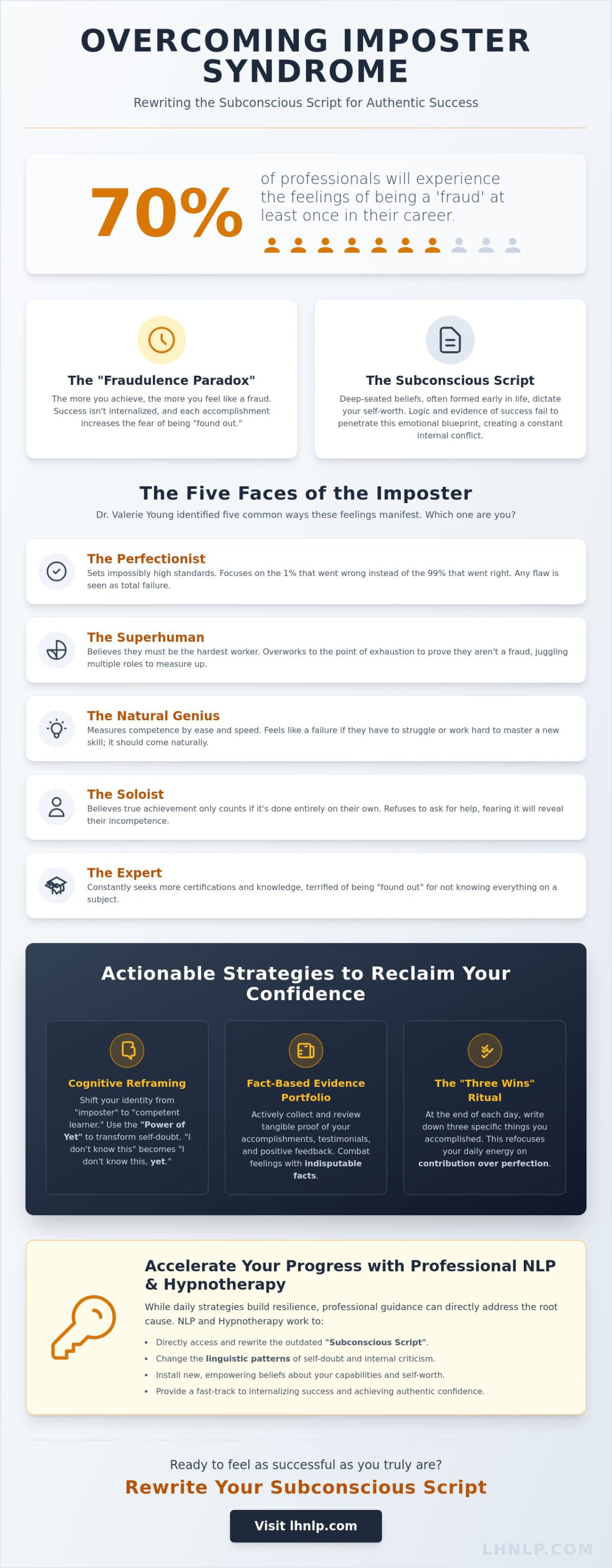
Did you know that approximately 70% of people will experience the suffocating weight of imposter syndrome at least once in their professional lives? It’s a startling figure that reminds us how many brilliant minds are currently searching for how to overcome imposter syndrome while secretly fearing they’ll be exposed as a fraud. You likely know the exhaustion of dismissing your achievements as mere luck or overworking to the point of burnout just to outrun a perceived inadequacy. This chronic inability to internalize success creates a glass ceiling on your potential that no amount of external praise seems to shatter.
We believe that this internal friction isn’t a character flaw, but rather a protective subconscious script that’s ready to be rewritten. You’ll discover how to move beyond the fear of being found out by understanding the subconscious roots of your anxiety and using NLP-based strategies to reclaim your success. We’ll explore the specific techniques used to quiet your inner critic so you can finally feel deserving of your professional status and enter every high-pressure meeting with a sense of calm, authentic presence.
Key Takeaways
- Understand the “fraudulence paradox” and why achieving more can sometimes make you feel like a bigger fraud if success isn’t properly internalized.
- Identify the “Subconscious Script” that dictates your self-worth and learn why logic alone is rarely enough when learning how to overcome imposter syndrome.
- Master NLP-based cognitive reframing techniques, including the “Power of Yet,” to shift your identity from a perceived imposter to a competent learner.
- Build a “Fact-Based Evidence Portfolio” and adopt the “Three Wins” ritual to refocus your daily energy on contribution rather than perfection.
- Discover how professional NLP and hypnotherapy can accelerate your progress by directly addressing the linguistic patterns of self-doubt in your subconscious mind.
Understanding Imposter Syndrome: Why High Achievers Feel Like Frauds
True success isn’t just about the titles on your business card; it’s about the quiet confidence that lives within you. For many high achievers, however, professional growth feels like building a house of cards. You’ve navigated complex negotiations and led teams through crises, yet you’re still waiting for that one tap on the shoulder that reveals you don’t belong. This persistent inability to internalize success is the hallmark of a deeper psychological pattern. Success shouldn’t feel like a secret.
Understanding the Imposter Phenomenon allows you to see the “fraudulence paradox” for what it is. It’s a strange reality where the more you achieve, the more you feel like a fraud. You tell yourself it was just luck, or that you were in the right place at the right time. Unlike healthy self-doubt, which serves as a compass for growth, this phenomenon acts as an anchor. It’s an emotional response that ignores the data of your own life.
To better understand this concept, watch this helpful video:
The Five Faces of the Imposter
Dr. Valerie Young categorized these feelings into five distinct archetypes that manifest in the workplace. The Perfectionist sets impossible standards and focuses on the 1% that went wrong. The Soloist believes that if they didn’t do it entirely on their own, the achievement doesn’t count. The Natural Genius feels like a failure if they have to struggle to master a new skill. The Expert constantly seeks more certifications because they’re terrified of being “found out” for not knowing everything. The Superhuman overworks to the point of exhaustion to prove they aren’t a fraud. Identifying which mask you wear is a vital step in learning how to overcome imposter syndrome and finding a path back to your true self.
The London Factor: High Pressure and Social Comparison
The Subconscious Script: Why Logic Alone Does Not Solve Imposter Feelings
You have the evidence. You have the testimonials, the revenue growth, and the hard-won promotions that prove your value. Yet, when you sit in a meeting, a quiet voice whispers that you’re just one mistake away from being exposed. This disconnect happens because the conscious mind, which processes logic and data, is often out of sync with the subconscious mind, where our emotional truths reside. Understanding this gap is the first step in learning how to overcome imposter syndrome because it shifts the focus from trying harder to rewiring deeper.
Our self-worth is often governed by a Subconscious Script. This is a hidden blueprint of what we believe we deserve. These scripts are frequently written during our formative years or during first-job traumas where a single harsh critique felt like an existential threat. These experiences create lasting neural pathways that prioritize safety over growth. Even at the highest academic and professional levels, as seen in personal accounts of overcoming imposter syndrome at Harvard, the brain can remain stuck in these old patterns regardless of current reality.
These scripts often manifest as internal rules that dictate our professional behavior:
- I must never make a mistake or I’ll be seen as incompetent.
- If I ask for help, it proves I don’t know what I’m doing.
- My success is entirely due to luck and I can’t repeat it.
Biologically, this manifests through the amygdala. This ancient part of the brain is responsible for our fight or flight response. It can’t distinguish between a physical predator and a challenging question from a CEO. When you feel like a fraud, your amygdala is effectively screaming that you’re in danger, causing your heart to race and your thoughts to scatter just when you need them most. These neural tracks are stubborn.
The Conflict Between Conscious Success and Subconscious Fear
Your subconscious mind isn’t trying to sabotage you; it’s trying to protect you. To the primitive brain, staying small is safe because it avoids the threat of being visible and potentially judged. Every time you achieve a new level of success, the perceived danger increases, which is why the inner critic often gets louder the higher you climb. When did that voice first start speaking to you? Reflecting on its origin can help you realize it’s a relic of the past, not a reflection of your present.
Moving Beyond the “Fake It Till You Make It” Trap
The popular advice to fake it can actually be counterproductive. When you act a part, you’re reinforcing the subconscious belief that your true self isn’t enough. This constant performance is exhausting and keeps you locked in a cycle of anxiety. The goal of professional intervention is to move toward Authentic Competence, where your internal sense of self finally matches your external achievements. This shift is essential for anyone looking for how to overcome imposter syndrome permanently. If the physical toll of this conflict is becoming too much, exploring Stress Management in London can provide the tools needed to calm the nervous system while we do the deeper work of rewiring your confidence.
Cognitive Reframing: Shifting from “Imposter” to “Competent Learner”
If the subconscious script is the blueprint of your self-doubt, then language is the tool we use to rebuild the structure. Neuro-Linguistic Programming (NLP) offers a precise methodology for this renovation. It’s not about forced positivity or ignoring your challenges. Instead, it’s about changing the linguistic architecture of your thoughts. When you discover how to overcome imposter syndrome, you realize that the way you describe your experiences dictates how you feel about them. You aren’t “faking it”; you’re in a state of active acquisition.
One of the most transformative shifts in NLP is the “Power of Yet.” This single word acts as a bridge between a fixed mindset and a growth mindset. “I don’t know how to lead this board meeting” is a closed door that triggers anxiety. “I don’t know how to lead this board meeting yet” is an open invitation to your brain to find solutions. It moves you from the role of a fraud to the role of a competent learner. This shift allows you to reframe “luck” as “preparation meeting opportunity,” acknowledging that while you can’t control every variable, you were the one ready to step through the door when it opened.
To reduce the emotional charge of your inner critic, try externalizing it. Instead of identifying with the voice of doubt, give it a name or imagine it as a ridiculous, tiny character. It’s much harder to be intimidated by a “fraud alert” when it sounds like a cartoon character. This creates the psychological distance needed to observe your thoughts without being consumed by them.
The NLP Reframing Framework
Changing a deep-seated belief requires a methodical approach. First, identify the limiting belief, such as “I don’t belong in this senior role.” Second, subject it to the “Is it true?” test. Can you prove, with 100% certainty, that you don’t belong? Usually, the evidence of your past performance suggests otherwise. Finally, create a “Counter-Script” that feels authentic. Instead of an empty affirmation, try: “I am a capable professional who is currently navigating a new level of responsibility.” This feels grounded in reality while providing the space to grow. For those seeking structured support, NLP Coaching can provide the specific linguistic tools to make these shifts permanent.
Practising Radical Self-Compassion
Sustainable high performance is impossible without self-compassion. Drawing from the British Psychological Society (BPS) models, we focus on three pillars: self-kindness, common humanity, and mindfulness. Recognizing that millions of other high achievers feel exactly as you do—the “common humanity” element—immediately reduces the isolation of imposter feelings. You wouldn’t speak to a colleague with the vitriol your inner critic uses on you. Being your own supportive coach is far more productive than being a harsh critic because a calm mind is a functional mind. Self-compassion is a prerequisite for sustainable high performance.
Actionable Daily Strategies to Reclaim Your Professional Confidence
While understanding the roots of your doubt is essential, transformation requires consistent action. You don’t wait for confidence to arrive; you build it through a series of intentional, daily rituals. Learning how to overcome imposter syndrome is like strengthening a muscle. It requires repetitions of truth to drown out the noise of old, outdated scripts. These strategies bridge the gap between knowing you’re capable and finally feeling it in your bones.
Building Your Evidence Portfolio
Emotional reasoning is the imposter’s greatest ally. When you feel like a fraud, you’re treating your internal anxiety as a verified fact. To counter this, you need a Fact-Based Evidence Portfolio. This isn’t just a folder of “nice things” people have said; it’s a rigorous documentation of specific achievements, hard skills, and quantifiable feedback. Record the project completion dates, the revenue targets you’ve met, and the specific technical problems you’ve solved. Looking at raw data is far more effective than “positive thinking” because data is harder for the inner critic to argue with. This practice is a core component of our Confidence Building Session framework, where we help you align your internal narrative with your external reality.
To maintain this momentum, adopt the “Three Wins” daily ritual. Every evening, record three ways you added value or contributed to your team. This shifts your focus from unattainable perfection to meaningful contribution. When the fear of making a mistake feels overwhelming, use the “So What?” Method. Ask yourself what the actual consequence of a mistake would be. By de-catastrophizing the situation, you realize that a single error is a data point for learning, not an indictment of your entire professional identity.
Pre-Meeting Anchoring Techniques
Confidence is a state of being, and in the world of NLP, states can be triggered. Anchoring allows you to create a physical “switch” for a state of calm authority. By associating a specific gesture, like pressing your thumb and forefinger together, with a memory of intense, authentic confidence, you can summon that feeling right before entering a high-stakes boardroom or a difficult negotiation. In the fast-paced corporate world of London, having this immediate tool for state management is invaluable. It allows you to step out of the “fight or flight” response and back into your power. For those who want to master these subconscious triggers, our Virtual Hypnotherapy Sessions offer deeper training in reclaiming control over your emotional responses from the comfort of your own office.
If you’re ready to move beyond these daily exercises and want to explore how these techniques are integrated into a professional clinical setting, you can read our latest insights on clinical hypnosis and NLP in 2026. Reclaiming your confidence is a methodical process, and you don’t have to navigate it alone.
Overcoming Imposter Syndrome with Professional NLP and Hypnotherapy in London
While the daily rituals we’ve explored provide a necessary foundation, there often comes a point where the sheer weight of a long-held subconscious script requires a more surgical intervention. Self-help strategies are excellent for maintaining progress, but they often struggle to penetrate the deepest layers of the “fraud” narrative that has been reinforced for years. Professional support offers a shortcut through the maze of self-doubt. It moves you from a state of constant management to one of genuine resolution. The most comprehensive answer to how to overcome imposter syndrome lies in addressing the mind at both the conscious and subconscious levels simultaneously.
At London Hypnotherapy & NLP, Kamalyn Kaur works with high-achieving professionals to dismantle these limiting structures. A session isn’t just a conversation; it’s a methodical process of deconstructing the linguistic glitches and emotional anchors that keep you feeling small. We understand that your professional identity is deeply personal. By combining rational inquiry with intuitive guidance, we help you align your internal sense of self with the successful professional the rest of the world already sees. Change doesn’t have to be a lifelong struggle.
How NLP and Hypnotherapy Work Together
Neuro-Linguistic Programming and clinical hypnotherapy are complementary forces. NLP acts as the architect, identifying the specific conscious thought patterns and verbal habits that sustain your doubt. It allows us to pinpoint exactly where your internal dialogue is failing you. Hypnotherapy then serves as the builder, accessing the receptive subconscious mind to plant seeds of genuine self-worth where they can actually take root. This dual approach ensures that your new confidence isn’t just a temporary boost, but a permanent shift in your mental blueprint. For those with demanding schedules, we offer Virtual Hypnotherapy Sessions that provide the same depth of transformation without the need for travel.
Taking the First Step Toward Professional Freedom
There’s a specific kind of exhaustion that comes from “white-knuckling” your career, waiting for a catastrophe that never arrives. You’ve spent enough energy trying to prove you belong in rooms you’ve already earned the right to sit in. Imagine the mental clarity you’ll regain when that background noise of anxiety finally goes silent. Liberating yourself from the imposter narrative allows you to lead with authentic authority and enjoy the fruits of your labor without the lingering taste of guilt. We are here to guide you through the process of how to overcome imposter syndrome by mobilizing your own internal resources. Your success is real, and it’s time you felt it. To begin this transformation, you can book a consultation at our London clinics or online and take the first step toward professional freedom.
Stepping Into Your Authentic Professional Power
Reclaiming your confidence is less about acquiring new skills and more about aligning your internal truth with your external reality. You have explored the subconscious roots of your doubt and the linguistic tools needed to shift from an “imposter” to a “competent learner.” By documenting your successes and anchoring states of calm, you begin the methodical process of how to overcome imposter syndrome. This journey requires patience and self-compassion, but the liberation of feeling as capable as you truly are is worth every step of the process.
If you’re ready to accelerate this transformation, professional guidance can provide the breakthrough you need. Kamalyn Kaur, a practitioner with over 20 years of experience, specializes in integrating Clinical Hypnotherapy and NLP to help high achievers thrive. Whether you visit our clinics in Harley Street, Ealing, or Tokenhouse Yard, or prefer working online, we’re here to help you rewrite your internal script. Book a Confidence Building Session with Kamalyn Kaur today and start leading with genuine authority. You’ve earned your place at the table; it’s time you finally believed it.
Frequently Asked Questions
What is the root cause of imposter syndrome?
The root cause of imposter syndrome is typically found in early subconscious scripts or formative professional traumas that create a blueprint for your self-worth. These patterns often develop as a protective mechanism designed to keep you safe from the perceived danger of failure or high-level visibility. It isn’t a lack of talent or ability, but rather a glitch in how your mind processes and internalizes your own competence.
Can imposter syndrome ever be a good thing for my career?
While it might feel like a motivator for perfection, imposter syndrome is ultimately a hindrance that leads to chronic overworking and eventual burnout. Healthy self-doubt can prompt necessary preparation, but the imposter phenomenon causes you to prepare solely out of a fear of being exposed. True professional growth comes from a place of authentic confidence rather than a constant, exhausting need to outrun a sense of inadequacy.
How is imposter syndrome different from low self-esteem?
Low self-esteem is a broad sense of personal inadequacy across all areas of life, whereas imposter syndrome is specifically tied to your professional achievements and competence. You can have high general self-esteem yet still feel like a fraud in the boardroom. The key difference lies in the evidence; an “imposter” has a clear track record of success that they simply cannot emotionally accept as their own.
Can NLP really help me overcome imposter syndrome quickly?
NLP is exceptionally effective for learning how to overcome imposter syndrome because it directly addresses the linguistic architecture of your self-doubt. By rewiring the way you describe your professional challenges, you can experience a rapid shift in your emotional state. It helps you move from a fixed mindset to a growth mindset by changing the internal dialogue at its subconscious source, often faster than traditional talk therapies.
Is imposter syndrome more common in women or men?
Research indicates that women and individuals from minority backgrounds are more frequently affected by these feelings. A KPMG survey found that 75% of female executives have experienced imposter syndrome at some point. In the UK, women are nearly twice as likely, at 21%, as men, at 12%, to report suffering from the phenomenon, often due to systemic pressures and high-stakes corporate environments.
What should I do when I feel like a fraud during a meeting?
When you feel like a fraud during a meeting, the most effective immediate step is to use a physical anchor or the “So What?” method to de-catastrophize the moment. Take a slow, grounding breath and remind yourself that you are a competent learner rather than a finished product. Shifting your focus from your internal anxiety to the actual contribution you can make to the team often breaks the cycle of fear.
How many therapy sessions are usually needed to see a difference?
Most individuals begin to notice a significant shift in their internal narrative within three to five sessions of professional intervention. While everyone’s journey is unique, the combination of NLP and hypnotherapy is designed for rapid cognitive reframing. This focused approach allows you to start applying new confidence-based strategies in your professional life almost immediately after your first few sessions.
Does imposter syndrome ever truly go away?
Imposter syndrome can be managed so effectively that it no longer dictates your career choices or your emotional well-being. It might never completely vanish as a fleeting thought during moments of extreme growth, but it loses its power to cause debilitating anxiety. You’ll learn to recognize the voice of the inner critic and dismiss it with logic and evidence before it gains any momentum.