

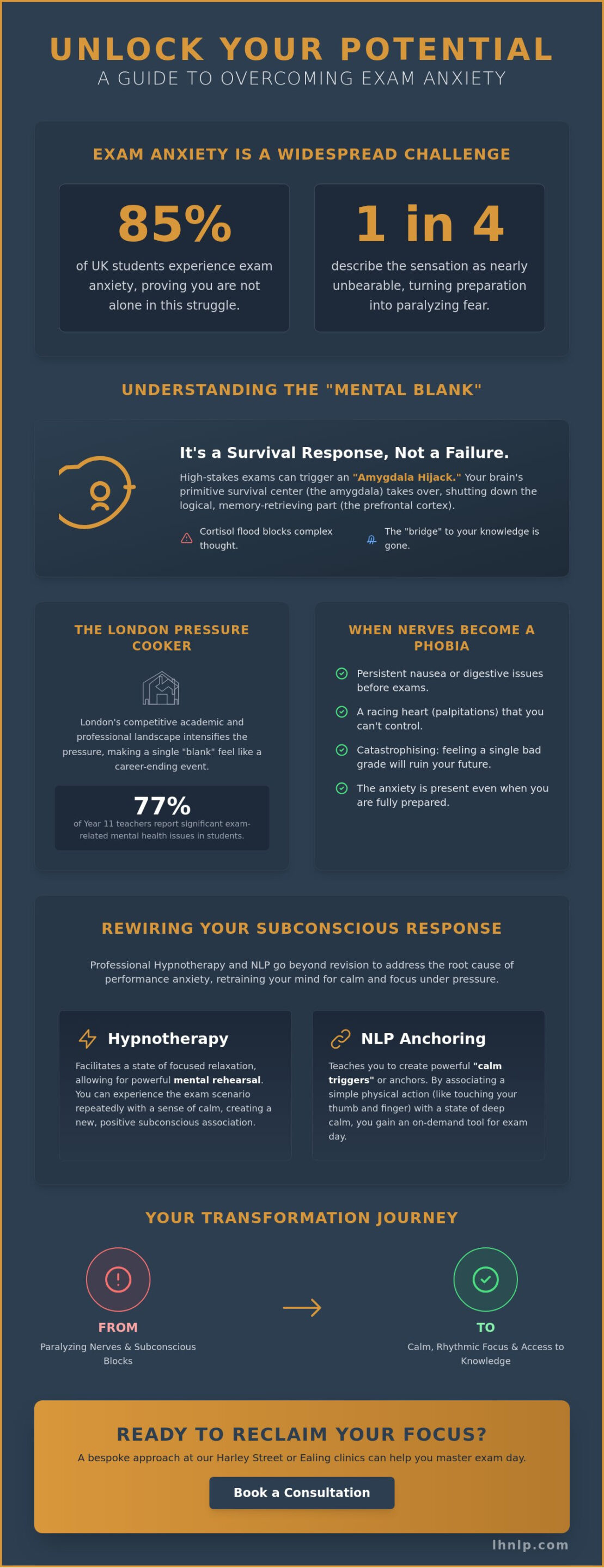
A 2026 survey revealed that 85% of UK students experience exam anxiety, with one in four describing the sensation as nearly unbearable. In the shadow of London’s high-stakes academic institutions, this pressure often transforms from simple nerves into a physical wall, manifesting as a racing heart or the sudden, terrifying silence of a mental blank just as the invigilator starts the clock. You’ve likely spent months preparing, only to find that the competitive atmosphere of the city makes the weight of expectation feel like an anchor rather than a sail. Seeking a professional fear of exams treatment London is a courageous step toward reclaiming your mental space, shifting the focus from the fear of failure to the quiet power of your own capability.
It’s deeply frustrating to know the material is there but feel completely unable to reach it when the pressure peaks. We’ll show you how professional hypnotherapy and NLP can rewire these subconscious blocks, dissolving the “blanking out” response so you can access your knowledge with calm, rhythmic focus. This article explores the methodical process of transforming your physiological response to stress and building a sustainable confidence that serves you long after the final paper is turned over.
Key Takeaways
- Recognize that “blanking out” is a subconscious survival response known as an amygdala hijack, which can be untangled through focused mental retraining rather than more revision.
- Understand how to navigate the intense competitive weight of London’s academic culture by shifting your internal narrative and releasing the pressure of high-stakes expectations.
- Discover how NLP anchors and hypnotherapy facilitate a state of mental rehearsal, ensuring you can access learned information with clarity even under significant pressure.
- Explore a structured fear of exams treatment London that moves beyond symptoms to address the root cause of performance anxiety within the subconscious mind.
- Learn how a bespoke approach at professional clinics in Harley Street or Ealing can help you replace paralyzing nerves with a sense of calm, rhythmic focus on exam day.
Beyond Revision: Understanding the “Exam Freeze” and Subconscious Fear
You’ve spent weeks, perhaps months, meticulously organizing your notes. You’ve memorized the dates, the formulas, and the arguments. Yet, the moment you sit at that desk, the ink seems to fade from your mind. This isn’t a failure of intelligence or a lack of effort; it’s a physiological response that your conscious mind cannot simply out-think. When seeking a fear of exams treatment London, it’s essential to understand that your brain is actually trying to protect you. It has mistakenly categorized the exam hall as a zone of mortal danger. A 2026 survey revealed that 85% of UK students experience this anxiety, proving you’re far from alone in this struggle.
This phenomenon is often called an “amygdala hijack”. The amygdala, the primitive part of your brain responsible for survival, takes over and shuts down the logical, thinking parts of your mind. It treats the examiner’s voice like the roar of a predator. While healthy nerves can sharpen your focus, debilitating performance anxiety creates a wall. Simply studying harder often reinforces this cycle because it increases the stakes, making the perceived “threat” even more formidable. The brain freezes. The bridge to your knowledge is gone.
To better understand this concept, watch this helpful video:
The Science of the Mental Blank
When the amygdala sounds the alarm, your body floods with cortisol. This hormone is useful for running away from a fire, but it’s disastrous for the prefrontal cortex, the area of the brain responsible for complex thought and memory retrieval. You know the information is there, but the path to reach it has been temporarily dismantled. The freeze response is a neurological bypass of logical thought that leaves you stranded in a state of mental paralysis.
Signs That Professional Treatment is Needed
How do you know when nerves have crossed the line into a phobia? If physical symptoms like nausea or heart palpitations persist despite being fully prepared, your subconscious is likely stuck in a loop. Understanding Test Anxiety involves recognizing when your reaction is no longer proportionate to the actual event. Catastrophising is a major indicator; if you feel that a single bad grade will irrevocably ruin your future, your fear of exams treatment London should focus on recalibrating this internal scale. Ask yourself: is this fear helping me, or is it a barrier I’m now ready to dissolve? You are ready.
The London Academic Landscape: Why Performance Pressure Peaks Here
London is a city defined by its velocity and its relentless pursuit of excellence. For students and professionals alike, the capital’s academic environment isn’t just about learning; it’s often about surviving a series of high-stakes hurdles. From the early pressure of 11+ entrance exams to the grueling A-Level cycles that determine university placements, the weight of expectation is palpable. This unique cultural intensity is why many seek a specialized fear of exams treatment London that understands the local context. In a June 2024 survey, 77% of Year 11 teachers reported seeing significant mental health issues in students specifically related to exam anxiety. This isn’t a general worry; it’s a specific byproduct of London’s competitive grammar and independent school system.
The pressure doesn’t end with graduation. Adult learners in the city’s financial and legal sectors face professional finals where a single “blank” can feel like a career-ending event. When these stakes are combined with the high cost of living and the “high-flyer” culture, the amygdala hijack becomes almost inevitable. A local expert who understands these nuances can offer more than just therapy; they provide a roadmap through the specific stressors of the capital. If you find yourself struggling to maintain focus, you might consider reaching out for professional support to navigate these demands.
From 11 Plus to Professional Finals
The Role of Perfectionism in the Capital
In London, there’s a pervasive fear of being “average”. This perfectionism often merges an individual’s self-worth with their academic output, creating a fragile foundation for performance. Clinical research, such as the work done at the Mayo Clinic on treating test anxiety, highlights how this fusion leads to debilitating physical symptoms. Hypnotherapy helps by gently detaching your identity from your test results, allowing you to perform with clarity rather than desperation. For those whose anxiety has evolved into a deeper avoidance or fear, our Phobia Treatment in London provides a comprehensive framework for recovery.
Hypnotherapy and NLP: Rewiring the Subconscious Response to Exams
Traditional talking therapies often spend significant time dissecting the past, which has its place, but when you’re facing a looming deadline, you need a solution-focused approach. Choosing a specialized fear of exams treatment London means moving beyond mere coping mechanisms and entering a collaborative, empowering process. Clinical hypnotherapy isn’t something that’s done to you; it’s a state of focused relaxation where we work together to update the outdated “software” of your mind. By accessing the subconscious, we can gently dismantle the associations between tests and terror, replacing them with a sense of quiet capability.
While NHS advice on student mental health often points toward university counseling or academic adjustments, these paths don’t always address the visceral, subconscious trigger that causes the “freeze”. Hypnotherapy bridges this gap by providing a safe space for mental rehearsal. Unlike the passive experience of sleep, clinical hypnosis is a state of heightened learning where your mind is exceptionally receptive to new, positive patterns of thought. It’s a methodical way to ensure that your internal dialogue supports your external goals.
How Hypnosis Accesses the “Exam-Ready” Mindset
One of the most effective tools we use is “future pacing”. In this state of deep relaxation, you’ll mentally rehearse the entire exam day, from the moment you wake up to the moment you hand in your paper, all while feeling completely calm and focused. This process creates a “memory of the future,” teaching your nervous system that this environment is safe. We work to replace intrusive thoughts like “I will fail” with more accurate, grounded suggestions such as “I am prepared and my mind is clear”. Hypnosis is not sleep, but a state of heightened learning where the conscious and subconscious minds align.
NLP Techniques for Instant Calm
Neuro-Linguistic Programming (NLP) complements hypnotherapy by providing tactical tools you can use in real-time. A central concept is “anchoring”, which involves creating a physical or mental trigger that instantly floods your system with confidence or calm. Imagine being able to press your thumb and forefinger together to “fire” a state of absolute focus right when you feel a wave of panic rising. Our approach to NLP Coaching provides these tactical tools to help you reframe the exam from a threat into a challenge. This mental shift changes your body’s chemistry, allowing you to stay in the “flow” state rather than falling into the “freeze” response. You don’t just learn to manage the fear; you learn to transform the energy into productive focus.
A Step-by-Step Approach to Overcoming Exam Phobia
While general advice often suggests “getting more sleep” or “talking to a teacher,” these surface-level tips rarely reach the root of a deep-seated phobia. A structured fear of exams treatment London provides a methodical path from paralyzing anxiety to calm performance. Ideally, this journey begins four to six weeks before your first test date. This window allows your mind to process new neural pathways and practice the “anchors” we build together. However, even if your exams are closer, a condensed approach can still provide significant relief and clarity. We don’t just offer tips; we offer a systematic rewiring of your emotional response.
The process is entirely bespoke, recognizing that a student sitting their 11+ in Ealing has different stressors than a professional taking their bar exams in Central London. The number of students disclosing mental health conditions to their universities has seen a six-fold increase between 2010 and 2023, highlighting a growing need for interventions that actually work. Our goal is to move you through a clear progression that builds confidence layer by layer, ensuring you feel supported at every turn.
Phase 1: Identifying the Anxiety Blueprint
Every student’s fear has a unique signature. During the initial assessment, Kamal focuses on identifying the specific triggers that cause your “freeze” response. Is it the heavy silence of the exam hall, the ticking clock, or perhaps a specific memory of a past academic setback? By finding the “first event” where this fear took root, we can begin to neutralize its power over your present. You aren’t treated as a collection of symptoms; you’re seen as an individual with a specific history. This phase isn’t about blaming the past, but about understanding the map your subconscious is currently following so we can draw a better one.
Phase 2: Building the “Mental Toolkit”
Once the blueprint is clear, we move into active sessions where we apply clinical hypnotherapy and NLP techniques. This is where you learn the “how” of staying calm. You’ll develop a personalized mental toolkit that includes self-hypnosis techniques you can use independently during your revision breaks. For those studying at universities outside the capital or facing tight schedules, we offer Virtual Hypnotherapy Sessions. This flexibility ensures that your progress isn’t interrupted by geography or a busy revision timetable. If you’re ready to start building your own toolkit, you can book an initial consultation today to begin the process.
Choosing London Hypnotherapy & NLP for Your Success
Choosing a therapist is a deeply personal decision, especially when the goal is to dismantle a performance block that feels so central to your future. At London Hypnotherapy & NLP, we don’t just see a student struggling with grades; we see an individual whose potential is temporarily obscured by a misplaced survival instinct. Kamal brings over 20 years of clinical experience in hypnotherapy and NLP to each session, offering a “wise mentor” approach that prioritizes your empowerment. This isn’t about being “fixed” by an outside expert. It’s about a partnership where you regain the keys to your own internal resources.
Our clinics in Harley Street and Ealing provide a professional, discreet environment where you can speak openly about the pressures of the capital’s academic culture. We understand that a fear of exams treatment London must be as sophisticated as the environment it serves. While some seek a “quick fix” for a single test, our commitment is to lasting change. We want you to walk into every subsequent challenge in life, whether it’s a university final, a job interview, or a professional presentation, with the same rhythmic, quiet confidence. True success isn’t just passing one exam; it’s knowing you have the mental tools to handle whatever comes next.
A Solution-Focused Environment
The tone of our practice is rooted in a blend of clinical excellence and deep empathy. We recognize that the journey from panic to peace is a process, which is why we offer multi-session packages designed to provide comprehensive support throughout the exam period. This allows us to layer the work, building resilience that sticks. You can learn more about Kamal’s professional background and credentials on our About Us page. We believe that when the mind feels safe and understood, change happens naturally and methodically.
Taking the Next Step Toward Calm
Don’t wait until the peak of exam season when the weight of expectation feels heaviest. Reaching out for a confidential discussion is the first step toward reclaiming your focus before the pressure becomes overwhelming. We provide clear guidance on how to navigate this transition, ensuring you feel supported from the very first phone call. If you’re ready to transform your relationship with performance and find a lasting fear of exams treatment London, please Contact Kamal today to discuss your fear of exams treatment in London. The change you’re looking for isn’t just possible; it’s a path we can walk together.
Stepping into the Exam Hall with Quiet Confidence
Your academic journey in London doesn’t have to be defined by the weight of anxiety or the fear of a mental blank. By understanding that the “exam freeze” is simply a misplaced survival response, you can begin the methodical process of retraining your subconscious mind. We’ve explored how a tailored fear of exams treatment London can replace paralyzing nerves with a state of focused, rhythmic clarity. This isn’t just about passing a single test; it’s about building a sustainable foundation of confidence that serves you in every high-stakes environment you encounter.
Kamal brings over 20 years of clinical experience and a specialization in high-performance NLP coaching to his clinics in Harley Street and Ealing. This professional expertise ensures that your path to change is grounded in proven methodology and deep empathy. You have the internal resources to succeed; sometimes, you just need a guide to help you access them. Ready to change your experience of performance? Book Your Exam Performance Consultation with Kamal and take the first step toward a calmer, more capable version of yourself. Your potential is waiting to be unlocked.
Frequently Asked Questions
Is hypnotherapy safe for children and teenagers facing exams?
Yes, hypnotherapy is entirely safe and highly effective for younger students. It’s a natural state of focused attention, much like being absorbed in a good book or a creative project. For those seeking fear of exams treatment London, this approach helps teenagers develop emotional resilience during the high-pressure GCSE and A-Level cycles. It empowers them with internal tools to manage academic expectations without the use of invasive interventions or medications.
How many sessions will I need to overcome my fear of exams?
Most students find that a course of three to six sessions provides a significant and lasting shift in their mindset. While some experience a breakthrough in just one or two appointments, we generally recommend starting the process four to six weeks before your first test date. This timeline allows enough space for the new neural pathways and “calm anchors” to become a natural part of your subconscious response.
Can hypnotherapy help with “blanking out” during a test?
Yes, hypnotherapy is specifically designed to prevent the neurological “freeze” that leads to mental blanking. By training your brain to stay in a state of relaxed focus, you ensure that the prefrontal cortex remains active and accessible. This allows you to retrieve learned information effortlessly, even when the clock is ticking. It’s about moving your mind from a survival response back into a performance mindset.
What is the difference between exam stress and exam phobia?
Exam stress is a common, often motivating response to a challenge, whereas exam phobia is a debilitating fear that triggers a physical survival response. While stress might make you feel “on edge,” a phobia often manifests as nausea, heart palpitations, or total mental paralysis. If your anxiety feels disproportionate to the actual event and hinders your ability to perform, it’s a sign that you could benefit from professional support.
Will I be in control during the hypnotherapy session?
You remain in complete control throughout every moment of the session. You aren’t asleep or unconscious; instead, you’re in a state of heightened awareness and deep physical relaxation. You can hear everything the therapist says and can choose to end the session at any time. It’s a collaborative and transparent partnership where you’re the one steering the change while the therapist acts as a skilled guide.
Can NLP help me with public speaking or oral exams as well?
Do you offer online sessions for students outside of London?
We offer comprehensive virtual sessions for students who are studying away from the capital or prefer the convenience of home. These online sessions are just as effective as in-person appointments, providing the same high level of professional support. This flexibility ensures that your fear of exams treatment London remains accessible regardless of your current location or your busy revision schedule during the final weeks of term.
What if my exam is only a few days away; can you still help?
We can certainly provide tactical support even if your deadline is imminent. While a longer lead time is ideal for deep-seated change, a single emergency session can equip you with immediate NLP “anchors” and breathing techniques to manage acute panic. It’s never too late to gain a sense of agency and calm before you walk into that exam hall, allowing you to perform to the best of your ability.