

What if the reason you haven’t quit smoking isn’t a lack of willpower, but simply a piece of outdated mental software that refuses to shut down? You’ve likely felt the frustration of repeated relapses or the subtle anxiety about your health as you navigate the high-stakes professional circles of the city. When exploring NLP to quit smoking London, you’re looking for a way to stop fighting your own impulses and start living with genuine clarity. It’s time to acknowledge that the old methods haven’t worked because they only scratch the surface of a much deeper, subconscious pattern.
I understand that the fear of losing a perceived “crutch” often feels more paralyzing than the habit itself. This article will show you how Neuro-Linguistic Programming dissolves the subconscious urge to smoke, moving you beyond the struggle of willpower and into the quiet confidence of a non-smoker identity. We’ll explore how this methodical approach helps you reclaim your vitality; ensuring that as the 2026 vaping taxes and tobacco restrictions change the landscape, you’re already standing on solid ground. You’re about to learn how to rewrite your internal narrative and step into a life of lasting, effortless freedom.
Key Takeaways
- Understand the psychological conflict between your conscious desire to quit and the deep-seated habits that make willpower alone feel like an exhausting struggle.
- Learn how Neuro-Linguistic Programming identifies and rewires the mental triggers that falsely link smoking to rewards like stress relief or emotional comfort.
- Compare the unique benefits of using NLP to quit smoking London against traditional methods to ensure you avoid common side effects like irritability or weight gain.
- Gain insight into the structure of a professional 50-60 minute session, where a supportive and non-judgmental environment facilitates your transition to lasting freedom.
- Discover how to permanently shift your internal identity to that of a non-smoker, allowing for a natural and effortless return to your full health and vitality.
The Psychology of the “Last Cigarette”: Why Willpower Often Fails
Many smokers approach their “last cigarette” with a mixture of hope and hidden dread. You’ve likely been there before, staring at an empty packet while promising yourself that tomorrow will be different. Yet, when the morning rush hits or a stressful email arrives, that resolve often vanishes. This isn’t a failure of character. It’s a fundamental conflict between your conscious desire for health and a subconscious habit that has been running in the background for years. When you rely solely on willpower, you’re essentially fighting a battle against your own mind, which often creates a “forbidden fruit” effect; the more you tell yourself you can’t have a cigarette, the more your brain fixates on it.
Understanding Neuro-linguistic programming (NLP) allows us to see smoking not just as a physical addiction, but as a deeply embedded mental programme. Your brain has spent years building associations between cigarettes and moments of relief, focus, or social connection. To break this cycle, we must look beyond the surface level of nicotine and address the underlying software. Validating your past struggles is the first step toward freedom. You haven’t failed because you’re weak; you’ve simply been using the wrong tools for a job that requires a more nuanced approach to human psychology.
To better understand how these mental patterns can be transformed, watch this helpful video:
The Willpower Trap vs. Subconscious Change
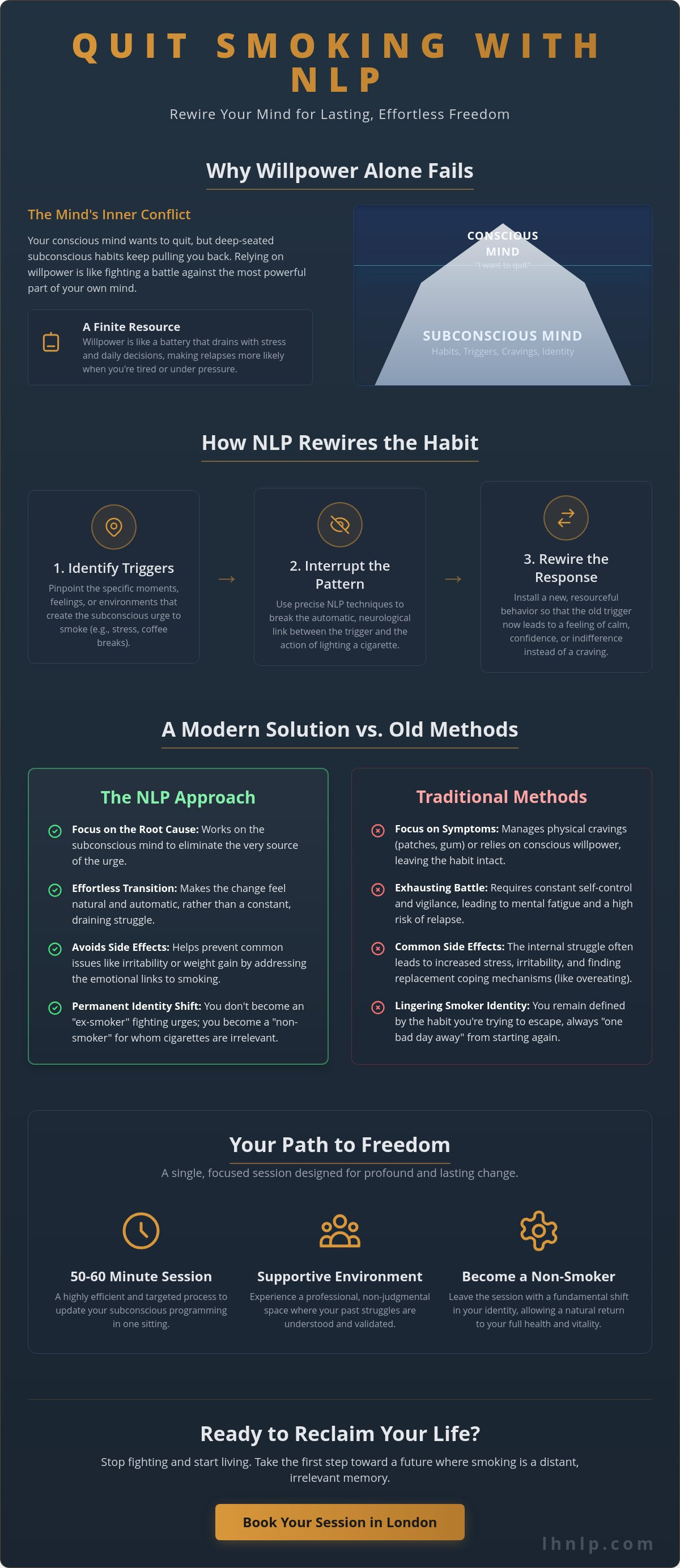
Willpower is a finite resource, much like a battery that drains throughout the day as you make decisions and manage stress. This mental fatigue is why most relapses happen in the evening or during high-pressure moments. Think of your mind as an iceberg. Your conscious desire to quit is the small tip visible above the water, while the massive, submerged portion represents your subconscious habits. Traditional quitting methods often focus on the tip, leaving the vast majority of the habit untouched. NLP techniques are designed to bypass the critical conscious filter, allowing you to update those deep-seated beliefs without the exhausting struggle of constant self-control. It’s about making the change feel natural rather than forced.
Smoking as a Coping Mechanism in London’s Fast-Paced Environment
Living and working in the capital presents a unique set of challenges that can make quitting feel impossible. The “automatic” smoking response is often tied to the specific rhythms of the city. Perhaps it’s the frantic commute through Waterloo, the ritualistic mid-morning break in a Square Mile alleyway, or the social pressure of drinks in a crowded Soho pub. These environments act as powerful triggers. By choosing NLP to quit smoking London, you’re opting for a solution that acknowledges these environmental pressures. Instead of just avoiding your triggers, we work to neutralise them at their root, turning what used to be a moment of craving into a moment of indifference. You can explore how these techniques fit into a broader wellness plan on our treatments page. We don’t just help you stop; we help you start a new way of being.
How NLP for Smoking Cessation Works: Rewiring the Habit
Neuro-Linguistic Programming (NLP) is often misunderstood as simple positive thinking, but in the context of smoking cessation, it functions as a precise manual for the mind’s operating system. While traditional methods focus on the physical craving, NLP addresses the neurological pathways that have linked a toxic habit to positive emotional states. Your brain isn’t trying to harm you; it’s simply following a misguided shortcut that equates a cigarette with a reward or a moment of peace. By utilizing NLP to quit smoking London, we work to interrupt these automated loops, allowing you to reclaim your autonomy from the subconscious scripts that have dictated your behavior for years.
A systematic review of NLP’s health effects suggests that while the field continues to evolve, its application in behavioral change offers a solution-focused alternative to more passive therapies. It is a practical, cognitive toolset that empowers you to look at your internal landscape with curiosity rather than judgment. If you’re curious about how this might apply to your specific situation, you can read more about our approach on our treatments page. This methodology doesn’t just ask you to stop a behavior. It asks you to de-link the associations that made the behavior feel necessary in the first place.
Anchoring and Reframing: The Core NLP Tools
Anchoring is a foundational technique where we consciously associate a specific physical gesture or mental image with a state of profound calm or resourcefulness. When the old urge to smoke arises, you can “fire” this anchor to flood your system with a different, more helpful sensation. Reframing, on the other hand, shifts the very meaning of the cigarette in your mind. Instead of seeing it as a “friend” that helps you through a tough day, we use linguistic shifts to expose it as a “poison” that steals your energy and time. These tools don’t just suppress the habit. They build entirely new mental pathways that make the old behavior feel irrelevant.
Identity Shift: Moving from “Quitter” to “Non-Smoker”
There’s a significant psychological difference between someone who is “trying to quit” and someone who simply is a “non-smoker.” The “quitter” is often in a state of deprivation, constantly resisting a temptation they still value. NLP facilitates a deep identity shift, changing your internal dialogue from a restrictive “I can’t have one” to an empowered “I don’t want one.” When you no longer identify with the habit, the need for willpower evaporates. The NLP identity shift acts as a permanent cognitive update that aligns your subconscious self-image with your conscious health goals. It’s the difference between fighting a ghost and simply walking through a door into a smoke-free life.
NLP vs. Traditional Quitting Methods: A Comparison
Most people who attempt to stop smoking find themselves trapped in a cycle of deprivation, where they feel they’ve sacrificed a “friend” without receiving anything in return. This perceived “void” is the primary reason why willpower alone often leads to irritability or unwanted weight gain as the mind searches for a substitute for the missing oral fixation. When you choose NLP to quit smoking London, you aren’t just removing a habit; you’re fundamentally changing the psychological structures that made the habit feel necessary. This approach manages the underlying anxiety of quitting by ensuring that there’s no sense of loss, only a profound feeling of relief and newfound space.
Traditional pharmaceutical aids focus almost exclusively on the chemical dependency, yet research into NLP for relapse prevention suggests that addressing the mental blueprints of addiction is what creates long-term success. While nicotine leaves the body relatively quickly, the mental association with the “hand-to-mouth” ritual can linger for decades if left unaddressed. By treating the mind as a holistic system, we can bypass the struggle of the “white-knuckle” approach and move directly into a state of indifference toward tobacco.
Why Patches and Gum Often Fall Short
Nicotine Replacement Therapy (NRT) treats the body but ignores the soul of the habit. You can provide the brain with all the nicotine it craves through a patch, but if your mind still believes that a cigarette is the only way to survive a stressful meeting or a lonely evening, you’ll eventually return to the pack. This is why pharmaceutical aids have such a high rate of failure; they don’t account for the deeply ingrained “hand-to-mouth” habit or the emotional triggers that spark the urge. Without a cognitive shift, the physical substitute is merely a temporary band-aid on a psychological wound.
The Advantage of a Combined Hypnotherapy and NLP Approach
In my practice, I’ve found that the most transformative results occur when we combine the cognitive precision of NLP with the deep, receptive state of clinical hypnosis. Utilizing hypnotherapy London allows us to reinforce the new NLP patterns at a level where the conscious mind no longer interferes. This synergy creates a powerful environment for change, where deep relaxation meets strategic cognitive rewiring. It’s a comprehensive process that addresses stress management simultaneously, ensuring that you leave the session not just as a non-smoker, but as a more resilient and centered individual. This isn’t about fighting your urges; it’s about making sure they no longer exist.
What to Expect During Your NLP Session in London
Stepping into a professional space for change should feel like a moment of profound relief. When you explore NLP to quit smoking London, you’re not just booking an appointment; you’re entering a partnership grounded in methodological clarity and deep respect for your personal journey. Kamal provides a sanctuary of sorts, whether you’re visiting the historic medical hub of Harley Street, the leafy quiet of Ealing, or the focused energy of Tokenhouse Yard in the heart of the City. Every 50 to 60 minute session is designed to be a collaborative process where your past failures are viewed as valuable data points rather than moral shortcomings.
For those with demanding schedules or global commitments, our virtual hypnotherapy services offer the same level of professional rigor and personal connection from the comfort of your own home. This flexibility ensures that the path to freedom remains accessible, regardless of your location or time constraints. Our goal is to make the transition as seamless as possible, providing a safe and non-judgmental atmosphere where you can focus entirely on your inner transformation.
The Discovery Phase: Identifying Your Triggers
We begin by mapping the specific landscape of your habit. Why do you reach for a cigarette at 11:00 AM? Is it the caffeine, the social expectation, or a subconscious need for a “pause” button? Instead of using a one size fits all script, we identify your unique emotional anchors and environmental triggers. This phase is about developing a nuanced understanding of your mind’s internal dialogue. I encourage you to reflect on your own life: what are those specific moments where the urge feels most undeniable? By naming these triggers, we strip them of their power and prepare the ground for lasting change.
The Treatment: Active Mental Exercises
During the active treatment, you remain fully in control and aware. This isn’t a passive experience where something is “done” to you; it’s a guided exploration of your own mental resources. With your eyes closed, we move through specific NLP reframing exercises designed to update your brain’s response to old triggers. We then enter a “testing” phase to ensure the new, calmer anchors are strong and resilient. We don’t leave the session hoping it worked; we verify that the old mental pathways have been replaced with a sense of indifference. If you’re ready to experience this shift for yourself, contact us today to begin your journey toward freedom.
Taking the First Step Toward a Smoke-Free Life in London
The decision to walk away from tobacco is often the most significant gift you can give your future self. By choosing NLP to quit smoking London, you’re moving beyond the temporary fixes of patches or willpower and entering a space of permanent cognitive resolution. It’s entirely natural to feel a lingering sense of hesitation. Perhaps you’ve tried and failed so many times that the idea of “freedom” feels like a distant dream. But consider this: you weren’t born a smoker. Your brain simply learned a habit, and anything that has been learned can be unlearned through a methodical, professional approach. At London Hypnotherapy & NLP, we don’t just help you stop a behavior; we help you rediscover the version of yourself that never needed to smoke in the first place.
The most common objection I hear is, “What if it doesn’t work for me?” This fear usually stems from the belief that your habit is uniquely powerful or that your mind is too stubborn to change. However, NLP doesn’t rely on being “suggestible” or having a specific personality type. It relies on the systematic understanding of how your brain processes information and stores habits. When you’re ready for a new identity, the tools we provide simply facilitate the transition that your conscious mind already desires. You’re not fighting your nature; you’re finally aligning your subconscious patterns with your true goals.
The Long-Term Support and “Booster” Packages
Change is a process that unfolds over time, and while many clients experience a total shift in a single session, we recognize that some behavioral patterns are more layered than others. For those who feel they need extra reinforcement, we offer multi-session packages designed for complex changes and ongoing transition support. These sessions act as a safety net during the first few weeks of your new identity, helping you navigate the high-pressure social and professional environments of the city with absolute confidence. If you’re curious about how a tailored programme could support your specific journey, I invite you to visit our contact page for a personalized consultation.
Your New Life as a Non-Smoker
The physical rewards of this shift begin almost immediately. Within days, your sense of taste and smell will sharpen, and your lung capacity will start to improve, allowing you to walk through London’s parks with a newfound vitality. Yet, the most profound change is the psychological relief of no longer being “controlled” by a substance. Imagine the freedom of no longer having to plan your day around the next “break” or feeling the social stigma in professional circles. You’re stepping into a life of genuine autonomy. The best time to make this change is the moment you decide that your old identity as a smoker no longer fits the person you’re becoming. Book your NLP session to quit smoking in London today and start your journey toward a lasting, effortless freedom.
Your Path to Lasting Vitality
With clinical expertise since 2005, Kamal has helped countless individuals navigate this transition as a dedicated Specialist in Smoking Cessation. Whether you visit our professional clinics in Harley Street or The City, you’ll find a supportive, non-judgmental environment focused entirely on your success. It’s time to stop fighting yourself and start living as the non-smoker you were meant to be. Begin your journey to a smoke-free life with Kamal today. Your new identity is waiting, and the best time to embrace it is right now.
Frequently Asked Questions
Is NLP the same as hypnosis for quitting smoking?
NLP and hypnosis are distinct but deeply complementary modalities. While hypnosis focuses on creating a receptive state of consciousness, NLP provides the specific linguistic and cognitive tools to restructure your internal experience. In our sessions, we often blend the two to ensure that the new mental patterns are accepted by both your conscious and subconscious mind.
How many sessions of NLP do I need to quit smoking for good?
Most individuals find that a single intensive session is sufficient to achieve a total shift in their identity. However, every mind is unique, and some complex behavioral patterns benefit from a multi-session approach or follow-up support. We tailor the duration to your specific needs, ensuring you feel confident and indifferent to tobacco before you leave our care.
Can NLP help me quit vaping or e-cigarettes as well?
Yes, the underlying neurological triggers for vaping are virtually identical to traditional smoking. Since the 2026 vaping tax and the Tobacco and Vapes Act have shifted the landscape, many are choosing NLP to quit smoking London and vaping simultaneously. The process of de-linking the “reward” from the habit works effectively regardless of the nicotine delivery method.
Will I gain weight if I use NLP to stop smoking?
Weight gain is not an inevitable consequence when you use a cognitive approach like NLP. Traditional “white-knuckle” quitting often leaves a psychological void that people try to fill with food. Because we neutralise the urge at its root, your brain doesn’t feel the need to search for a substitute reward, allowing your metabolism and appetite to remain balanced.
What is the success rate of NLP for smoking cessation?
While industry-wide statistics for self-regulated fields are not centralized like NHS data, practitioners consistently report that addressing the subconscious identity is far more effective than willpower alone. NLP focuses on a permanent cognitive update. This shift from “struggling quitter” to “indifferent non-smoker” provides a foundation for success that traditional nicotine replacements often lack.
Is NLP safe for someone with high anxiety or stress?
Do I need to be “suggestible” for NLP to work on my smoking habit?
You don’t need to be “suggestible” or have a specific personality type for these techniques to be effective. NLP is a logical, methodical process that works with the way your brain already structures information and language. It’s about updating your mental software through active participation, not about being put into a passive trance where you lose control.
How much does an NLP session to quit smoking in London cost?
The investment for a session varies depending on the practitioner’s expertise and the specific clinic location, such as Harley Street or Tokenhouse Yard. Many clients view this as a one-time investment in their long-term health and financial freedom. It’s best to check our contact page or individual treatment descriptions for the most current information regarding our bespoke session packages.