
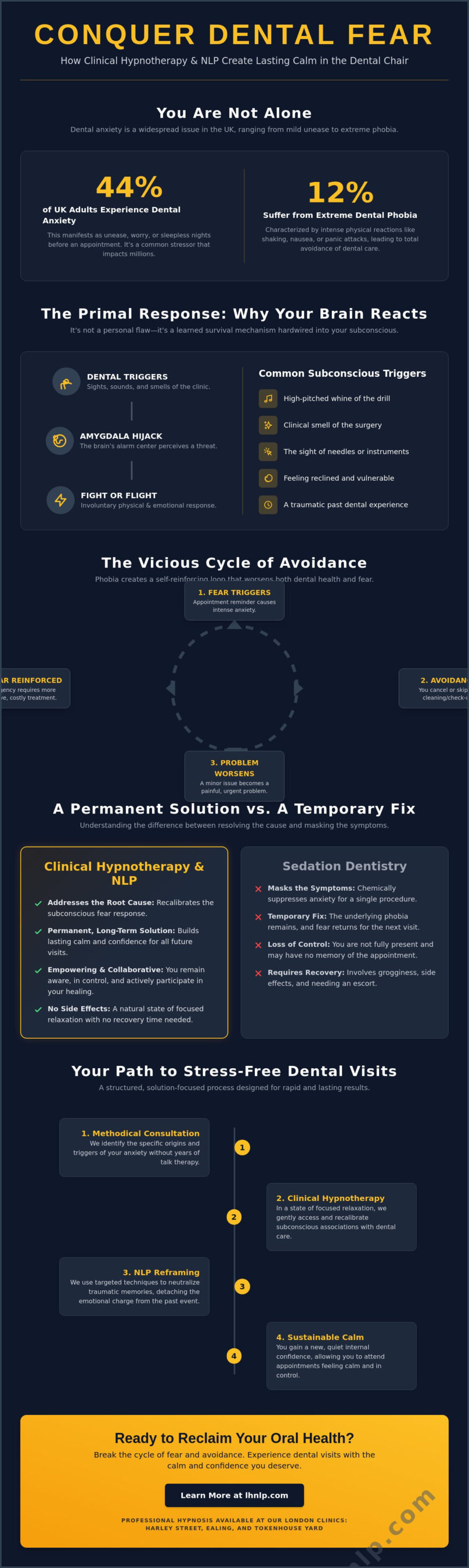
Imagine the moment you receive a dental check-up reminder. For many, it’s not just a minor chore; it’s a trigger for cold sweats, a sudden wave of nausea, and an overwhelming urge to cancel. If you’ve ever felt small or weak while shaking in a waiting room, please know that you aren’t alone. Recent data indicates that 44% of UK adults experience dental anxiety, while 12% struggle with extreme phobia. It’s easy to feel “silly” for these reactions as an adult, but your mind is simply trying to protect you from a perceived threat it learned long ago. When seeking a sophisticated solution for fear of dentists hypnosis London offers a methodical path to unlearning these deep-seated survival responses.
You don’t have to rely on temporary sedation or white-knuckled endurance to protect your oral health. By utilizing clinical hypnotherapy and NLP, we can gently recalibrate your subconscious associations, allowing you to replace panic with a quiet, internal confidence. This guide explores how these evidence-based methods transform phobia into a sustainable state of calm. We’ll examine why your brain triggers the “freeze” response and provide a clear, 2026 roadmap to reclaiming your well-being without the shadow of fear.
Key Takeaways
- Understand how your amygdala triggers the involuntary “fight or flight” response and why dental phobia is a learned survival mechanism rather than a personal flaw.
- Discover why clinical hypnotherapy offers a permanent cognitive shift in your fear response, providing a long-term solution that temporary chemical sedation cannot achieve.
- Learn how NLP techniques reframe traumatic dental memories to ensure you feel calm and fully in control during your next appointment.
- Explore the structured, solution-focused path to overcoming the fear of dentists hypnosis London specialists offer at our Harley Street, Ealing, and Tokenhouse Yard clinics.
- Identify the specific triggers of your anxiety through a methodical consultation process designed to produce rapid results without years of talk therapy.
Understanding the Root of Dental Phobia and Anxiety
Odontophobia is far more than just a simple case of the “jitters” before a check-up. It’s a profound, visceral response that can leave even the most composed person feeling paralyzed. While many people feel a slight unease at the thought of a drill, a true phobia involves a total hijacking of the nervous system. This happens because the amygdala, the brain’s ancient emotional processing center, identifies the dental chair as a site of extreme danger. It triggers a “fight or flight” response before your rational mind can even begin to argue. When individuals search for fear of dentists hypnosis London, they’re often looking for a way to quiet this internal alarm that logic alone cannot reach.
A deep dive into Understanding the Root of Dental Phobia reveals that this condition is rooted in evolutionary biology. Your brain isn’t being “silly”; it’s trying to protect you. Common triggers like the high-pitched whine of the drill, the clinical scent of the surgery, or the feeling of being reclined and unable to move freely are interpreted by the subconscious as threats to your safety. Because this response is generated in the primal parts of the brain, no amount of “thinking positive” can easily override it. You can’t talk yourself out of a physiological reflex, but you can retrain it.
To better understand how this survival response functions and how it can be shifted, watch this helpful video:
Anxiety vs. Phobia: Which Are You Experiencing?
Distinguishing between dental anxiety and a full-blown phobia is the first step toward resolution. Anxiety usually manifests as a sense of unease or worry, perhaps a few sleepless nights before an appointment. Phobia, however, is characterized by intense physical markers: shaking, nausea, or even panic attacks at the mere mention of a dentist. This often leads to an “avoidance cycle.” You skip a cleaning, which leads to a minor issue becoming painful, which eventually requires a more invasive procedure. This cycle reinforces the fear, making the next visit seem even more daunting. Often, these fears are “borrowed” anxieties, absorbed from a parent’s stories or a single traumatic event in childhood that the mind has frozen in time.
The Psychological Impact of Avoiding the Dentist
How Hypnosis Resolves the Fear of Dentists at a Subconscious Level
Many people hesitate to explore hypnotherapy because they associate it with the loss of control seen in theatrical stage shows. Clinical hypnosis is a fundamentally different experience. It’s a collaborative process where you remain fully aware and in complete control of your thoughts and actions. Think of it as a state of profound, focused relaxation. In this quiet space, the loud, intrusive chatter of the conscious mind fades away, allowing us to speak directly to the subconscious where your phobia actually resides. When addressing the fear of dentists hypnosis London practitioners provide offers a bridge between your logical desire for health and your body’s instinctive urge to flee.
We utilize Neuro-Linguistic Programming (NLP) to reframe the traumatic memories that often fuel dental anxiety. If a negative childhood experience has been “frozen” in your mind as a template for all future visits, NLP allows us to edit that internal movie. We change the sub-modalities of the memory, perhaps making the image smaller, dimmer, or further away, until the emotional charge simply evaporates. This isn’t about forgetting what happened; it’s about stripping the memory of its power to hurt you in the present. Through systematic desensitisation, we introduce the idea of the dental surgery while you’re in a state of deep physiological calm, teaching your nervous system that it can remain relaxed even in a clinical setting.
Rewiring the Brain’s Survival Response
The goal is to move your internal response from a “danger” signal to a “safety” signal. Scientific research, such as this systematic review on the Efficacy of Hypnosis, demonstrates that hypnotic interventions can significantly lower the distress associated with medical and dental procedures. By using specific NLP techniques, we can effectively “collapse” an old fear anchor in just a few minutes, neutralizing the emotional charge of a past trauma. This process creates a new, neutral “anchor” for the dental environment, ensuring that the smell of the surgery or the sight of the chair no longer triggers an automatic panic response. You can explore how these specialized phobia treatments work to create these lasting shifts.
The Role of Visualisation and Future Pacing
Once the old fear is cleared, we use “future pacing” to build neurological pathways for success. You’ll mentally rehearse a visit to the dentist, experiencing every step, from the waiting room to the chair, while feeling entirely composed and at ease. Kamal’s approach in London relies on bespoke metaphors tailored to your unique personality to soothe the nervous system during this process. This mental rehearsal acts like a blueprint for your brain. When you finally attend your appointment, your mind feels as though it has already successfully completed the task many times before. Resolving this specific phobia often has a ripple effect, improving your overall sense of agency and reducing general anxiety in other areas of your life.
Hypnotherapy vs. Sedation Dentistry: Which is Right for You?
Choosing how to manage your dental experience is a decision that balances immediate comfort with long-term freedom. For many years, the standard answer for extreme anxiety was chemical sedation, either through intravenous (IV) methods or inhalation of nitrous oxide. These tools are effective at numbing the senses and creating a pharmacological buffer between you and the procedure. However, they’re essentially a temporary mask. When the chemicals leave your system, the underlying phobia remains untouched, waiting to resurface at the next appointment. When seeking a resolution for the fear of dentists hypnosis London residents are increasingly turning to a method that offers a permanent cognitive shift rather than a recurring prescription.
The practical differences are immediate and significant. Chemical sedation often leaves you in a “fog,” requiring a chaperone to take you home and a full day of recovery. In contrast, clinical hypnotherapy involves no “hangover” effect. Because you’re utilizing your own natural capacity for deep relaxation, you remain alert and capable. You can finish a session and drive home to Ealing or return to a high-pressure meeting in Harley Street immediately. This autonomy is often the first step in reclaiming your sense of self-governance, proving that you don’t need a chemical intervention to feel safe in your own body.
Why Sedation Doesn’t Solve the Underlying Problem
A hidden risk of relying solely on sedation is “sensitisation.” By consistently using drugs to “knock yourself out,” you might inadvertently reinforce the subconscious belief that the dental environment is so dangerous it can only be endured while unconscious. This deepens the amygdala’s alarm response over time. Hypnotherapy offers a superior safety profile because it involves no physiological risk or general anaesthesia. It allows you to attend appointments without the logistical burden of a chaperone, transforming the visit from a major medical event into a routine part of your health maintenance. You’re not just surviving the chair; you’re teaching your brain that the chair is neutral.
Combining Hypnosis with Modern Dental Care
The most effective approach often involves a partnership between your therapist and your dentist. We encourage you to talk openly with your London dental professional about your progress with hypnotherapy. Many leading practices in the city are now embracing “hypnodontics,” where they recognize the value of patients who arrive in a self-induced state of calm. This integrated path ensures that your physical treatment and psychological well-being are aligned. For those ready to move beyond temporary fixes, exploring Phobia Treatment in London provides a comprehensive roadmap to unlearning the fear response entirely. This isn’t about avoiding the dentist; it’s about arriving there with a quiet mind and a steady pulse.
Your Path to Stress-Free Dental Visits in London
Reclaiming your oral health isn’t a matter of sudden, forced bravery; it’s a structured journey that respects the pace of your nervous system. We don’t expect you to walk into a surgery and feel perfectly fine overnight. Instead, we follow a methodical four-step process designed to build layers of internal safety. We begin with a deep-dive initial consultation to identify your specific “fear triggers.” Is it the vibration of the drill, the clinical scent of the room, or perhaps a feeling of being trapped? By mapping these triggers, we can tailor the subsequent sessions to your unique psychological landscape. When you commit to resolving your fear of dentists hypnosis London clinics provide the necessary framework to move from avoidance to action.
Once we’ve identified the roots, we move into customized sessions at our Ealing, Harley Street, or Tokenhouse Yard locations. These sessions focus on the NLP and hypnotherapy techniques we’ve discussed, such as reframing traumatic memories and collapsing old fear anchors. The third step involves equipping you with practical self-hypnosis tools that you can carry with you into the chair. Finally, we encourage a “test” visit. This isn’t for a major procedure, but a simple, low-stakes check-up. This allows you to experience the internal shift in a real-world setting, proving to your subconscious that the old danger is gone. It works. You’ll find that the environment that once triggered panic now feels remarkably neutral.
Self-Hypnosis Techniques for the Dental Chair
Empowerment comes from having a toolkit you can use in real-time. We teach the “Square Breathing” method, a simple 4-4-4-4 rhythm that physically forces your heart rate to slow down and signals your brain that you’re safe. Alongside this, we use mental “Safe Place” anchoring. Anchoring is a psychological tool that allows a patient to trigger a specific, positive emotional state on demand by linking it to a physical touch or a mental image. By pressing your thumb and forefinger together, you can instantly recall the profound calm achieved during our sessions. This creates a psychological shield, allowing you to remain centered while the dentist performs their work. If you’re ready to build your own toolkit, you can book your initial consultation at one of our London locations.
Choosing Your London Location for Therapy
We understand that your environment plays a significant role in your ability to relax. For those who find comfort in a tradition of medical excellence, our Harley Street clinic offers a prestigious and highly professional atmosphere ideal for tackling medical-related phobias. If you prefer a more tranquil, residential feel, our West London sessions in Ealing provide a relaxed environment that feels far removed from the stresses of the city. For busy professionals working in the Square Mile, our City-based sessions at Tokenhouse Yard offer a convenient sanctuary where you can resolve your anxiety during a lunch hour or after work. Each location is dedicated to the same high standard of clinical hypnotherapy, ensuring your path to calm is as convenient as it is effective.
Professional Hypnosis for Dental Phobia at London Hypnotherapy & NLP
At London Hypnotherapy & NLP, we believe that your past experiences don’t have to dictate your future oral health. Kamal, our lead specialist, brings years of expertise in resolving complex phobias and high-stakes anxiety. He understands that your fear isn’t a personality trait; it’s a neurological program that simply needs an update. Unlike traditional counseling that might spend months dissecting the “why” behind your feelings, our approach is rigorously solution-focused. We don’t need years of talk therapy to achieve a breakthrough. Instead, we use precise tools to target the specific neural pathways where your anxiety lives. For many seeking help with fear of dentists hypnosis London residents find that a few targeted sessions are enough to produce a profound and lasting shift in their comfort levels.
We recognize that for some, the journey to our physical clinics in Harley Street, Ealing, or Tokenhouse Yard might feel like a hurdle in itself during the early stages of treatment. That’s why we offer virtual sessions via Zoom. These remote consultations provide the same level of clinical excellence from the safety and comfort of your own home. It allows you to begin the process of desensitization in an environment where you already feel secure, gradually building the internal resources needed for a physical visit. Booking a discovery call is the first step toward a healthy smile and a life free from the burden of dental dread.
Bespoke Therapy for Lasting Change
No two fears are identical. One person might dread the sensation of loss of control, while another is triggered by specific sensory inputs like the vibration of the chair. Because of this, every strategy we employ is entirely bespoke. We often integrate our specialized Anxiety Therapy into our phobia protocols to ensure we’re treating the whole person, not just a single symptom. Our success stories speak for themselves. We’ve helped clients who hadn’t seen a dentist in thirty years successfully complete major restorative work with a steady pulse and a calm mind. They didn’t find “bravery”; they simply unlearned the fear.
Take Control of Your Oral Health Today
If you’re dealing with layered issues, such as a combination of medical and needle phobias, we offer structured session packages designed to provide comprehensive support. These packages allow for a deep dive into the various facets of your anxiety, ensuring every trigger is addressed and neutralized. You can Contact Us today for a confidential consultation to discuss your specific needs. Remember, the shaking hands and racing heart you feel today are simply old programs running in your mind. They can be updated. Your future self, smiling with confidence and health, is waiting for you to take this single, courageous step toward inner peace.
Reclaiming Your Smile and Your Peace of Mind
The journey from paralyzing dental phobia to a state of quiet composure is not a matter of luck, but a methodical process of neurological realignment. We’ve explored how your brain’s survival response can be retrained and why clinical hypnotherapy offers a permanent cognitive shift that temporary chemical sedation simply cannot match. By utilizing bespoke NLP strategies and practical self-regulation tools, you can transform the dental chair from a site of perceived danger into a neutral, manageable space. When you decide to resolve your fear of dentists hypnosis London practitioners at our Harley Street and Ealing clinics offer the professional expertise to guide you through this transition.
With over 20 years of clinical experience, Kamal provides the steady hand of an Accredited NLP Practitioner and Clinical Hypnotherapist. You don’t have to let another year pass in discomfort or shame. Whether you visit us in person or begin with virtual sessions, the path to oral health is open to you. It’s time to release the old patterns and embrace a future where you are in control. Book Your Consultation for Dental Phobia Relief in London and take that first step toward a calm, healthy smile. You have the inner resources to change, and we are here to help you activate them.
Frequently Asked Questions
How many sessions of hypnosis are needed for dental phobia?
Most individuals experience a significant shift in their comfort levels within three to five sessions. The exact duration of your journey depends on the depth of your previous experiences and the specific nature of your triggers. Our solution focused approach aims to produce rapid, lasting changes so you can attend your next appointment with a sense of genuine calm.
Can I be hypnotised if I am a very logical or analytical person?
Analytical individuals often make the best candidates for hypnotherapy because they possess the high level of mental focus required for the process. Hypnosis isn’t about losing your logic; it’s about using your concentration to communicate with the subconscious mind. Your analytical brain remains an active, observant partner while we work to update your internal survival programs.
What if I have a panic attack during the hypnotherapy session?
Your therapist is a trained professional who creates a safe, controlled environment designed to prevent overwhelming distress. If a strong emotional response arises, we use immediate grounding techniques to return your nervous system to a state of safety. We move at a pace that respects your boundaries, ensuring you always feel supported and in control of the experience.
Is hypnosis for dental fear covered by health insurance in the UK?
Coverage for hypnotherapy varies widely across UK private health insurance providers. While many standard policies don’t include it, some premium plans or health cash accounts may offer reimbursement for treatments conducted by accredited practitioners. We recommend contacting your insurance provider directly to discuss your specific policy details regarding psychological interventions for phobias.
Can hypnotherapy help with a gag reflex at the dentist?
Hypnotherapy is remarkably effective at soothing an overactive gag reflex, which is often an involuntary physical response to underlying anxiety. By calming the body’s “fight or flight” mechanism and using NLP to reframe the sensation of dental instruments, we can significantly reduce this sensitivity. This specialized focus is a key reason why people seek out fear of dentists hypnosis London specialists.
Will I remember everything that happens during the hypnosis session?
You’ll typically have a full and clear memory of everything that occurs during your session. Hypnosis is a state of heightened awareness and focused attention rather than a period of sleep or unconsciousness. You remain the navigator of your thoughts, and you’ll leave the clinic with a conscious understanding of the new, calm associations we’ve built together.
Do I need to see my dentist before starting hypnotherapy?
You aren’t required to see a dentist before we begin our work together. In fact, many of our clients find that starting hypnotherapy first provides them with the emotional resilience needed to book that initial check-up. Once you feel more centered, you can approach your dental professional with a newfound sense of agency and calm.
Can children benefit from hypnosis for dental anxiety?
Children are often exceptionally responsive to hypnosis because they’re naturally comfortable with imagination and metaphor. By using gentle, age-appropriate NLP techniques, we can help them resolve early fears before they become deep-seated adult phobias. This builds a foundation of dental confidence, ensuring they view oral healthcare as a routine and safe part of their lives.