

What if your brain’s intense reaction to a passing dog isn’t a lack of logic, but a sophisticated safety program that simply needs a professional update? For many, the reality of living in a city where dog ownership has surged means that a simple walk through Richmond Park can feel like navigating a minefield. If you’ve found yourself scanning every corner for off-lead pets or declining social invitations to avoid a friend’s dog, you’re part of the 12% of UK adults who experience some level of cynophobia. Finding a specialized fear of dogs treatment London can offer is the first step toward reclaiming a life that isn’t dictated by hyper-vigilance.
It’s understandable why you feel this way; a 2024 YouGov poll revealed that 69% of people uncomfortable around dogs find them unpredictable. We’re here to show you that this internal alarm system can be recalibrated through the gentle, methodical application of hypnotherapy and NLP coaching. This article explores how you can dissolve the subconscious triggers of fear and replace them with a sense of calm authority. You’ll discover a path to walking through any London park with your head held high, feeling completely in control of your environment and your emotional response.
Key Takeaways
- Learn why your mind prioritizes a survival response over logic and how to bridge the gap between knowing a dog is safe and actually feeling secure in its presence.
- Explore how professional fear of dogs treatment London offers can help you update the subconscious “operating system” that keeps you in a state of hyper-vigilance.
- Gain insights into navigating London’s increasingly dog-friendly landscape, from bustling gastro-pubs to the wide-open spaces of Clapham Common and Richmond Park.
- Understand the transformative power of a personalized approach that uses NLP coaching to dismantle old patterns in a safe, clinical environment.
Understanding Cynophobia: Why a Fear of Dogs is More Than Just Nerves
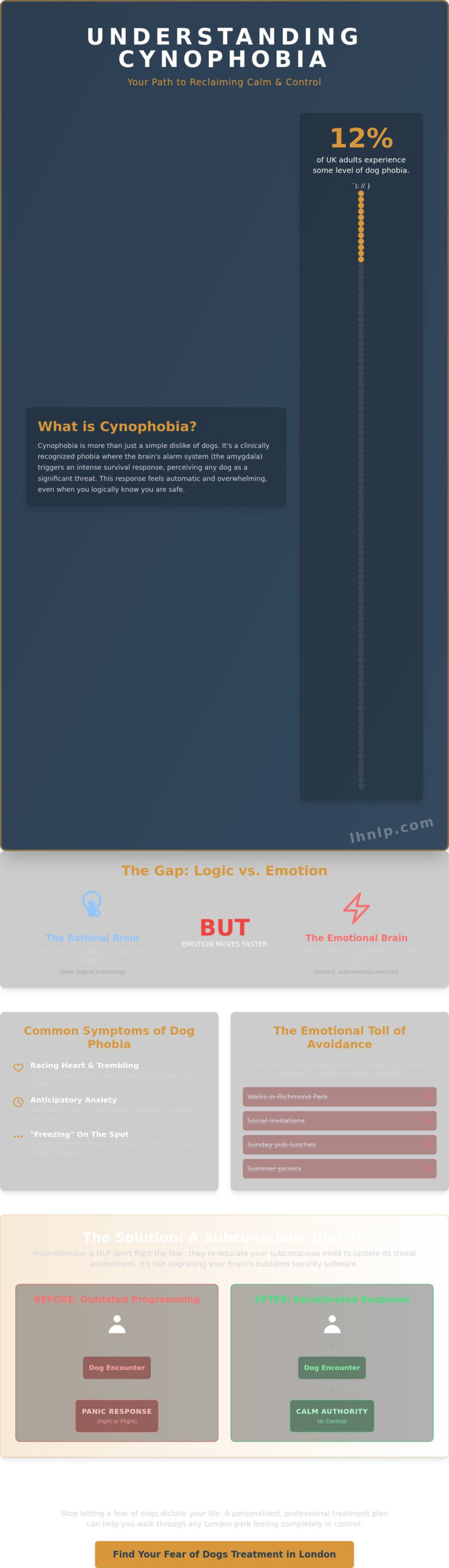
Cynophobia isn’t just a slight discomfort or a simple preference for cats. It’s a clinically recognized specific phobia where the brain’s alarm system, the amygdala, triggers an intense survival response that feels entirely out of proportion to the actual situation. When you encounter a dog, your nervous system doesn’t see a pet; it perceives a biological threat. This experience, known as Cynophobia, is one of the most common animal phobias in the UK. Research indicates that up to 12% of adults may experience this level of fear. You aren’t alone in this, and your reaction isn’t a sign of weakness. It’s a sign that your subconscious mind is working too hard to protect you.
The most frustrating part for many is the divide between logic and emotion. You might stand there, watching a small dog on a lead, and logically understand that it cannot reach you. Yet, your heart hammers against your ribs and your breath becomes shallow. This happens because the emotional brain moves much faster than the rational one. By the time your logic catches up, your body is already flooded with adrenaline. Understanding this gap is a vital part of seeking effective fear of dogs treatment London can provide, as it shifts the focus from fighting your feelings to re-educating your response.
To better understand how this fear operates and how it can be addressed, watch this helpful video:
Triggers vary between individuals, but they often center on unpredictability. A sudden bark, a dog jumping in excitement, or the sight of a dog running off-lead in a park can send ripples of panic through your system. In a city where dog ownership has grown significantly since the pandemic, these encounters are becoming harder to avoid. This constant state of high alert is exhausting. It makes the search for a permanent solution through professional Phobia Treatment more than just a luxury; it’s a necessity for your mental peace and daily freedom.
Common Symptoms of Dog Phobia
The physical reality of this fear is undeniable and often overwhelming. You might experience a racing heart, trembling, or even “freezing” on the spot, unable to move until the dog has passed. Psychologically, this often manifests as intense anticipatory anxiety. You might spend hours before leaving the house worrying about potential encounters. This often leads to cognitive distortions, such as catastrophising, where your mind interprets a dog’s wagging tail not as friendliness, but as a sign of an impending attack.
The Emotional Toll of Avoidance
Every time you cross the street or cancel a park visit to avoid a dog, you send a message to your brain that the danger was real. This reinforces the fear loop, making the phobia stronger over time. The social cost is heavy; it means missing out on Sunday pub lunches, summer picnics, or simple walks with friends. Avoidance acts as a short-term relief but a long-term prison.
The Subconscious Blueprint: How Hypnotherapy and NLP Resolve Dog Phobias
Your brain is essentially running an outdated piece of security software. The amygdala, a small but powerful part of your brain, acts as a sentinel that’s constantly scanning for threats. For someone with cynophobia, this sentinel has been programmed to see every dog as a predator. The moment a dog enters your field of vision, the amygdala triggers a cascade of adrenaline and cortisol, plunging you into a fight-or-flight state before your logical mind can even speak. This is why standard logic fails; you cannot reason with a part of the brain that’s convinced you’re in a life-or-death struggle. Professional fear of dogs treatment London focuses on communicating directly with this subconscious “operating system” to update its threat assessment.
Unlike some traditional talking therapies or standard phobia treatments, we don’t spend years dissecting your childhood or searching for the “original” trauma. While understanding the past can be helpful, the focus here is strictly solution-oriented. We’re interested in how your brain is “doing” the fear in the present moment. By using hypnotherapy to access the subconscious mind, we can begin to adjust the dials on your emotional responses. It’s a process of re-education, teaching your nervous system that it can remain calm and observant rather than reactive and panicked.
If you’re ready to explore how this works, our Phobia Treatment sessions provide a structured, safe way to begin that transformation.
Recoding the Fear Response
Through NLP coaching, we identify the “internal movie” you play when you see a dog. Do you see the dog as larger than it is? Is the sound of its bark amplified in your mind? By changing these mental submodalities, we can shrink the power of these fearful associations. We also use a technique called “anchoring,” which allows you to “press a button” on a state of deep, physiological calm. This new anchor replaces the old panic response, giving you a tangible tool to use whenever you’re out in the city.
Why Hypnosis is Effective for Phobias
Hypnosis is a state of focused relaxation, not a loss of control. It allows us to bypass the “critical faculty,” that part of your conscious mind that stubbornly insists “I’ve always been afraid, and I always will be.” When this guard is down, we can suggest and create new, neutral neural pathways. Instead of a high-voltage fear response, your brain learns to view a canine encounter with the same neutrality as seeing a passing car or a tree in the park. This effective fear of dogs treatment London residents utilize helps bridge the gap between knowing you’re safe and actually feeling it.
Navigating London with Cynophobia: The Hidden Cost of Avoidance
London’s landscape has shifted significantly, becoming one of the most dog-friendly cities in the world. While this is a delight for pet owners, it creates a unique set of challenges for those living with cynophobia. Whether it’s a “bring your dog to work” policy in a Shoreditch office or a crowded gastro-pub in Islington, the presence of dogs is now a constant variable in urban life. For anyone looking for the fear of dogs treatment London provides, the goal isn’t just to “get over it,” but to stop the exhausting process of constant environmental scanning. Understanding Cynophobia involves realizing that the city’s density leaves little room for the traditional coping mechanism of avoidance. You can’t always cross the street on a narrow Soho pavement or easily move to a different carriage on a packed Northern Line train where dogs are permitted on leads.
This forced proximity makes the phobia particularly draining. The mental energy required to plan a route that avoids high-traffic pet areas is energy that could be spent on your career, your family, or your own well-being. Living in a state of perpetual “what if” isn’t just a phobia; it’s a tax on your quality of life. By seeking a specialized fear of dogs treatment London specialist can offer, you’re choosing to stop paying that tax and start living with a sense of genuine ease.
The “Park Anxiety” Cycle
Walking through Clapham Common, Hampstead Heath, or Hyde Park should be a restorative experience. Instead, for those with cynophobia, it becomes a tactical mission. You’re scanning for off-lead dogs, calculating distances, and listening for the jingle of a collar. This hyper-vigilance keeps your nervous system in a state of high alert, contributing to the general background stress of London life. Professional intervention allows you to return to these green spaces without the mental exhaustion of constant surveillance, finally enjoying the city’s beauty as it was intended.
Social Life and Dog-Friendly Pubs
The social cost is perhaps the most painful part of this phobia. Many London pubs are now proudly dog-friendly, which can make a simple invitation feel like a threat. You might find yourself declining a Sunday roast or feeling awkward asking a friend to keep their pet in another room during a visit. It limits your social circle and your weekend choices. If you’re tired of saying “no” to things you actually want to do, exploring Phobia Treatment in London can help you break these patterns and reclaim your social freedom.
The Path to Freedom: What to Expect from Specialist Treatment in London
Embarking on a journey to overcome a lifelong phobia requires more than just a generic set of instructions; it demands a deeply personalized strategy. No two fears are coded in the subconscious in exactly the same way. One person might be triggered by the sound of a bark, while another feels panic only when a dog is off-lead. This is why the fear of dogs treatment London residents access through our practice is built around your unique internal blueprint. We provide a sanctuary for this work, ensuring all sessions take place in a safe, dog-free clinical environment where you can focus entirely on your progress without external triggers.
Accessibility is key to reducing the friction of starting therapy. We offer several convenient London locations, including Harley Street, Ealing, and Tokenhouse Yard, allowing you to integrate these sessions into your professional life. For those who prefer the comfort of their own home or live outside the capital, our Virtual Hypnotherapy Sessions provide the same level of clinical expertise and breakthrough results. The goal is to make your transformation as seamless as possible. Have you ever wondered how different your daily commute would feel if the presence of a dog was simply a neutral fact rather than a threat?
Step 1: The Consultation and Assessment
Our work begins with a thorough understanding of your specific triggers and the history of your fear. What does freedom actually look like for you? Is it walking through Hyde Park without scanning the horizon, or is it simply being able to visit a family member who owns a pet? By setting clear, tangible goals, we build the rapport and trust necessary for the deep psychological work ahead. This initial stage ensures that our approach is perfectly aligned with your desired outcomes.
Step 2: The Therapeutic Intervention
During the intervention phase, we use NLP to dismantle the rigid structure of the phobia. We look at how your mind represents the fear and begin to shift those internal images and sounds. This is paired with Clinical Hypnotherapy to reinforce new, calm associations at a subconscious level. We don’t just remove the fear; we provide “mental rehearsals” for successful future encounters, allowing your brain to practice being at ease before you ever step foot near a dog.
Step 3: Integration and Real-World Testing
Change happens in the mind first. We utilize gradual, self-paced “mental exposure” to ensure your new response is stable and reliable. We equip you with practical tools to manage the unpredictability of London life, ensuring you feel prepared for unexpected canine encounters. As you progress, we fine-tune your subconscious response, ensuring that the fear of dogs treatment London has provided you leads to a permanent shift in perspective. If you’re ready to begin this process, please get in touch with us today to discuss your path forward.
Reclaim Your Confidence: Professional Dog Phobia Treatment at lhnlp.com
Choosing the right partner for your transformation is a decision that requires both trust and professional assurance. Since 2005, Kamalyn Kaur has been guiding individuals through the intricate process of subconscious change using clinical hypnotherapy and NLP coaching. She understands that London isn’t just a city; it’s a high-stakes environment where your personal freedom is often challenged by the proximity of others and their pets. This specialized fear of dogs treatment London residents seek is rooted in a deep understanding of urban stressors and the specific ways they amplify phobic responses. We believe that inner change is not a matter of luck, but a methodical process that can be navigated with the right guide.
Our approach is fundamentally solution-focused and deeply empathetic. We don’t view your fear as a flaw, but as an overprotective program that simply needs updating. By combining intellecutal elegance with practical psychological tools, we help you bridge the gap between where you are and where you want to be. The fear of dogs treatment London specialists offer at our practice ensures that you are seen as a partner in your own growth, empowered by the mobilization of your own inner resources. Is it time to stop letting a subconscious program dictate which streets you walk down?
Our London Clinic Locations
Accessibility and comfort are vital when addressing deep-seated fears. Our clinics are positioned to be as accessible as the city itself, providing quiet, professional settings designed for absolute comfort and confidentiality. You can find us at:
- Harley Street: Located in the heart of Central London’s medical district.
- Tokenhouse Yard: Conveniently situated for those working in The City.
- Ealing: A welcoming space for those in West London.
Every location is a strictly dog-free clinical environment, allowing you to feel completely secure as we do this work together. To learn more about our philosophy and heritage, you can read more About London Hypnotherapy & NLP.
Booking Your Initial Consultation
The first step toward reclaiming your freedom is often the most significant. Your journey begins with an initial 50-60 minute session where we explore your goals and map out your specific path to confidence. This is a space for self-reflection and the beginning of a deep internal shift. You can reach out to us directly via our Contact Page to schedule your appointment. Remember, the version of you that is calm and in control around dogs already exists; we’re simply here to help you find them and bring them to the forefront of your life.
Step Into a Life of Urban Freedom
Living with cynophobia in a city as vibrant as London shouldn’t be a permanent sentence of avoidance and hyper-vigilance. You’ve explored how your brain’s survival response can be recoded and why the specific pressures of the capital make professional intervention so valuable. By addressing the subconscious blueprint of your fear, you move beyond mere coping and toward a state of genuine emotional neutrality. This process allows you to stop scanning the horizon and start engaging with the world around you on your own terms.
Since 2005, our practice has specialized in helping individuals dismantle these restrictive patterns through expert fear of dogs treatment London can rely on. Whether you visit our Harley Street or City of London locations, you’ll find a safe, clinical space dedicated to your transformation. It’s time to reclaim the parks, the pubs, and the daily commutes that are currently off-limits. You have the inner resources to change. We have the methodology to help you unlock them.
Book Your Dog Phobia Consultation in London today.
The version of you that walks through a park with a quiet mind is ready to emerge. Your journey to freedom starts with a single, courageous choice.
Frequently Asked Questions
Is hypnotherapy for fear of dogs safe?
Hypnotherapy is completely safe and non-invasive, as it involves a state of focused relaxation where you remain in full control of your faculties. Unlike medical interventions, it relies on the natural power of your subconscious mind to process and release old fears. We work within your comfort zone, ensuring that the process feels supportive and empowering rather than overwhelming. It’s a collaborative journey where your safety and mental well-being are always the highest priority.
How many sessions will I need to overcome my dog phobia?
The number of sessions varies depending on the depth of the phobia and your individual response, though most clients see significant shifts within three to four sessions. Because we use solution-focused techniques like NLP, the goal is to achieve lasting change as efficiently as possible. During your initial consultation, we’ll discuss a tailored roadmap that aligns with your specific needs. This ensures that your fear of dogs treatment London experience is both effective and respectful of your time.
Will I be forced to be around dogs during the session?
No, you’ll never be forced to be around a physical dog during our sessions. Our clinics in Harley Street and the City are strictly dog-free environments, allowing you to feel completely secure while we do the internal work. We focus on “mental rehearsals” and recoding your subconscious response first. You’ll only choose to interact with a dog in the real world when you feel a genuine sense of calm and readiness.
Can NLP work for a lifelong fear of dogs?
NLP is remarkably effective for lifelong fears because it focuses on the “how” rather than the “why.” Your brain has simply learned a very efficient way to produce a fear response, and NLP provides the tools to interrupt and redirect that neural pathway. Even if you’ve been afraid since childhood, we can update the subconscious blueprint that keeps that fear alive. It’s about changing how you process canine encounters in the present moment.
Does dog phobia treatment work for children as well as adults?
Yes, this approach is highly effective for children, as they often have a natural ability to engage with the imaginative and metaphorical aspects of hypnotherapy. We adapt our techniques to be age-appropriate, ensuring the child feels safe and understood throughout the process. By addressing the fear early, we can prevent it from becoming a lifelong burden. This helps them grow up with a sense of confidence and freedom in public spaces.
What is the difference between hypnotherapy and standard exposure therapy for cynophobia?
Standard exposure therapy often relies on “feeling the fear” while being physically near a dog, which can be traumatizing for some. In contrast, hypnotherapy and NLP work at the subconscious level to neutralize the fear response before you ever face a real-world encounter. We address the internal “blueprint” first, making any future real-life interaction a choice made from a place of calm rather than a forced or terrifying ordeal.
Can I do these sessions online if I cannot travel to London?
Yes, we offer comprehensive fear of dogs treatment London residents and those further afield can access via our secure virtual platform. Virtual hypnotherapy is just as effective as in-person sessions, as the work happens entirely within your own mind. Many clients find that being in their own familiar environment allows them to relax more deeply, facilitating a smoother therapeutic process. This flexibility ensures that geography is never a barrier to your emotional freedom.
What happens if I encounter a dog immediately after my first session?
While many clients report feeling an immediate sense of relief, the therapeutic process is often cumulative. After your first session, you’ll already have simple tools to manage your physiological response, such as specific breathing techniques or mental “anchors.” If you encounter a dog, you might notice you’re more observant and less reactive than before. We’ll continue to strengthen these new neural pathways in subsequent sessions to ensure your calm response becomes your new default.