

What if the reason you haven’t quit smoking isn’t a lack of willpower, but a silent misunderstanding between your conscious goals and your subconscious fears? You likely feel the weight of this habit every morning, trapped between the desire for vitality and the paralyzing anxiety of withdrawal. It’s natural to be skeptical and ask, does stop smoking hypnosis really work, especially when you’ve already tried patches, gum, or sheer grit without lasting success.
The truth is that hypnosis isn’t a stage trick; it’s a methodical way to resolve the conflict between your wish to be free and the fear of losing what feels like a vital emotional crutch. This article explores the clinical evidence for 2026, including a meta-analysis of over 70,000 smokers which found hypnosis to be twice as effective as self-care methods. We’ll examine the psychological mechanisms that allow for a permanent end to cravings by addressing the deep-seated “why” behind your habit. By the end, you’ll understand how to navigate this transition with a sense of calm confidence rather than a constant struggle against yourself. We are moving beyond the surface of addiction to find the quiet, resilient strength already waiting within you.
Key Takeaways
- Explore the psychological mechanisms that resolve the inner conflict between your logic and your habits; this is where true change begins.
- Look at the latest 2026 clinical findings to see does stop smoking hypnosis really work as a scientifically backed alternative to nicotine replacement therapy.
- Familiarize yourself with the clinical journey, from the first consultation to the deep state of focused attention that makes new perspectives possible.
- Understand how to manage withdrawal symptoms by shifting your perception of stress through professional hypnotherapy techniques.
- Use our readiness checklist to gauge your commitment and learn how self-hypnosis can help you maintain a calm, smoke-free life indefinitely.
Understanding the Mechanism: How Hypnosis Rewires the Smoker’s Mind
Clinical hypnotherapy is often misunderstood as a loss of agency, yet it’s actually a state of heightened, focused attention. You aren’t being “put under” in the sense of sleep; instead, you’re entering a window of increased suggestibility where the noise of the world fades. Many people ask, does stop smoking hypnosis really work, because they’ve reached the end of their tether with traditional methods and fear they’ll lose control during a session. In reality, you remain fully aware and in charge of the process. It’s a partnership. The therapist simply guides your subconscious to accept the changes your conscious mind already desires. This isn’t magic. It’s a methodical realignment of your inner priorities.
To better understand how this process looks in practice, watch this helpful video:
One of the biggest hurdles to quitting is the “Mind Control” myth. You might worry that a therapist will make you do something against your will. This is impossible. Your subconscious mind has a protective gatekeeper that only accepts suggestions aligned with your values. If you truly want to quit, hypnosis makes that transition smoother. It removes the friction. Instead of a battle between your logic and your cravings, we create a unified path forward where the desire to smoke simply evaporates because it no longer serves a purpose.
The Conscious vs. Subconscious Barrier
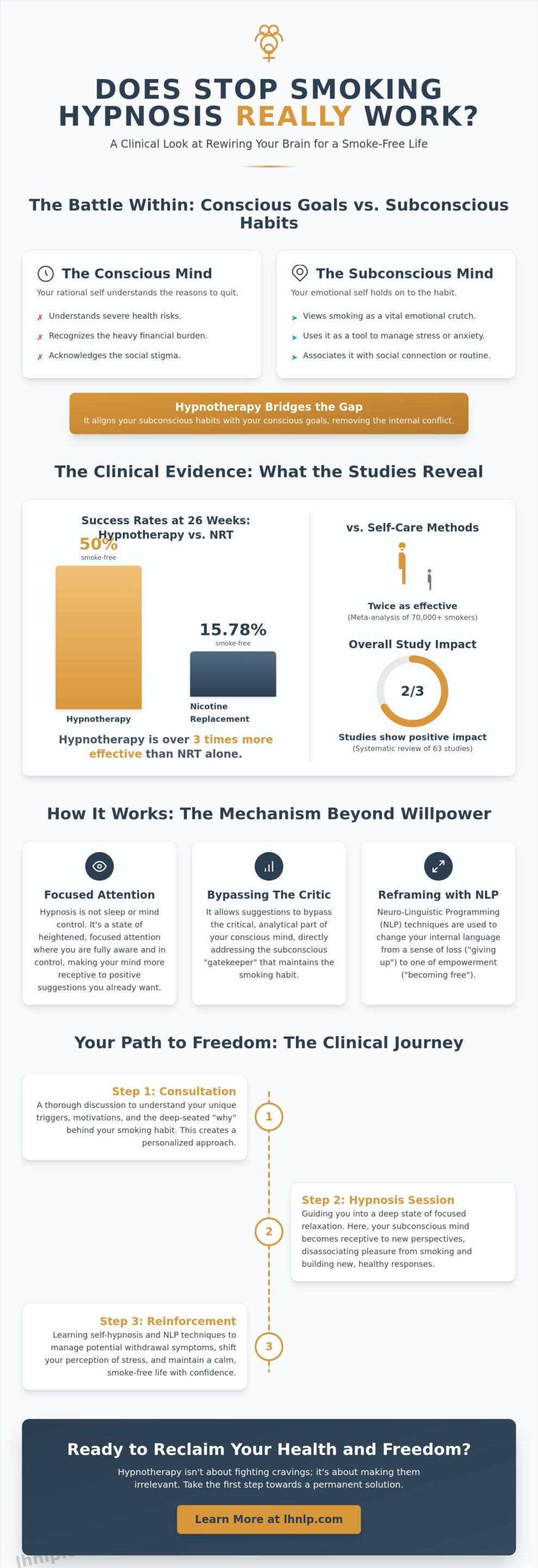
The friction you feel when trying to quit comes from a deep-seated mental divide. Your conscious mind is rational. It understands the health risks, the financial burden, and the social stigma. However, your subconscious mind often views smoking as a protective tool or a necessary social anchor. This part of your brain doesn’t care about statistics. Hypnosis bridges this gap, allowing these two parts of your mind to finally speak the same language. You can find more Evidence for hypnosis in smoking cessation when looking at how these mental barriers are dismantled through focused relaxation. Once the subconscious agrees that smoking is no longer a “friend,” the physical urge loses its power.
The Role of Neuro-Linguistic Programming (NLP)
At our clinic, we don’t rely on hypnosis alone. We integrate NLP Coaching to address the specific language of your addiction. NLP is the study of how we “program” our thoughts through the words we use. Think about your internal dialogue. Do you feel like you’re “giving up” something? That language creates a sense of loss. We help you reframe this as “becoming free.” Kamal uses NLP to break the automatic trigger-response cycle that makes you reach for a cigarette the moment you feel stressed. By changing these mental shortcuts, we replace the old habit with a new, empowering response. It’s about outgrowing the habit rather than just surviving it.
The Evidence Base: Does Stop Smoking Hypnosis Really Work?
When people ask, does stop smoking hypnosis really work, they’re often looking for a bridge between skepticism and hope. It’s vital to separate the “stage hypnosis” you see on TV from the clinical practice used in therapeutic settings. While an entertainer seeks a reaction, a clinical hypnotherapist seeks a resolution. In 2026, the evidence for this modality has grown more robust. A systematic review from 2025, which analyzed 63 different studies, found that two-thirds of the reports showed a positive impact of hypnosis on smoking cessation. This isn’t about being “tricked” into quitting. It’s about utilizing a scientifically observed state of mind to bypass the filters that keep you stuck.
What the Clinical Studies Reveal
Data shows that for many, this method outperforms traditional aids. A notable study found that 50% of patients treated with hypnotherapy remained smoke-free at 26 weeks. In contrast, only 15.78% of those in the nicotine replacement group achieved the same result. This is particularly significant for “treatment-resistant” smokers. These are individuals who have tried patches, gum, and willpower but found no relief from the psychological urge. You can learn more about How hypnosis for smoking cessation works by looking at how it addresses the subconscious layers of addiction. Unlike generic recordings, a personalized session adapts to your specific triggers, whether they’re social, emotional, or purely habitual.
A meta-analysis of over 600 studies, including more than 70,000 smokers, found hypnosis to be twice as effective as self-care methods like quitting cold turkey. This suggests that the subconscious intervention provides a layer of support that logic alone cannot provide. It isn’t just about stopping a behavior; it’s about changing the internal environment that made the behavior feel necessary in the first place.
Success Factors: Why It Works for Some More Than Others
The efficacy of this process isn’t just about the technique; it’s about the partnership. Your internal “Readiness to Change” acts as the fuel for the entire process. If you’re only quitting because of outside pressure, the results may be fleeting. However, when you’re truly ready to reclaim your health, the rapport with your practitioner becomes a catalyst for change. It’s also a common misconception that one session is a “magic bullet” that fixes everything. While some experience immediate shifts, most successful journeys involve a series of sessions to reinforce new pathways. If you’re curious about how we structure this journey, you can explore our Hypnotherapy for Smoking Cessation sessions to see if this path aligns with your goals.
Practitioners in 2026 increasingly view hypnosis as part of an integrative approach to behavioral health. It’s no longer seen as a fringe alternative, but as a primary tool for those who need to address the emotional roots of their habits. By focusing on the individual rather than a “one size fits all” script, clinical hypnotherapy offers a tailored exit strategy from the cycle of addiction.
Beyond Willpower: Hypnotherapy vs. Nicotine Replacement Therapy
Choosing between a chemical substitute and a mental shift is often the final crossroads for a smoker. Nicotine Replacement Therapy (NRT), including patches, gum, or vaping, focuses entirely on the biological addiction. While these tools can ease physical cravings, they leave the psychological habit untouched. This is why so many people return to smoking even after months of using patches. They’ve addressed the “what” but not the “why.” When you look at the Cochrane systematic review, it’s clear that the qualitative shift in a smoker’s mindset is what truly determines long-term success. So, does stop smoking hypnosis really work as a standalone solution? For those seeking a natural transition without chemical side effects, it offers a way to lower the perceived stress of withdrawal by reframing how the mind perceives the cigarette.
The cost-benefit analysis also favors a psychological approach. Consider the mounting expense of cigarette purchases over a lifetime. While NRT requires ongoing investment in products that keep the nicotine addiction alive, hypnotherapy is an investment in a permanent lifestyle change. It isn’t just about saving money. It’s about reclaiming the mental energy you currently spend on managing cravings and planning your next smoke break.
The Problem with Nicotine Substitutes
NRT often creates what many describe as an “empty feeling.” You have the nicotine in your system, but you still miss the ritual. You miss the “break” or the social connection you’ve associated with smoking for years. Because NRT ignores the psychological habit, it feels like you’re constantly grieving a lost friend. Hypnotherapy changes this narrative. Instead of feeling like you’re losing something, you realize you’re gaining your life back. Our Stop Smoking Hypnotherapy London guide goes deeper into how local professionals use this mindset shift to ensure the change is permanent. By addressing the habit at its root, we remove the need for a chemical crutch.
Why Willpower is a Finite Resource
We’ve all experienced “decision fatigue.” It’s that moment at the end of a long, stressful day when your resolve simply crumbles. Willpower is like a muscle; it gets tired. Brute-forcing your way through a craving is exhausting and rarely sustainable. Hypnosis aims to make the process feel effortless. By removing the internal struggle at a subconscious level, you aren’t “trying” not to smoke. You simply aren’t a smoker anymore. This shift from resistance to release is what makes hypnotherapy a more sustainable choice. It moves you away from the daily battle of willpower and toward a calm, natural state of being smoke-free.
The London Experience: What Happens in a Clinical Hypnosis Session
Stepping into a quiet clinic in the heart of London is often the first moment a smoker feels a genuine sense of relief. Whether you seek support in the prestigious surroundings of Harley Street or a tranquil space in Ealing, the environment itself signals to your subconscious that a significant shift is beginning. Many clients arrive with a lingering doubt, asking, does stop smoking hypnosis really work when the pressure of city life is so intense? The answer lies in the transition from the chaotic energy of the London streets to the focused, professional calm of the consulting room. This isn’t just a meeting; it’s a dedicated space for your internal evolution.
The process is designed to be as efficient as it is deep. For the busy Londoner, time is a precious resource. This is why the clinical approach moves beyond surface-level relaxation to address the specific neural pathways that keep you tethered to the habit. You aren’t just a passive participant. You are an active partner in a process that respects your intellect and your desire for freedom.
Your First Session with Kamal
Your journey begins with a comprehensive “pre-talk” where we map out your unique smoking landscape. We don’t just look at how many cigarettes you smoke; we investigate the emotional architecture behind them. We use NLP Coaching techniques during this initial dialogue to begin loosening the grip of old associations before the formal hypnosis even starts. Once we’ve identified your patterns, we move into the induction. The induction is a guided transition into a state of focused calm where your mind becomes receptive to new, empowering possibilities. It’s a gentle descent into a level of clarity you may not have experienced in years.
Tailoring the Suggestions to Your Life
If you’re ready to experience this transformation for yourself, you can book your initial consultation to begin the process of becoming smoke-free. We are here to guide you through every step of this methodical and life-changing journey.
Preparing for Success: How to Ensure Your Quit Smoking Journey Lasts
Success in hypnotherapy isn’t something that happens to you; it’s a transformation you actively step into. Many people arrive at a crossroads, wondering, does stop smoking hypnosis really work if they’ve been smoking for decades or have failed with other methods. The evidence suggests it does, but the depth of that success often depends on your inner preparation. Before your first session, it’s helpful to evaluate your own readiness through a few reflective questions:
- Are you quitting because you want freedom, or to satisfy someone else’s expectations?
- Can you imagine a version of yourself that handles stress without reaching for a cigarette?
- Are you willing to let go of the old “smoker” identity to make room for a healthier self?
- Do you believe your mind has the capacity to learn new, more supportive responses?
If you can answer “yes” to these, you’ve already laid the foundation for a permanent shift. We also provide tools for self-hypnosis, allowing you to reinforce the work done in the clinic whenever you feel the need for a moment of centeredness. This follow-up support ensures that the new neural pathways we create remain strong and resilient.
Setting Your “Quit Date” and Mindset
Viewing your quit date as a day of liberation rather than a day of loss changes your entire neurological response to the process. In the first 48 hours after a session, managing your environment is key. Remove the visual cues, like lighters or ashtrays, that used to trigger the old habit. This isn’t about hiding from life, but about giving your new subconscious pathways the space to solidify without unnecessary interference. You can learn more About Us to understand the clinical background and professional qualifications Kamal brings to this delicate process.
Taking the Next Step in London
For those living or working in the capital, finding a practitioner who understands the unique pressures of the city is essential. You can explore our Hypnotherapy London guide for a deeper look at how we combine clinical hypnosis with NLP. If your schedule doesn’t allow for a trip to our central locations, we also offer Virtual Hypnotherapy Sessions via Zoom, providing the same level of professional support from the comfort of your own home.
Choosing a practitioner requires looking beyond simple certifications; you need someone who views the mind as a whole system. When you’re ready to reclaim your health and step into a smoke-free life, the right support makes all the difference. 2026 is the year to finally stop managing a habit you hate and start living with the vitality you deserve. We invite you to Contact London Hypnotherapy & NLP to begin your journey today.
Step Into Your Smoke-Free Future
Quitting smoking isn’t just about removing a toxin; it’s about reclaiming the mental space that habit has occupied for years. We’ve explored how clinical hypnotherapy bridges the gap between your conscious desire for health and your subconscious patterns. By resolving this inner conflict, the question of does stop smoking hypnosis really work becomes a lived reality rather than a clinical debate. You don’t have to rely on finite willpower when you can rewire the very triggers that once held you captive. This is a methodical process of outgrowing a habit that no longer serves your path.
Book Your Personalised Stop Smoking Session in London
Frequently Asked Questions
Is everyone hypnotisable for smoking cessation?
Most people have the capacity to enter a state of hypnosis if they are willing and motivated to do so. Hypnosis isn’t something done to you, but a collaborative process of focused attention. If you’ve ever found yourself lost in a book or a daydream, you can experience the benefits of this method. Your openness to the process is the primary factor that determines how effectively your mind accepts new suggestions.
How many sessions of hypnosis are needed to stop smoking for good?
The number of sessions required varies depending on your personal history with smoking and your level of commitment. While some people experience a profound shift in a single session, others benefit from a series of two or three meetings to reinforce new neural pathways. This structured approach ensures that the non-smoker identity becomes deeply rooted in your subconscious, providing a more resilient foundation for long-term freedom.
Will I remember what happened during my smoking hypnosis session?
You will remain fully aware and remember the details of your session. Clinical hypnotherapy isn’t like sleep or unconsciousness; it’s a state of heightened awareness where you stay in control. You’ll hear the therapist’s voice and be able to recall the insights and metaphors discussed during the process. This conscious memory helps you integrate the changes into your daily life once you leave the clinic.
Can hypnosis help with the weight gain often associated with quitting smoking?
Hypnosis can effectively address the psychological triggers that often lead to weight gain after quitting. Many people turn to food as a substitute reward when they stop smoking. By using suggestion therapy, we can help your mind find healthier ways to manage stress or boredom. This ensures you don’t trade one habit for another, allowing you to maintain a balanced lifestyle as you reclaim your health.
Is stop smoking hypnosis safe for everyone?
Hypnotherapy is a safe and non-invasive process for the vast majority of people. It doesn’t involve chemicals or medical prescriptions, making it a natural alternative to pharmacological aids. However, individuals with certain severe mental health conditions should consult their specialist before starting. For most, the experience is simply one of deep relaxation and mental clarity that leaves them feeling refreshed and empowered.
How much does a stop smoking hypnotherapy session in London typically cost?
The cost of stop smoking hypnotherapy in London varies significantly based on the practitioner’s expertise and the location of the clinic. When researching does stop smoking hypnosis really work, it’s important to consider the value of a permanent lifestyle change compared to the ongoing expense of cigarettes. You should check individual provider websites for their current fees and package options to find a professional who aligns with your needs.
What happens if I start smoking again after my session?
If you happen to smoke again, it’s important to view it as a moment of feedback rather than a total failure. A relapse often highlights a specific trigger that hasn’t been fully addressed yet. In these cases, a follow-up session can help refine your strategy and strengthen your subconscious resolve. We view the journey as a methodical process, and we are here to support you in navigating any temporary setbacks.
Can I do smoking hypnosis online via Zoom or Skype?
You can absolutely experience the benefits of hypnosis through online sessions via Zoom or Skype. Many people find that being in their own comfortable environment allows them to relax more deeply into the process. The effectiveness of the suggestions remains the same whether you are in a London clinic or your own living room. These virtual sessions provide a convenient and flexible way to find out does stop smoking hypnosis really work for your specific lifestyle.