

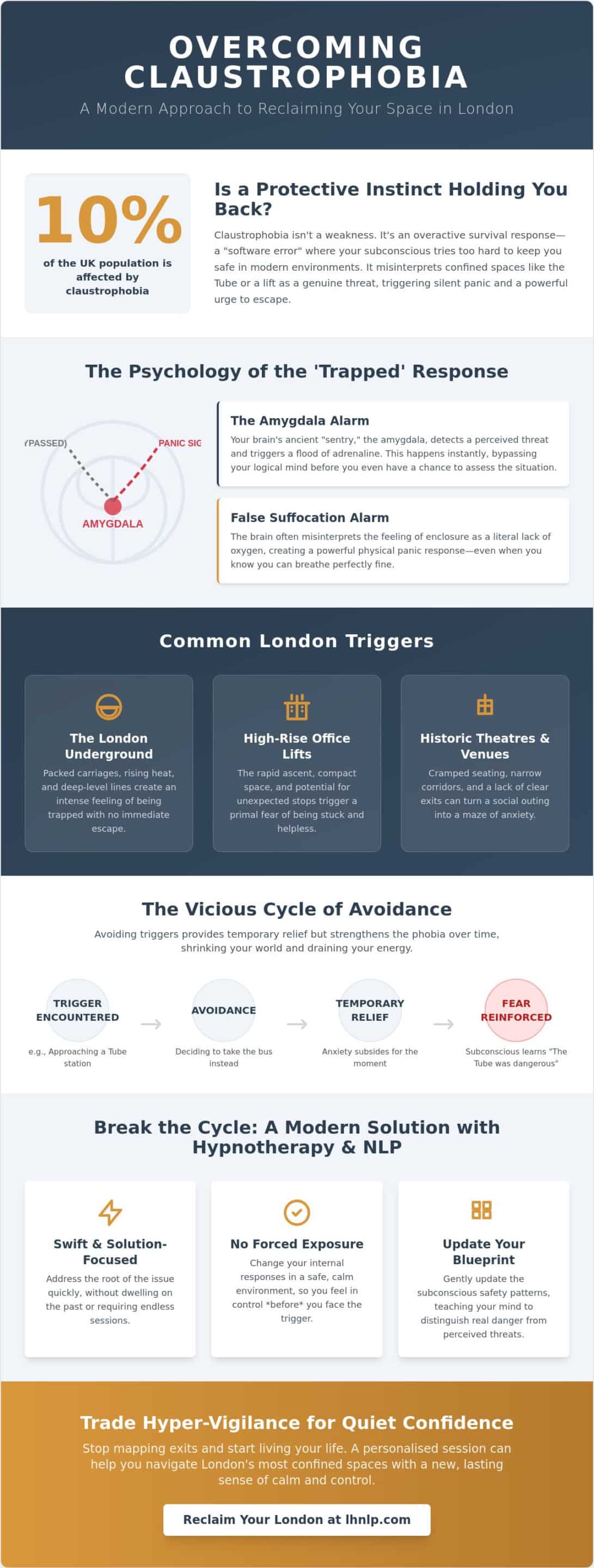
Imagine standing on the edge of a crowded platform at Oxford Circus, watching the carriage doors slide open, only to feel your chest tighten and your breath catch as the space feels suddenly too small to breathe in. For nearly 10% of the UK population, this isn’t just a daily commute; it’s a gauntlet of hyper-vigilance and silent panic that dictates where they work and how they live. If you’ve spent years mapping out routes to avoid lifts or the Underground, seeking effective claustrophobia treatment London is often the first step toward reclaiming your personal geography. It’s not a sign of weakness, but rather a protective response from a subconscious mind that’s simply trying too hard to keep you safe.
You likely feel exhausted by the constant mental scanning for exits and the physical toll of a nervous system that stays on high alert. This article will show you how modern hypnotherapy and NLP can help you navigate London’s most confined spaces with a sense of calm and quiet confidence. We’ll explore why your brain creates these spatial “software errors” and how targeted sessions can update your internal responses, allowing you to step into a lift or a Tube carriage feeling entirely in control of your own body.
Key Takeaways
- Understand why your brain perceives modern environments like the London Underground as a threat and how to reframe this survival response into a manageable experience.
- Identify the role of the amygdala in creating “trapped” sensations and why your subconscious mind needs a gentle update to its internal safety blueprints.
- Discover why modern claustrophobia treatment London utilizing hypnotherapy and NLP provides a swift, solution-focused path to freedom without the need for forced exposure.
- Learn practical grounding exercises and rhythmic breathing techniques that allow you to maintain physical control during high-pressure moments in lifts or crowds.
- Explore how a personalized session can help you trade constant hyper-vigilance for a new, lasting sense of confidence in any enclosed environment.
Understanding Claustrophobia in the Heart of London
Claustrophobia is essentially a protective instinct that has lost its sense of timing. In an evolutionary sense, feeling a surge of adrenaline when restricted once saved lives, but in a modern metropolis, this “software error” creates significant distress. For those seeking a comprehensive overview of claustrophobia, it’s clear that the condition is less about the physical dimensions of a room and more about the perceived lack of escape. It’s a primal alarm sounding in a world of glass, steel, and concrete.
To better understand how this fear manifests and how it can be addressed, watch this helpful video:
Common London Triggers for Claustrophobia
The London Underground is perhaps the most iconic trigger for spatial panic. Deep-level lines like the Northern or Central lines can feel particularly oppressive during peak hours when the crowd limits your movement and the heat rises. In the City, the high-speed lifts of high-rise offices trigger a similar “trapped” response, especially if they stop unexpectedly. Even social life in the West End presents challenges. Historic theatres often feature cramped seating and narrow corridors that feel like a labyrinth with no clear exit. These environments turn a simple commute or a night out into a calculated risk.
The Physical Cost of Avoidance
Many people adopt “The Long Way Round,” taking buses or walking for hours just to avoid a ten-minute Tube journey. While this provides temporary relief, it carries a heavy cost. It drains your energy, limits your career opportunities, and forces you into a state of constant hyper-vigilance. You might find yourself “exit-mapping” every room you enter, which is mentally exhausting. Paradoxically, every time you avoid a situation, you tell your subconscious that the danger was real. This actually strengthens the phobic response, making the next encounter even more daunting. Breaking this cycle requires a shift in how your mind processes these environments, which is a core focus of phobia treatment sessions.
The Psychology of the ‘Trapped’ Response: Why Your Brain Panics
Your brain’s amygdala acts like a tireless sentry, always scanning the horizon for potential danger. It’s a primal mechanism designed to keep you alive, yet it lacks the sophisticated nuance required to distinguish between a prehistoric cave-in and a modern morning commute. When this internal alarm sounds, it bypasses your rational mind entirely, flooding your system with adrenaline before you’ve even had a chance to think. This is why logic so often fails in the heat of the moment. You know the lift is safe, and you know the Tube will reach the next station, but your primal brain has already decided that your life is at risk.
Conditioned responses often stem from a single, high-impact event that leaves a lasting blueprint on your neural pathways. Perhaps it was a stalled lift during a childhood holiday or being stuck in a crowded corridor during a fire drill. Your mind stores these spatial memories as “safety boundaries,” and whenever you approach those limits, the alarm triggers automatically. This response is often tied to the “False Suffocation Alarm” theory, where the brain misinterprets the perception of enclosure as a literal lack of oxygen. While traditional Cognitive Behavioral Therapy for claustrophobia focuses on challenging these thoughts, the speed of the panic response often outruns the pace of logical reflection.
If you’ve found that willpower alone hasn’t been enough to break this cycle, it’s because the fear isn’t stored in your conscious mind. It lives in the subconscious, a place where deep-seated patterns are maintained and protected. Exploring a specialized phobia treatment can help you access these deeper layers where change actually happens.
The Subconscious Blueprint
Your mind is a master of pattern recognition. It creates a map of what is “safe” and what is “threatening” based on past experiences, and it will fight to maintain that map even when it no longer serves you. The critical faculty is the mental gatekeeper that protects your existing beliefs from being challenged by new, logical information. When you enter a confined space, your fight-or-flight response activates because your subconscious blueprint has labeled that specific environment as a trap. It isn’t a flaw in your character; it’s a survival system that’s simply over-performing its duties.
From Anxiety to Panic: The Escalation Ladder
Anxiety rarely stays static; it moves like a ladder. It begins with a subtle physical cue, perhaps a slight prickle of sweat or a shallow breath. This sensation is then interpreted by the mind as a “catastrophic thought,” which in turn increases the heart rate. This creates a feedback loop that can escalate into a full-blown panic attack in mere seconds. Identifying your personal “point of no return” is a vital part of claustrophobia treatment London, as it allows you to intervene before the physical response becomes overwhelming. By understanding this ladder, you can begin to interrupt the climb before you reach the top.
Claustrophobia Treatment: Beyond Traditional Exposure Therapy
While many clinical settings prioritize gradual exposure therapy, the prospect of repeatedly facing your worst fears can feel like a mountain too steep to climb. Traditional Cognitive Behavioral Therapy (CBT) often relies on logical deconstruction, yet as we’ve explored, the primal brain rarely listens to logic during a panic spike. This is why modern claustrophobia treatment London has evolved to include more solution-focused modalities like Hypnotherapy and Neuro-Linguistic Programming (NLP). Unlike “flooding” or forced exposure, which can sometimes re-traumatize a sensitive nervous system, these methods work within the safety of your own mind to update the spatial software that’s currently malfunctioning.
The power of this approach lies in “mental rehearsal.” Your brain doesn’t distinguish between a vivid, focused imagination and a physical reality. By rehearsing a calm response in a state of deep relaxation, you create new neural pathways. You’re effectively building a “memory of success” before you even step onto a platform. This allows you to navigate the city’s confined spaces not through white-knuckled endurance, but through a genuine internal shift in perception.
Hypnotherapy for Claustrophobia
Hypnotherapy allows us to bypass the critical faculty and speak directly to the subconscious mind. It’s here that the emotional charge of past events is stored. By entering a state of focused awareness, you can begin to install new, calmer responses to environments that previously felt threatening. This process isn’t about forgetting the past, but rather reducing its power over your present. If you’re curious about how these methods apply to various fears, you can explore our full range of treatments to see how we address the root causes of anxiety and spatial distress.
NLP Techniques for Rapid Change
NLP offers a precise toolkit for “un-linking” the panic response from specific triggers like Tube tunnels or windowless rooms. One of the most effective tools is the “Fast Phobia Cure,” also known as the Rewind Technique. This involves changing the “sub-modalities” of your internal fear-movies. By making the mental image smaller, turning it black and white, or even adding a humorous soundtrack, you alter the structure of the memory. The brain stops associating that space with immediate danger. We also utilize “Anchoring,” which helps you create a portable state of calm. Imagine being able to trigger a feeling of total composure just by touching your thumb and forefinger together as you step into a lift. It’s about giving you back the steering wheel of your own physical responses.
Practical Steps for Managing Claustrophobia in Public Spaces
While professional claustrophobia treatment London provides the structural changes your subconscious needs for long-term freedom, you also require a practical toolkit for the “here and now” of city life. When the doors of a Northern Line carriage close or a lift begins its ascent, your body may still try to default to its old alarm settings. In these moments, grounding techniques act as a physiological anchor, keeping you present while the wave of anxiety passes without taking hold. These tools are designed to interrupt the escalation ladder before you reach the point of panic.
The 7-11 breathing technique is one of the most powerful ways to physically override the panic response. By inhaling for a count of seven and exhaling for a count of eleven, you force your heart rate to slow down and signal to your nervous system that you’re safe. Similarly, expanding your peripheral vision can be transformative. When we panic, our vision tunnels, which only increases the feeling of being trapped. By consciously softening your gaze and noticing the space to your far left and right, you trick the brain into feeling that the environment is much larger than it appears. If you feel overwhelmed, don’t be afraid to communicate. Simply telling a companion, “I just need a moment to focus on my breathing,” removes the extra layer of anxiety that comes from trying to hide your physical response.
The Commuter’s Survival Kit
Sensory distractions serve as an effective circuit breaker for the panic loop. Carrying a specific scent, like a small bottle of peppermint oil, or listening to complex, rhythmic music can give your brain a different focal point. The 5-4-3-2-1 technique is particularly useful in a crowded carriage: acknowledge five things you see, four you can touch, three you hear, two you can smell, and one you can taste. Box breathing is a rhythmic pattern that effectively lowers cortisol levels by signaling to the brain that the immediate threat has passed. These tools don’t just manage the symptoms; they help you prove to your subconscious that you can survive the moment with composure.
Long-term Resilience Building
True recovery involves more than just surviving the commute; it requires building a foundation of calm. This includes managing your sleep hygiene and reducing caffeine intake, as stimulants can often mimic the physical symptoms of a panic attack and prime your body for a phobic response. Expanding your comfort zone is a process of gathering small, daily wins, such as staying on the Tube for just one extra stop when you feel calm. For a more comprehensive approach to maintaining your inner balance, you might explore our sessions for Stress Management. If these self-help tools feel like temporary patches for a deeper issue, consider booking a phobia treatment session to address the root cause of your spatial anxiety.
Professional Claustrophobia Treatment at London Hypnotherapy & NLP
While grounding techniques provide an essential lifeline during a difficult commute, true liberation comes from addressing the subconscious patterns that trigger the panic in the first place. At London Hypnotherapy & NLP, Kamal offers a sophisticated blend of Hypnosis and NLP coaching designed to update these outdated survival responses. This isn’t just about managing symptoms; it’s about a fundamental re-patterning of how your mind perceives space and safety. By choosing professional claustrophobia treatment London, you’re stepping into a process that respects the complexity of your experience while focusing on rapid, measurable change.
Your first session is a sanctuary of calm and professional focus. It’s a space where we deconstruct the specific triggers that affect your life, whether it’s the deep-level lines of the Underground or the high-rise lifts of the City. We don’t believe in one-size-fits-all solutions. Instead, we work together to understand your unique internal map and begin the work of gently shifting your boundaries. You can access this support at several convenient locations, including our Harley Street clinic, our practice in Ealing, or Tokenhouse Yard in the heart of the City. For those who prefer to begin their journey from a familiar environment, we also offer virtual hypnotherapy sessions that are just as effective as in-person appointments.
Why Choose Our London Clinic?
With over two decades of experience helping Londoners reclaim their freedom, we understand the specific urban pressures that exacerbate spatial anxiety. We’ve seen how the exhaustion of hyper-vigilance can bleed into every area of life, and we’ve refined a methodology that addresses these challenges with both intellectual elegance and practical results. Each treatment plan is meticulously tailored to your lifestyle, ensuring that the changes we make together are sustainable and deep-seated. To learn more about our philosophy and the experience we bring to every session, feel free to visit our About Us page.
Take the First Step Toward Freedom
Imagine a morning where you step onto the Tube without scanning for the nearest exit, or an office meeting where the windowless room feels entirely neutral. Overcoming claustrophobia has a profound ripple effect. When you no longer need to plan your life around avoiding small spaces, your overall confidence begins to flourish. You reclaim your time, your energy, and your sense of agency in the world. It’s a journey from feeling trapped to feeling entirely at home in your own skin. Don’t let another year of avoidance dictate your choices. Book your consultation with Kamal today and start the process of breaking free from the fear for good.
Reclaiming Your Freedom of Movement
Seeking specialized claustrophobia treatment London gives you access to over 20 years of clinical expertise and rapid phobia techniques. With central locations in Harley Street and the City, professional support is always accessible to help you expand your boundaries. It’s time to stop mapping out exits and start looking forward to the journey ahead. Book Your Claustrophobia Consultation in London today and take the first step toward a more open future. You have the inner resources to change; we’re here to help you activate them.
Frequently Asked Questions
Is claustrophobia treatment in London expensive?
Private therapy costs in the capital reflect the expertise of the practitioner and the location of the clinic, with Harley Street services typically sitting at the higher end of the spectrum. While private sessions require an investment, many individuals find that the rapid results achieved through hypnotherapy and NLP offer better value than months of traditional talk therapy. You can also access free support through the NHS, where talking therapies like CBT are available via self-referral for those registered with a local GP.
Can hypnotherapy really cure claustrophobia in just a few sessions?
Many clients experience a profound shift in their spatial perception after only a few appointments because these methods work directly with the subconscious mind. Unlike traditional counseling that may take months to peel back layers of history, hypnotherapy and NLP are solution-focused and aim to update your internal safety blueprints quickly. While everyone’s journey is unique, the goal is always to achieve a lasting sense of calm in the shortest time possible for your specific needs.
What happens if I have a panic attack during the therapy session?
You are in a safe, controlled environment where your physical and emotional comfort is the absolute priority throughout the process. If you feel a surge of anxiety, we use immediate grounding techniques to help your nervous system return to a state of balance. The session is a compassionate partnership; we move at a pace that feels manageable for you, ensuring you always remain in total control of the experience.
How do I know if my claustrophobia is severe enough for professional treatment?
If your fear of enclosed spaces dictates your travel routes, limits your social life, or causes you to avoid specific career opportunities, it’s time to seek help. You don’t need a formal psychiatric diagnosis to benefit from claustrophobia treatment London. If the prospect of a lift or a Tube journey triggers hyper-vigilance or physical distress, professional support can help you reclaim the freedom of movement you deserve.
Do you offer online sessions for claustrophobia if I can’t travel to the clinic?
Virtual hypnotherapy sessions are a highly effective and convenient option for those who find traveling to a central clinic too daunting or impractical. These appointments take place via secure video calls, allowing you to engage in the work from the comfort and safety of your own home. Many clients find that establishing a foundation of confidence in a familiar environment makes the eventual transition to public spaces much smoother.
Is NLP the same as exposure therapy for phobias?
NLP is quite different from traditional exposure therapy because it focuses on changing how your brain encodes the fear rather than just enduring the trigger. While exposure therapy involves gradual, often uncomfortable confrontation with small spaces, NLP uses mental techniques to “un-link” the panic response from the situation. This approach allows you to rewire your internal reactions in a safe mental space before you ever have to test them in the real world.
Can children be treated for claustrophobia at your London locations?
Phobia treatment is often very effective for younger people because their subconscious patterns are typically more flexible and open to change. While we adapt our methods to suit the maturity and specific needs of the individual, it’s best to discuss your child’s situation during an initial consultation. Addressing these spatial fears early can prevent them from becoming lifelong habits of avoidance and hyper-vigilance.
Will I be ‘put under’ during hypnotherapy for my phobia?
You remain fully awake, aware, and in complete control during every moment of a hypnotherapy session. It’s a state of deep, focused relaxation similar to being completely absorbed in a beautiful piece of music or a compelling story. You can hear the practitioner’s voice clearly, you can speak if you wish, and you can end the session whenever you choose. It’s an active, collaborative process where your mind remains sharp and attentive.