

Did you know that 66% of professionals who choose to negotiate their salary are successful, yet 55% of people never even attempt the conversation? This hesitation often masks a deeper struggle with imposter syndrome and the physical symptoms of anxiety, like a shaking voice or sudden sweat, that arise when we consider how to ask for a pay rise with confidence. It’s natural to worry about damaging a professional relationship you’ve worked hard to build. You aren’t alone in feeling like you’re asking for a favor rather than discussing a fair exchange of value.
True negotiation isn’t about aggressive demands; it’s about a fundamental shift in your internal architecture. This guide will show you how to use NLP and psychological tools to quiet your inner critic and approach the table as a respected partner. We’ll explore the mental strategies needed to stay calm under pressure and provide a clear, data-driven plan for the meeting itself. By the end of this article, you’ll have the unshakeable self-belief and practical framework required to secure the salary increase you deserve.
Key Takeaways
- Learn why your nervous system perceives a salary request as a survival threat and how to bridge the “confidence gap” through psychological reframing.
- Discover how to anchor a state of unshakeable presence using NLP techniques, allowing you to remain centered and articulate even when the conversation feels challenging.
- Develop a robust evidence file that highlights both your financial impact and your contribution to company culture to justify your market value effectively.
- Master a structured five-step approach on how to ask for a pay rise with confidence by aligning your request with strategic timing and professional clarity.
- Recognize when internal barriers like imposter syndrome require a deeper shift through specialized tools like hypnotherapy or NLP coaching to reprogram your response to authority.
Understanding the Psychology of the Confidence Gap
The journey toward a higher salary often begins long before you step into your manager’s office. It starts in the quiet, often turbulent spaces of the mind where we grapple with what psychologists call the “Confidence Gap.” This gap represents the chasm between our tangible professional achievements and our internal permission to claim their worth. While you may excel in your daily tasks, the prospect of articulating that value can trigger a profound sense of vulnerability. By Understanding the Psychology of the Confidence Gap, we can see that true self-assurance isn’t about the absence of fear; it’s the mastery of it. This is especially vital for high achievers who frequently experience imposter syndrome, where success is dismissed as luck rather than a result of competence.
Why does a simple conversation about compensation feel like a life-or-death encounter? Our brains are wired for survival, not for corporate negotiation. For our ancestors, social rejection meant being cast out from the tribe, which was a literal death sentence. When you consider how to ask for a pay rise with confidence, your amygdala doesn’t distinguish between a modern salary review and a prehistoric predator. It interprets the risk of a “no” as a threat to your standing in the group. In 2026, with real average weekly earnings decreasing by 0.2% when accounting for inflation, the pressure to negotiate effectively is both a psychological and a practical necessity. For those struggling with deep-seated blocks, NLP Coaching can help dismantle the mental scripts that fuel this survival-based anxiety.
To better understand this concept, watch this helpful video:
The Fight-or-Flight Response in the Boardroom
When the fight-or-flight mechanism takes over, your body prioritizes physical survival over verbal eloquence. Adrenaline surges through your system, leading to distressing symptoms like a racing heart, shallow breath, or a shaking voice. This physiological hijack is why “just being brave” is rarely a sustainable strategy. You cannot willpower your way through a biological storm. Instead, you must learn to regulate your nervous system. By addressing these physical responses, you ensure that your voice remains steady and your arguments remain sharp, transforming the boardroom from a place of fear into a space of opportunity.
Reframing the Negotiation as a Value Exchange
The shift from anxiety to authority happens when we change the narrative of the meeting. Most employees approach a pay review as if they are asking for a personal favor, which immediately places them in a subordinate position. Reframing changes everything. Using cognitive shifts, you can view the discussion as a strategic investment proposal. You aren’t asking for money because you need it; you’re presenting a case for why the company should continue to invest in a high-performing asset. When you master the internal mechanics of your mind, you finally learn how to ask for a pay rise with confidence by treating your manager as a collaborator in your mutual success.
NLP Techniques to Anchor Your Professional Confidence
Neuro-Linguistic Programming, or NLP, serves as a sophisticated manual for the mind, allowing us to understand how our internal “software” influences our external results. While many career guides suggest simply practicing a script, they often ignore the physiological state of the speaker. If your nervous system is in a state of alarm, even the most polished words will sound hollow. Mastering how to ask for a pay rise with confidence requires you to move beyond mere rehearsal and into the realm of state management. By using NLP, you can intentionally curate the emotions you bring into the boardroom, ensuring your delivery is as impactful as your data.
One of the most transformative tools in this methodology is “Future Pacing.” This technique involves mentally rehearsing the negotiation in vivid detail, seeing the room through your own eyes and hearing the steady, resonant tone of your voice. By pre-living a successful outcome, you diminish the brain’s fear of the unknown. You aren’t just hoping for a positive result; you’re creating a neurological blueprint for it. For those who find that deep-seated anxieties still cloud their vision, engaging in NLP Coaching can provide the personalized structure needed to break through these invisible barriers.
Creating a Confidence Anchor for Your Meeting
Anchoring is a process where you associate a specific internal state with an external trigger. It allows you to access a feeling of unshakeable self-belief on command. To create your own anchor, follow these steps:
- Identify a past moment where you felt completely successful, capable, and proud.
- Close your eyes and step back into that memory, making the colors brighter and the sounds clearer until the feeling reaches a peak.
- At the height of this emotion, perform a subtle physical gesture, such as pressing your thumb and forefinger together.
- Release the gesture as the feeling fades. Repeat this several times to “set” the association.
During your salary discussion, you can discreetly fire this anchor to flood your system with that same peak-performance energy, keeping you centered even if the conversation takes an unexpected turn.
The Language of Certainty: NLP Verbal Patterns
The words we choose act as a bridge between our internal world and our manager’s perception. High-achievers often fall into the trap of using “minimizing” language, such as “I just wanted to check” or “I feel like I’ve done well.” These phrases subtly signal a lack of conviction. Instead, use presuppositions that lead the conversation toward a positive conclusion. Phrases like “As we discuss the adjustment to my compensation” assume that a change is already a logical next step.
Pair this with the technique of mirroring and matching. By subtly reflecting the posture and speech tempo of your manager, you create a subconscious sense of rapport and safety. This isn’t about manipulation; it’s about building a harmonious frequency where your proposal can be heard clearly. When you combine these verbal patterns with a grounded internal state, you finally understand how to ask for a pay rise with confidence by speaking the language of a true partner.
Strategic Preparation: Building Your Evidence File
Confidence is rarely a spontaneous occurrence; it is the natural byproduct of meticulous preparation. While NLP techniques help you manage your internal state, a robust evidence file provides the external validation your logical mind requires to remain steady. When you possess a physical or digital record of your contributions, you aren’t just relying on your memory during a high-pressure moment. You’re standing on a foundation of undeniable facts. This shift transforms the meeting from a vulnerable request into a professional presentation of mutual value. It serves as a psychological mirror, reflecting your true worth back to you before you even enter the room.
Building this file involves more than just listing your daily tasks. You must distinguish between “hard” data, such as revenue generated or costs saved, and “soft” data, which includes your impact on team culture and client retention. In 2026, many employers report that talent retention is a top priority, giving you significant leverage if you can prove your role in maintaining a stable, productive environment. Learning how to ask for a pay rise with confidence means speaking the language of the business. When you show that your presence is a direct contributor to the company’s success, the conversation naturally shifts toward a fair exchange of value.
Market Rates and the London Context
Translating Your Wins into Manager Language
To make your case undeniable, use the “Result-Action-Context” framework. Don’t just say you “managed a project.” Instead, state that you “delivered a 12% increase in efficiency (Result) by implementing a new automated workflow (Action) during a period of significant staff turnover (Context).” This structure provides the clarity your manager needs to justify the increase to their own superiors. As you compile this data, you might feel the familiar stirrings of anxiety. It’s helpful to consult our guide on stress management to stay grounded during this intensive preparation phase. By translating your efforts into a one-page “Value Deck,” you provide a tangible tool that speaks for you, allowing you to focus entirely on your delivery and presence.
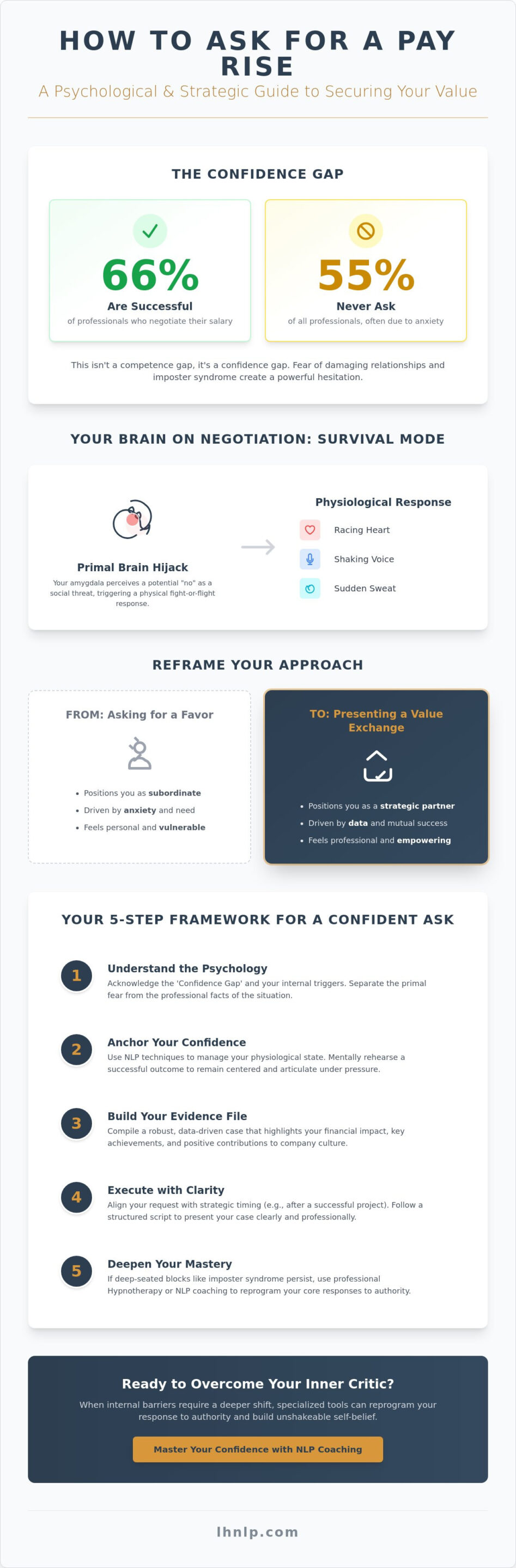
The Negotiation: 5 Steps to Asking with Confidence
Timing is often described as the invisible architect of a successful negotiation. You’ve prepared your evidence and anchored your state, but choosing the right moment is what allows your message to land effectively. Research shows that 61% of employers believe the economy will moderately or significantly impact their 2026 compensation decisions. This makes it vital to initiate the conversation when the company has recently celebrated a win or during a scheduled performance review. When you understand the external climate, you can position your request within the flow of the business rather than as an interruption to it. Learning how to ask for a pay rise with confidence involves recognizing that the “when” is just as important as the “what.”
Once you are in the room, the transition from a general performance review to a salary discussion requires a clear, unapologetic pivot. You aren’t there to hope for a reward; you’re there to align your compensation with the value you’ve already delivered. Given that 66% of professionals who negotiate are successful, the odds are firmly in your favor if you remain grounded. If you find the physical pressure of the moment still feels overwhelming, our Confidence Building Sessions can provide the deep-seated psychological support needed to hold your space with authority.
Opening the Conversation
To maximize impact, use the “State-Statement-Silence” technique. First, fire your NLP anchor to enter a peak state of calm. Second, deliver your opening statement: “Based on my contributions to the X project and the current market rate for my role, I am requesting a salary adjustment to Y.” Third, and most importantly, remain silent. The first person to speak after the ask often does so out of nervous tension, which can weaken the proposal. Let the silence do the work. It signals that you are comfortable with your request and that you expect a thoughtful response.
Navigating Resistance and Rejection
A “no” is rarely the end of the journey; it’s simply a data point. Use NLP reframing to view a rejection as a “not yet” or a request for more information. If your manager cites a frozen budget, ask specific, collaborative questions: “What metrics would I need to hit over the next six months to make this increase possible?” or “Can we look at the total compensation package, including professional development budgets or remote work stipends?” In 2026, negotiations are increasingly focused on the entire package rather than just the base salary.
Close the loop by confirming everything in writing, regardless of the immediate outcome. This ensures that the professional relationship remains intact and that a clear roadmap for your future growth is established. By maintaining your composure during resistance, you demonstrate the very leadership qualities that justify a higher salary. You’ve moved from being a passive participant to a strategic partner in your own career trajectory.
Deepening Your Confidence with Professional Support
Sometimes, despite having the best data and practicing the perfect script, a glass ceiling remains. This barrier isn’t always found in the office; often, it exists within the subconscious mind. If you find that the thought of how to ask for a pay rise with confidence still triggers a visceral, paralyzing fear, it’s time to look beneath the surface. Deep-seated blocks, often formed in early professional or personal experiences, can create a survival response that conscious willpower alone cannot override. In the high-velocity environment of London’s corporate world, these internal barriers can prevent even the most talented individuals from claiming their true market worth.
NLP coaching acts as the vital bridge between these internal shifts and your daily professional life. It provides the permanent tools needed to maintain a new, empowered identity throughout your career. By integrating these skills, every subsequent negotiation becomes a natural extension of your professional value rather than a source of dread. This methodical process of inner change allows you to step into your power, ensuring that your external achievements are finally matched by an unshakeable internal certainty.
Hypnotherapy for Professional Self-Belief
Clinical hypnosis is a powerful modality for addressing the subconscious architecture that dictates our behavior under pressure. While conscious preparation focuses on the “what,” hypnotherapy in London works on the “who”—the version of you that shows up in the boardroom. It’s particularly effective for those who struggle with public speaking or high-stakes negotiations, as it allows for the quietening of the inner critic that whispers doubts. Through this process, hypnotherapy creates a “new normal” where unshakeable confidence becomes your default state rather than a temporary performance. This deeper work ensures that your response to authority figures is one of mutual respect rather than outdated, childlike deference.
Taking the Next Step with London Hypnotherapy & NLP
Integrating these psychological shifts into your professional identity requires a personalized, empathetic approach. At London Hypnotherapy & NLP, we offer tailored Confidence Building Sessions and stress management techniques designed specifically for the modern professional. When you work with Kamal, you aren’t just learning a set of tips; you’re engaging in a methodical process of internal transformation. Our sessions provide a safe, supportive space to explore the roots of your hesitation and replace them with a grounded sense of authority.
This isn’t about becoming a different person; it’s about removing the layers of anxiety that hide your most capable self. If you’re ready to transcend your current limitations and finally master how to ask for a pay rise with confidence, we are here to guide you through that evolution. Every professional deserves to be compensated fairly for the value they bring to the table. Book your discovery session to build unshakeable career confidence today and start the journey toward the professional life you deserve.
Stepping Into Your True Professional Value
Navigating the complexities of a salary discussion requires more than just a list of achievements; it demands a fundamental shift in how you perceive your own worth. By mastering the internal mechanics of NLP anchoring and grounding your request in localized market data, you transform a potentially stressful encounter into a strategic partnership. You’ve learned that preparation is the antidote to anxiety and that silence can be your most powerful ally in the boardroom. Understanding how to ask for a pay rise with confidence is a skill that, once acquired, serves you for the duration of your career.
If you feel that deep-seated blocks are still holding you back, professional support can facilitate the breakthrough you need. With over 20 years of experience in clinical hypnotherapy and specialised NLP coaching for professional performance, we help you dismantle the survival responses that hinder your growth. Whether you visit our centrally located London clinics in Harley Street or Ealing, or connect with us virtually, we’re committed to your evolution. Book Your Confidence Building Session in London today to start claiming the compensation that reflects your true impact. Your future self is waiting for you to take this brave step toward alignment.
Frequently Asked Questions
How do I start the conversation about a pay rise?
Initiate the process by requesting a dedicated meeting rather than catching your manager in an informal setting. Use a clear, professional subject line like “Career Development and Compensation Review” to set a transparent agenda. Once the meeting begins, lead with a summary of your recent high-impact wins to establish a foundation of value before making your specific request. This approach shifts the dynamic from an emotional plea to a logical business discussion.
What is the best time of year to ask for more money?
The ideal time is typically three to four months before the annual budget is finalized or immediately following the completion of a significant project. In 2026, 61% of employers report that the economy will influence their compensation decisions, so it’s wise to look for “green light” moments when the company has achieved a major milestone. Aligning your request with a period of growth or stability increases the likelihood of a positive outcome.
How much of a pay rise should I realistically ask for?
Aim for a range based on localized market research, typically between 5% and 10% for a merit-based increase. With US employers planning an average salary increase of 3.5% in 2026, asking for a figure that reflects your specific impact helps you stay ahead of the 3.8% inflation rate. If you’ve recently stepped into a new role, remember that the average pay increase for a promotion in 2026 is 8.7%.
What if my boss says there is no budget for a raise?
Can NLP really help me feel more confident during a meeting?
NLP provides a structured methodology for state management that goes far beyond simple rehearsal. By using techniques like anchoring, you can learn how to ask for a pay rise with confidence by triggering a physiological state of calm and authority on command. This mental “reprogramming” changes your perception of the meeting from a survival threat to a professional exchange, allowing you to remain articulate under pressure.
How do I handle the physical symptoms of anxiety before the talk?
Address physical symptoms like a shaking voice or racing heart through nervous system regulation and grounding exercises. These symptoms are merely your body’s survival response to a perceived social threat. Using NLP tools or clinical hypnotherapy can help retrain your subconscious mind to view the negotiation as a safe, neutral event. When your body feels secure, your voice naturally regains its resonance and steady tone.
Is it okay to ask for a pay rise via email?
Use email only to schedule the meeting, not to conduct the actual negotiation. A face-to-face or virtual discussion is essential because it allows you to build rapport through subtle non-verbal cues like mirroring and matching. Since 66% of professionals who negotiate are successful, you want every advantage that human connection provides. An in-person talk conveys a level of conviction and professional presence that text simply cannot replicate.
How often should I be asking for a salary review?
Request a formal salary review once every twelve months, usually in conjunction with your annual performance appraisal. If your responsibilities have significantly expanded or the scope of your role has changed mid-year, a more frequent review may be justified. Regular discussions ensure that your compensation keeps pace with both your increasing expertise and the current 3.8% inflation rate, maintaining a fair balance of value.