

Did you know that 22% of British professionals cite work presentations as their primary source of anxiety? In the high-pressure boardrooms of Canary Wharf and the City, that dry throat and racing heart aren’t just uncomfortable; they’re invisible barriers to the career progression you’ve worked so hard to achieve. If you’ve searched for ways to improve my public speaking skills, you’ve likely realized that traditional advice to “just practice” doesn’t quiet the internal panic that strikes the moment you stand up to speak.
It’s exhausting to feel like an imposter while your peers move ahead, yet you know your insights deserve to be heard. You deserve to feel as confident at the lectern as you do at your desk. This guide will show you how to transform public speaking from a source of dread into a powerful professional asset by using proven psychological techniques to reprogram your nervous system. We’ll explore how to master your state of mind, silence the fear of judgment, and finally command the room with a calm, articulate presence that reflects your true expertise.
Key Takeaways
- Understand why traditional “practice makes perfect” advice often fails when it doesn’t address the underlying physiological triggers of performance anxiety.
- Discover how Neuro-Linguistic Programming (NLP) allows you to maintain state control, ensuring you remain calm and articulate under the intense pressure of London boardrooms.
- Learn a methodical 5-step framework to improve my public speaking skills by auditing your personal triggers and mastering a “pre-flight” routine for the critical first 60 seconds.
- Explore how hypnotherapy can access the subconscious mind to dissolve imposter syndrome and replace it with a lasting sense of executive presence.
Understanding the Challenge: Why Public Speaking Skills are Vital in London
London’s professional landscape is uniquely demanding. Whether you’re navigating the glass towers of Canary Wharf or the historic boardrooms of the City, the ability to articulate complex ideas is the currency of influence. Glossophobia, or the fear of public speaking, remains the third most common phobia in the UK, affecting roughly 15% of the population. By 2026, as digital tools handle more technical tasks, the value of human connection and persuasive speech has only intensified. Simply trying to improve my public speaking skills through repetition often feels like building a house on sand if you don’t first stabilize the foundation of your nervous system.
To truly understand the weight of this skill, one can look back at The history of public speaking, which has always been about more than just words; it’s about the projection of authority and character. In a city where 21% of people admit to avoiding presentations entirely, mastering this art isn’t just a soft skill. It’s a survival strategy. When you master your internal state, you stop being a passenger to your fear and start becoming the architect of your own executive presence.
To better understand the psychological mechanics of this process, watch this helpful video:
The High Cost of Avoiding the Stage
In London’s competitive market, staying silent has a measurable price tag. Research indicates that avoiding high-visibility roles can limit salary potential by significant margins over a career span. Beyond the financial loss, the psychological toll of “playing small” creates a cycle of frustration that erodes self-belief. In 2026, executive presence is no longer reserved for the C-suite; it’s expected at every level of management. If you consistently pass on opportunities to lead meetings, you aren’t just avoiding a speech. You’re signaling that you aren’t ready for the next step in your career progression.
The Science of the “Freeze” Response
When you stand before a crowd and your mind goes blank, you’re experiencing what psychologists call an “Amygdala Hijack.” Your brain’s primitive survival center perceives a room full of staring eyes as a predatory threat. It floods your system with cortisol and adrenaline, effectively shutting down the prefrontal cortex, which is the part of your brain responsible for logic and language. This is why you can’t simply “think” your way out of a panic attack. The freeze response is a survival mechanism that can be unlearned through methodical state control. By exploring specialized treatments for anxiety, you can begin to reclaim your voice. Once the physical panic is managed, the journey to improve my public speaking skills becomes a process of refinement rather than a battle for survival.
The Psychological Blueprint: How NLP and Hypnotherapy Transform Speakers
Most public speaking advice focuses on the surface. They tell you to stand straight, maintain eye contact, or project your voice. While these are useful habits, they don’t help when your heart is pounding and your mind feels like a blank screen. Neuro-Linguistic Programming (NLP) offers a different path by focusing on state control. Instead of forcing a confident posture, you learn to access the internal neurological state of confidence first. This is how you truly improve my public speaking skills; by changing the internal signal before the broadcast begins.
Hypnotherapy takes this transformation deeper. It bypasses the critical conscious mind to reach the subconscious, where imposter syndrome often hides. if you’ve ever felt like a fraud in a boardroom, your subconscious is likely running an outdated script designed to keep you safe by keeping you small. By accessing these deeper layers, we can dissolve the roots of that anxiety. To effectively overcome your fear of public speaking, you must shift your internal focus from self-protection to genuine contribution.
Two key tools in this psychological blueprint are anchoring and reframing. Anchoring is a technique where you associate a specific physical touch or gesture with a peak state of calm or power. Think of it as a neurological shortcut you can trigger on demand. Reframing, meanwhile, changes the internal narrative. You stop seeing the audience as judges and start seeing them as partners in a conversation. If you find that self-doubt is holding you back, a few targeted Confidence Building Sessions can provide the mental clarity needed for high-stakes London environments.
Reprogramming Your Internal Dialogue
The “inner critic” is that voice telling you that you aren’t ready or that the audience will see through you. It’s often just a protective mechanism gone wrong. We can replace these sabotaging thoughts with empowering beliefs that support your professional goals. By identifying the specific triggers that spark negative self-talk, we can neutralize them. This process creates a mental environment where your expertise can finally shine through without the filter of fear.
State Control: Staying Calm in the Eye of the Storm
Staying calm is a skill that requires more than just deep breathing. While breathwork is a great start, neurological anchors provide a more robust defense against the “freeze” response. Visualization isn’t just daydreaming; it’s a form of mental rehearsal. Elite performers in the City use this to pre-experience success, ensuring that when they step onto the stage, their brain already knows the path to victory. This level of preparation allows for a “flow state” even during unpredictable Q&A sessions.
Traditional Advice vs. Psychological Mastery: What Actually Works?
Traditional public speaking advice often feels like a set of band-aids applied to a deep wound. You’ve likely heard that you should practice in front of a mirror or imagine the audience in their underwear. While these are common practical ways to improve public speaking, they fail to address why your body reacts with a survival response in the first place. For the London professional, “just practicing” a speech while your nervous system is in a state of high alert is a recipe for burnout. If you really want to improve my public speaking skills, you must move beyond behavioral tips and focus on psychological reprogramming.
The Limit of Behavioral Coaching
Trying to “fake it till you make it” often creates a secondary layer of stress known as cognitive dissonance. You’re trying to project authority while your body is screaming for an exit. In the authentic leadership culture of 2026 London, this disconnect is easily sensed by peers and clients. If your fear has crossed the line into a paralyzing dread, you might benefit from specialized Phobia Treatment in London to address the root cause. True executive presence comes from being comfortable in your own skin, not from following a script of power poses.
A Holistic Framework for Speaking Success
Success happens at the intersection of structure and psychology. You need a well-organized message, but you also need a calm vessel to deliver it. A sustainable speaking habit isn’t built on willpower alone; it’s built on a foundation of neurological safety. Holistic speaking mastery is the union of technical preparation and mental calm. By integrating NLP techniques with your professional preparation, you ensure that your expertise is accessible even under the brightest lights of a City boardroom.
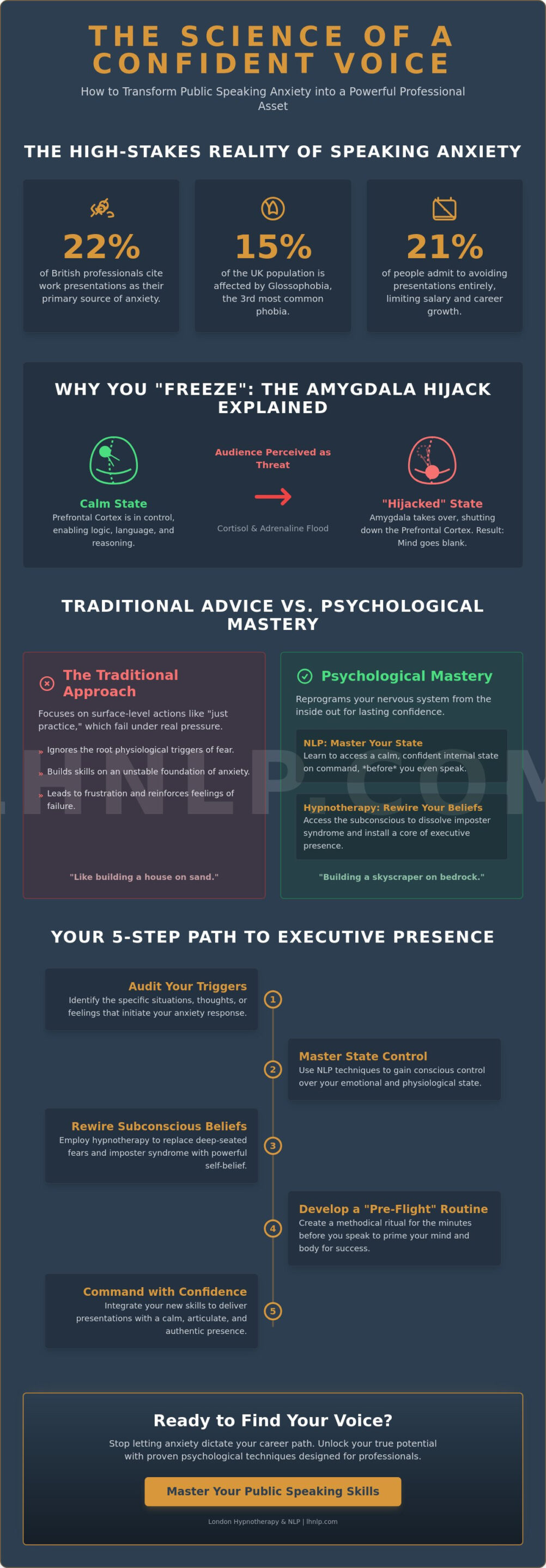
A Practical 5-Step Framework to Improve Your Public Speaking Skills
While mastering your internal state is the foundation of confidence, applying that calm through a structured framework is what creates true executive presence. In the fast paced environments of the City and Canary Wharf, your audience expects efficiency, clarity, and authority. To effectively improve my public speaking skills, you must bridge the gap between psychological readiness and physical delivery. This five step process provides a methodical way to ensure your message isn’t just heard, but remembered.
- Step 1: Audit your triggers. Before you can change your response, you must map your internal landscape. Do you notice your throat tightening during the introduction, or do your palms sweat when you see a specific senior stakeholder? Identifying these physical cues allows you to apply state control techniques exactly when they’re needed most.
- Step 2: Master the “Pre-Flight” routine. This is the critical window before you speak.
- Step 3: Structure for the London attention span. Corporate audiences in 2026 have little patience for long preambles. Start with your most impactful insight to hook their interest immediately.
- Step 4: Use Vocal Variety. Your voice is an instrument that signals your level of authority.
- Step 5: Conduct a post-performance review. Instead of spiraling into self-criticism, look for “micro-wins.” Did your anchor hold? Did you maintain eye contact during the Q&A? Building on these successes creates a positive feedback loop for your subconscious mind.
Step 2: The First 60 Seconds
The first minute of your presentation often determines how the rest of the session will unfold. Before you even walk to the front of the room, you should fire your neurological anchor to flood your system with a resourceful state. Use power posing in private to shift your hormonal balance, reducing cortisol and increasing testosterone. When you begin, don’t waste time with “Thank you for having me.” Start with a provocative question or a startling statistic. Maintain a soft focus eye contact, scanning the room to include everyone without fixating on any one individual, which helps you feel connected rather than intimidated. This is a primary way to improve my public speaking skills in high stakes environments.
Step 4: Commanding the Room with Your Voice
Authority in the boardroom isn’t about volume; it’s about resonance and rhythm. Deep, diaphragmatic breathing supports your vocal cords, giving your voice a richer, more grounded tone. A common trap for London executives is “uptalk,” where sentences end on a rising inflection, making statements sound like questions. This subtle habit undermines your expertise. Instead, practice ending your points with a slight downward inflection to signal certainty. Use the power of the pause. Silence creates gravitas and gives your audience time to digest your most important points. It shows you’re comfortable with the space you’re taking up.
If you’re ready to move beyond generic tips and want a tailored approach to your professional development, consider booking a session for Public Speaking Coaching to accelerate your progress.
Elevating Your Executive Presence with LHNLP in London
Standard public speaking classes often focus on the mechanics of delivery. They teach you where to stand and how to move your hands. While these are helpful habits, they rarely touch the underlying anxiety that keeps you from being your best self in a high-stakes environment. At LHNLP, Kamal’s approach focuses on the psychological foundation of your performance. If you’ve spent years trying to improve my public speaking skills through generic group workshops, you’ve likely found that they lack the depth required for a lasting internal shift. Our work is about more than just a speech; it’s about building a presence that commands respect before you even say a word.
We offer 1-to-1 coaching sessions in the heart of London, with locations in Harley Street and Ealing. These private settings allow us to delve into your specific triggers and unconscious patterns without the distraction of a group setting. For the busy global professional, our virtual hypnotherapy sessions provide the same level of deep work from the convenience of your office or home. One of our recent clients, a senior executive in the City, came to us in early 2026 with a paralyzing fear of boardroom presentations. Through a series of targeted sessions, he moved from avoiding visibility to delivering a keynote address at a major industry conference just four months later. His journey wasn’t about learning a new script, but about reclaiming his own internal power.
Personalised Coaching for Lasting Change
High-achievers often find that one-size-fits-all workshops feel superficial. They don’t address the unique pressures of leadership or the specific nuances of your professional role. In your first Public Speaking Coaching session, we’ll map your current state and identify the anchors that keep you stuck in a cycle of stress. We’ll then begin the process of installing new, resourceful states that you can access on demand. You can easily book a consultation through our website to start this transformative process in person or via Zoom. This bespoke attention ensures that every technique we use is calibrated to your specific career goals.
Your Journey to Unshakeable Confidence
Mastering your mind is a lifelong investment that pays dividends far beyond the boardroom. When you lose the fear of being seen, you gain the freedom to lead with authenticity. This isn’t just about professional survival; it’s about the deep satisfaction of knowing you can handle any situation with grace and clarity. If you’re curious about the mechanics behind this change, I encourage you to read Hypnotherapy London: The Definitive Guide for a deeper exploration of our methodology. Your voice is your most valuable asset. It’s time you felt confident enough to use it. Take that first step toward visibility today, and let’s unlock the executive presence you’ve always known was there.
Step Into Your New Professional Reality
The transition from boardroom panic to executive presence is a journey of internal realignment. By moving beyond surface level tips and mastering your neurological state, you transform the way you interact with every audience. We’ve explored how state control, the 5-step framework, and subconscious reprogramming work together to ensure you never have to “fake” confidence again. When you choose to improve my public speaking skills through this integrated approach, you aren’t just giving a speech; you’re projecting the true depth of your expertise.
With over 20 years of experience, practitioner Kamalyn Kaur provides a tailored blend of NLP and Hypnotherapy designed for the unique pressures of the City. Whether you visit us in Harley Street or our City locations, the focus remains on your individual breakthrough. Ready to command the room? Book your public speaking coaching session in London today. Your voice has the power to shape your career, and it’s time you felt the quiet confidence to let it be heard. The stage is ready when you are.
Frequently Asked Questions
How long does it take to see improvement in my public speaking skills?
You can often experience a significant shift in your internal state after just one session, though lasting neurological change typically requires three to five sessions. While traditional courses might take months of repetition, NLP and hypnotherapy target the subconscious patterns directly. This accelerated approach allows you to step into your next boardroom meeting with a fundamentally different physical response; you move from managing panic to projecting poise.
Can hypnotherapy really cure a lifelong fear of public speaking?
Hypnotherapy is exceptionally effective for lifelong fears because it bypasses the critical conscious mind to resolve the original sensitizing event. Most fears are learned responses stored in the subconscious; therefore, they can be unlearned through methodical reprogramming. By updating these outdated survival mechanisms, you can move from a state of paralysis to one of calm authority, regardless of how long you’ve carried the fear.
What is the best way to handle a mind-blank during a presentation?
The best way to handle a mind-blank is to fire your neurological anchor and take a deliberate three-second pause. This silence projects confidence to the audience while allowing your prefrontal cortex to come back online. If you want to improve my public speaking skills, learning to embrace these pauses is more effective than rushing to fill the silence with filler words. It shows the room that you are in total control of the space.
Is public speaking coaching in London worth the investment for my career?
Investing in your presence is essential in London, where research shows that 22% of professionals report that presentation anxiety hinders their career growth. High-level communication is often the deciding factor for promotions in the City or Canary Wharf. By mastering these skills, you ensure that your technical expertise is matched by your ability to influence and lead; this directly impacts your long-term salary potential.
How do I stop my voice from shaking when I am nervous?
A shaking voice is usually the result of shallow breathing caused by an adrenaline spike. To steady your tone, you must engage your diaphragm and focus on lengthening your out-breath. When you control your physiology through state control techniques, the physical symptoms of anxiety naturally dissipate. This leaves your voice sounding resonant and grounded, which is a key marker of executive presence in any high-stakes environment.
Can I improve my speaking skills through virtual or online sessions?
Virtual sessions are highly effective because NLP and hypnotherapy rely on linguistic patterns and internal focus rather than physical proximity. Many global professionals choose online consultations to fit into their demanding schedules. These sessions allow you to improve my public speaking skills from the comfort of your own environment while still achieving the deep, subconscious shifts necessary for lasting confidence.
What is the difference between a public speaking coach and a hypnotherapist?
A traditional public speaking coach focuses on external behaviors like body language and slide design. A hypnotherapist works with the internal processes that cause the fear in the first place. At LHNLP, we combine both worlds to ensure your internal state is as polished as your external delivery. This holistic approach creates a truly authentic presence that doesn’t feel like a performance.
How do I deal with “difficult” audiences or aggressive Q&A sessions in the City?
Dealing with aggressive Q&A sessions requires you to maintain a “resourceful state” through the NLP technique of reframing. Instead of seeing a challenger as an opponent, view their question as an opportunity to demonstrate your depth of knowledge. By staying grounded in your anchor, you can respond with logic and poise rather than reacting with defensiveness. This shift in perception changes the power dynamic in the room instantly.