

Imagine standing on a crowded Waterloo platform at 5:30 PM, where the collective hum of the city feels less like energy and more like a physical weight pressing against your chest. You’ve likely accepted this constant state of high alert as the inevitable tax on a successful career, even when it manifests as 3:00 AM insomnia or sudden heart palpitations before a boardroom presentation. The 2023 Health and Safety Executive report highlights that 875,000 UK workers currently struggle with work-related stress. This is why professional hypnotherapy for anxiety has become a vital tool for those seeking to reclaim their mental space from the relentless pace of the capital.
Retraining your nervous system is a methodical process rather than a fleeting wish. By combining clinical hypnotherapy with NLP, you can learn to reshape your subconscious response to these specific urban triggers. This guide reveals how techniques like state control and anchoring provide a practical path to lasting calm amidst the chaos. We’ll explore a specific toolkit designed to help you regain emotional focus, improve your sleep quality, and transform your relationship with the pressures of London life.
Key Takeaways
- Understand how the “London Effect” triggers a constant fight-or-flight response and why your anxiety is actually a protective subconscious programme that can be updated.
- Discover how clinical hypnotherapy for anxiety leverages neuroplasticity to rewire your brain’s response to stress, bypassing the critical faculty of the conscious mind.
- Learn how the LHNLP approach integrates Neuro-Linguistic Programming to help you move from questioning “why” you feel anxious to mastering “how” to change your internal state.
- Evaluate the practical differences between hypnotherapy and traditional counselling to identify which therapeutic depth and duration best suit your path to lasting calm.
- Gain clarity on what to expect during your initial consultation and choose the ideal setting for your transformation, from prestigious Harley Street to accessible Ealing or online.
Understanding Anxiety Within the High-Pressure London Environment
Anxiety isn’t a personality flaw or a sign of weakness; it’s a sophisticated, albeit often misplaced, protective programme running within your subconscious mind. This internal system was designed to keep you safe from physical danger, yet in the modern world, it often misidentifies psychological pressures as life-threatening events. In a city like London, where 61% of workers reported feeling burnt out in a 2023 mental health survey, this programme is frequently stuck in the “on” position. The “London Effect” describes the biological reality of navigating 4.8 million daily journeys on the Underground, enduring the 85-decibel roar of the Central Line, and competing in one of the world’s most aggressive professional landscapes. Your brain often struggles to distinguish between a predatory threat and a delayed train or a sharp email from a senior partner.
It’s vital to differentiate between Generalised Anxiety Disorder (GAD) and situational city stress. While situational stress might peak before a high-stakes meeting at The Shard, GAD feels like a low-frequency hum that never quite fades, regardless of your schedule. You’ve likely found that traditional willpower fails to silence this hum. This happens because your prefrontal cortex, the logical part of your brain, cannot simply “talk down” the amygdala once the fight-or-flight response has been triggered. This is why hypnotherapy for anxiety is so effective; it bypasses the critical faculty to communicate directly with the deeper subconscious drivers that logic cannot reach.
Common Anxiety Triggers for London Professionals
- Public speaking anxiety: Standing before a boardroom in Canary Wharf can trigger a primal fear of social exclusion and professional judgment.
- Social anxiety: The pressure to be “always on” during networking events in Mayfair or crowded urban socialising leads to profound emotional exhaustion.
- Health anxiety: In a 24/7 culture, any dip in productivity is often misinterpreted as a medical crisis, exacerbated by constant self-monitoring and the fast-paced city lifestyle.
The Physical Toll of Living in a Constant State of Alert
Your nervous system doesn’t know it’s the 21st century. It reacts to a missed deadline with the same surge of cortisol it would use to escape a physical predator. Research indicates that persistent urban stress contributes to a 21% increase in anxiety disorders compared to rural settings. You might recognise the signs in your own body: persistent insomnia, digestive issues, or the heavy fog of what we call “London burnout.” Anxiety is a physiological response to perceived psychological threats. When you understand that your body is simply trying to protect you, you can begin to use hypnotherapy for anxiety to retrain that response and reclaim your inner calm.
How Hypnotherapy for Anxiety Rewires Your Subconscious Mind
The human brain possesses an extraordinary capacity for change, a phenomenon known as neuroplasticity. This means your neural pathways aren’t set in stone; they’re more like forest trails that can be rerouted with the right guidance at any age. While traditional talk therapies often focus on the conscious, logical mind, hypnotherapy for anxiety targets the subconscious where 95% of our cognitive processing occurs. By bypassing the “critical faculty” – that internal gatekeeper that maintains your current habits – we can introduce new, calmer responses directly to your emotional core.
Traditional “top-down” approaches like CBT require months of conscious effort to override deep-seated fears. Hypnotherapy works “bottom-up,” addressing the nervous system’s survival response before the logical mind even has a chance to intervene. This shift is why many clients report visible changes in their stress levels after just 3 to 6 sessions, rather than years of analysis. It’s about changing the software of the mind, not just discussing the bugs.
The Hypnotic State: Dispelling the Myths of Control
Living in a fast-paced city like London, you’re likely used to being in the driver’s seat. It’s a common misconception that hypnosis involves a loss of agency or falling into a deep sleep. In reality, it’s a state of heightened, focused attention. You’re fully aware of your surroundings and in complete control of your choices throughout the session. As your therapist, I act as a skilled navigator. I don’t “take over” your mind; I simply facilitate the conditions where your own inner resources can finally become accessible. You might explore our range of treatments to see how this collaborative process unfolds in practice.
The Mechanism of Rapid Emotional Release
Anxiety often stems from an Initial Sensitising Event (ISE), a specific moment where your subconscious learned that a certain situation was “dangerous.” We use hypnotic metaphors and regression techniques to identify these root causes, neutralising the emotional charge without the need for reliving the trauma. By communicating through symbols and stories, we speak the primary language of the emotional brain. Clinical hypnosis is a recognised therapeutic tool for anxiety management, frequently cited by professional bodies as a valid intervention for psychological distress. This method allows for a swifter, more elegant release of old patterns, paving the way for a more grounded version of yourself.
The LHNLP Approach: Combining Hypnosis with NLP Techniques
Traditional talk therapy often spends months dissecting the historical “why” behind your panic. While understanding your past has value, Kamalyn Kaur integrates Neuro-Linguistic Programming (NLP) with clinical hypnotherapy for anxiety to focus on the “how” of your recovery. This transition from analysis to action is vital for Londoners who need practical results that work in real-time. By combining these modalities, we don’t just explore the root of the problem; we re-code the neural pathways that sustain it.
Anxiety in the city often manifests as a cycle of catastrophic thinking. You might find yourself imagining the worst-case scenario before a presentation or feeling a rising sense of dread during your commute. Kamalyn uses NLP to help you reframe this internal dialogue. Instead of being a passive observer of your intrusive thoughts, you learn to become the director of your mental cinema. We work on creating “anchors,” which are physical or mental triggers that immediately elicit a state of calm. Imagine pressing your thumb and forefinger together on a crowded Jubilee Line train and feeling a wave of composure wash over you. This isn’t magic; it’s a conditioned neurological response designed to interrupt the fight-or-flight mechanism.
Strategic NLP Tools for Immediate Anxiety Relief
Our sessions incorporate specific techniques that provide immediate shifts in your emotional state. The “Swish Pattern” is particularly effective; it involves identifying the grainy, dark image of an anxious future and “swishing” it away to be replaced by a vibrant, empowered version of yourself. This helps the brain bypass old habits. Through State Management, you gain the ability to choose your emotional response in high-pressure environments. You can discover our full range of treatments to see how these tools are applied across different challenges.
Personalised Therapy Plans for Londoners
A “one size fits all” approach fails because your experience of stress is unique to your lifestyle and biology. Research suggests that 85% of clients see faster results when cognitive tools are combined with subconscious work. We move away from generic scripts to create a solution-focused mindset in every session. This ensures that hypnotherapy for anxiety is tailored to your specific triggers, whether they are social, professional, or existential. You can learn more on our About Us page regarding Kamalyn’s extensive expertise in bridging the gap between clinical theory and lived experience. We prioritise your internal resources, ensuring you leave each session with a tangible sense of progress.
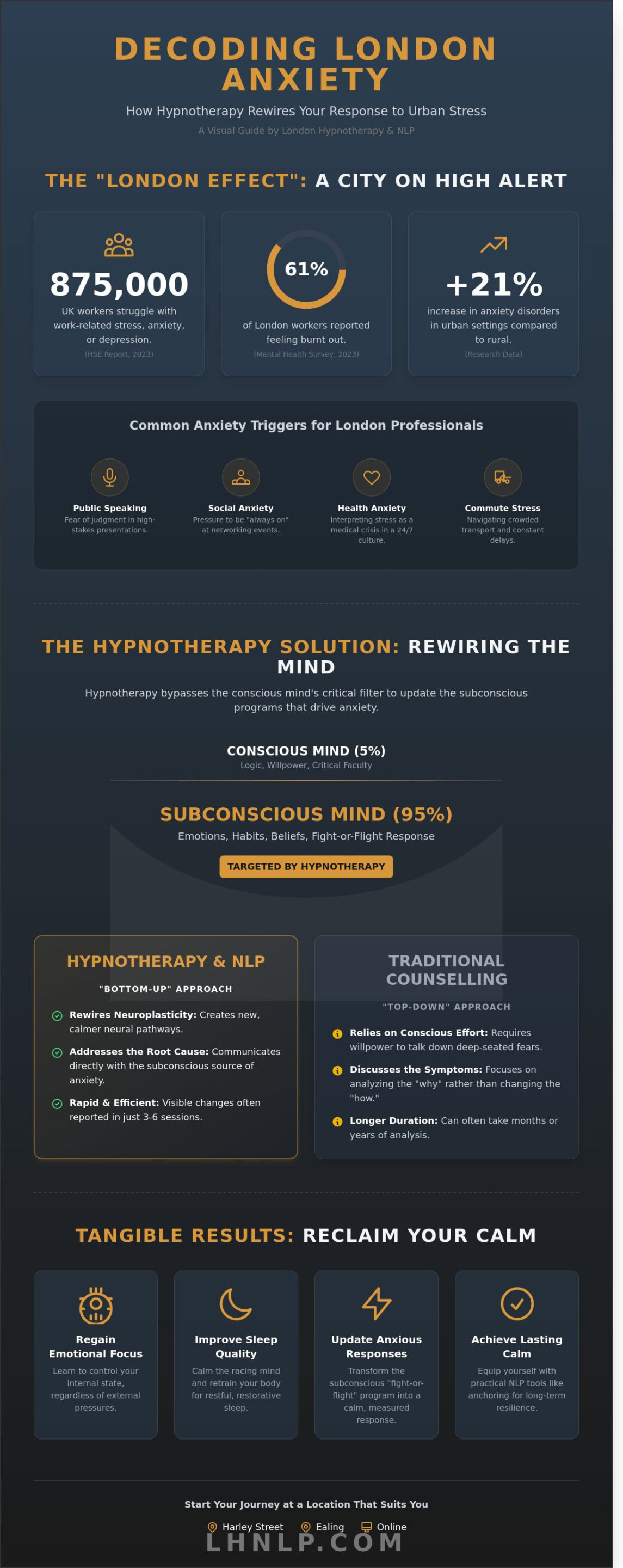
Hypnotherapy vs. Counselling: Which Is Right for Your Anxiety?
Deciding between traditional talk therapy and clinical hypnosis is a pivotal step in your healing journey. Counselling often operates through the lens of history. It provides a safe space to vent and understand the conscious “why” behind your feelings. You might spend months tracing the threads of your childhood to see how they weave into your current patterns. It’s a valuable, reflective process, yet it often stays within the boundaries of the analytical mind. You understand the problem, but the physical sensation of dread remains.
Hypnotherapy for anxiety functions with a different set of mechanics. It’s a goal-oriented modality that pivots from the past toward your desired future. Instead of just talking about the fear, we retrain the brain’s response to it. We work directly with the subconscious habits that trigger your racing heart or intrusive thoughts. While counselling builds awareness, hypnotherapy builds new internal pathways. Many clients find that combining these approaches offers the most holistic path to wellness; use counselling to gain clarity, and use hypnosis to install the actual change. For those exploring different therapeutic options, our comprehensive guide on counselling for anxiety in London compares traditional and solution-focused approaches to help you make an informed decision.
Why Londoners Often Choose Hypnotherapy for Faster Results
Time is the most precious currency for professionals in Harley Street or the City. When anxiety disrupts a high-stakes career, waiting years for incremental progress isn’t a viable strategy. Efficiency is why many choose this path. A landmark study published in American Health Magazine indicated a 93% recovery rate after just 6 sessions of hypnotherapy, compared to a 38% recovery rate after 600 sessions of traditional psychoanalysis. In the fast-paced London environment, the ability to achieve noticeable shifts in 4 to 8 weeks rather than years is transformative. It’s about direct intervention at the root cause rather than perpetual symptom management.
Safety and Suitability for Anxiety Treatment
Your safety is the absolute priority in any therapeutic intervention. While hypnosis is a natural and relaxing state, it isn’t suitable for everyone. Individuals experiencing active psychosis or specific personality disorders should generally avoid deep trance work. We always recommend that you choose a practitioner registered with accredited UK bodies like the National Council for Hypnotherapy (NCH). If you have specific concerns about the process or how it feels, you can find detailed answers in our FAQs regarding what to expect during a session. We ensure every client is screened to guarantee the approach is both safe and effective for their unique neurological profile.
Starting Your Journey to Calm: Harley Street, Ealing, or Online
Your path to recovery shouldn’t be a source of further stress. Choosing where to begin your hypnotherapy for anxiety is a personal decision that should align with your lifestyle and comfort levels. We offer three distinct pathways to suit your needs. Our Harley Street practice represents the pinnacle of clinical prestige, situated in a world-renowned medical district that has set the standard for excellence since the 19th century. For those seeking a more suburban, grounded atmosphere, our Ealing location provides a quiet sanctuary away from the central bustle.
Do you travel frequently or live outside the capital? Our online hypnotherapy services bridge the gap, delivering the same clinical efficacy as our physical offices. A 2013 study from the University of Zurich confirmed that psychotherapy delivered via the internet is just as effective as face-to-face treatment, with 57% of online patients no longer showing signs of depression compared to 42% in conventional settings. Whether you sit in our Ealing chair or your own living room, the transformation remains equally profound.
The Structure of a Professional Hypnotherapy Session
Every session at London Hypnotherapy & NLP follows a rhythmic, purposeful structure designed to respect your time and your mind’s natural learning patterns. We begin with the “Pre-talk,” where we dissect your specific triggers. Is it the claustrophobia of the Central Line at rush hour, or perhaps the mounting pressure of a boardroom presentation? By identifying these anchors, we can reframe them.
Next comes the Induction. This isn’t a loss of control; it’s a guided transition into a state of focused internal awareness. In this quiet space, your subconscious becomes receptive to post-hypnotic suggestions. These are the “mental seeds” we plant to ensure your new-found calm persists long after you’ve left the clinic. You don’t just learn about relaxation; you experience it at a cellular level.
Book Your Consultation Today
The transition from a life governed by fear to one of empowered calm starts with a single, decisive action. We provide face-to-face sessions at Harley Street and Tokenhouse Yard, ensuring you have access to a professional sanctuary regardless of where you are in the city. If you’re ready to explore how hypnotherapy for anxiety can rewire your response to stress, the next step is simple.
- Identify your preferred location: Harley Street, Ealing, or Online.
- Consider your availability for a 60-minute initial consultation.
- Use our direct Contact information to schedule your session.
Don’t let another month pass under the shadow of “what if.” Reach out today and begin the process of reclaiming your peace of mind.
Reclaiming Your Inner Quiet in the Heart of London
Living in London often feels like navigating a relentless tide that keeps your nervous system on high alert. You’ve explored how the LHNLP method moves beyond the limitations of traditional talk therapy by integrating clinical hypnosis with Neuro-Linguistic Programming. With over 15 years of clinical experience, I’ve guided many individuals as they shift from constant hyper-vigilance to a state of regulated, lasting calm. This process isn’t about temporary relief; it’s about a fundamental structural change in how you process the world around you.
Real change happens when your subconscious mind is invited into the therapeutic process. By choosing hypnotherapy for anxiety, you aren’t just managing surface-level symptoms; you’re actively rewiring the deep-seated patterns that no longer serve your growth. Whether we meet at my accredited Harley Street practice, the Ealing clinic, or through a secure online session, the focus remains on your unique internal world. This dual-modality approach ensures that the shifts you experience are both profound and sustainable. Your path to a quieter mind is a methodical journey that we can begin whenever you feel ready to step forward.
Book your anxiety consultation at our Harley Street or Ealing clinic today
You don’t have to carry the weight of the city’s pressure on your own. The resources for your peace are already within you, waiting to be rediscovered.
Frequently Asked Questions
Is hypnotherapy for anxiety effective and scientifically proven?
Clinical research confirms that hypnotherapy is a highly effective intervention for emotional distress. A 2019 meta-analysis published in the International Journal of Clinical and Experimental Hypnosis found that 75% of participants receiving hypnosis reported fewer symptoms than those who didn’t. This isn’t just about simple relaxation. It’s a structured method to rewire the unconscious processes that trigger your fight-or-flight response. By using hypnotherapy for anxiety, you can access the deeper layers of your mind where these patterns are stored.
How many sessions of hypnotherapy will I need for my anxiety?
Most clients see significant shifts within 4 to 6 sessions. While every individual’s journey is unique, the British Society of Clinical Hypnosis notes that short-term therapy is the standard for specific anxiety triggers. We focus on rapid state control and anchoring techniques to ensure you feel a difference from your very first hour. Is it possible to change a lifelong habit in just a few weeks? It’s entirely possible when we work directly with the subconscious to update your internal responses.
Can hypnotherapy make my anxiety worse or cause new problems?
Professional hypnotherapy is a safe, non-invasive process that doesn’t create new psychological issues. You’re always in a state of heightened awareness, not a vulnerable stupor. A 2023 safety review of psychological therapies in the UK confirmed that adverse effects are extremely rare when practitioners follow CNHC guidelines. We ensure every session is grounded in safety and ecological checks. This ensures your progress remains stable and supportive of your overall well-being as you move toward a calmer state.
Will I lose control or say something I don’t want to under hypnosis?
You stay fully in control of your speech and actions throughout the entire process. Hypnosis isn’t a truth serum; it’s a state of focused internal attention where you’re actually more aware of your inner boundaries. You can’t be forced to reveal secrets or act against your moral code. Think of it as a guided meditation where you’re the one holding the map. You can open your eyes or stop the session at any moment you choose.
What is the difference between hypnosis and NLP for treating anxiety?
Hypnosis focuses on entering a deep trance state to suggest changes to the subconscious, while NLP (Neuro-Linguistic Programming) provides specific “how-to” tools to change how you process thoughts. Combining them allows us to not just relax the mind, but to actively recode the mental triggers that cause panic. It’s the difference between calming a storm and learning how to steer the ship. Both are essential for lasting emotional freedom and developing a sense of internal mastery.
Is hypnotherapy for anxiety available on the NHS in London?
Accessing hypnotherapy on the NHS is quite difficult and depends on your local GP’s funding in specific London boroughs. Most patients find that private sessions, which typically cost between £80 and £150 in Central London, provide more immediate relief without the 18-week waiting lists. You should check the National Institute for Health and Care Excellence (NICE) guidelines, as they currently prioritise CBT. Private practice allows for a more tailored, empathetic approach that fits your specific schedule and needs.
For these private clinics to connect with people who need them, being visible in online searches is essential. This is a specialised field in itself, handled by digital marketing experts such as SEO PageOne Ltd.
Can I do hypnotherapy for anxiety online via Zoom or Skype?
Online sessions via Zoom or Skype are just as effective as face-to-face consultations in a physical office. A 2020 study by the University of Manchester showed that tele-therapy outcomes for anxiety matched in-person results across 92% of cases. You only need a stable internet connection and a quiet space where you won’t be disturbed. Many clients prefer the comfort of their own home, as it helps them enter a receptive state more naturally. It’s a convenient way to access expert hypnotherapy for anxiety from anywhere.
What happens if I cannot be hypnotised?
Research suggests that 95% of the population can enter at least a light trance, which is all that’s required for meaningful change. Hypnosis is a natural human capacity, similar to getting lost in a good book or daydreaming while on the Underground. If you’re open to the process and can follow simple instructions, you can experience the benefits. We simply adapt the technique to match your unique way of processing information. Your willingness to change is far more important than your “hypnotisability” score.