

What if the reason you struggle to find the right words isn’t a lack of vocabulary, but a silent dialogue happening within your own mind before you even open your mouth? You’ve likely experienced that sudden, disorienting brain fog during a high-stakes meeting, or perhaps you’ve left a networking event in London feeling like your true professional value was somehow lost in translation. It’s frustrating to feel misunderstood when you know your ideas have merit, yet the bridge between your thoughts and your audience feels fragile. If you are currently questioning how to improve my communication skills for a more impactful 2026, the answer lies not in what you say, but in how you perceive the interaction itself. True change starts within.
This article explores a shift from surface-level tactics to a deep, psychological transformation through the lens of Neuro-Linguistic Programming. We’ll examine how addressing the roots of your internal blocks can lead to effortless rapport, public speaking confidence, and clearer professional boundaries. While traditional advice focuses on the mechanics of speech, we’ll focus on the mindset shifts that allow you to navigate difficult conversations with a sense of calm, intellectual elegance. Are you ready to stop overthinking and start connecting from a place of inner alignment?
Key Takeaways
- Understand why traditional communication tips often fail and how your internal psychological state dictates your external clarity.
- Learn how to improve my communication skills by using NLP as a user manual for your brain to manage high-stakes interactions.
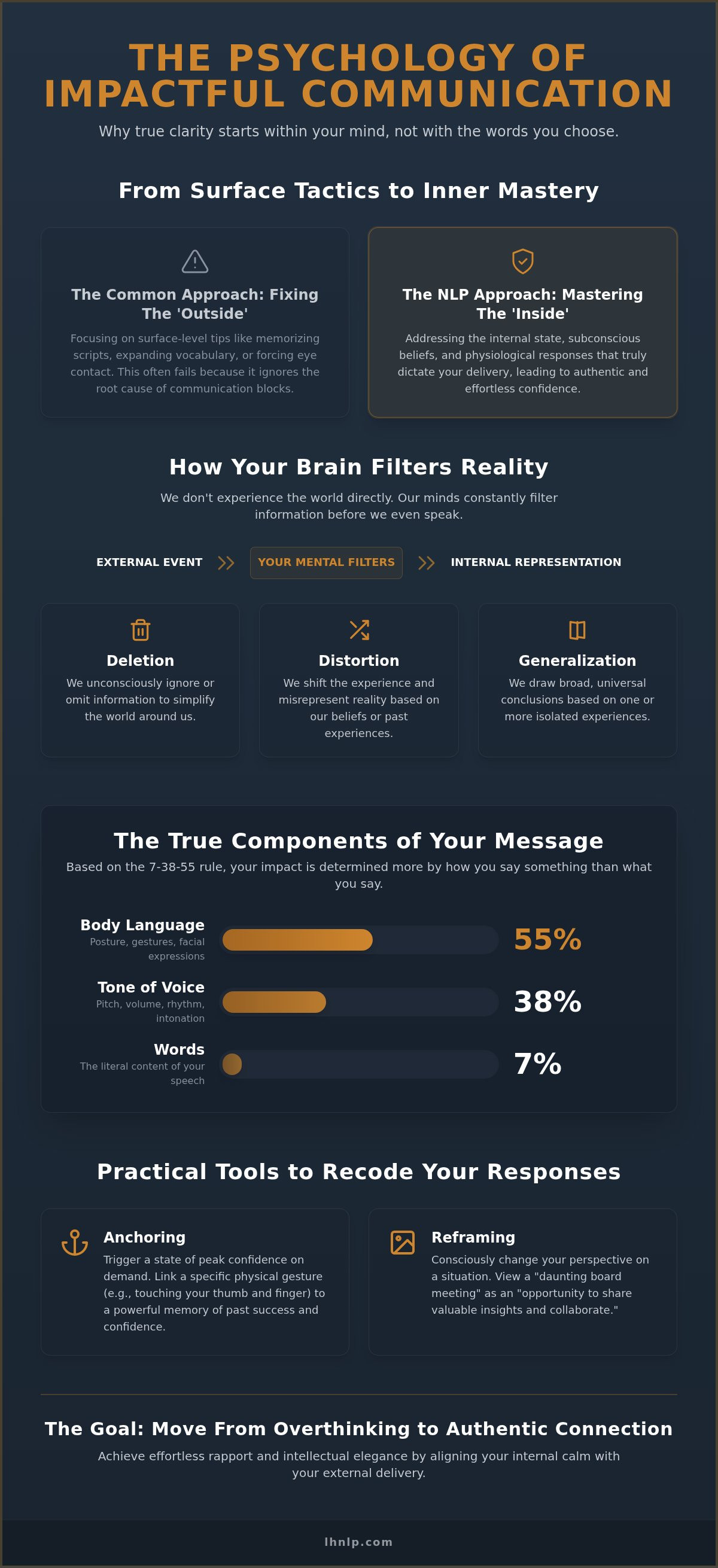
- Master the 7-38-55 rule to ensure your body language and tone are congruent with the words you choose to speak.
- Gain practical tools for navigating the unique social and professional pressures of London, from Harley Street to the City.
- Discover how professional NLP coaching and hypnotherapy can re-code subconscious responses to speaking, moving beyond the limits of simple willpower.
The Psychology of Effective Communication: Why ‘Tips’ Aren’t Enough
Communication is far more than a simple exchange of information; it’s a vivid reflection of our internal reality. Every sentence we utter is filtered through our current emotional state and the long-held beliefs we carry about our own worth. When we search for ways on how to improve my communication skills, we often look for external scripts, but true mastery begins with understanding the inner landscape. Our subconscious mind stores every past interaction, creating a blueprint for how we show up today.
During high-stakes conversations, your nervous system can sometimes ‘hijack’ your logical faculties. Instead of clear thinking, you might experience a surge of cortisol that leaves you feeling flustered or stuck. This physiological response prioritizes survival over sophistication, making it nearly impossible to access your best vocabulary or maintain a steady tone. Communication is the bridge between internal thought and external impact.
To better understand these psychological dynamics and how to navigate them effectively, watch this helpful video:
The Hidden Barriers to Connection
Identifying limiting beliefs is the first step toward reclaiming your voice. These are the quiet “I’m not interesting enough” or “I’ll say something stupid” thoughts that hum in the background of social interactions. These barriers aren’t just mental; they’re deeply rooted in the psychology of interpersonal communication. Past negative experiences can create real-time processing delays, where social anxiety slows down your ability to find the right words. It isn’t a lack of intelligence, but a protective mechanism of the mind that needs gentle re-coding to allow for effortless expression.
Moving Beyond Surface-Level Advice
Standard advice like “just make eye contact” often fails because it asks you to perform a behavior while your body is in a state of distress. If you’re feeling anxious, forcing eye contact can actually increase your internal tension, making you appear less authentic. There’s a profound difference between performing communication and being genuinely present. When you focus on how to improve my communication skills through mindset, you learn to manage the underlying physiological responses. For those navigating the high-pressure environments of the capital, exploring Stress Management in London can provide the calm foundation needed to stop performing and start connecting. Real impact comes from congruence, where your internal calm matches your external delivery.
Master Your Internal State: The NLP Perspective on Communication
Neuro-Linguistic Programming, or NLP, acts as a sophisticated user manual for the human brain. While many seek advice on how to improve my communication skills by memorizing scripts, NLP looks at the neurological patterns that dictate our speech. At its core, the NLP Communication Model explains that we don’t experience the world exactly as it is. Instead, our minds delete, distort, and generalize information based on our past experiences and beliefs. This filtering process determines whether we feel confident or constricted when we speak.
To truly improve your communication skills, you must learn to manage these internal filters. Techniques like ‘anchoring’ allow you to trigger a state of peak confidence on demand, perhaps by linking a specific physical gesture to a memory of intense success. Similarly, ‘reframing’ helps you view a daunting board meeting not as a threat, but as an opportunity to share valuable insights. These aren’t just mental tricks; they are ways to consciously direct your brain’s processing power before you even enter the room.
The Power of Self-Talk
Your internal dialogue is the architect of your external tone. If you’re constantly thinking, “I shouldn’t say this,” your voice will likely lack resonance and authority. By shifting that inner narrative to “My perspective adds value,” you create a neurological alignment that naturally enhances your vocal projection. It’s about moving from a state of self-censorship to one of authentic contribution. When your internal thoughts are supportive, your external delivery becomes naturally more persuasive and calm.
Building Instant Rapport
Rapport is the invisible thread that connects two people, and it can be built methodically. NLP teaches us to create this connection through subtle mirroring and matching of body language and speech patterns. We also look at representational systems: whether your listener primarily processes the world through Visual, Auditory, or Kinaesthetic channels. When you adapt your language to match their “world,” you create an environment where they feel deeply understood. If you’re interested in mastering these nuances, exploring professional NLP Coaching can help you integrate these tools into your daily professional life with ease and elegance.
Non-Verbal Mastery and the Art of Empathetic Presence
Words are the smallest part of the puzzle. According to the 7-38-55 rule, your actual vocabulary accounts for just 7% of the impact you make during an interaction. The remaining 93% is divided between your vocal tonality and your physical presence. When you are exploring how to improve my communication skills, you must achieve congruence. This is the state where your external signals match your internal intent. If you speak about confidence while your shoulders are hunched, your listener will subconsciously trust your body language over your words every time.
Mastery also requires sensory acuity. This is the refined ability to observe subtle shifts in your conversation partner, such as a change in skin colour, breathing rate, or micro-expressions. By noticing these cues, you can pivot your approach in real-time, ensuring your message is truly being received rather than just heard. It allows you to move beyond a monologue and into a dance of mutual understanding.
The Silent Language of Confidence
Our physiology and psychology are a closed loop. Adopting an expansive posture doesn’t just look confident; it actually shifts your internal chemistry by lowering cortisol and increasing testosterone. In high-pressure London boardrooms, your tonality often speaks louder than your data. Using downward inflections at the end of your sentences conveys authority and certainty. Conversely, ‘uptalk’ or rising inflections can make your statements sound like questions, which can subtly erode the trust of your audience. Managing your micro-expressions during conflict is equally vital; a slight jaw clench or a narrowed gaze can escalate a situation before a single word is spoken.
Listening as a Strategic Tool
Most of us don’t listen; we simply wait for our turn to speak. This ‘wait-to-speak’ habit prevents genuine connection and leads to the very misunderstandings we fear. Transitioning to active listening involves three distinct levels: moving from your own internal thoughts to a focused attention on the speaker, and finally to ‘global’ listening where you sense the entire atmosphere of the interaction. Harvard’s guide to improving communication emphasizes that validating another person’s perspective doesn’t require agreement, but it does require presence. Silence is not a void to be filled, but a deliberate tool that allows for reflection and signals that you are comfortable with the weight of the conversation. When you stop rushing to fill the gaps, you often find that the most important information surfaces in the quiet moments.
Practical Frameworks for High-Stakes London Environments
London’s professional landscape, from the fast-paced City to the refined consultations of Harley Street, demands a level of communication that is both precise and resilient. When you’re considering how to improve my communication skills within these high-stakes environments, you need frameworks that work as well in a boardroom as they do in a networking lounge. Success here isn’t just about what you say; it’s about your ability to adapt to the room’s energy while maintaining your own. The Prep-State-Perform method ensures your technical preparation is matched by a peak internal state before you ever step onto the stage.
To prepare for a high-pressure meeting, begin by defining your ‘Well-Formed Outcome’. What specifically do you want to achieve, and how will you know when you’ve reached it? Next, use the ‘Perceptual Positions’ technique to mentally rehearse the interaction. View the meeting from your own eyes, then from the perspective of your counterpart, and finally as a detached observer. This triple perspective dissolves personal bias and reveals hidden objections before they even surface. It allows you to enter the room with a 360-degree understanding of the social dynamics at play.
Navigating Professional Networking
Networking in London can often feel transactional, but an NLP-inspired elevator pitch shifts the focus from what you do to the value you provide. Instead of leaden job titles, frame your introduction around the specific problems you solve for others. This value-based framing invites curiosity rather than polite dismissal. When it’s time to move on, exit conversations gracefully by validating the connection and setting a clear follow-up action. This leaves a memorable, professional impression without the awkwardness of a forced departure. If social anxiety still feels like a barrier to these connections, our Confidence Building Sessions are designed to help you own any room with quiet authority.
Mastering Difficult Conversations
Difficult personalities often trigger our defensive ‘fight or flight’ responses, clouding our ability to respond with logic. While many executive guides suggest radical candor, it can backfire if the delivery lacks empathy. Instead, try using ‘Clean Language’. These are neutral, metaphor-free questions that uncover the root of a conflict without adding your own emotional baggage to the mix. By staying centered and refusing to match an aggressor’s heightened tone, you maintain control of the narrative. This approach doesn’t just resolve the immediate issue; it builds a foundation of mutual respect that lasts long after the meeting ends. If you’re ready to transform your professional interactions, you can contact Kamalyn Kaur to begin your journey toward communication mastery.
Transforming Your Communication with Professional NLP Coaching
Intellectual knowledge is a powerful starting point, but why do we so often falter in the very moments we need our skills the most? You might have spent hours researching how to improve my communication skills, yet find that your throat still tightens during a crucial presentation. This disconnect exists because willpower is a function of the conscious mind, while our physiological reactions to stress are governed by the subconscious. To create lasting change, we must move beyond simple effort and address the neurological patterns that trigger these automatic responses.
Professional NLP coaching, led by Kamalyn Kaur, offers a methodical path to bridge this gap. With over 20 years of experience, Kamalyn acts as a seasoned guide, helping you navigate the complexities of your own mind. Whether you choose face-to-face sessions at our clinic locations in Harley Street and Ealing or prefer the flexibility of global Zoom consultations, the focus remains on personal empowerment. This isn’t just about learning a new set of rules; it’s about a fundamental shift in how you relate to yourself and others. It’s a process of aligning your internal dialogue with your external goals.
The Role of Hypnotherapy in Communication
Hypnotherapy serves as a precision tool for re-coding the subconscious responses that lead to communication blocks. Often, the fear of being seen or heard is rooted in a ‘root cause’ from the past that the conscious mind has long since forgotten. By accessing these deeper layers, we can resolve the underlying anxiety at its source. This approach is particularly effective for those seeking Phobia Treatment in London for public speaking or social interactions. Through ‘future-pacing’, we build a mental blueprint of success, allowing your mind to rehearse a state of calm confidence until it becomes your new natural baseline.
Your Path Forward at LHNLP
What sets professional coaching apart from general advice is the degree of personalization. In a 1-to-1 session, we don’t just talk about communication; we actively rewire the habits that hold you back. You aren’t just receiving a lecture; you’re engaging in a transformative process designed for your specific professional and personal context. This journey of self-mastery allows you to stop fighting against your own instincts and start using your internal resources to communicate with effortless elegance. If you feel ready to move beyond temporary fixes and experience a deeper level of change, you can visit our Contact Page to arrange a consultation. How much more could you achieve if your voice finally matched the strength of your ideas?
Embracing Your Voice with Authenticity and Authority
Mastery isn’t about memorising lines; it’s about shifting your internal state. We’ve explored how to improve my communication skills by addressing the subconscious filters that often distort our message. By integrating NLP techniques and understanding the silent language of non-verbal cues, you move from performing to genuinely connecting. True impact arises when your internal calm matches your external delivery, allowing you to navigate even the most high-stakes London environments with ease. This shift ensures your message is not only heard but felt by those around you.
Kamalyn Kaur brings over 20 years of experience to her personalized, solution-focused approach. Whether you visit our clinic locations in Harley Street, Ealing, or Tokenhouse Yard, you’ll receive support tailored to your unique professional journey. Don’t let internal blocks silence your potential any longer. The bridge between your thoughts and your audience is waiting to be built. Book a consultation with Kamalyn Kaur to transform your communication skills today and discover the power of a mindset-first approach. Your voice is your greatest asset; it’s time to use it with confidence.
Frequently Asked Questions
How long does it take to see improvement in my communication skills?
The timeline for change is unique to every individual, but many clients report a significant shift in their internal state after just one to three sessions. While initial insights happen quickly, sustainable behavioral change usually requires a series of sessions to reinforce new neurological pathways. This methodical approach ensures that your new way of speaking becomes an instinctive part of your personality rather than a temporary performance.
Can NLP really help with social anxiety in professional settings?
Neuro-Linguistic Programming is exceptionally effective for social anxiety because it addresses the internal “programming” that triggers your stress response. By identifying the specific mental images or self-talk that cause you to feel flustered, we can ‘re-code’ those patterns. This allows you to navigate professional environments in London with a sense of inner calm, enabling you to focus on your message instead of your nerves.
What is the difference between communication coaching and hypnotherapy?
Communication coaching, particularly through NLP, focuses on the technical “how-to” of the mind and strategic language patterns. Hypnotherapy works at a deeper subconscious level to resolve the emotional root causes of speaking blocks or phobias. At London Hypnotherapy & NLP, we often combine these modalities. This ensures your conscious communication strategy is fully supported by your subconscious instincts, creating a state of total congruence when you speak.
How can I stop my voice from shaking when I am nervous?
A shaking voice is a physical symptom of a nervous system that feels under threat. To stabilize your tone, you must first calm your physiology through grounding techniques and diaphragmatic breathing. In our sessions, we use NLP anchoring to link a feeling of absolute certainty to your vocal projection. This technique allows you to access a steady, authoritative tone on demand, even during high-pressure professional interactions.
Is it possible for an introvert to become a great communicator?
Introversion is often a hidden strength in communication. Introverts naturally excel at active listening and deep observation, which are vital for building rapport. When you learn how to improve my communication skills through a mindset-first approach, you don’t try to mimic an extrovert. Instead, you learn to leverage your natural reflective qualities while removing the internal blocks that prevent you from sharing your insights with confidence.
What are the first steps to take if I feel paralyzed during meetings?
If you feel paralyzed, the most immediate step is to break the internal loop of panic by shifting your focus outward. Pick a neutral object in the room or focus intently on what another person is saying to move out of your own head. Using a subtle physical anchor can also help reset your nervous system. These small “pattern interrupts” allow you to transition from a reactive state back into a resourceful one.
Can I improve my communication skills through online sessions?
Virtual consultations via Zoom or Skype are just as effective as face-to-face appointments. While many clients enjoy visiting our clinics in Harley Street or Ealing, online sessions offer the same level of personalized, solution-focused care. This flexibility allows you to engage in deep psychological work from the comfort of your own space, ensuring that your journey toward self-mastery is consistent and fits into your professional schedule.
How much does a communication coaching session in London cost?
Fees for professional coaching and therapy in London vary based on the practitioner’s experience and the specific clinic location. We provide individual session fees as well as multi-session packages designed for those seeking comprehensive behavioral change. To understand the best path for your needs and to receive details on current rates at our Harley Street or Ealing locations, we invite you to contact us for a personalized consultation.