

If you’re lying awake at 3 AM with a racing heart while the city hums outside your window, you aren’t alone; in fact, data from 2026 reveals that over half of adult Londoners have navigated similar mental health challenges this year. You likely feel as though you’re constantly on edge, carrying a physical tension that refuses to dissolve even after the laptop is closed and the lights are dimmed. It’s a heavy burden to carry when you can’t quite tell if you’re reacting to a busy week or if something more persistent has taken root in your mind. Understanding the difference between stress and anxiety is the first step toward reclaiming the quiet confidence that belongs to you. You deserve to know whether you’re facing a temporary storm or an internal echo that needs a different kind of attention.
In this guide, you’ll learn how to distinguish between external pressure and the internalised worry that lingers long after a trigger has vanished. We’ll provide you with immediate coping strategies to ease that tight chest and racing heart, while offering a clear, solution-focused path to lasting relief through subconscious rewiring. This isn’t about clinical labels; it’s about finding your way back to a state of inner calm and mental clarity.
Key Takeaways
- Learn to identify the fundamental difference between stress and anxiety by recognizing whether your discomfort stems from a tangible external trigger or a lingering internal echo.
- Discover how the relentless pulse of London life can mask chronic anxiety as professional ambition, helping you decode the physical signals of tension that affect your sleep and focus.
- Master immediate NLP techniques and the ‘Stop, Breathe, Reflect’ framework to shift your emotional state and reclaim mental clarity during high-pressure moments.
- Understand why logic alone rarely stops a worry spiral and how clinical hypnotherapy allows you to communicate directly with your subconscious to rewire your stress response.
- Transition from feeling constantly on edge to a state of methodical inner change, utilizing professional paths that lead toward a more grounded and peaceful daily experience.
Defining the Divide: What is the Difference Between Stress and Anxiety?
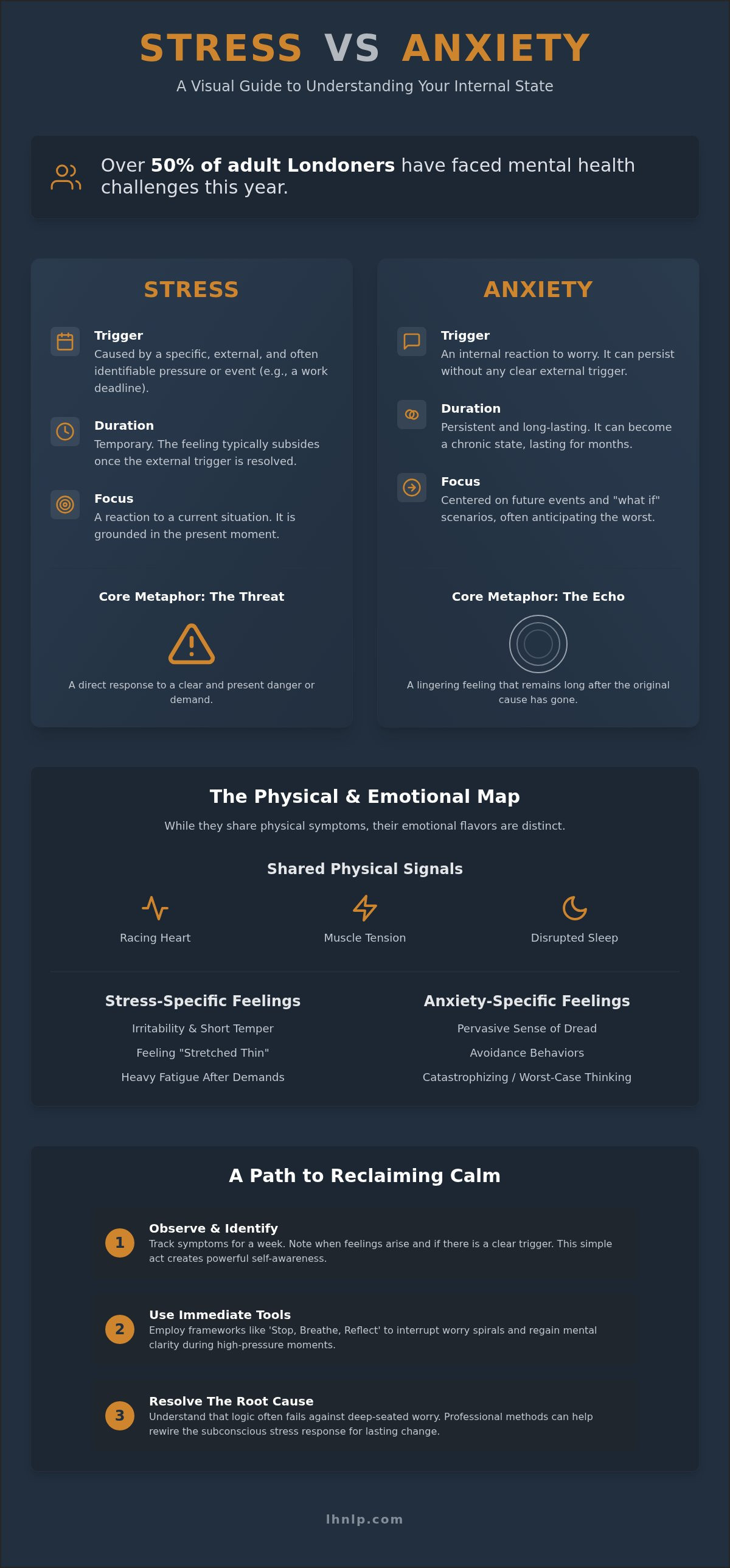
To truly understand the difference between stress and anxiety, we must first look at the origin of the feeling. Imagine walking through the crowded streets near Tokenhouse Yard; the sudden noise of a siren triggers an immediate physical response. This is stress, a biological reaction to a tangible, external pressure. But what happens when you’re back home, the city is silent, yet your heart still pounds as you imagine future sirens? This lingering state is what we define as anxiety. Finding a path through specialised treatments begins with this clarity.
Distinguishing between these two states isn’t just an academic exercise; it’s the vital first step toward reclaiming your inner calm. While stress acts as the “threat” standing directly in front of you, anxiety is often the “echo” that continues to bounce around the chambers of your mind long after the source has vanished. Citing a comprehensive overview like What is Anxiety? helps us see that while the physical sensations may feel identical, their roots require different approaches for resolution.
To better understand this concept, watch this helpful video:
Triggers: Obvious Situations vs. Perceived Threats
Stress is almost always anchored to a specific “why.” Whether it’s a looming deadline at a Harley Street firm or a difficult financial conversation, the demand on your energy is clear. Anxiety, however, often detaches itself from reality to create elaborate “What If” scenarios. Your Amygdala, the brain’s emotional smoke detector, can easily begin to misinterpret the general bustle of London as a constant, looming threat. Instead of reacting to what is happening, you start reacting to what might happen in the future.
Persistence and Duration: When the Feeling Won’t Leave
The most telling marker of stress is its transience. Usually, once the project is submitted or the commute ends, the nervous system begins its natural descent back to baseline. Anxiety doesn’t follow this rhythm. It tends to become a “default state,” where the body remains in high alert without a clear reason. Clinicians often look at a persistent pattern of six months to determine if worry has become a chronic loop. If you find you can’t switch off even on a quiet Sunday, you’re likely navigating the difference between stress and anxiety by experiencing the latter’s persistent grip.
The Physical and Emotional Map: Identifying Your Symptoms
The body speaks its own language, often whispering through a tightened chest or a restless night before we even realize we’re struggling. While we try to push through our busy schedules, our physiology remains remarkably honest about our internal state. Both conditions share a biological foundation that manifests through a racing heart, persistent muscle tension, and disrupted sleep patterns. However, identifying the difference between stress and anxiety requires looking closer at the emotional flavour of your discomfort. Recognizing these nuances is the first step toward reclaiming your sense of self.
- Stress-specific signs: You might feel “stretched thin,” accompanied by irritability, a short temper, and a deep, heavy fatigue that follows a demanding day.
- Anxiety-specific signs: These carry a sharper edge of dread, often leading to avoidance behaviours and a mind that instinctively jumps to the worst possible outcome.
To gain true clarity, try tracking your symptoms over a 7-day period. Note when your heart races or when you feel that sense of dread. Is there a clear trigger, or does the feeling seem to appear from nowhere? This simple act of observation shifts you from being a victim of your emotions to being a conscious observer of your own mind, providing a foundation for effective stress management.
The Shared Language of the Fight-or-Flight Response
When you’re navigating the high-pressure environment of city life, your body is frequently flooded with cortisol and adrenaline. Your nervous system is ancient; it doesn’t distinguish between a prehistoric predator and a significant train delay or a demanding client email. This chronic activation means your body stays in a state of “fight-or-flight” long after you’ve left the office. Over time, this constant chemical surge can impact your long-term physical health, making it essential to understand how your body reacts to persistent pressure.
Cognitive Patterns: Worry vs. Apprehension
The way you think provides another map to your emotional landscape. Stress-based worry is typically problem-oriented; you’re concerned about a specific task, and once that task is finished, the worry usually dissolves. In contrast, anxiety-based apprehension feels vague and diffuse, like a mist that settles over your entire future. Anticipatory anxiety is the fear of future stress. This distinction is central to the Difference Between Stress and Anxiety as defined by professional psychological standards. Understanding these cognitive loops allows us to address the root cause rather than just the surface symptoms.
The City Pulse: Why Londoners Often Confuse the Two
The pulse of the capital rarely slows down, creating a unique environment where the boundaries between professional drive and personal distress often blur. For those living and working in London, the ‘Always-On’ culture isn’t just a phrase; it’s a physiological reality that keeps the nervous system in a state of perpetual engagement. When your commute involves the sensory overload of the Underground and your workday is defined by high-stakes decisions, your brain begins to lose the ability to distinguish between a temporary challenge and a chronic state of worry. This environment makes identifying the difference between stress and anxiety particularly difficult, as the city itself acts as a constant, low-level stressor.
In a global hub like this, social comparison fuels a subtle but persistent performance anxiety. We see others seemingly thriving in the chaos, which leads us to internalise our struggle as a personal failing rather than a natural response to an unnatural pace. Corporate expectations often reinforce this by masking chronic anxiety as ‘ambition’ or ‘hard work.’ If you find yourself unable to switch off even when the city lights dim, it may be time to look closer at your internal landscape.
Corporate Pressure and Performance Stress
There’s a delicate balance between ‘Optimal Stress,’ which can sharpen your focus during a presentation, and the point where that pressure leads to burnout. Professional drive is a powerful tool, but it becomes a mental health burden when the fear of failure begins to outweigh the joy of achievement. If the weight of your role feels like it’s crushing your ability to enjoy life outside of Tokenhouse Yard, exploring Stress Management in London can provide the tools needed to reset your boundaries. It’s about learning to lead without losing your peace.
When Healthy Vigilance Becomes Hyper-Vigilance
The transition from being ‘organised’ to being unable to stop checking emails or worrying about tomorrow’s schedule is often invisible. In a city that never sleeps, healthy vigilance can quickly morph into hyper-vigilance, where the nervous system remains in a state of high alert long after the workday has ended. This is where The difference between stress and anxiety becomes most apparent; stress is the reaction to the deadline, while anxiety is the inability to let go once the deadline has passed. Londoners often require more intentional ‘unplugging’ than those in quieter environments because our baseline level of stimulation is so high. Recognizing this need isn’t a sign of weakness; it’s an essential act of self-preservation in a demanding world.
Immediate Tools for Reclaiming Calm and Clarity
Navigating the city pulse requires more than just endurance; it demands a toolkit for immediate intervention. When you feel that familiar tightening in your chest, the ‘Stop, Breathe, Reflect’ framework offers a momentary bridge back to yourself. First, stop the physical momentum of your day, even if only for sixty seconds. Breathe deeply into the abdomen to signal safety to your nervous system. Finally, reflect: is this a reaction to a present demand or an internalised worry? Understanding the difference between stress and anxiety in these high-pressure moments allows you to choose the right tool for the task. Creating a ‘Sensory Sanctuary’, perhaps through noise-cancelling headphones or a specific calming scent at your desk, helps shield your mind from the relentless London noise. Setting firm boundaries with digital stressors, like disabling non-essential notifications after 7 PM, prevents the constant drip-feed of adrenaline that fuels chronic tension.
NLP Techniques for State-Shifting
Neuro-Linguistic Programming (NLP) provides sophisticated methods to alter your emotional state within seconds, moving you from reactive to proactive. The ‘Swish Pattern’ involves identifying a stressful mental image and rapidly replacing it with a calm, empowered version of yourself until the old trigger loses its psychological power. Anchoring allows you to associate a physical touch, like pressing your thumb and forefinger together, with a state of total confidence, effectively creating a ‘reset button’ you can use on demand. Reframing is the art of changing your internal dialogue. Instead of viewing a high-stakes presentation as a threat to your security, you reframe it as a challenge to your professional growth. These aren’t just mental exercises; they are ways to consciously direct the focus of your subconscious mind.
Mindful Grounding for High-Pressure Environments
In moments where a panic spike feels imminent, the 5-4-3-2-1 technique brings your focus back to the tangible world by engaging all your senses. Identify five things you see, four you can touch, three you hear, two you can smell, and one you can taste. This sensory process pulls your energy away from catastrophic ‘What If’ scenarios and anchors you firmly in the present moment. Box breathing, inhaling, holding, exhaling, and holding for four counts each, is an elite tool used by performers for rapid nervous system regulation. If these self-help tools feel like temporary bandages on a deeper wound, seeking professional Anxiety Therapy London can help you address the underlying patterns that define the difference between stress and anxiety for your unique nervous system.
Ready to move beyond temporary relief? Book a session with Kamalyn Kaur to begin your methodical journey toward lasting inner change.
Beyond Surface Relief: How Hypnotherapy Resolves the Root Cause
Logic is a powerful tool for solving a difficult equation or planning a complex city commute, but it often falls silent when an anxiety spiral takes hold. You might rationally know that you’re safe in your environment, yet your nervous system continues to signal a state of emergency. This disconnect occurs because while stress is usually managed by the conscious, logical mind, anxiety is deeply rooted in the subconscious. To bridge the difference between stress and anxiety, we must speak the language that the subconscious understands. Kamalyn Kaur’s approach at London Hypnotherapy & NLP combines clinical hypnotherapy with specialized NLP coaching to move beyond surface-level symptoms. Whether you visit the tranquil professional settings in Harley Street or Tokenhouse Yard, or prefer the flexibility of virtual sessions via Zoom, the focus remains on a methodical, solution-oriented path to relief.
Rewiring the Subconscious Response
True change happens when we address the root events where specific anxiety patterns first formed. During a session, which lasts exactly 50 to 60 minutes, hypnosis creates a state of relaxed focused attention. In this receptive state, the mind becomes more open to positive suggestions and new perspectives, allowing us to rewire how your brain perceives and reacts to city-based stressors. This process is not about losing control; it’s about gaining a deeper mastery over your own internal reactions. For a comprehensive look at how these methods work, explore our Hypnotherapy London Guide to see how clinical hypnosis creates lasting psychological shifts.
Personalised Coaching for Sustainable Change
Sustainable relief requires moving beyond simple symptom management into a total lifestyle transformation. We don’t just want you to feel less stretched; we want you to feel empowered and grounded in every area of your life. This solution-focused model is designed to be time-efficient, respecting the busy schedules of London professionals while providing a clear framework for growth. By understanding the difference between stress and anxiety as it applies to your unique history, we can build a personalized map for your recovery. It’s a journey from feeling constantly on edge to rediscovering a sense of inner quiet that stays with you, regardless of the pace of the world around you.
Book a consultation with Kamalyn Kaur today to begin your journey toward a calmer, more focused version of yourself.
Reclaiming Your Inner Quiet in a Fast-Paced World
The journey toward mental clarity begins with the simple yet profound realization that you don’t have to be a passenger to your own nervous system. By understanding the fundamental difference between stress and anxiety, you’ve already taken the first step toward dismantling the loops of worry that keep you on edge. Whether you’re navigating corporate pressures or the sensory overload of the city, remember that your internal state is something you can methodically influence. Real change isn’t just about managing symptoms; it’s about shifting the underlying patterns of your mind.
With over two decades of clinical experience, Kamalyn Kaur provides a bridge between where you are and where you wish to be. Through a blend of NLP coaching and clinical hypnotherapy, it’s possible to rewire the subconscious responses that logic alone cannot reach. You can access this specialized support through virtual consultations via Zoom or in person at the prestigious Harley Street and Tokenhouse Yard locations. Don’t let another year pass in a state of high alert. Book your anxiety or stress management session in London today and begin the process of returning to your natural state of calm. You’re capable of profound change, and the path forward is clearer than it’s ever been.
Frequently Asked Questions
Can stress turn into an anxiety disorder if left untreated?
Chronic stress acts as a persistent weight on the nervous system, which, if left unaddressed, can indeed morph into a more permanent anxiety disorder. This transition often occurs when the body loses its ability to return to a baseline of calm after a stressor is removed. By understanding the difference between stress and anxiety, you can intervene early. Professional support helps rewire these habituated responses before they become your default state.
How do I know if I have an anxiety disorder or just a busy life?
A busy London life is defined by external demands, whereas an anxiety disorder is characterized by internal persistence. If your heart races and your mind spirals even during quiet moments or on weekends, it’s likely more than just a full schedule. When worry becomes detached from actual events and starts to interfere with your sleep or decision-making, it indicates that your subconscious is stuck in a loop of perceived threat that requires resolution.
What are the most common physical symptoms of anxiety?
Anxiety often manifests as a physical echo in the body, creating sensations that feel incredibly real and urgent. Common signs include a racing or irregular heartbeat, shortness of breath, and persistent muscle tension in the neck and shoulders. You might also experience disrupted sleep patterns or a constant feeling of being on edge. These symptoms are your body’s way of signaling that the nervous system is trapped in a fight-or-flight response.
How many hypnotherapy sessions are usually needed for anxiety?
Every individual’s journey is unique, but our solution-focused approach typically involves a series of personalized sessions. Most clients begin to experience significant shifts within four to six appointments. Each session lasts approximately 50 to 60 minutes, focusing on your specific triggers and subconscious patterns. This time-efficient model ensures that we aren’t just talking about the problem, but actively working toward a measurable and lasting state of inner calm and mental clarity.
Is hypnotherapy for anxiety effective for everyone?
Hypnotherapy is a collaborative process that is highly effective for those who are open to the experience and ready for internal change. It isn’t a magic wand, but rather a methodical tool for communicating with the subconscious mind. While individual results vary based on commitment and the complexity of the issue, most people find it a powerful way to break through the logical barriers that keep them stuck in a cycle of persistent worry.
Can I do hypnotherapy online for stress management?
Yes, virtual consultations via Zoom or Skype are just as effective as in-person sessions for managing stress. Many busy professionals in London prefer this option as it eliminates the added pressure of travel. Whether you’re at home or in a quiet office space, we can work together to implement techniques that help you reset your nervous system without the need to visit our Harley Street or Tokenhouse Yard locations.
What is the difference between nervousness and anxiety?
Nervousness is a natural, temporary response to a specific upcoming event, such as a job interview or public speaking. It usually vanishes once the event is over. Anxiety, however, is a more diffuse and persistent apprehension that lingers without a clear or immediate cause. Understanding the difference between stress and anxiety helps you see that while nervousness is a reaction to a moment, anxiety is often a reaction to a thought.
How does NLP help with work-related stress?
Neuro-Linguistic Programming (NLP) provides practical tools to shift your internal state in real-time. By using techniques like reframing, you can change how you perceive a demanding deadline, moving from a sense of threat to one of professional challenge. NLP also uses anchoring to help you trigger feelings of confidence or calm on demand. This approach is particularly effective for London professionals who need to maintain high performance without sacrificing their mental well-being.