

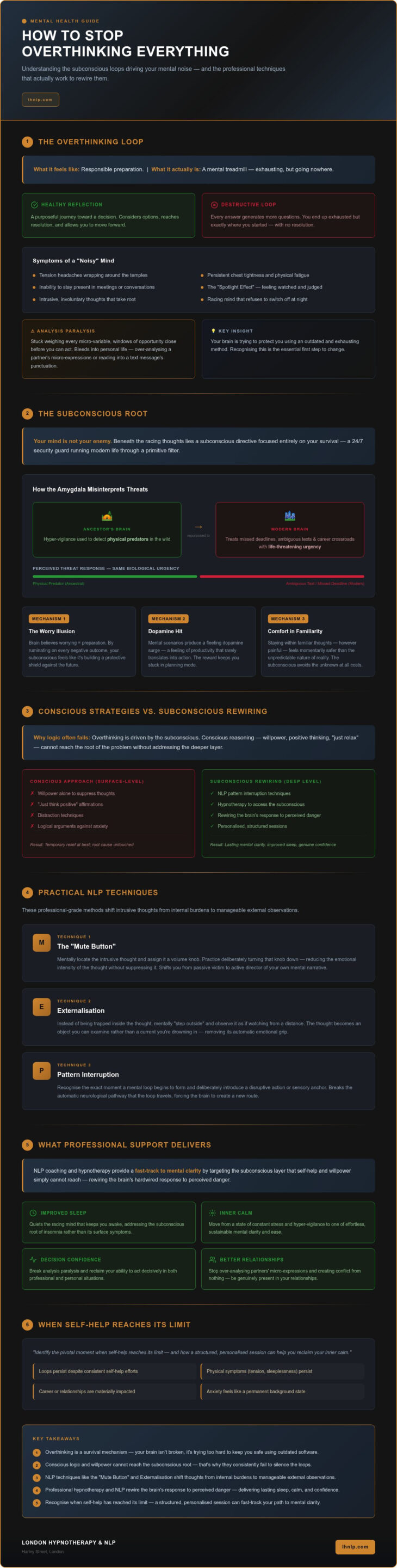
What if the reason you can’t stop thinking isn’t a lack of willpower, but a survival mechanism that’s simply lost its way? You’ve likely felt the exhaustion of a racing mind that refuses to switch off when the lights go out, or the heavy weight of analysis paralysis that stalls your progress in both career and relationships. Learning how to stop overthinking everything requires more than just a temporary distraction; it demands a deeper look at the subconscious patterns driving your mental loops.
This guide moves beyond the surface to address the roots of your anxiety and physical tension. You’ll discover how professional NLP and hypnotherapy techniques can help you reclaim your inner calm, improve your sleep, and build genuine decision-making confidence. We’re going to explore the hidden mechanics of your mind and provide a methodical path to a quieter, more focused life. It’s time to stop fighting your thoughts and start understanding them, allowing you to move from a state of constant stress to one of effortless clarity.
Key Takeaways
- Understand why your mind treats rumination as a survival tool and learn to distinguish between healthy reflection and destructive mental loops.
- Discover why conscious logic often fails to quiet the mind and how to stop overthinking everything by addressing the subconscious roots of your anxiety.
- Master practical NLP techniques, such as the “Mute Button” and Externalisation, to shift intrusive thoughts from internal burdens to manageable external observations.
- Explore how professional hypnotherapy and NLP coaching provide a fast-track to mental clarity by rewiring the brain’s response to perceived danger.
- Identify the pivotal moment when self-help reaches its limit and learn how a structured, personalized session can help you reclaim your inner calm.
Understanding the Overthinking Loop: Why Your Mind Won’t Let Go
Overthinking often presents itself as a responsible form of preparation. It feels like you’re doing the hard work of anticipating problems, yet this “productive-feeling” rumination rarely yields a resolution. Instead of finding a way out, you find yourself trapped in a cycle where every answer only generates more questions. While healthy reflection is a purposeful journey toward a decision, the overthinking loop is a treadmill that leaves you exhausted but exactly where you started.
Imagine a film director who refuses to stop filming the same scene. They demand take after take, obsessed with minor details that don’t actually change the story’s outcome. This internal director keeps the cameras rolling long after the sun has set, draining your energy and preventing you from moving to the next act of your life. In a city like London, where competition is fierce and the stimuli are constant, this mental noise can become deafening. The pressure to perform and the endless options of urban life provide fertile ground for these loops to flourish.
The Symptoms of a “Noisy” Mind
Your body often knows you’re overthinking before your conscious mind does. You might experience tension headaches that wrap around your temples or a persistent tightness in your chest. This physical fatigue is the direct result of a mind that never rests. You may also fall victim to the “Spotlight Effect,” a cognitive bias that makes you feel as though everyone is observing your perceived flaws. When an unwelcome, involuntary thought takes root, it becomes nearly impossible to stay present during a meeting or a dinner with friends.
The Cost of Analysis Paralysis
Analysis paralysis is the silent killer of professional decisiveness and creative spark. When you’re stuck weighing every micro-variable, the window of opportunity often closes before you can act. This pattern bleeds into your personal life too. You might find yourself over-analysing a partner’s micro-expressions or reading into the punctuation of a text message, creating conflict where none existed. This state of constant hyper-vigilance is a primary reason people seek insomnia treatment. If you want to learn how to stop overthinking everything, you must first recognize that your brain is trying to protect you using an outdated and exhausting method.
The Subconscious Root: Why Your Brain Sees Overthinking as Survival
To truly master how to stop overthinking everything, we must first acknowledge that your mind is not your enemy. Beneath the surface of your racing thoughts lies a subconscious directive focused entirely on your survival. This ancient part of the brain, specifically the amygdala, functions as a 24/7 security guard. While our ancestors used this hyper-vigilance to scan for physical predators, the modern mind has repurposed the mechanism. Today, it treats a missed deadline, an ambiguous text, or a career crossroads with the same biological urgency as a life-threatening encounter.
The brain often falls into a cognitive trap where it mistakenly believes that worrying equals preparation. It’s a subtle form of trickery. By ruminating on every possible negative outcome, your subconscious feels as though it’s building a shield against the future. This is the subconscious mind operating as a protective but outdated software; it’s attempting to run complex, modern life through a primitive survival filter. Your brain isn’t broken; it is simply trying too hard to keep you safe.
The Illusion of Control
Why do we find ourselves replaying a conversation from three years ago at two in the morning? We often obsess over the past in a futile attempt to “fix” the future. This process provides a fleeting dopamine hit during the planning phase. We feel a surge of productivity while running mental scenarios, yet this rarely translates into “doing.” The subconscious uses overthinking to avoid the perceived danger of the unknown. By staying within the familiar territory of our thoughts, however painful they may be, we feel momentarily safe from the unpredictable nature of reality.
London Stress and the Primitive Brain
The relentless “hustle culture” of London exerts a unique pressure on our internal safety settings. The constant stimuli of the city, from the crowded commute to the professional competition on Harley Street, tell your primitive brain that danger is lurking around every corner. This urban environment keeps the nervous system in a state of high alert, making it difficult to find the off-switch. Integrating professional stress management into your life is a vital step in recalibrating these internal alarms. If you feel your internal security system is stuck on high, exploring hypnotherapy for anxiety can offer a path to updating that outdated software and reclaiming your peace.
Conscious Strategies vs. Subconscious Rewiring: Why Logic Often Fails
Most of us were taught that logic is the ultimate tool for problem-solving. When faced with a challenge, we analyze, categorize, and strategize. However, when you’re trying to figure out how to stop overthinking everything, this “Top-Down” approach often hits a glass ceiling. You cannot solve a problem using the same level of consciousness that created it. Trying to use logic to silence an overactive imagination is like trying to fix a software glitch by shouting at the monitor; the message simply isn’t reaching the right layer of the system.
While conscious strategies rely on willpower and analysis, “Bottom-Up” approaches like Neuro-Linguistic Programming (NLP) address the subconscious foundations where these thoughts originate. NLP acts as a manual for the mind, allowing us to understand the coding behind our mental processes. Similarly, hypnotherapy provides a bridge to the subconscious, bypassing the critical faculty that usually rejects change. By working at this deeper level, we can install new mental habits that feel natural rather than forced.
The Limit of Willpower
Have you ever noticed that the harder you tell yourself “don’t think about it,” the louder that thought becomes? In psychology, this is known as the “White Bear” effect. When you consciously try to suppress a thought, your brain must constantly monitor for that thought to ensure you aren’t thinking it, which ironically keeps it at the forefront of your mind. This conscious effort increases mental tension and drains your energy, often leading to a rebound effect where the overthinking returns with even greater intensity.
The Power of NLP and Hypnosis
NLP is a transformative tool because it focuses on the structure of your thoughts rather than just the content. Instead of debating with the “Director” we mentioned earlier, NLP teaches you how to change the film’s brightness, volume, or even the camera angle. This creates a “Pattern Interrupt” that can break a mental loop instantly. When combined with professional hypnotherapy London sessions, these shifts become lasting. Hypnosis allows the mind to enter a state of relaxed focus where it’s more receptive to supportive suggestions, making the transition to a quieter mind feel like a relief rather than a battle. It’s about moving from a state of constant internal friction to one of effortless mental alignment.
Practical NLP Techniques to Break the Overthinking Cycle
Breaking the loop requires actionable tools that engage the brain’s plasticity rather than just its logic. Learning how to stop overthinking everything is not about silencing the mind through force, but through precise mental strategy. By using Neuro-Linguistic Programming (NLP), you can begin to treat your thoughts as data that can be edited rather than absolute truths that must be obeyed. These techniques offer an immediate way to interrupt the “Director” in your head and regain control over your internal narrative.
To begin your practice, consider these five foundational steps for mental recalibration:
- Step 1: The “Mute Button”: Identify the internal voice that’s ruminating. Notice its volume and location. Mentally reach for a dial and turn the volume down until the voice is a faint whisper, or change its pitch to something ridiculous, like a cartoon character, to strip it of its authority.
- Step 2: Externalisation: Imagine taking the stressful thought out of your head and placing it on a television screen across the room. Observe it from a distance. By moving the thought from “inside” to “outside,” you create the psychological space needed for clarity.
- Step 3: The 5-Second Rule: When you feel the hesitation of analysis paralysis, count backward: 5-4-3-2-1. This simple countdown bypasses the prefrontal cortex and prompts the brain to move into action before the overthinking loop can start.
- Step 4: Future Pacing: Visualise a situation that usually triggers your overthinking. See yourself responding with a calm, quiet mind. By mentally rehearsing this success, you’re building new neural pathways for future composure.
- Step 5: Anchoring: Recall a moment when you felt completely at peace. As that feeling peaks, squeeze your thumb and forefinger together. You’re creating a physical trigger that you can use later to summon that state of calm instantly.
Changing the Mental Soundtrack
The impact of our thoughts often comes from their “sub-modalities,” which are the qualities of our internal representations. If your critical inner voice is loud, fast, and echoing, it will naturally trigger a stress response. You have the power to change the volume, pitch, and tone of this monologue. When you transform a scary internal voice into a harmless or funny one, you’re changing the structure of the thought. This shift makes it significantly easier to manage how to stop overthinking everything, as the thought no longer carries the same emotional weight.
Grounding in the Present
Sensory engagement is the most effective way to shut down the ruminative “Default Mode Network” of the brain. During a busy London commute or a high-pressure meeting, use the 5-4-3-2-1 technique: acknowledge five things you see, four you can touch, three you hear, two you can smell, and one you can taste. This process pulls your energy away from the abstract future and grounds you in the physical present. If you’re ready to move beyond self-help and experience these shifts through a guided process, Kamalyn Kaur offers personalized NLP coaching to help you master these internal tools.
Reclaiming Mental Clarity: Professional Support in London
While the NLP techniques discussed can provide immediate relief, there are moments when the mental noise feels too loud to manage alone. If you’ve spent months or years trying to figure out how to stop overthinking everything and still find yourself trapped in the same cycles, it’s a signal that the subconscious pattern is deeply rooted. Professional intervention isn’t a sign of failure; it’s a strategic choice to work with a guide who understands the map of the human mind. When self-help reaches its limit, a structured approach can provide the breakthrough you’ve been seeking.
Kamalyn Kaur at London Hypnotherapy & NLP provides a sanctuary for those exhausted by their own thoughts. Her sessions don’t mirror traditional “talk therapy,” which can sometimes lead to further rumination by constantly replaying the problem. Instead, she utilizes a solution-focused model that prioritizes the “how” of change over the “why” of the past. During anxiety therapy London sessions, the focus is on dismantling the outdated survival coding in your subconscious and installing more supportive, quiet mental habits.
Tailored Sessions in the Heart of London
For professionals navigating the high-pressure environment of the city, convenience is essential. Sessions are held in prestigious locations such as Harley Street and Tokenhouse Yard, offering a calm space to do this deep internal work. If your schedule or location makes travel difficult, online hypnotherapy services provide the same level of personalized care and clinical effectiveness via Zoom. Each session is bespoke, ensuring that the “mental toolkit” you build is specifically designed for your unique triggers and life circumstances.
Your Path to a Quieter Mind
Stepping Into a Life of Mental Clarity
Reclaiming your inner stillness is not about silencing your thoughts through force; it’s about understanding that your mind’s tendency to loop is a protective response that simply needs a modern update. We’ve explored how the subconscious treats worry as a survival tool and why traditional logic often falls short when you’re trying to figure out how to stop overthinking everything. By applying practical NLP techniques and addressing the root causes of your mental noise, you can transition from constant analysis to genuine presence.
If you’re ready for a methodical process for change, specialist support is available. Kamalyn Kaur brings over 20 years of experience in solution-focused NLP and clinical hypnotherapy to her practice in London’s prestigious Harley Street. Whether you choose in-person or online sessions, you’ll receive a bespoke toolkit designed to quiet the noise for good. Book a consultation with Kamalyn Kaur today and take the first step toward the calm you deserve. A quieter mind is within your reach, and the journey begins with a single decision.
Frequently Asked Questions
Is overthinking a symptom of an anxiety disorder?
Overthinking is frequently a primary symptom of various anxiety-related challenges, though it doesn’t always indicate a clinical disorder. Many people struggle with racing thoughts due to the high-pressure London lifestyle or temporary environmental stress. While it’s a common feature of Generalized Anxiety Disorder, it’s essentially the brain’s survival mechanism being overactive. If your mental loops feel uncontrollable, seeking professional guidance can help you understand the root of these patterns without requiring a formal psychiatric diagnosis.
Can hypnotherapy really stop me from overthinking everything?
Hypnotherapy is highly effective because it addresses the subconscious layers where overthinking originates. Instead of just talking about the problem, it helps you learn how to stop overthinking everything by recalibrating your brain’s response to perceived stress. By bypassing the critical faculty of the conscious mind, hypnotherapy installs new, quieter mental habits. This solution-focused approach allows you to break free from destructive mental loops, leading to lasting clarity and improved decision-making confidence.
How is NLP different from traditional counselling for overthinking?
Traditional counselling often focuses on exploring the past to understand why you feel a certain way. In contrast, Neuro-Linguistic Programming (NLP) is solution-focused and examines the actual structure of your thoughts. It provides a practical manual for the mind, teaching you how to interrupt mental loops in real-time. Rather than just discussing your history, NLP gives you tools to change how you represent information internally, making it a faster route to achieving a quiet mind.
How many hypnotherapy sessions will I need to see a difference?
Every individual is unique, but many clients report a significant shift in their internal dialogue within just a few sessions. Because Kamalyn Kaur uses a solution-focused model, the goal is to provide you with a mental toolkit as efficiently as possible. Some people find the clarity they need in three to six sessions, while others with more complex, long-standing patterns may benefit from a longer engagement. The focus is always on creating sustainable, independent change.
Can I do these overthinking exercises at work or on the Tube?
One of the greatest benefits of NLP techniques is that they are completely discreet and can be practiced anywhere. Whether you’re in a high-pressure meeting or navigating a busy London commute on the Tube, tools like the “Mute Button” or sensory grounding require no outward movement. You can adjust the sub-modalities of your internal voice or engage your senses without anyone noticing, allowing you to reclaim your calm in the exact moments you need it most.
What happens during a typical session with Kamalyn Kaur?
A typical session begins with a focused conversation about your specific goals and the triggers that drive your mental loops. Kamalyn Kaur then introduces personalized NLP strategies to help you understand and edit your mental processes. The session usually concludes with clinical hypnotherapy, where you’ll enter a state of relaxed focus. This allows your subconscious to integrate the new strategies, ensuring that the shift toward mental quietness feels natural and effortless once you leave the office.
Is virtual hypnotherapy as effective as in-person sessions in London?
Virtual hypnotherapy sessions via Zoom or Skype are just as clinically effective as in-person appointments at Harley Street or Tokenhouse Yard. The core of the work involves focused attention and verbal guidance, which translates perfectly to a digital format. Many city professionals prefer virtual consultations because they offer greater flexibility and allow you to begin the process of calming your mind from the comfort and safety of your own home or office environment.
Will I lose control during a hypnotherapy session for overthinking?
You remain in complete control throughout the entire hypnotherapy process. It’s a common misconception that hypnosis involves a loss of willpower; in reality, it is a state of heightened, relaxed focus where you are more receptive to supportive suggestions. You can hear everything the practitioner says and can end the session at any time. The process is a collaborative partnership designed to empower you with the resources needed to manage your own thoughts more effectively.