

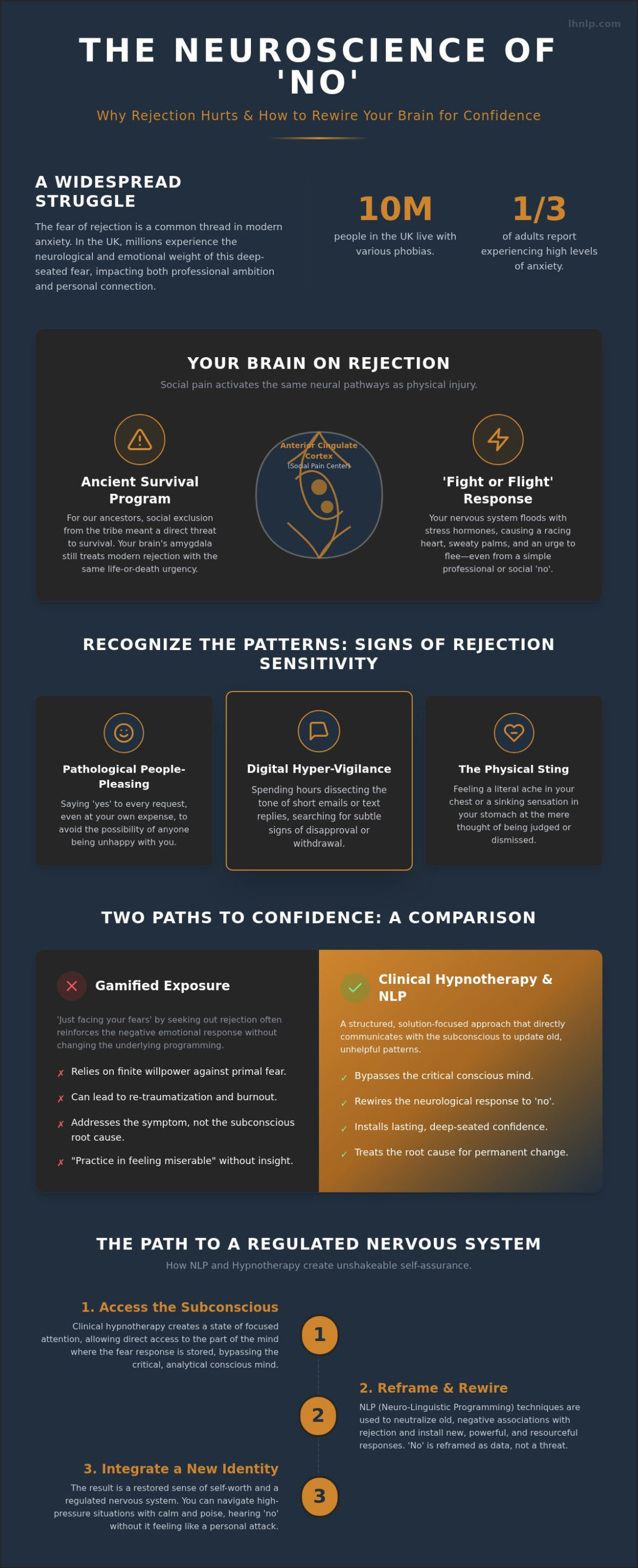
What if the sharp sting of a “no” wasn’t a reflection of your worth, but simply a neutral data point that your nervous system has been misinterpreting for years? With over 10 million people in the UK living with phobias and nearly a third of adults reporting high anxiety, you’re certainly not alone in this struggle. You might recognize the pattern of staying silent in boardrooms to avoid a perceived slight, or feeling your heart race and palms sweat before asking for what you truly need. It’s a protective mechanism that often leads people to seek fear of rejection therapy London as a way to reclaim their professional and personal lives.
Key Takeaways
- Understand why your brain perceives social rejection as a physical threat and how this ancient evolutionary response triggers an unnecessary “fight or flight” state.
- Compare the benefits of structured clinical interventions against gamified exposure techniques to find the most effective path for deep-seated anxiety.
- Discover how specialized fear of rejection therapy London utilizes NLP and hypnotherapy to bypass the critical mind and install lasting confidence.
- Learn to navigate high-pressure professional and social environments with a regulated nervous system and a restored sense of self-worth.
- Explore how a professional consultation at premier locations like Harley Street can help you finally hear “no” without it feeling like a personal attack.
The Paralyzing Weight of Rejection Anxiety
Rejection is far more than a momentary discomfort; it’s a profound neurobiological event. When you experience a social snub or a professional dismissal, your brain doesn’t distinguish between emotional distress and physical injury. It activates the same somatosensory cortex regions that light up when you’re physically hurt. In a city as fast-paced and competitive as London, this biological response can become a constant background noise. Many high-achievers find that specialized fear of rejection therapy London provides the structured environment needed to dismantle these barriers and reclaim their agency.
In the Square Mile or the creative hubs of Soho, the pressure to perform is unrelenting. If you find yourself holding back from a promotion or avoiding a conversation because the possibility of a “no” feels catastrophic, you’ve hit an invisible ceiling. This isn’t just about being shy. It’s a clinical sensitivity that constricts your income and your intimacy. While most people feel a healthy level of caution, those struggling with deep-seated sensitivity experience what was historically described as Hysteroid Dysphoria, where the mere hint of disapproval triggers a crushing emotional weight. If you want to understand how these patterns can be broken, you can explore my treatments for a more detailed look at the methodology.
Common Symptoms of Rejection Sensitivity
Recognition is the beginning of change. Look for these patterns in your daily life:
- Pathological People-Pleasing: You say yes to every request to ensure no one has a reason to be unhappy with you, even at the cost of your own well-being.
- Digital Hyper-Vigilance: You spend hours dissecting the tone of a three-word email or a delayed WhatsApp reply for signs of “cooling off.”
- The Physical Sting: You feel a literal ache in your chest or a sinking feeling in your stomach when you think you’ve been judged.
Why ‘Just Face Your Fears’ Often Fails
The Subconscious Roots: Why Your Brain Fears ‘No’
Your brain is a master of survival, not necessarily a master of modern social etiquette. To your subconscious mind, the prospect of being turned down for a promotion or a second date isn’t just a minor setback; it’s a threat to your existence. This biological wiring dates back to our ancestors, for whom exclusion from the tribe meant literal death. When you feel that surge of panic before making a request, your amygdala is simply doing its job. It triggers a “fight or flight” response because it cannot distinguish between a boardroom rejection and being left alone in the wilderness. To move beyond these primal alarms, many find that specialized fear of rejection therapy London offers the tools to recalibrate these outdated survival mechanisms.
This ancient template is often reinforced by childhood imprinting. If your early experiences with caregivers were marked by conditional love or frequent criticism, you may have developed a “rejection template” that persists into adulthood. You learn to reject yourself before anyone else has the chance, creating a protective wall that actually keeps you isolated. It’s a cycle where the internal critic becomes so loud that the external world never gets a chance to prove it wrong.
The Neurobiology of Social Pain
Modern research has shed light on why these feelings are so visceral. What science says about the anterior cingulate cortex reveals that social snubs activate the same neural pathways as physical pain. In the high-pressure environment of London, where professional competition and social pacing are relentless, your nervous system can remain in a state of high alert. This constant “Safety First” mechanism of the subconscious mind ensures you stay small to stay safe, even when your conscious self is desperate to grow.
Breaking the Cycle of Self-Sabotage
We often adopt “Safety Behaviors” to cope with this fear. You might over-prepare for meetings, use self-deprecating humor, or simply never ask for what you want. While these tactics provide temporary relief, they actually keep the fear alive by confirming the subconscious belief that rejection is something you must survive rather than manage. It’s essential to understand the difference between who you are and what happened to you. If you’re ready to explore how these deep-seated patterns can be unlearned, you can learn more about Kamalyn’s approach to anxiety and how she helps clients navigate these internal shifts.
Transformation begins when you stop viewing “no” as a verdict on your worth and start seeing it as a neutral interaction. By addressing these subconscious roots, you allow your nervous system to return to a state of balance, making room for the unshakeable self-assurance you deserve.
This internal stability often translates into a willingness to pursue new and diverse career paths; for those interested in the digital economy, you might explore שיווק שותפים (Affiliate Marketing) as a way to build a business that rewards persistence and strategic thinking.
Rejection Therapy vs. Clinical Hypnotherapy: A Comparison
Choosing the right path to emotional freedom requires an honest assessment of your current internal landscape. On one hand, you’ll find the popular, gamified approach often referred to as “rejection therapy,” which treats the fear of “no” as a muscle that simply needs more weight through repetitive exposure. On the other hand, a clinical, solution-focused intervention addresses the very wiring of the nervous system. While gamified challenges can take months of daily discomfort to yield results, seeking fear of rejection therapy London allows you to target the subconscious root much faster, often within a handful of focused sessions at a premier location like Harley Street.
The gamified approach asks you to seek out rejection in the wild, perhaps by asking a stranger for a discount or a ride. For someone with mild social jitters, this might offer a sense of desensitization. However, if your anxiety is deep-seated, this “brute force” method often lacks the personalized, one-to-one guidance necessary to process the emotional fallout. In a professional therapeutic setting, the work isn’t about enduring pain; it’s about changing the internal representation of that pain so it no longer triggers a crisis.
When is a ‘Challenge’ Not Enough?
If your fear of rejection is rooted in early childhood imprinting or specific past traumas, generic challenges can actually be counterproductive. There’s a significant risk of “flooding,” a psychological state where exposure therapy happens too quickly, causing the nervous system to shut down or become re-traumatized. Signs that you need a more clinical approach include physical symptoms like a racing heart at the mere thought of a request, or a persistent “inner critic” that devalues you before you even speak. Professional guidance ensures you move at a pace that respects your boundaries while still facilitating profound change.
The Clinical Advantage in London
The true power of clinical work lies in the use of personalized NLP patterns and hypnotherapy to bypass the critical conscious mind. Instead of just “practicing” being rejected, we work to change the subconscious meaning you assign to the word “no.” This shifts the experience from a personal attack to a neutral data point. It’s about building unshakeable confidence from the inside out, rather than relying on external “wins” to feel secure. For those whose fear has escalated into a broader avoidance of social situations, you might also find my guide on Phobia Treatment in London helpful for understanding how deep-seated fears are systematically dismantled.
By stepping into a professional environment at Tokenhouse Yard or Ealing, you’re not just trying a “hack.” You’re engaging in a methodical process of self-mastery that respects the complexity of your mind. Why spend months in a state of forced discomfort when you can resolve the underlying conflict with expert support?
How NLP and Hypnosis Rewire Your Response to ‘No’
NLP is a method for changing the internal language of fear. One powerful tool is the “Swish Pattern,” where we train your mind to automatically replace a mental image of failure with a vivid, compelling image of your desired success. We also utilize “Dissociation,” a technique that allows you to view a perceived rejection from a neutral, third-person perspective. Instead of being “inside” the pain, you become a calm observer. This creates the emotional distance needed to maintain your composure. This isn’t about ignoring reality, but about choosing a perspective that serves your growth. If you’re looking for a deeper dive into these methods, the Hypnotherapy London Guide provides a comprehensive overview of how these clinical tools integrate.
Hypnotherapy: Deep Subconscious Healing
While NLP works with the structure of your thoughts, hypnotherapy addresses the deep-seated beliefs held within the subconscious. By bypassing the critical conscious mind, we can install new, empowering beliefs that stick even when you’re under pressure. We often use regression to identify the “Initial Sensitizing Event” (ISE), the specific moment in your past where the fear of rejection first took root. Once that root is addressed, we use “Future Pacing.” This involves mentally rehearsing social success while in a deeply relaxed trance state, effectively “pre-programming” your brain for a positive outcome. It’s like a mental rehearsal that makes the real event feel familiar and safe.
This dual approach ensures that you aren’t just managing anxiety but resolving it at its source. If you’re tired of the social paralysis that holds you back, you can book a consultation at our London clinics to begin your transformation. Change is not only possible; it’s a methodical process that we can start together today.
Start Your Journey to Unshakeable Confidence in London
The journey from social paralysis to unshakeable self-assurance doesn’t have to be a lonely or uphill struggle. Choosing the right environment for your fear of rejection therapy London is a vital part of the healing process, as the physical space should reflect the professional and calm state you’re seeking to cultivate. Whether you prefer the historic prestige of Harley Street, the accessibility of Ealing, or the central convenience of Tokenhouse Yard, you have the luxury of choice. Each location provides a discreet, high-end setting where you can step away from the city’s noise and focus entirely on your internal realignment.
When you step into your first session with Kamalyn Kaur, you’re meeting with a practitioner who brings over 20 years of experience to the table. You won’t find a cold, clinical assessment here. Instead, you’ll experience a 50 to 60 minute deep-dive into your specific triggers and goals. We’ll move beyond surface-level symptoms to understand the unique architecture of your anxiety. This is the moment where “surviving” your social and professional interactions ends, and the process of truly “thriving” within them begins. You’ll leave that first encounter not just with hope, but with a clear, solution-focused roadmap for change.
Tailored Therapy for the Busy Londoner
In a city that never stops, your time is your most precious resource. My approach is designed for efficiency, focusing on lasting results rather than endless cycles of talk therapy. For those with demanding schedules or those who travel frequently, Virtual Hypnotherapy Sessions offer the same clinical depth from the comfort of your own home or office. This flexibility ensures that your commitment to self-development never becomes another source of stress. Every session is held in the strictest confidentiality, maintaining the high standards expected of a premier London practice.
Your Path to a ‘Yes’ Life
Imagine a life where the word “no” is simply a neutral data point, a piece of information that helps you pivot rather than a wound that stops you in your tracks. When you rewire your subconscious response to rejection, the ripple effect is profound. You’ll find yourself speaking up in high-stakes meetings, pursuing relationships with genuine vulnerability, and navigating the world with a regulated nervous system. This isn’t just about social freedom; it’s about reclaiming the income, the connections, and the peace of mind that fear once held hostage. If you’re ready to take that first definitive step, I invite you to book your initial consultation today and begin the transition to your most confident self.
Reclaim Your Social Freedom Today
Your nervous system has spent years trying to protect you by keeping you small, yet that very protection has become the primary barrier to your professional and personal growth. We’ve explored how the sting of a “no” is rooted in ancient survival mechanisms and how early childhood templates can be effectively rewritten through clinical intervention. True change doesn’t require months of painful, forced exposure; it requires a precise, solution-focused realignment of your subconscious beliefs. By choosing specialized fear of rejection therapy London, you’re opting for a method that respects the complexity of your mind while delivering efficient, lasting results.
Kamalyn Kaur brings over 20 years of experience and the clinical excellence of Harley Street to every bespoke session. Whether you visit our Ealing or Tokenhouse Yard locations, you’ll find a supportive partner dedicated to transforming your internal dialogue. It’s time to stop merely surviving social interactions and start thriving within them with unshakeable self-assurance. Book Your Confidence Building Session in London and take the first step toward a more expansive life. You possess the inner resources to make this shift, and the freedom you seek is well within your reach.
Frequently Asked Questions
What is rejection therapy, and how does it differ from traditional counselling?
Rejection therapy as a popular concept involves gamified exposure to build resilience through repeated “no” encounters. In contrast, the professional clinical approach I provide focuses on the subconscious roots of the fear. While traditional counselling often involves long-term talk therapy about the past, my solution-focused sessions aim for efficient, lasting results by addressing how your brain processes social pain. This ensures you aren’t just practicing feeling miserable, but fundamentally changing your internal response to social requests.
Can hypnotherapy really help me stop feeling hurt by rejection?
Hypnotherapy is a powerful tool because it allows us to bypass the critical conscious mind and speak directly to the subconscious. By accessing this deeper level, we can reframe the emotional “sting” of rejection into neutral information. When you engage in fear of rejection therapy London, we work to install new, empowering beliefs that protect your self-worth. This process calms your nervous system, ensuring that a “no” no longer triggers a primal “fight or flight” response.
How many sessions will I need to see a difference in my confidence?
Every individual’s journey is unique, but my solution-focused approach is designed for efficiency rather than years of talking. Most clients begin to experience a noticeable shift in their internal calm and social confidence within a few sessions. Each clinical session lasts approximately 50 to 60 minutes, providing enough space for deep, transformative work without overwhelming your schedule. We focus on mobilising your inner resources to ensure the changes you experience are both profound and sustainable.
Is the fear of rejection a form of social anxiety disorder?
While I don’t provide medical diagnoses, the fear of rejection is widely recognized as a core driver of social anxiety. It often manifests as a hyper-vigilance toward potential judgment or exclusion, which can paralyze professional and personal growth. In England, anxiety disorders affect a significant portion of the population, with approximately 6 in 100 people diagnosed with Generalised Anxiety Disorder. Addressing this specific fear through targeted therapy can often alleviate the broader symptoms of social avoidance and physical anxiety.
Where are your London therapy clinics located?
To accommodate the busy schedules of London professionals, I offer consultations at three premier locations across the city. You can choose to meet for in-person sessions in the prestigious medical district of Harley Street, at my clinic in Ealing, or at Tokenhouse Yard in the City of London. Each location provides a discreet, professional, and tranquil environment designed to facilitate deep psychological work and ensure your absolute confidentiality throughout our time together.
Do you offer online therapy for the fear of rejection?
Yes, I provide comprehensive virtual consultations for those who cannot attend my London clinics in person. These fear of rejection therapy London sessions are conducted via Zoom or Skype, offering the same clinical depth and effectiveness as face-to-face appointments. This flexibility allows you to access specialized support from the comfort of your own home or office, ensuring that your path to unshakeable confidence remains consistent regardless of your location or travel commitments.
What is the difference between NLP and Hypnotherapy for building confidence?
NLP (Neuro-Linguistic Programming) functions as a “user manual” for your brain, focusing on the language and mental structures that create fear. It helps you edit the software of your reactions in real-time. Hypnotherapy, however, works at a deeper subconscious level to install new beliefs and resolve past imprinting. When used together, they provide a dual-layered approach: NLP gives you practical tools for conscious control, while hypnotherapy ensures your deep-seated emotional responses are aligned with your goals.
Will I be ‘put under’ or lose control during a hypnotherapy session?
You will never lose control or be “put under” in the way it’s often portrayed in entertainment. Clinical hypnotherapy is a state of deep, pleasant relaxation and focused attention, similar to being completely absorbed in a good book. You remain fully aware of your surroundings and in total control of your actions throughout the session. It’s a collaborative process where I act as a guide, helping you access your own internal resources to facilitate positive, lasting change.