

A phobia plan can address how fear is experienced, not just the story behind it. NLP for phobias in London can be explored in one-to-one sessions, starting with an assessment and a tailored approach. One named technique is the Rewind Technique, also known as Visual-Kinaesthetic Dissociation. It involves revisiting a memory from a calm, detached perspective.
It’s understandable to want to know what a session involves before taking that first step, especially if fear affects everyday choices. This article explains how an assessment can shape a plan, what NLP techniques may involve and how clinical hypnotherapy or other complementary approaches may fit. You’ll also learn what can influence treatment, when this approach may be useful and how to consider its limits. The aim is to give you a clearer view of your options and help you consider a manageable way forward.
Key Takeaways
- Learn how the Rewind Technique and other NLP methods may be used to work with phobic responses.
- See how an assessment can identify triggers, avoidance patterns and goals to shape a personalised plan.
- Understand how clinical hypnotherapy may complement NLP when exploring options for phobia-related fear.
- Find out what to consider about treatment limits and when anxiety-focused support may be a useful next step.
How can I get Neuro-Linguistic Programming in London?
To explore NLP for phobias in London, arrange an initial session with a practitioner who works with phobic fears. Be ready to discuss the trigger, how you respond and what you’d like to manage differently. You can then agree on an approach and practise techniques at a pace that feels workable.
The Rewind Technique, also called Visual-Kinaesthetic Dissociation, involves revisiting a distressing memory from a calm, detached perspective, with the aim of experiencing it as an ordinary, neutral memory. The process is described as non-intrusive and doesn’t require you to share precise details of the memory or encounter.
NLP may use visualisation and imagination to help make a feared situation feel more manageable. Anchoring links a chosen cue, such as a gesture, with a positive state; reframing explores a different way to interpret a trigger or response. A practitioner may also match gestures or body language to build rapport. These techniques focus on patterns, perception and learned responses, rather than asking you to ignore fear.
Some practitioners combine NLP with hypnosis and cognitive behavioural techniques, such as noticing a fear-related thought and considering a more helpful response. Havening Technique™ and Amygdala Depotentiation Therapy may also be discussed as complementary approaches. Ask what each method involves, how it relates to your goals and whether you feel comfortable before proceeding. These are distinct approaches, not interchangeable labels.
For children, NLP phobia techniques can be adapted for those aged 7 and older. An adult and practitioner can discuss the child’s understanding of the fear, use age-appropriate visualisation and agree how progress will be recognised.
NHS services may provide or refer people for phobia support, but NLP is not something to assume is available through an NHS referral in London. NHS options depend on the local pathway. Ask your GP about support for phobia and whether NLP is included.
Assessment and personalised treatment planning
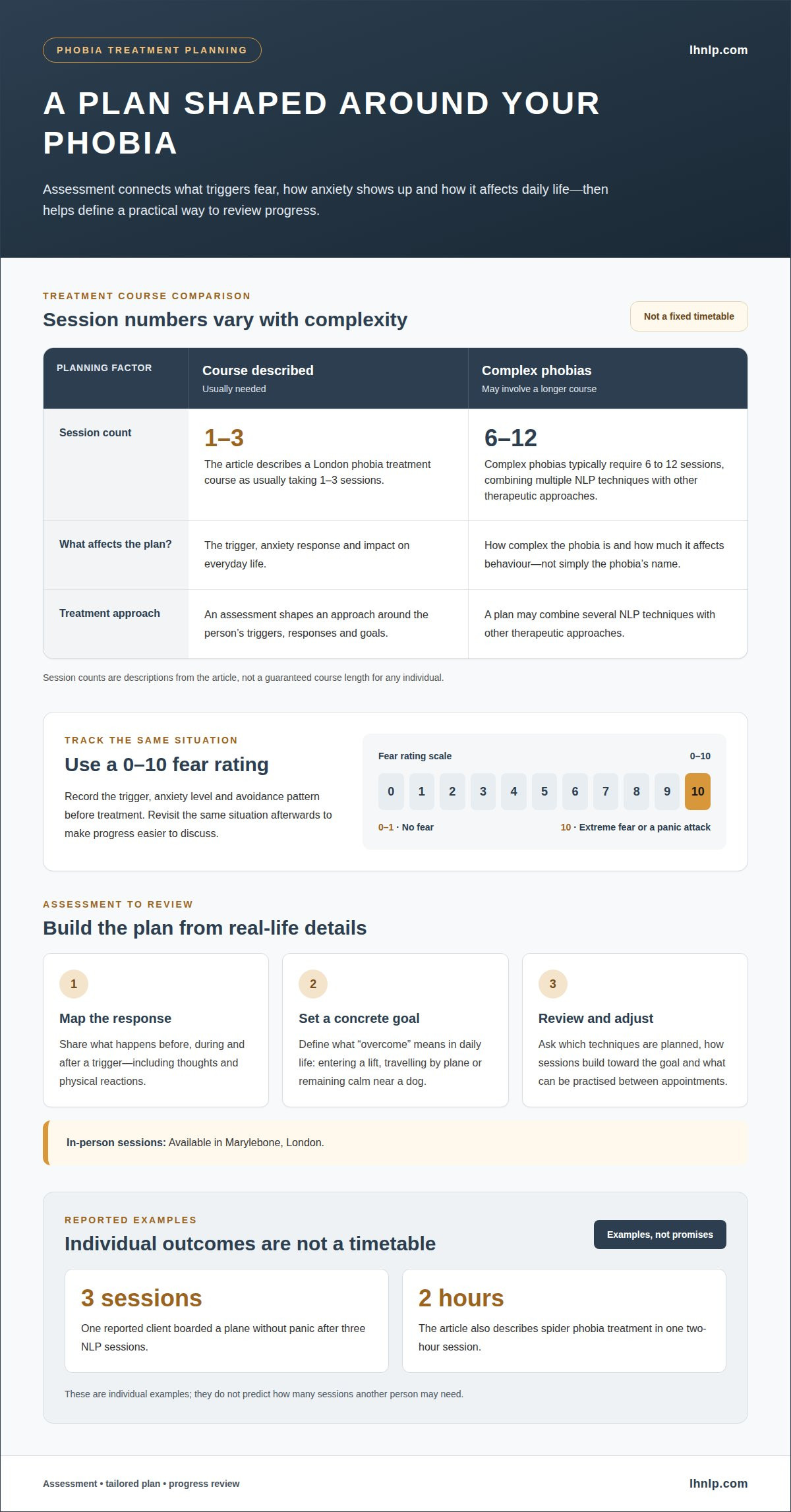
An assessment connects the phobia’s triggers, anxiety response and daily impact to a practical treatment plan. In-person sessions are available in Marylebone, London.
Typical Number of Sessions
A London phobia treatment course is described as usually taking 1-3 sessions. Complex phobias typically require 6 to 12 sessions, combining multiple NLP techniques with other therapeutic approaches. The difference depends on the phobia’s complexity and how it affects behaviour, not simply on its name.
Assessment can map fear on a 0-10 scale: 0-1 means no fear, while 10 represents extreme fear or a panic attack. Record the trigger, anxiety level and avoidance pattern before treatment, then revisit the same situation afterwards. This makes progress easier to discuss and helps shape the next step.
Treatment Questions
Ask how treatment will be tailored, which techniques are planned and how you’ll review progress. Share what happens before, during and after a trigger, including any negative thoughts or physical reactions. These details help distinguish the feared situation from the thought and emotional patterns around it.
Also ask how sessions build towards your goal and what you can practise between appointments. Reported examples include a client boarding a plane without panic after three NLP sessions, and treatment of spider phobia in one two-hour session. These are individual outcomes, not a timetable for every person.
Planning also considers what “overcome” means in daily life: entering a lift, travelling by plane or remaining calm near a dog. A practitioner can use those examples to set meaningful milestones, rather than relying only on a general feeling of improvement. Treatment questions should leave you clear about the approach and how progress will be reviewed. Explore phobia treatment options as you consider the next step.
Clinical hypnotherapy for phobias
Clinical hypnotherapy offers another way to explore the emotional response behind a phobia. A session may use focused attention and guided imagery to help you consider a feared situation from a calmer perspective. You remain aware and in control; the aim is to work with feelings, stress responses and expectations connected to the trigger.
A practical session can begin by identifying the specific moment that brings fear forward. For fear of flying, that might be imagining boarding, hearing the aircraft engines or feeling the plane move. The practitioner can then guide your attention towards a different mental rehearsal, helping you notice the situation without automatically following a familiar fear pattern. Your response and comfort guide the pace.
Hypnotherapy can complement NLP rather than replace it. NLP may focus on language, mental imagery and learned patterns, while hypnotherapy uses guided focus to explore emotional reactions. A tailored plan can connect these approaches to a clear goal, such as delivering a speech or attending an appointment. The useful question is how each technique relates to your particular trigger.
Reported experiences illustrate the range of goals people bring to treatment. One client with a fear of flying boarded a plane without panic for the first time in 15 years. In another case, a 35-year-old client reported feeling calm during her next conference speech after hypnotherapy. These examples centre on specific situations, not an abstract idea of confidence.
After a session, reflect on what changed when you imagined or encountered the trigger. Did your stress rise at the same moment? Did your feelings shift as the scene unfolded? Those observations can inform the next session and help shape practical steps towards the real-life situation. Progress is easier to discuss when the goal is concrete, such as speaking at a conference or preparing for a flight.
What are the risks or limitations of NLP for phobias?
NLP techniques offer a structured way to explore fear, but they don’t provide a guaranteed cure. A London phobia treatment service states that therapy cannot guarantee a cure for every client. Keep that distinction clear: an approach can support change without promising a particular result.
One limitation is that a technique may not address every part of a phobia. Fear of flying, for example, can involve anticipation, airport sounds, turbulence or worries about losing control. If visualising one part feels manageable but another remains overwhelming, that information matters. Discuss your response and adjust the plan, rather than treating one exercise as proof of success or failure.
Complex phobias typically require 6 to 12 sessions combining multiple NLP techniques with other therapeutic approaches. A short course may not fit fears involving several triggers or strong avoidance across daily life. During treatment, track a specific goal, such as entering a lift or attending an appointment, and review what changes between sessions.
Another practical consideration is comfort. Recalling a distressing encounter or imagining a feared situation can bring up difficult feelings. Agree how to pause, change the exercise or focus on a less intense step. For a child aged 7 or older, adapt the language and imagery to their understanding, and include a trusted adult in planning where appropriate.
Before starting, ask what the technique involves, how progress will be reviewed and what happens if the fear remains disruptive. Notice whether each exercise links to a real-life goal, rather than relying on broad claims about “rewiring” the mind. If anxiety affects daily functioning or the plan needs a different focus, discuss suitable support with a qualified health professional. A clear plan makes limits easier to recognise and respond to.
Review phobia treatment options to consider what a structured approach may involve.
London Hypnotherapy & NLP: Hypnotherapy for Anxiety
London Hypnotherapy & NLP offers Hypnotherapy for Anxiety for people whose fear is closely linked with anxiety in everyday life. If you’re considering support after learning about NLP and hypnotherapy, a focused conversation can help clarify the difficulty you want to address and the approach you’re seeking.
NLP Coaching may also suit people who want to explore thought patterns, responses and practical personal goals. Start with your own experience: perhaps anxiety arises in a specific situation, or fear has begun to shape your choices. Naming the impact can make the next step more purposeful.
Support should be grounded in what you want to work on, rather than pressure to choose a particular method. If anxiety is the central concern, explore whether Hypnotherapy for Anxiety aligns with your needs. For a next step, you’re welcome to contact London Hypnotherapy & NLP to discuss your enquiry.
Choose a next step that feels manageable
Start by naming one situation you’d like to approach differently, such as travelling, speaking in a meeting or attending an appointment. A clear personal goal can make an initial conversation more useful: describe how fear affects your day and what progress would look like for you.
If you’re considering NLP for phobias in London, think about whether you want focused help with a specific fear or support for anxiety more broadly. London Hypnotherapy & NLP offers Hypnotherapy for Anxiety, Hypnotherapy for Weight Loss and Hypnotherapy for Smoking Cessation. The right starting point depends on the concern you want to address. Outcomes vary and are not guaranteed, so a thoughtful discussion about your goals and options matters.
When you’re ready to explore that conversation, contact London Hypnotherapy & NLP. You can take the next step at your own pace, with a clearer sense of what you want to change.
Frequently Asked Questions
What are phobias?
A phobia is an intense fear associated with a particular object, activity or situation, such as spiders, flying or enclosed spaces. The fear can lead someone to avoid the trigger, even when they recognise that their response feels stronger than the immediate danger. For example, fear of injections might make booking a routine vaccination difficult. Triggers and their impact differ from person to person.
What is NLP?
NLP stands for neuro-linguistic programming, an approach exploring links between language, thought patterns and behaviour. It was developed in the 1970s by Richard Bandler and John Grinder. In coaching and therapy settings, practitioners use techniques such as goal-setting, reframing and mental rehearsal. For instance, someone preparing for a presentation might practise imagining themselves beginning their talk calmly and clearly.
What is NLP therapy for phobias and how does it work?
NLP for phobias uses structured exercises to explore how someone thinks about and responds to a feared trigger. A practitioner might help you describe a specific goal, such as entering a lift, then work with the images, language or expectations connected to that situation. You can discuss what feels manageable and review the goal using practical examples from daily life.
Is there scientific evidence that NLP is effective for treating phobias?
Individual case examples can describe a person’s experience, but they don’t show that a method works reliably for everyone. Testimonials alone are not proof that NLP is effective for phobias. When reviewing claims, distinguish personal reports from research that tests outcomes across groups. Ask how progress is measured and whether the evidence relates specifically to phobia treatment.
How does NLP compare with CBT and exposure therapy for phobias?
NLP typically focuses on language, mental imagery and learned response patterns. Cognitive behavioural therapy (CBT) examines links between thoughts, feelings and actions; exposure therapy involves planned contact with feared situations. These approaches can differ in structure and activities. For example, a plan might explore a fear-related thought, rehearse a response mentally or work towards facing a real-world trigger.
Where can I find qualified NLP practitioners specialising in phobias in London?
London Hypnotherapy & NLP provides phobia support in London, with in-person sessions at Harley Street, Ealing and Tokenhouse Yard, as well as virtual consultations. Practitioner Kamal is a registered Clinical Hypnotherapist. Ask how the proposed sessions relate to your phobia, what techniques they involve and how you’ll discuss progress. These questions help you understand the approach before deciding whether it suits your needs.