

Yes, in-person support for fear of flying is available in London, including hypnotherapy at locations in Harley Street, Ealing and Tokenhouse Yard. The NHS lists both cognitive behavioural therapy (CBT) and hypnotherapy among treatments for phobias, so hypnosis for fear of flying near you is one approach to consider.
Fear of flying can affect more than the journey itself. It may influence the trips you plan, the people you travel with and the choices you feel able to make. Wanting practical support is understandable, and exploring an approach does not mean you have to feel calm overnight.
This article explains how hypnosis and NLP may be used to work with fear of flying, what the clinic’s approach involves and what clients have reported about flying after therapy. You’ll also find details about its London locations, helping you understand what nearby support looks like before deciding on a next step.
Key Takeaways
- Learn how fear of flying can be connected to different anxiety triggers, and what to notice in your own response.
- See how hypnosis and NLP are used to address the thoughts and reactions associated with flying.
- Read what clients have shared about taking flights after therapy, while keeping in mind that experiences differ.
- Discover what to expect from fear-of-flying support in London and how to decide whether it feels like a suitable next step.
Do you offer Hypnotherapy for Fear of Flying Near Me?
London-based hypnotherapy is available for people seeking support with fear of flying. The NHS lists both hypnotherapy and cognitive behavioural therapy (CBT) among treatments for phobias.
Anticipatory Anxiety and Flying Fears
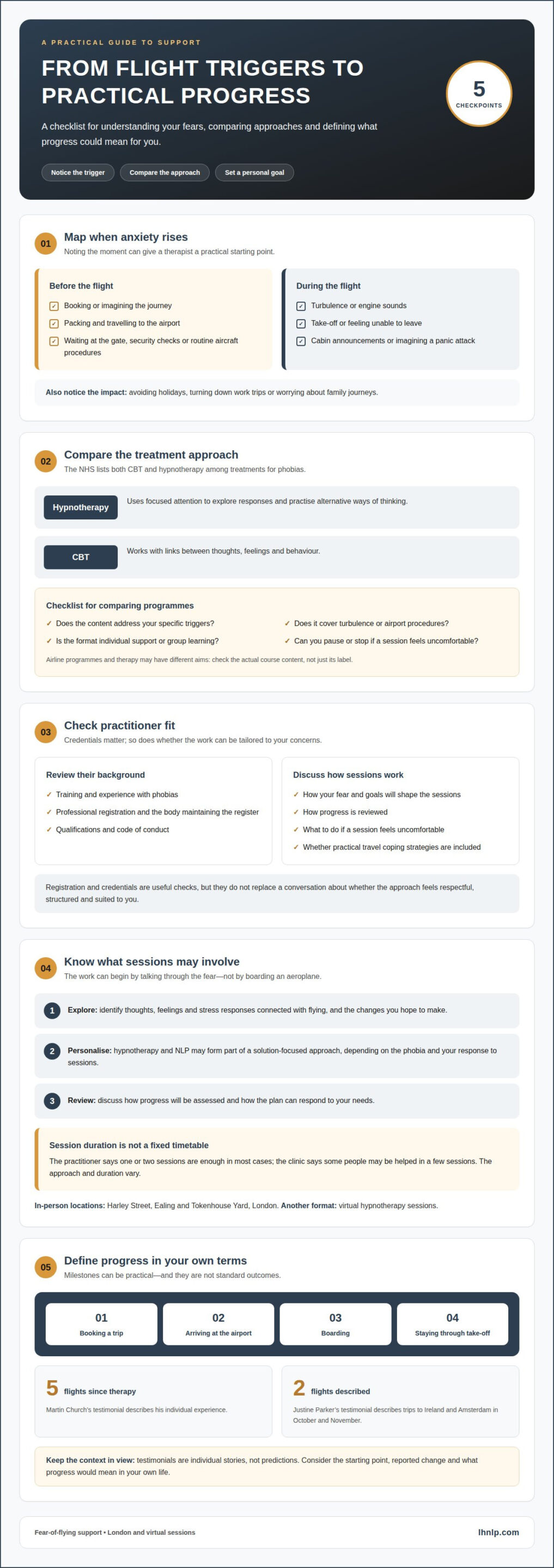
If you’re searching for fear-of-flying hypnosis near you in London, start by identifying what feels hardest. Anticipatory anxiety may begin before you book, then build around packing, travelling to the airport or waiting at the gate. During a flight, turbulence, engine sounds, take-off or feeling unable to leave may trigger fear. Security checks and routine aircraft procedures can also draw your attention to danger.
Notice when your anxiety rises, such as when reading a boarding pass, hearing a cabin announcement or imagining a panic attack. These details can help focus a conversation with a therapist. Fear may also affect daily life, from avoiding holidays to turning down work trips or worrying about family journeys. Naming these effects gives the work a practical starting point.
Hypnotherapy and CBT Options
Hypnotherapy and CBT offer different ways to approach flight anxiety. Hypnotherapy uses focused attention to explore responses and practise alternative ways of thinking; CBT works with links between thoughts, feelings and behaviour. The NHS includes both among phobia treatments. Compare what each programme involves, how it addresses your triggers, and whether its format suits your needs.
Airline programmes and therapy may have different aims, so look at the actual course content rather than its label. Check whether it covers your particular fears, such as turbulence or airport procedures, and whether it includes individual support or group learning. For risks or side effects, ask how sessions are conducted and how you can pause or stop. You remain an active participant throughout.
Choosing a Qualified Hypnotherapist
When choosing a hypnotherapist in the UK, consider their training, experience with phobias and professional registration. Ask which professional body maintains the register, then review the practitioner’s entry, qualifications and code of conduct. Registration and credentials are useful checks, but it’s also important to discuss how sessions could be tailored to your fear of flying.
Before starting, describe the situations that trouble you and what you hope to do differently. Ask how progress is reviewed, what you can do if a session feels uncomfortable, and whether the approach includes practical coping strategies for travel. Clear answers can help you decide whether the working relationship feels respectful, structured and suited to your needs.
Client experience of flying after therapy
Personal accounts show what changed for individual travellers, but progress differs from person to person. In a testimonial, Martin Church said he had taken five flights since meeting his therapist. This is one example of returning to air travel, not a prediction of how someone else will feel at the airport or on holiday.
Justine Parker’s testimonial describes two flights, to Ireland and Amsterdam, in October and November. These details make the account specific, from preparing for departure to reaching another country. The useful question is what the person could do after therapy that had felt difficult before, not whether every anxious feeling disappeared.
Client experiences may include practical changes, such as booking a trip, arriving at the airport, boarding or staying on the aeroplane through take-off. One traveller may move forward by taking a short flight; another may consider a family holiday after avoiding travel. These are possible milestones, not standard outcomes.
Read testimonials as individual stories. Look at the starting point, the reported change and the context, such as flights taken or destinations reached. A review may describe a calmer journey, but it cannot show that everyone will have the same experience. It can help you consider what progress would mean in your life, whether that’s travelling for pleasure or pursuing a work opportunity or promotion.
If you’re considering support, write down one travel goal and the moment that currently feels hardest, such as boarding or turbulence. That gives you a clear way to discuss your hopes and concerns in therapy, and to reflect on changes over time. To explore the treatment approach, read about hypnotherapy treatment options.
The clinic’s hypnosis, NLP and phobia-treatment approach
A session begins by exploring the thoughts, feelings and stress responses connected with flying that you want to change. Hypnotherapy and NLP can then form part of a personalised, solution-focused approach.
Treatment Without Facing the Fear
You don’t need to board an aeroplane or recreate a feared situation to begin. You can talk through your phobia in a session, including thoughts that arise when imagining departure or hearing a cabin announcement. Hypnosis uses focused attention, while NLP can explore language and mental patterns. The work focuses on your response and what you want to approach differently.
Consider which trigger you’d like to discuss first, such as turbulence or airport procedures.
Session Process and Treatment Duration
An initial conversation can identify the situations that cause stress and the changes you hope to make. The practitioner can tailor the work to those goals, using hypnotherapy and NLP as appropriate. The approach varies according to the phobia and your response to sessions.
The practitioner says one or two sessions are enough in most cases, while the clinic says some people may be helped in a few sessions. These are not a fixed timetable. Discuss how progress will be reviewed and how the plan can respond to your needs.
In-person appointments take place at locations in London, including Harley Street, Ealing and Tokenhouse Yard. Virtual hypnotherapy sessions offer another way to attend from elsewhere. The practitioner reports completing more than 1,000 hours of training before seeing a first client, and says his training has exceeded 2,000 hours. The team also reports delivering thousands of hours of hypnosis and NLP training.
The clinic says it often has a waiting list of several weeks, so consider your travel plans when planning treatment. The hypnotherapy treatment options explain the approaches available.
Fear-of-flying hypnotherapy in London
If you’re looking for fear of flying hypnosis near you in London, convenience matters, as does having a clear goal. You might want to book a flight, reach the airport without avoiding the journey or manage anxiety when turbulence begins. Naming a specific action makes it easier to discuss what you hope to change, without expecting yourself to feel positive every moment.
London’s transport network can make getting to an appointment part of your planning. Consider which route and location fit your routine, then think about whether travelling there feels manageable alongside your concerns. If the journey adds stress, share that as useful context. The aim is to make the process practical, not to add another obstacle.
Before a session, note the moment you anticipate most, perhaps boarding, take-off or hearing an announcement. If you’re searching for fear of flying hypnosis near you, this detail can help you explain what support you want, whether your goal is a holiday, work travel or simply feeling more at ease discussing flying.
Think about timing in relation to your plans. The clinic says some people may need a few sessions, while the work is tailored to individual needs. Use your own goals and progress to guide the conversation, rather than treating a suggested timeframe as a promise.
To explore whether this approach fits your travel goals, explore London hypnotherapy support.
London Hypnotherapy & NLP: Hypnotherapy for Anxiety
London Hypnotherapy & NLP offers Hypnotherapy for Anxiety for people whose fear of flying affects their travel choices or wellbeing. Sessions take a personalised, solution-focused approach, with time to discuss what feels most difficult, whether that’s anticipating take-off or managing anxiety around a flight.
NLP Coaching is another option for exploring thought patterns and developing a more useful response to stressful situations. Consider what you want to change, such as feeling able to book a journey or approach an airport with greater confidence. This gives the conversation a clear, personal focus without assuming every traveller needs the same approach.
If you’d like to discuss support for flight-related anxiety, contact London Hypnotherapy & NLP.
Take a considered step towards your next journey
If you’re considering fear of flying hypnosis near you, make your next step a clear conversation about what you want to change. You might want to approach booking with less apprehension, manage thoughts before departure or feel more able to travel for reasons that matter to you. Choose a goal that feels personal and practical, rather than expecting yourself to become fearless all at once.
London Hypnotherapy & NLP offers Hypnotherapy for Anxiety, as well as Hypnotherapy for Weight Loss and Hypnotherapy for Smoking Cessation. These services address different concerns, so focus your enquiry on the support relevant to your situation. A discussion can help you explain your priorities and understand the approach before deciding what feels right.
For a calm next step, contact London Hypnotherapy & NLP to discuss support for anxiety around flying. You can move forward at your own pace, with a clearer sense of what you hope to make possible.
Frequently Asked Questions
But is flying actually safe?
Commercial air travel is generally regarded as safe, though no journey is entirely without risk. Feeling anxious does not mean an aircraft is in danger. If turbulence worries you, follow the cabin crew’s instructions and keep your seat belt fastened when advised. Learning what routine cabin announcements mean may also help you distinguish an unfamiliar sensation from an emergency.
Can it be done online?
Yes, sessions can take place online through Zoom or Skype, allowing you to join from home. Choose a quiet, private room with a reliable internet connection, and minimise interruptions during your appointment. You might use headphones if they help you focus. Meeting online removes the journey to a clinic, while you still take an active part in discussing your concerns and goals.
How many sessions will I need?
There isn’t one set number of sessions for everyone seeking help with fear of flying. The approach depends on how anxiety affects you, your experiences with air travel and what you hope to do differently. Before starting, describe a specific goal, such as booking a ticket or staying on a flight. You can then discuss how progress will be reviewed and whether the plan needs adjusting.
How much does it cost?
Sessions are charged per appointment, so the total depends on how many appointments form your plan. You can discuss the approach and the number of sessions relevant to your goals before booking, rather than assuming that one fixed course suits every person.
What if I have never flown, or have not flown in years?
You can discuss flight anxiety even if you haven’t flown recently. Start by identifying what you imagine will be difficult, such as boarding, take-off, turbulence or feeling unable to leave the cabin. If you haven’t flown for years, note what has changed in your plans or concerns. These details provide a clear starting point without requiring you to fly first.
What if I panic on the plane?
If panic rises during a flight, place both feet on the floor and slowly name objects you can see, such as your seat, a window or a book. Follow cabin crew instructions, and let a crew member know if you need help. Before travelling, write a simple plan for who to alert and which grounding action you’ll try first.